
For most creators selling e-books, courses or templates, a platform that acts as Merchant of Record beats a bare-bones payment service provider, because it takes VAT registration, invoicing and payout compliance off your plate. A PSP-only setup gives you lower headline fees but leaves you owning every tax obligation yourself. The platform positions itself as a built-in alternative to stitching these pieces together manually.
TL;DR:
- Platforms that act as Merchant of Record automatically handle VAT collection, invoicing, remittance, and compliance, reducing administrative burdens.
- Fragmented fees, including platform commissions, payment processing, FX spreads, and payout charges, can collectively erode 5 to 12% of international creators' earnings.
- Correctly managing EU VAT obligations requires registering for OSS, charging the appropriate rates, issuing compliant invoices, and maintaining evidence of buyer location.
- Multi-currency wallets and direct bank payouts each serve different needs, with direct payouts favoring simplicity and speed, and wallets offering currency control for global sales.
- Moving to a compliant payout platform with VAT handling and multi-currency support significantly reduces operational friction and speeds up access to funds.
Table of Contents
- What is a payment service provider versus a Merchant of Record?
- How do fees actually add up on a digital sale?
- Do you need to register for VAT on digital sales?
- How do payouts and multi-currency handling actually work?
- What's the setup checklist before you accept your first payment?
- What mistakes cost creators the most money?
- A creator's view on switching to a compliant payout workflow
- How Bibliowlteca handles payments for creators
- Sources
What is a payment service provider versus a Merchant of Record?
A payment service provider (PSP) moves money from buyer to seller and takes a processing cut, but you remain the legal seller. That means you register for VAT where required, issue compliant invoices, and answer to tax authorities if something goes wrong. A Merchant of Record (MoR), by contrast, becomes the seller of record on paper: it collects VAT, remits it, issues the invoice, and carries the legal liability for getting that part right.
The practical split usually looks like this:
- PSP route: lower percentage fees, full control over checkout design, but you handle VAT registration, filing and invoicing yourself.
- MoR route: higher blended fee, but VAT collection, remittance and compliant invoicing happen automatically on your behalf.
- Hybrid setups: some creators use a PSP for domestic sales and an MoR layer for international or EU digital sales specifically.
A solo creator selling a handful of e-books a month to a few countries has little to gain from managing VAT registrations across jurisdictions. A creator running a mature course business with in-house finance support might prefer a PSP's lower fees and accept the extra admin. Bibliowlteca's guide to global sales breaks down this trade-off in more depth, including how MoR platforms accept legal liability that would otherwise sit with you.
How do fees actually add up on a digital sale?
Every digital sale carries several layered costs, and they rarely show up as one clean number on your dashboard. Understanding each piece is the only way to compare offers honestly.
- Platform commission — a percentage the marketplace or course platform takes, often 5–15% depending on the plan.
- Payment processing fee — typically a percentage plus a small fixed fee per transaction, charged by the underlying processor.
- FX spread — a markup applied whenever a sale currency differs from your payout currency.
- Payout or wire fee — a flat or percentage charge deducted when funds actually leave the platform to your bank.
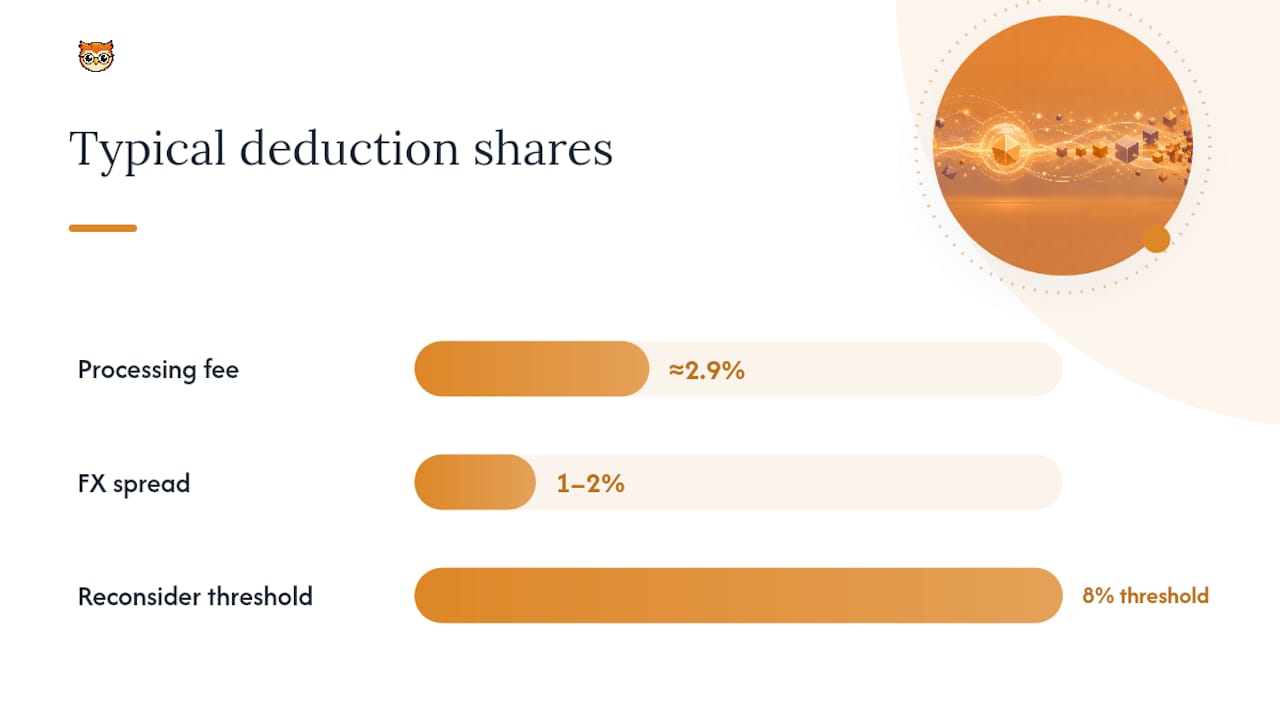
Take a €49 course sale as a working example. A processing fee of roughly 2.9% plus €0.30 removes another €1.72. If the buyer paid in a different currency, an FX spread of 1–2% might shave off another €0.50 to €1. Payout fees on top of that can eat a further percentage on smaller balances. Add it up and you can lose a sizable portion of a single sale before it reaches your account, before any tax is even considered.
Statistic to watch: fragmented payout stacks, correspondent banking delays and FX spreads can consume 5 to 12% of international creators' earnings on top of standard processing fees. If your total deductions creep past roughly 8% of revenue on a consistent basis, Bibliowlteca's guide suggests that's usually the point to reconsider your setup.
Do you need to register for VAT on digital sales?
If you sell digital products to consumers in the EU, VAT applies at the buyer's local rate, not yours. The One Stop Shop (OSS) scheme exists precisely because tracking twenty-seven different VAT rates and filing separately in each country would be unmanageable for a small creator business. OSS lets you register once and file a single consolidated return covering all EU consumer sales.
That simplification only removes the filing burden, not the underlying obligation. You still need to:
- Charge VAT at the correct rate for the buyer's country of residence, not your own.
- Issue invoices that meet the destination country's formatting requirements.
- Keep evidence of the buyer's location (billing address, IP address, bank details) to justify the rate charged.
- Register for OSS or in each relevant country before you start selling, not after.
Get this wrong and the consequences aren't hypothetical. Estonian VAT guidance for digital businesses warns explicitly that incorrect handling can trigger back-tax liability and penalties, sometimes years after the sales happened. A PSP like Stripe offers tax calculation tools that help you charge the correct VAT rate for Estonian and EU sales, but the tool doesn't file or remit anything for you. That's the gap an MoR closes: the platform collects, remits and invoices under its own VAT registration, so the compliance risk shifts away from you entirely.
How do payouts and multi-currency handling actually work?
Payouts land in one of two broad shapes. A multi-currency wallet lets you hold balances in several currencies and choose when to convert or withdraw, which suits creators selling across many markets who want control over timing. A direct-to-bank payout converts automatically and lands in your home account on a fixed schedule, which suits creators who want simplicity and fast access to local currency.
Settlement speed depends heavily on the rails behind the scenes. Cross-border payouts routed through correspondent banking can take several business days and pick up hidden fees at each intermediary bank along the way. Modern payout stacks that connect directly to domestic rails in the recipient's country can cut both the delay and the FX cost compared with older correspondent chains.
- Choose a wallet if you sell in many currencies and want to batch conversions strategically.
- Choose direct-to-bank if you need predictable, fast access to funds in one main currency.
- Check minimum payout thresholds before committing, since small balances can be disproportionately hit by fixed fees.
Some newer payout rails use stablecoins for near-instant settlement, though off-ramping to your bank account and the tax treatment of that step still add complexity worth understanding before you rely on them.
Pro Tip: Check your payout frequency against your monthly sales volume before switching platforms. Weekly payouts on low volume can mean each transfer barely clears the fixed wire fee, so switching to monthly batches can quietly save you money.
What's the setup checklist before you accept your first payment?
Get these steps done in order and you avoid the two most common launch mistakes: a broken delivery link and a payout that never arrives.
- Decide between PSP and MoR based on how much VAT admin you're willing to own.
- Confirm your VAT obligations and register for OSS if selling to EU consumers.
- Set up checkout to accept the currencies your audience actually uses.
- Test the full payment flow yourself, including a real card transaction if possible.
- Configure delivery with expiring, signed download links and a capped number of downloads per purchase.
- Complete KYC verification early, since unverified accounts can get payouts blocked right when you need the money.
- Set your payout threshold and schedule, matched to your expected sales volume.
- Record proper accounting fields for every sale (VAT charged, currency, fees) and test a refund end to end before launch.
What mistakes cost creators the most money?
The single most expensive mistake is assuming your PSP handles tax because it handles payments. It doesn't. Stripe calculates VAT if you configure it correctly, but filing and remittance remain your responsibility unless you're on an MoR arrangement.
- Never launch without testing your delivery link. Unsigned or non-expiring download URLs get shared and quietly cost you sales.
- Never ignore small payout fees on frequent low-value transfers. They erode margins faster than the headline commission does.
- Never treat a chargeback as a customer service issue only. Log the download activity too, since audit trails of download events give you evidence if a dispute turns adversarial.
- Never skip a live refund test before launch. Discovering your refund flow is broken during an actual customer complaint is the worst possible time to find out.
A creator's view on switching to a compliant payout workflow
Moving to a platform that handles VAT and payouts directly cut the admin load dramatically and got funds into a usable currency faster than juggling separate tax filings. The two changes that mattered most: switching to a provider offering multi-currency payouts instead of a single-currency PSP account, and updating every invoice template to match the destination-country VAT rules rather than a single flat rate. Neither change took long, but both removed recurring friction that had been quietly costing time every month.
— BibliOWLteca
How Bibliowlteca handles payments for creators
The platform offers an alternative to piecing together a PSP, a separate tax tool and a spreadsheet for invoicing. It bundles checkout, multi-currency payments, VAT handling and secure delivery into one storefront, so the operational burden described throughout this guide, chasing VAT rates, gating downloads, tracking payout fees, sits with the platform rather than with you.
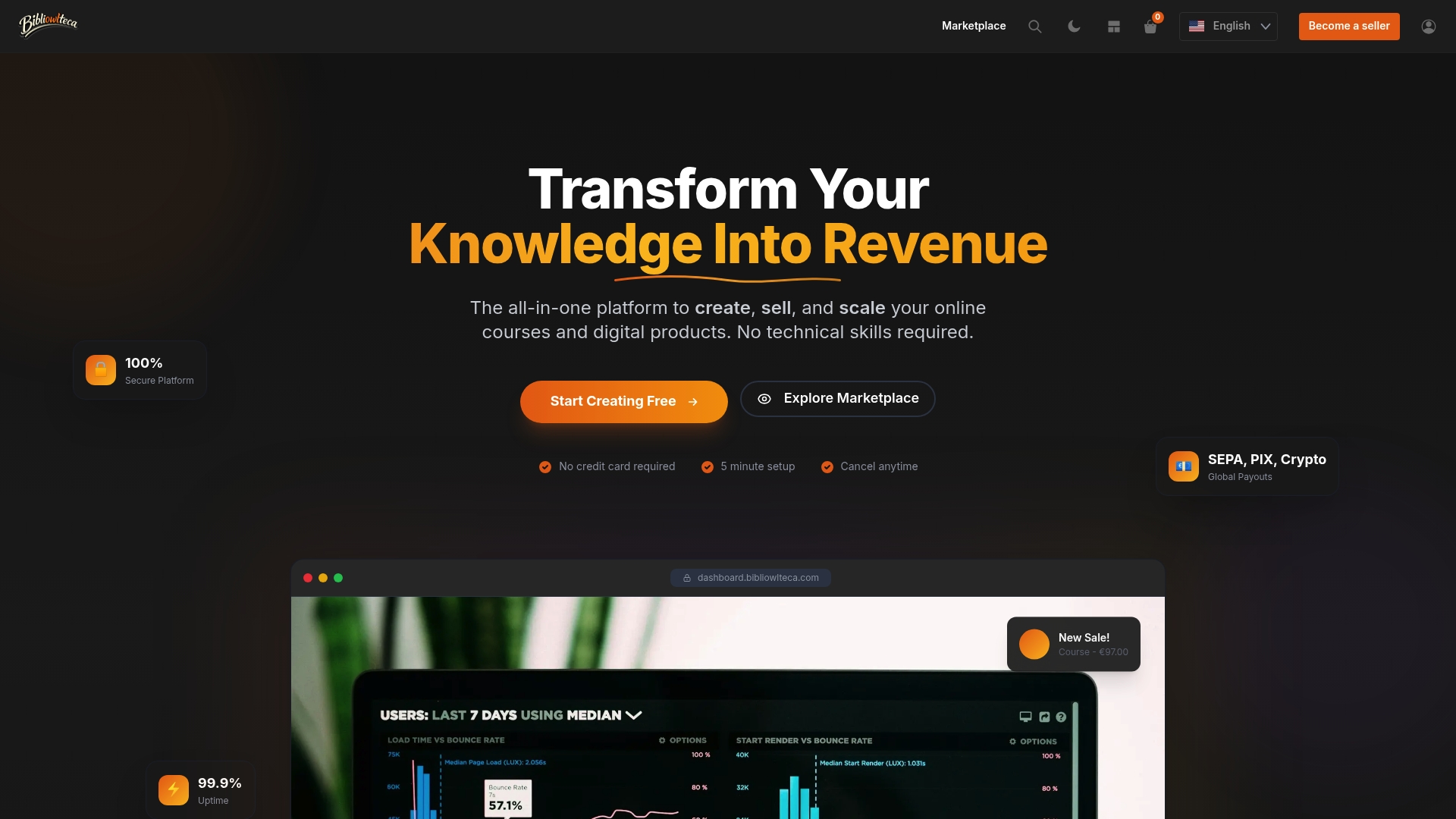
Sales route through a built-in checkout that supports multiple currencies out of the box, so you're not bolting on a separate FX tool as you expand into new markets. Digital delivery comes with the same gating logic recommended earlier: expiring links and download limits, configured for you rather than built from scratch. If you want to see exactly how the storefront and payment flow fit together, the features overview covers courses, e-books and mentorship products side by side. For e-book sellers specifically, the e-book product page shows how pricing, currency and delivery settings work together, and you can set up a store directly from the main platform page when you're ready to start selling.
Sources
- Creator Economy Payments: Solving Global Payout Challenges
- Creator Economy Payments: How Platforms Pay Creators and Why It's Broken | Spark