
Deliver digital products through an automated platform workflow: a hosted storefront or course portal that grants instant access the moment the payment clears, handles multi-currency transactions and issues secure, time-limited links. This removes manual fulfilment, simplifies VAT handling on electronically supplied services and cuts support requests. The next step is simple: set up an automated post-payment fulfilment flow on a platform built for it, such as BibliOWLteca.
TL;DR:
- Using merchant-of-record services increases transaction fees but simplifies VAT compliance for international digital product sales.
- Streamed content provides the best piracy resistance for high-value videos, while expiring download links suit low-cost, one-off products.
- Manual fulfillment is slow and error-prone, making automated platforms essential to reliably deliver digital content at scale.
- Streamlining delivery with a platform like BibliOWLteca reduces technical setup, supports multi-currency payments, and automates VAT reporting.
- Post-launch marketing efforts, such as email sequences and social proof, are crucial for turning initial sales into recurring income.
Table of Contents
- What does automated digitaalse sisu edastamine actually look like?
- How should you handle payments and VAT on digital products?
- Which security controls actually stop unauthorised sharing?
- How do you keep a digital product selling after launch?
- Why platform-level delivery beats piecing it together yourself
- Ready to set up automated delivery on Bibliowlteca?
- Sources
What does automated digitaalse sisu edastamine actually look like?
Digital content delivery isn't one flow. It's three, and picking the wrong one for your product creates support tickets you didn't need to have.
The first is the instant single download: a customer buys an e-book, PDF pack or template, and the platform serves them a link straight away.
The second is a gated course or membership portal, where access is tied to a login rather than a file, so the material can be updated after the sale without reissuing anything. The third is streamed or progressive-reveal content, used for video courses or drip-fed modules, where access unlocks over time rather than all at once.
Each shares the same technical backbone: payment confirmation triggers a redirect to a branded confirmation page, followed by an automated email containing either a secure single-use token or account login details. No human touches the fulfilment step.
- Instant download: fast and simple, but the easiest format to leak or resell if links don't expire.
- Gated portal: harder to pirate wholesale, easier to update, but requires ongoing account management.
- Streamed content: best piracy resistance for high-value video, though it demands more hosting infrastructure.
Downloads suit low-cost, one-off products such as a modestly priced template. Portals suit anything you'll revise, like a course curriculum that gets a new module every quarter. Streaming suits anything expensive enough that a leaked copy would actually hurt your revenue. Match the format to the product's value and lifespan, not to whichever option feels easiest to set up today.
How should you handle payments and VAT on digital products?
Estonia's Tax and Customs Board classes e-books, online courses and downloadable assets as electronically supplied services, delivered automatically with minimal human involvement. That classification matters: it's the automated nature of your delivery flow that determines how the product is treated for VAT purposes, not just what the product contains.
You have two practical routes for taking payment. Running your own checkout means you register for VAT in every jurisdiction where you cross local thresholds, then file and remit it yourself. Using a platform that acts as merchant of record means the platform collects and reports VAT on your behalf, in exchange for a slightly higher transaction fee.
The trade-off in numbers: merchant-of-record services typically charge more per sale than raw payment processing, but they remove the compliance overhead of multi-country VAT registration entirely.
Pricing carries its own trade-off. A low, high-volume price point widens your buyer pool; a premium price protects margin per sale but shrinks it. Fee structures compound this: percentage-based fees suit early-stage creators with unpredictable volume, while fixed plans start paying off once sales are consistent and high.
-
Cross-border sales: merchant-of-record simplifies remittance.
-
Domestic-only sales: self-managed checkout can be cheaper.
-
Unpredictable volume: percentage fees.
-
Steady, high volume: fixed subscription fees.
Which security controls actually stop unauthorised sharing?
Piracy resistance and a decent customer experience aren't opposites, but plenty of creators treat them that way. You don't need aggressive DRM to protect a course. You need a handful of unglamorous, mostly invisible controls that do the job quietly.
- Expiring, single-use download links for file-based products, so a link shared publicly stops working after one use or a set window.
- Single-session account access for portals, which limits simultaneous logins and flags accounts being shared across multiple devices.
- Watermarking on PDFs and videos, tying a copy visibly to the buyer who purchased it.
- Streaming rather than downloading for high-value video, served behind signed URLs with short-lived session tokens.
- Versioning and access revocation, so refunded customers lose access automatically and updated editions replace old ones without a manual reissue.
Manual fulfilment, emailing files individually after checking a spreadsheet, is the single biggest risk in this list. It's slow, it's error-prone, and it leaves no reliable log for dispute resolution when a customer claims they never received their purchase.
Pro Tip: Reserve account-based streaming for your highest-value course or flagship product, and use simple expiring download links for lower-priced items. Locking down a $15 template as tightly as a $500 course wastes engineering effort and irritates buyers for no real security gain.

How do you keep a digital product selling after launch?
Launch day isn't the finish line. It's the point where most creators stop paying attention, and it's exactly when momentum quietly dies.
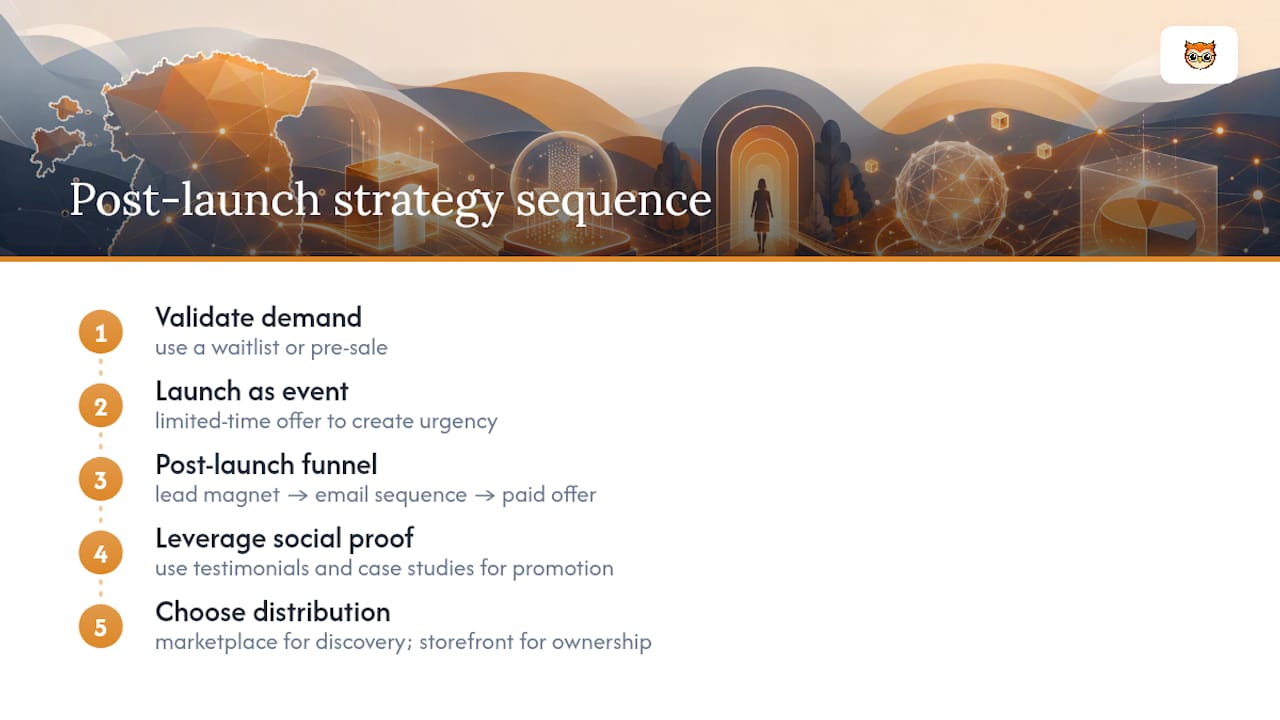
Before launch, validate demand with a waitlist or pre-sale rather than guessing. A limited-time launch offer creates urgency and, done well, generates the first testimonials you'll need to convert the next wave of buyers. Treating a launch as a scheduled event with a deadline consistently converts better than simply switching a product live and hoping people notice.
After launch, the funnel doesn't stop working, it starts. A free lead magnet feeds an email sequence, which feeds your core paid offer. Case studies and social proof from your first cohort become the promotion material for your second. This is the piece creators most often skip: ongoing visibility, not the initial sale, is what turns a one-off launch into a repeatable income stream.
Distribution strategy depends on where you're starting from. A marketplace gives you discovery when you don't yet have an audience; a controlled storefront gives you ownership of customer data and repeat-purchase relationships once you do. Many creators use both: marketplace for new buyer discovery, storefront for retention. Practitioners in audience-led promotion consistently point to the same pattern: the sale is the beginning of the relationship, not the end of it.
Why platform-level delivery beats piecing it together yourself
Most of what breaks digital product delivery isn't a bad product. It's a fulfilment process cobbled together from a payment link, a shared drive folder and someone manually checking email at 11pm. BibliOWLteca was built around the assumption that creators shouldn't have to become part-time systems engineers to sell an e-book.
The platform runs secure, scalable infrastructure with multi-currency payments built in, so a course sold to a buyer in Tallinn and one sold to a buyer in Toronto both land through the same automated flow. Course hosting with gated video and quizzes, downloadable products with expiring links, and mentorship spaces with account-based access all map directly onto the delivery formats covered above, alongside analytics that show which products are actually retaining buyers rather than just converting them once.
Our view is straightforward: the creators who struggle with digital delivery are rarely struggling with demand. They're struggling with plumbing. Fix the plumbing and the rest gets easier.
— BibliOWLteca
Ready to set up automated delivery on Bibliowlteca?
Bibliowlteca removes the plumbing problem entirely: no stitching together a payment processor, a file host and a VAT spreadsheet just to sell one course. Multi-currency checkout, secure automated delivery and course hosting sit in one place, so the flows described above (instant downloads, gated portals, streaming) work out of the box rather than needing custom setup.

Getting started takes three steps: sign up, publish your first product, and turn on automatic delivery and payments. From there, the checkout, secure link generation and VAT handling for electronically supplied services run without you touching them again. If you want to see what a finished product page actually looks like to a buyer before you build your own, browse a live example or check the full feature set covering course hosting, mentorship spaces and global payments. Set up your storefront today and let the automation handle the rest.
Sources
- E‑kaubanduse ja teenuste erikorrad | Maksu- ja Tolliamet
- How to Sell Digital Products Online as a Creator — CreatorTribune