
A creator selling courses, e-books, templates or mentorship needs a customisable storefront built for education, not a generic shop bolted onto a payment button. One platform designed for that job offers multi-currency checkout, tax tooling and content delivery aimed at instructors. Before you commit, check three things first: which payment methods it supports, how it handles tax and OSS reporting, and how tightly it controls access to your content.
TL;DR:
- Creators should prioritize platforms that support multi-currency checkout, tax automation, and content access controls aligned with digital education needs.
- Handling tax, especially the €10,000 cross-border sales threshold and OSS reporting, requires testing accurate VAT application and exportable reports before launch.
- Verify the platform's data controller and processor roles through signed agreements, and review privacy, retention, and breach policies to ensure compliance.
- Configuring and testing payment methods, catalog structure, and access rules may take several weeks, with a soft launch to gather feedback and fix issues.
- Using a platform built specifically for digital education ensures better integration of content delivery, course tools, and global payment features, saving time over generic e-commerce solutions.
Table of Contents
- Must-have features for a customisable creator storefront
- Tax and international payments: what checkout and reporting must do
- Data protection and marketplace governance to verify
- Launch checklist: configure, test and open your customised store
- BibliOWLteca perspective: why this platform is designed for creators
- Try BibliOWLteca: the Creator Plan and your next step
- Sources
- FAQ
Must-have features for a customisable creator storefront
A storefront built for physical goods will always feel like a compromise for digital education. Before you sign up anywhere, insist on features that match how courses, e-books and mentorship programmes actually get sold and delivered.
Course architecture matters more than storefront colour schemes. You want lessons organised into modules, video and audio hosting that does not choke on file size, quizzes with pass thresholds, drip schedules that release content on a timeline, and enrolment rules that can gate access by cohort or purchase type.
Secure delivery is not optional once you sell downloadable files. Look for access tokens tied to a buyer's account, download limits, and the ability to restrict content by region when licensing requires it.
- Storefront customisation: branding, layout and product types (courses, e-books, templates, mentorship) that match your niche.
- Course tools: multimedia hosting, quizzes, drip content and enrolment rules.
- Secure delivery: access tokens, download restrictions and optional geographic limits.
- Payments: multi-currency pricing, several payment methods and a working test checkout.
- Tax and reporting: buyer-country tax logic, automatic invoicing and exportable reports.
- Commerce tools: coupons, bundles, subscriptions and affiliate payouts.
- Analytics: completion tracking, cohort views and learner messaging.
Commerce features you might not think to check until launch day include bundle pricing, membership tiers and affiliate payout handling, all of which affect how you price and promote a course later. Analytics that show completion rates and cohort behaviour help you improve a course rather than just sell it once.
Pro Tip: Test the buyer-side experience yourself, on a phone and a laptop, before you invite a single paying student.
Tax and international payments: what checkout and reporting must do
Selling digital education products across borders means your checkout has to do tax work, not just take a card number. Under EU rules, once a seller's cross-border digital sales to consumers pass an annual threshold, VAT is generally due in the buyer's country rather than the seller's, and the Estonian Tax and Customs Board's guidance on special schemes sets out how the One Stop Shop (OSS) scheme lets a seller report that VAT through a single return instead of registering in every buyer country.

The threshold that changes everything is €10,000 in annual cross-border digital sales. Below it, many small sellers can still apply their home country's VAT rules; above it, recipient-country VAT typically applies and OSS registration becomes the practical way to report it, as explained in the Estonian Tax and Customs Board's taxation guidance.
Your platform needs to collect and store the evidence that proves where a buyer is based (billing address, IP location and payment method country), apply the correct tax rate automatically, and let you export VAT declarations in a format you can actually file. Run through this before you launch:
- Simulate purchases from at least three different countries and check the tax applied on each invoice.
- Confirm invoices show the correct VAT rate, seller details and a sequential invoice number.
- Export a sample OSS report and check it matches your actual sales records.
- Verify payout reports separate gross sales, fees and tax collected.
For payment methods, prioritise cards, SEPA transfers and locally preferred wallets, alongside buy-now-pay-later options where your audience expects them. A deeper walkthrough of the €10,000 rule and what it means in practice for creators is covered in our VAT guide for digital sellers.
Data protection and marketplace governance to verify
Before you upload a single lesson, find out who is legally responsible for the data your learners hand over. Ask the platform directly which party is the controller and which is the processor for checkout data, analytics, marketing emails and any community features, and request a signed data-processing agreement rather than a general privacy policy. The EDPB's guidelines on the interplay between the DSA and GDPR stress that platforms need to identify these roles clearly wherever obligations under both frameworks overlap.
If the platform lets consumers buy directly from third-party sellers, it likely carries additional duties under the Digital Services Act, including storing trader information, running a notice-and-action process for illegal content, and handling complaints transparently.
- Request the platform's privacy documentation and a copy of its data-processing agreement.
- Test a data export for a sample learner account to confirm it actually works.
- Check consent flows before any profiling or advertising use of learner data.
- Ask how breach notification and content moderation complaints are handled.
Pro Tip: Read the platform's retention policy for learner data before launch, not after a support ticket forces the question. Our GDPR checklist for course sellers walks through each of these checks in more detail.
Launch checklist: configure, test and open your customised store
Getting a customisable storefront live takes more than uploading a course file. Work through these steps in order rather than skipping ahead to publishing.
- Decide your catalogue structure: single purchases, subscriptions or bundles, and price each accordingly.
- Set up payment integrations, switch on multi-currency pricing, and run test checkouts from at least three countries.
- Configure tax settings per product, turn on invoice automation, and export a test OSS report to confirm the numbers add up.
- Upload your content, set access rules and download limits, then buy your own product to confirm delivery works end to end.
- Publish legal pages (terms, privacy, refund policy) and set up a support inbox or chat before announcing anything.
- Run a soft launch with a small pilot cohort, collect their feedback, and fix friction points before opening to everyone.
A platform comparison for scaling beyond your first few hundred learners is covered in our guide to building a scalable online store for digital education, which is worth reading before you commit to a pricing tier.
BibliOWLteca perspective: why this platform is designed for creators
The instinct to treat course platforms and general e-commerce tools as interchangeable is where most creators go wrong. Some platforms are built specifically to let creators sell and distribute educational content globally, including e-books, courses and other digital products, rather than adapting a physical-goods cart to fit education. Its infrastructure bundles digital delivery, payment processing and tax compliance into one system, which matters more than any single feature in isolation: a creator switching between five disconnected tools loses far more time than one using a slightly less polished all-in-one platform. Our features page lists the full breakdown of course, e-book and mentorship tools alongside the payment and access-control resources on our blog.
— BibliOWLteca
Try BibliOWLteca: the Creator Plan and your next step
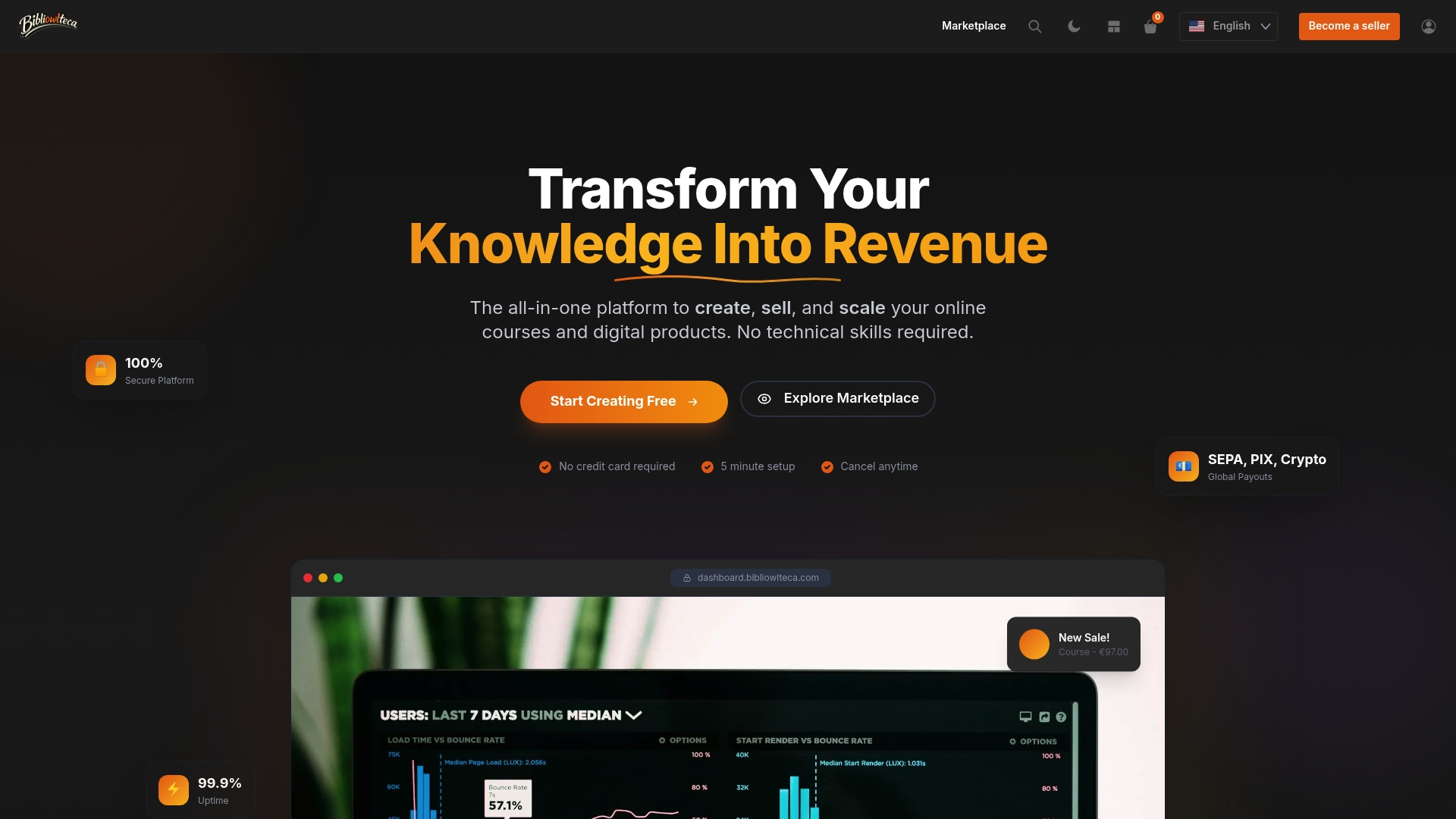
This platform gives you a storefront built around the checklist above rather than around generic retail. Users get a customisable storefront, global payments, tax tooling and course-specific features (video hosting, quizzes, mentorship spaces) without paying a monthly fee before making a sale.
- Browse the Creator Plan and pricing details, including the per-sale transaction fee.
- Check the full feature list against the checklist you just read.
- See examples of e-books, courses and templates already selling on the platform.
Start by setting up your storefront and running a test sale before you open it to real students.
Sources
Before launch, check the Estonian Tax and Customs Board's OSS guidance, the EDPB's DSA and GDPR guidelines, and, for a broader view on seller trust signals, Crontent's piece on content provenance.
- Special schemes of e‑commerce and services | Estonian Tax and Customs Board
- Guidelines 3/2025 on the interplay between the DSA and the GDPR
- Regulation (EU) 2022/2065 (Digital Services Act)
FAQ
What is a customisable e-commerce platform for digital products?
It is a storefront system that lets a creator brand their own shop, set their own pricing structures and control delivery of courses, e-books, templates or mentorship, rather than using a generic retail template. BibliOWLteca is one example built specifically around education products.
Do I need to register for VAT to sell courses internationally?
Once your cross-border digital sales to EU consumers pass the €10,000 annual threshold, VAT generally becomes due in the buyer's country, and OSS registration is the standard way to report it through a single return. Below that threshold, different rules may apply, so check your own situation against the official guidance.
What data protection duties does a course platform have?
The platform and the creator each hold controller or processor roles depending on the processing activity, such as checkout data versus marketing emails, and this should be documented in a data-processing agreement. The EDPB's guidance on the DSA and GDPR explains why these roles need to be identified clearly.
How much does BibliOWLteca cost for creators?
BibliOWLteca's Creator Plan has no published monthly fee listed on its pricing page, and the platform instead charges a transaction fee starting from €0.99 per sale. Full current pricing is available on the BibliOWLteca pricing page.
How long does it take to launch a customised digital storefront?
The timeline depends on how much content and how many tax and payment settings you need to configure, but a working storefront can typically be set up, tested and soft-launched within a few weeks. Running test purchases from multiple countries and checking invoices before a full launch, as outlined in the launch checklist above, is the most reliable way to catch problems early.