
Sell mentorship as an outcome, not your time: build one named process with 2 to 3 tiers, price against the transformation you deliver, and enrol people through an application and a discovery call rather than a chat message. Group formats work for lower price points; 1:1 and hybrid formats justify the higher tiers. A platform handles the payments and delivery mechanics so you can focus on the offer itself.
TL;DR:
- Mentorship packages should be built around a clear outcome, fixed timeline, named deliverables, a repeatable process, and one anchor price.
- Offering two or three tiers, with the middle as the default, should focus on access differences, not content volume, with group formats for entry and 1:1 or hybrid for higher tiers.
- Pricing should be based on the result and access level, typically falling between $1,200 and $3,000 for signature offers, adjusted for platform fees and client capacity.
- High-ticket sales rely on application forms and discovery calls, revealing price only after diagnosing the client's needs and emphasizing value over chat conversations.
- Content marketing must directly support the mentorship outcome, with concrete case studies, clear calls to action, and streamlined application processes to reliably attract clients.
Table of Contents
- How do you package mentorship into something people will buy?
- What should you actually charge for mentorship?
- What does a funnel that closes premium clients look like?
- How do you get people into that funnel in the first place?
- How do you deliver, get paid and stay compliant once someone buys?
- Worked pricing examples and a quick formula
- How do you keep clients renewing instead of churning?
- BibliOWLteca perspective: common errors and practical checks
- Selling mentorship on Bibliowlteca: what to set up first
- Sources
How do you package mentorship into something people will buy?
A mentorship offer that actually sells has five parts: a single clear outcome, a fixed timeline, named deliverables, a repeatable process with its own name, and one anchor price. SetSmart's packaging framework treats these five as the baseline for any coaching product that moves beyond "pay me for my time," and the naming detail matters more than most creators assume. A process called "The 90 Day Signal System" sounds like something worth buying. "12 weekly calls" does not.
Once the core package exists, split it into two or three tiers. Resist the urge to build five. SetSmart's guide and LVLUP's 2026 pricing breakdown both point to the same structure: entry, core and premium, with the middle tier set as the default choice on your sales page. The upgrade between tiers should be about access, not extra content:
- Entry: group cohort, weekly group calls, community access
- Core: small-group or hybrid format, monthly 1:1 sessions, faster message response
- Premium: full 1:1 access, direct messaging, bonus workshops or a done-with-you element
Group formats suit the entry tier because they cap your time per client. Hybrid and 1:1 formats belong at the top, where the price supports the extra attention.
Pro Tip: Price the jump between tiers around response time and direct access, not more calls. Clients pay for proximity to you, not volume of content.
What should you actually charge for mentorship?
Price the outcome, not the hours. A client paying for a career pivot or a revenue jump is buying the result, and anchoring your fee to that outcome, plus the access level, produces a far more defensible number than an hourly rate ever will.
That said, ranges help when you're starting out. Here's roughly where the market sits, based on current data:
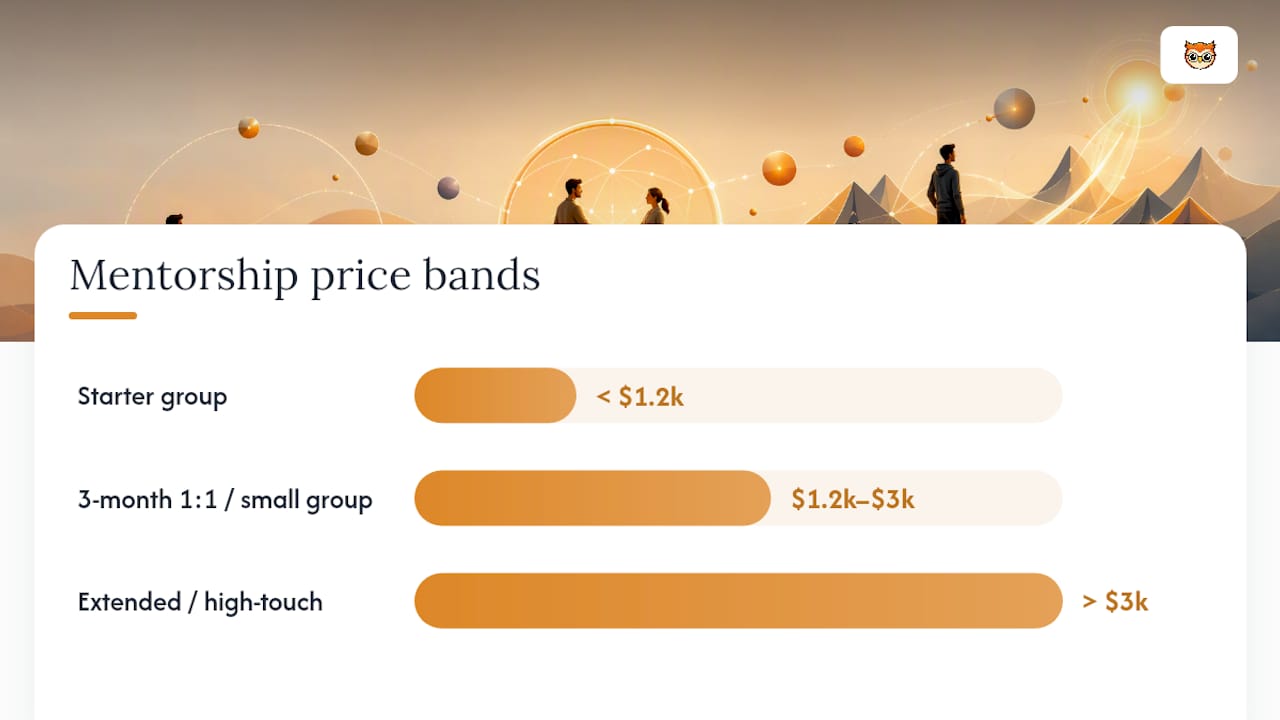
- Short, starter-style group packages: often under $1,200
- Three-month signature 1:1 or small-group offers: commonly $1,200 to $3,000
- Extended or high-touch mentorship, including corporate engagements: well above that band
These figures come from Onlinemoneyguides' pricing research, and they hold up as a sanity check even if your niche or credentials push you higher.
One number worth remembering: platform and processing fees eat directly into these figures. LVLUP's analysis flags that commission and processing costs materially change what a creator actually keeps, so factor that into your headline price rather than discovering the gap after your first payout.
Work backwards from your income target rather than picking a number that feels comfortable. If you want $8,000 a month and can realistically handle 8 clients, your price needs to clear $1,000 before fees. Payment plans (2 or 3 instalments) help close hesitant premium buyers, but reserve them for the top tier. Discounting the entry tier for instalments just trains buyers to expect a lower number.
What does a funnel that closes premium clients look like?
Selling a $3,000 mentorship package in a DM thread almost never works. High-ticket coaching offers close through a two-step flow: an application form first, then a discovery call where price comes up only after you've diagnosed what the client actually needs. Paperbell's breakdown of high-end coaching sales is blunt about this: premium offers sell in conversation, not in chat.
The application step does double duty. It filters out people who aren't serious, and it gives you material to open the call with instead of small talk. A few qualifying questions work well before you even offer a slot:
- "What's the specific result you're trying to hit in the next 90 days?"
- "What have you already tried, and why didn't it get you there?"
- "What would it be worth to you to solve this in three months instead of twelve?"
Structure the call around four moves: where the client is now, where they want to be, what's creating the gap, and then your proposal, price included. Revealing price last, after the client has said the gap out loud, is what makes the number land as reasonable rather than arbitrary.
Pro Tip: When a prospect pushes back on price, ask what specifically feels expensive before you touch the number. Half the time the objection is about timeline or trust, not cost.
How do you get people into that funnel in the first place?
Content should map directly to the outcome your package promises, not to mentorship as a general topic. If your signature offer gets freelancers to their first $10,000 month, every piece of content should show a piece of that path, not generic advice about mindset or hustle.
Micro case studies do more work than polished testimonials. A short before/after post about one client's specific win builds more trust than a glossy quote, because it's checkable and concrete.
- Publish one consistent call to action across content: "DM me [word]" or "apply via the link"
- Never split your CTA across three different asks in the same week
- Combine organic content with a small paid budget or an email sequence once DMs become unpredictable to manage
- Route every qualified reply straight into your application form, not a back and forth chat
Scaling intake reliably is less about volume of content and more about removing friction between interest and application.
How do you deliver, get paid and stay compliant once someone buys?
The first 30 days set the tone for the entire relationship. A simple checklist keeps onboarding consistent across clients:
- Send a welcome message and confirm the contract and first payment
- Run an intake session to lock the outcome and timeline in writing
- Set the delivery schedule: calls, check-ins, milestones
- Deliver the first tangible piece within the first week, not the first month
Your platform needs to support gated lesson or resource access, scheduling, in-app messaging, secure checkout and automatic receipts. Paperbell's guide to premium client experience notes that a fragmented post-sale process, contract in one tool, scheduling in another, payment somewhere else, quietly downgrades how premium the offer feels, even when the coaching itself is excellent.
On payment structure: one-off payments simplify cash flow but raise the barrier to entry; instalments widen your buyer pool but add admin and risk of non-payment; subscriptions suit ongoing mentorship communities better than fixed-outcome programmes. Whichever you choose, keep clean records of every transaction. A platform that generates receipts and handles multi-currency payments automatically removes a genuine administrative burden, particularly once clients start paying from outside your home country.
Worked pricing examples and a quick formula
Three package shapes cover most creators starting out:
| Package | Format | Deliverables | Plausible price band |
|---|---|---|---|
| Entry | Group cohort | Weekly group call, community access, workbook | At lower price points. |
| Signature | Small group or hybrid, 3 months | Biweekly 1:1, group calls, milestone reviews | At mid-tier price points |
| Premium | 1:1, 3 months | Weekly 1:1, direct messaging, bonus workshop | At higher price points |
To reverse-engineer your own number: divide your target monthly income by the number of clients you can realistically handle, then adjust upward for platform fees and the time each tier actually takes. If existing clients need a price rise, apply it to new enrolments first and grandfather current clients for one renewal cycle before the new rate applies. Announce it as an improvement to the offer, not just a number change.
How do you keep clients renewing instead of churning?
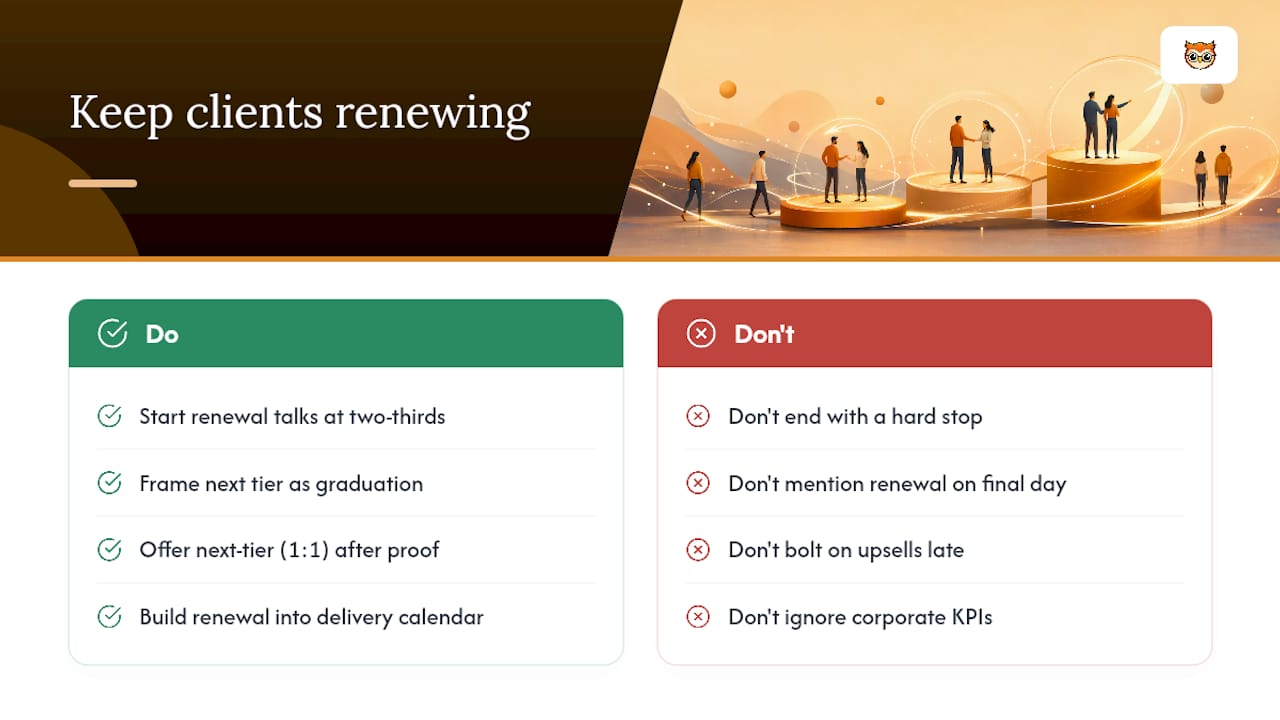
The easiest sale you'll ever make is to someone who's already seen results. Mentorship programmes that end with a hard stop and no renewal conversation leave revenue on the table that took the hardest work (the first sale) to earn.
Build the renewal conversation into your final weeks, not your final day. Around the two-thirds mark of any programme, start naming what's still ahead: the next outcome the client hasn't hit yet, or a harder goal that naturally follows the one they're finishing. This works because it's honest. Most clients who get real results want more of the same relationship, not a different one.
Upselling works best as a natural next tier, not a bolt-on. Someone who finished your entry group cohort is a strong candidate for the 1:1 premium tier once they've proven they'll do the work. Frame it as graduation, not an upsell pitch.
For corporate and professional buyers specifically, renewal often means expanding scope rather than repeating the same engagement. The Mentors' guidance on corporate procurement points out that enterprise buyers expect measurable KPIs baked into the original SOW, which makes a renewal or expansion conversation straightforward: you're simply presenting results against agreed metrics and proposing the next scope.
Whatever you do, don't let renewal be an afterthought you mention in the last session. Build it into the delivery calendar from day one.
BibliOWLteca perspective: common errors and practical checks
The three mistakes we see most often are selling time instead of an outcome, building too many tiers, and pitching price inside a DM conversation before any real diagnosis has happened. Each one quietly caps what a creator can charge, no matter how good the mentoring itself is.
What works consistently: a named process, a middle tier positioned as the obvious default, and enrolment that runs through a proper call rather than a typed-out pitch. None of this requires more effort, just a different order of operations.
For creators building this out, our guide to structuring mentorship programmes and our notes on writing a sales page that sells the transformation cover the implementation side in more depth than a single section can.
— BibliOWLteca
Selling mentorship on Bibliowlteca: what to set up first
Platforms can handle the operational side of everything covered above: multi-currency payments, gated delivery for your named process, an enrolment flow that supports application forms ahead of a discovery call, and payouts that work whether your client is paying from different locations.
If you're weighing this against building your own checkout and hosting patchwork, the trade-off is straightforward: less time on infrastructure, more time on the coaching itself. Start by listing your signature tier first, since it's the one that best tests whether your pricing and positioning actually hold up in front of real buyers. Once that's live, add the entry and premium tiers around it.
If you're pitching to corporate or professional buyers, pair your package with a proper SOW and pricing grid. ESG Training Institute's corporate advisory resources are worth a look if procurement conversations are new territory for you.
To see how the payment, delivery and enrolment pieces fit together on the platform, visit the digital marketing product page and set up your first package this week.
Sources
- Coaching packages
- How to price online coaching services
- How to price online coaching in 2026: rates & tiers | LVLUP
- SOW & pricing grid for corporate mentoring (2026)