
Multi-currency payments (mitmevaluutalised maksed in Estonian) let you accept, hold, and pay out in more than one currency without forcing every transaction through a GBP conversion. The immediate actions: open a multicurrency account with a provider that lets you hold balances, configure your checkout to display local prices, set rules for when you convert, and align your bookkeeping with HMRC's currency-conversion guidance. Do those four things and you have the foundation.
Quick action checklist:
- Enable a multicurrency merchant account or wallet that holds foreign-currency balances
- Configure checkout to display prices in the customer's local currency
- Decide your conversion rule: convert on receipt, on a schedule, or hold and use for matching expenses
- Update your bookkeeping chart of accounts to track each currency separately
- Register exchange gains and losses in line with HMRC's functional currency rules
Key takeaways
Effective multi-currency payment management requires a multicurrency account that holds balances, clear conversion rules, and UK-compliant bookkeeping from the first transaction.
| Point | Details |
|---|---|
| Hold balances to cut costs | Matching foreign receipts to foreign expenses eliminates conversion fees on those outflows. |
| Conversion timing is a policy decision | Set a written rule for when to convert; automatic settlement conversion is the most common hidden cost. |
| UK VAT invoices need GBP amounts | Show the GBP VAT figure on every invoice, using the rate at the tax point or HMRC's published period rate. |
| Provider selection determines real cost | Ask for the FX markup, settlement currency options, and reconciliation export format before committing. |
| Bibliowlteca for creators | Bibliowlteca provides multi-currency checkout, global payouts, and seller reporting in one platform. |
Table of Contents
- What counts as a multi-currency payment, and how does it differ from cross-border?
- How does multi-currency processing actually work?
- How to set up multi-currency acceptance at checkout
- Should you hold foreign balances or convert immediately?
- How to calculate your real FX costs and reduce them
- UK accounting, VAT and compliance for multi-currency receipts
- How to choose a multi-currency payment provider
- Natural hedging and practical use cases for creators and SMEs
- What experienced finance teams do differently
- Bibliowlteca makes multi-currency selling straightforward for creators
- Sources
What counts as a multi-currency payment, and how does it differ from cross-border?
A multi-currency payment is any transaction where the buyer's currency differs from the seller's settlement currency or where a business holds and operates in more than one currency simultaneously. Cross-border payments, by contrast, are defined by geography: money moving between two countries. The two concepts overlap frequently but are not the same thing.
A UK creator selling a course to a German buyer in EUR is doing both at once. But a UK business with a EUR-denominated subsidiary account paying a EUR supplier is running a multi-currency transaction without any cross-border movement at all. That distinction matters when you are choosing banking partners and settlement rails, because the fees, regulatory treatment, and available payment methods differ between the two scenarios.
Practical examples for digital creators and marketplace sellers:
- A UK-based course creator prices in USD for North American buyers and EUR for European buyers, settling both into GBP or holding balances separately
- A digital marketplace collects payments in eight currencies and pays out creators in their local currency, never converting unless the creator requests it
- A buyer in France pays in EUR via a UK merchant's checkout; the merchant holds the EUR to pay a French contractor, avoiding two conversion events
The refund implication is often overlooked. If a customer paid in EUR and you have already converted to GBP, a refund requires you to buy EUR back at the current rate. Holding the original EUR balance eliminates that exposure entirely.
How does multi-currency processing actually work?
The end-to-end flow moves faster than most finance teams realise. Modern payment gateways fetch live exchange rates, apply markups, and route funds through acquiring banks and card networks in seconds. Here is the sequence:
- Transaction initiation: the customer selects a currency at checkout (or the merchant pre-sets it based on IP/locale)
- Currency selection and rate lock: the gateway fetches a real-time rate and locks it for the session, applying its markup
- Authorisation: the card network or payment method authorises the charge in the customer's currency
- Conversion decision: the gateway either converts to the merchant's base currency immediately or holds the funds in the original currency if the merchant has a multicurrency balance
- Settlement: funds settle into the merchant's account, in either the original or converted currency, typically within one to three business days
- Reconciliation: the merchant matches settled amounts to invoices, records any exchange differences, and revalues open balances at period end
Roles in the flow:
| Party | Responsibility |
|---|---|
| Merchant | Sets accepted currencies, conversion rules, and settlement preferences |
| Payment gateway | Fetches rates, applies markup, routes authorisation, holds or converts funds |
| Acquiring bank | Processes the settlement and credits the merchant account |
| Card network (Visa/Mastercard) | Sets the base interbank rate; may add a cross-border assessment fee |
| FX provider | Supplies the conversion rate to the gateway; sometimes the gateway itself |
The conversion markup is where most hidden cost sits. Gateways rarely advertise it as a separate line item; it is baked into the rate you see versus the mid-market rate at that moment.
How to set up multi-currency acceptance at checkout
Getting the checkout right is where most teams make avoidable mistakes. The configuration sequence below covers the essentials.
Setup checklist:
- Enable each target currency in your payment processor or merchant account settings
- Configure a currency selector at checkout, or use geo-IP detection to pre-select the customer's local currency
- Localise displayed prices (not just currency symbols — round to local conventions, e.g. €49 not €48.73)
- Map each currency to the correct VAT or tax rate for that customer's jurisdiction
- Decide which payment methods to offer per currency (SEPA Direct Debit for EUR, iDEAL for Dutch buyers, etc.)
- Set your DCC (dynamic currency conversion) policy: on, off, or optional
Dynamic currency conversion deserves particular attention. DCC lets a foreign-currency cardholder pay in their home currency at the point of sale, with the conversion handled by the card terminal or gateway rather than their bank. Presenting a local-currency amount at checkout and showing the conversion rate reduces customer surprise and chargebacks. The trade-off: DCC typically carries a higher markup than the card network's own rate, and some customers distrust it when the rate is not clearly disclosed.
For digital products and courses, the cleaner approach is usually to price natively in each major currency (USD, EUR, GBP) rather than relying on DCC. You control the price, the customer sees a clean local amount, and there is no last-minute rate surprise at checkout.
Pro Tip: Set a price-rounding rule per currency before you go live. A course priced at £199 should display as €229 or $249, not €228.47 or $248.91. Clean price points convert better and look more professional, and they are easier to reconcile.
Should you hold foreign balances or convert immediately?
This is the single most consequential operational decision in multi-currency management. Holding funds in multiple currencies lets businesses avoid repeated conversion fees and can improve margins over time by matching foreign receipts to foreign expenses. Immediate conversion is simpler but more expensive if you have matching foreign outflows.

| Factor | Hold foreign balances | Convert immediately to GBP |
|---|---|---|
| FX exposure | Open: balance value moves with rates | Closed: rate locked at conversion |
| Conversion cost | Lower if you match receipts to expenses | Paid on every receipt |
| Cashflow visibility | Requires multi-currency reporting | Simpler: everything in GBP |
| Refund risk | Low: refund from existing balance | Higher: must buy currency back |
| Accounting complexity | Higher: revalue balances at period end | Lower: one currency in books |
| Best for | Businesses with foreign expenses or suppliers | Businesses with GBP-only costs |
Reconciliation checklist for held balances:
- Match each incoming payment to its originating invoice in the same currency
- Record the GBP equivalent at the transaction date (using HMRC-approved rates or the actual rate applied)
- Track unrealised FX gains and losses on open balances monthly
- Revalue all foreign-currency balances at the period-end spot rate
- Document every conversion event with date, rate, and amount for audit purposes
Good recordkeeping, a clear monthly close checklist, and one responsible owner are not optional extras when you are running multi-currency books. Assign one person to own the currency rules and the month-end revaluation. Shared responsibility for FX positions almost always means gaps.
How to calculate your real FX costs and reduce them
Most businesses underestimate their FX spend because the cost is spread across several line items, none of them labelled "FX fee."
Typical fee components:
- Processor markup: the spread between the mid-market rate and the rate applied at conversion, often 0.5%–2.5%
- Card network cross-border fee: charged by Visa or Mastercard on transactions where the card's issuing country differs from the merchant's country
- Gateway transaction fee: a flat or percentage fee per transaction, separate from the FX markup
- Bank receiving fee: some banks charge to receive international transfers, even in GBP
Worked example: EUR sale settling in GBP
A UK creator sells a course for €200. Here is what actually arrives:
- Sale amount: €200.00
- Mid-market EUR/GBP rate at transaction: 0.8600 (so €200 = £172.00)
- Gateway FX markup: rate applied was lower than mid-market, reducing the received amount
- Card network cross-border fee deducted
- Gateway transaction fee deducted
- Net receipt is noticeably less than the mid-market equivalent
This shows how conversion and transaction fees reduce actual proceeds compared to the theoretical mid-market rate. On a high volume of EUR transactions, that compounds quickly. Processors commonly add transaction and cross-border fees; passing them to customers can harm loyalty, while absorbing them raises operating costs. The practical answer is to reduce conversion events, not to pass fees on.
Cost-control tactics:
- Hold EUR receipts and pay EUR expenses from the same balance (natural hedging)
- Batch conversions rather than converting each transaction individually
- Negotiate the FX markup directly with your provider once monthly volume justifies it
- Use a multi-currency platform that lets you hold balances rather than forcing immediate settlement
UK accounting, VAT and compliance for multi-currency receipts
HMRC requires UK businesses to report in their functional currency, which for most UK companies is GBP. Every foreign-currency transaction must be converted to GBP for VAT and corporation tax purposes, but the rules for which rate to use give you some flexibility.
Recording exchange differences:
- Record the GBP equivalent of each transaction at the rate on the transaction date
- Use either the actual rate applied by your bank or payment processor, or HMRC's published monthly average rates (acceptable for VAT purposes)
- At period end, revalue all foreign-currency monetary items (balances, receivables, payables) at the closing spot rate
- The difference between the carrying amount and the revalued amount is an exchange gain or loss, recognised in profit and loss
VAT treatment:
- UK VAT invoices must show the VAT amount in GBP, even if the invoice is denominated in a foreign currency
- Use the rate of exchange at the tax point (usually the invoice date) or HMRC's published period rate
- For B2C digital services sold to EU customers, the place of supply rules and any applicable OSS registration requirements apply separately from UK VAT
Audit-ready recordkeeping checklist:
HMRC's guidance on foreign currency transactions is published in its Business Income Manual (BIM39500 series) and the VAT Notice 700. Both are the authoritative starting points for any finance team setting up multi-currency accounting for the first time.
How to choose a multi-currency payment provider
The provider decision is where many businesses lose money quietly for years. The checklist below is designed to surface the questions that separate genuinely capable providers from those that look capable on a features page.
Evaluation checklist:
- Supported currencies: how many can you accept, and how many can you hold as balances (not just accept and immediately convert)?
- Settlement currencies: can you settle in currencies other than GBP, or does the provider force conversion on settlement?
- Conversion controls: can you set rules for when conversion happens, or is it automatic?
- Fee transparency: are the FX markup, transaction fee, and cross-border fee disclosed separately, or bundled into one opaque rate?
- Payment methods per currency: does the provider support local payment methods (SEPA, iDEAL, Bancontact) or only cards?
- Payout rails: how do you get funds out, in which currencies, and how quickly?
- Reporting and reconciliation tools: can you export transaction-level data with the rate applied, in a format your accounting software can ingest?
- API and webhook support: does the provider offer real-time event notifications for payment status changes, including FX conversion events?
- Chargeback handling: how are chargebacks managed for foreign-currency transactions, and in which currency is the dispute amount held?
- Integration with accounting software: does the provider connect directly to Xero, QuickBooks, or Sage, and does it pass the original currency and GBP equivalent?
Questions to ask vendors directly:
- What is your FX markup over the mid-market rate, and is it fixed or variable?
- At what point in the flow does conversion happen: at authorisation, at settlement, or on demand?
- Can I hold EUR, USD, and other balances indefinitely, or is there a holding limit or time cap?
- What settlement latency should I expect for each currency?
- How do you handle refunds on converted transactions?
Red flags:
- Opaque "competitive rates" language with no published markup figure
- Forced automatic conversion to GBP on every settlement with no opt-out
- No transaction-level export with rate data
- Poor or absent reconciliation tooling
A multi-currency payment can occur without crossing borders, and understanding that distinction prevents selecting the wrong settlement rails entirely. A provider built for cross-border wire transfers may be the wrong choice for a digital marketplace collecting EUR card payments from European buyers.
For creators and digital sellers, payment processing guidance that covers integration notes and fee structures is worth reading before committing to a provider.
Natural hedging and practical use cases for creators and SMEs
Natural hedging is the most cost-effective FX strategy available to most small businesses, and it requires no financial instruments. UK best practice recommends holding foreign-currency receipts to pay like-currency expenses, eliminating conversion costs for those outflows entirely.
Worked use case: a UK course creator with EUR expenses
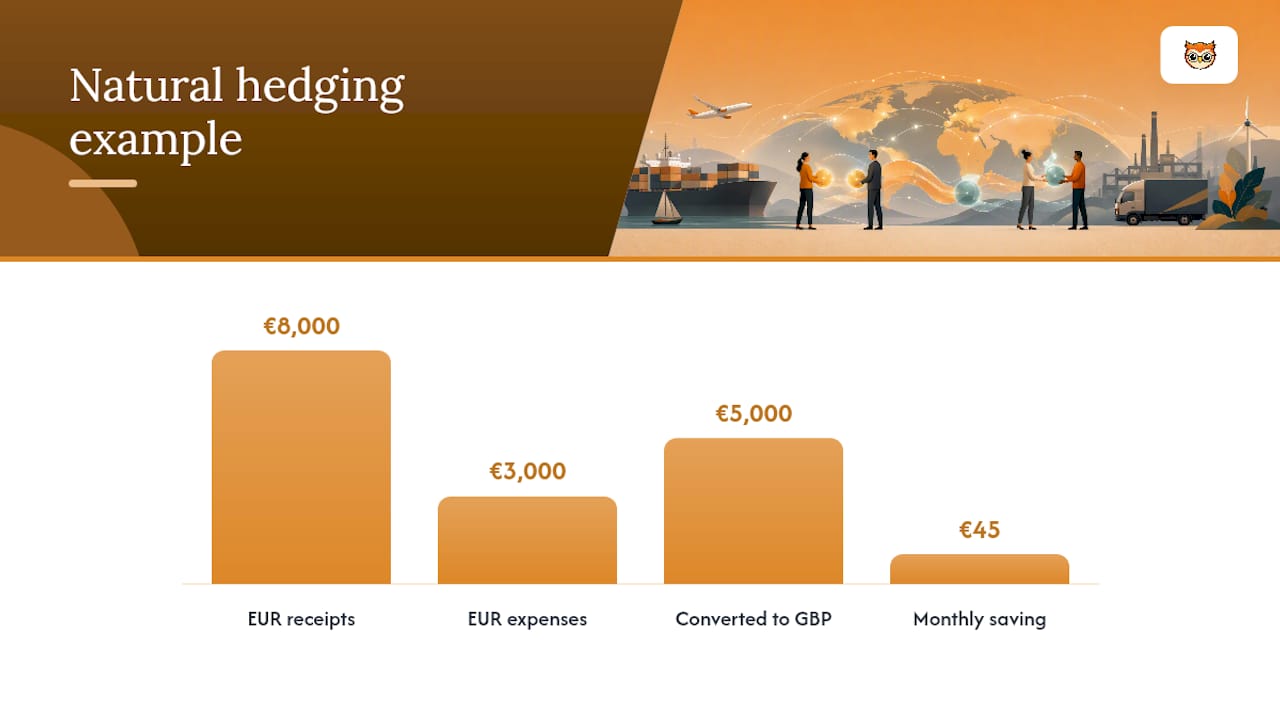
A creator earns €8,000 per month from European course sales and pays €3,000 per month to a German video editor and a French subtitling service. Without a multicurrency account, every EUR receipt converts to GBP and every EUR payment converts back, generating two sets of conversion costs. With a EUR balance, the €3,000 in expenses is paid directly from receipts, and only the remaining €5,000 needs converting. At a 1.5% markup, that saves roughly €45 per month, or €540 per year, on a modest revenue base.
The strategy scales. A creator earning €30,000 monthly with €12,000 in EUR expenses saves proportionally more, and the benefit compounds if the EUR strengthens against GBP during the holding period.
Risk controls for holding foreign balances:
- Set a maximum balance threshold per currency beyond which you convert automatically (e.g. convert EUR above €20,000 to GBP monthly)
- Review open positions at least monthly and document the decision to hold or convert
- Record unrealised gains and losses in management accounts at each month end, even if they are not yet taxable
- Avoid holding speculative positions: the goal is matching receipts to expenses, not FX trading
Pro Tip: Build a simple conversion rule document: "Convert EUR to GBP on the last working day of each month, except amounts earmarked for EUR supplier payments in the following 30 days." One page, one owner, reviewed quarterly. It removes the temptation to time the market and gives auditors a clear policy to review.
Without a multicurrency account to hold balances, many providers force automatic conversion on settlement at a marked-up rate. That is the most common and most avoidable source of hidden FX cost for UK digital businesses.
What experienced finance teams do differently
The gap between businesses that manage multi-currency payments well and those that muddle through is rarely about the tools. It is about habits.
Finance teams that handle cross-currency payments cleanly tend to do three things consistently. They run a monthly revaluation without exception, treating it as a fixed close task rather than something done when there is time. They assign one person to own the currency rules, which means one person who knows the current conversion policy, the current provider markup, and the current balance in each currency. And they reconcile on a transaction-by-transaction basis, not in bulk at quarter end.
The most common mistake is assuming that accepting payment in a foreign currency automatically saves on conversion. It does not, unless you have a multicurrency settlement account that actually holds the balance. Many providers convert on settlement regardless of what the checkout shows the customer. A merchant can display EUR prices, collect EUR from the buyer, and still receive GBP in their account because the provider converted silently. That is not a feature; it is a default that costs money.
Invoice currency practice is the second common failure point. Issuing a GBP invoice to a EUR customer and then accepting EUR payment creates a currency mismatch in the books that is tedious to unwind. Issue invoices in the customer's currency, record the GBP equivalent at the invoice date, and track the difference at settlement as an exchange gain or loss. It takes an extra column in your spreadsheet and saves hours at year end.
Pro Tip: Run a quarterly FX cost audit: pull every conversion event from your provider's transaction export, calculate the mid-market rate at each conversion date, and compare it to the rate you received. The difference is your markup cost. Most businesses that do this once negotiate better rates within 90 days.
Bibliowlteca makes multi-currency selling straightforward for creators
Selling digital products internationally means dealing with currencies, tax rules, and payment methods that vary by market. Bibliowlteca is built for exactly that: a creator platform where multi-currency checkout, global payouts, and tax compliance are part of the infrastructure, not add-ons to configure separately.

With Bibliowlteca, you can price your courses, e-books, and mentorship programmes in multiple currencies, accept payments from buyers worldwide, and receive payouts without the manual conversion overhead that comes with general-purpose payment processors. The platform's built-in seller reporting and features give you transaction-level visibility across currencies, so your monthly close is a matter of exporting clean data rather than reconstructing what happened.
For creators who want to sell globally without building a custom payment stack, Bibliowlteca removes the friction. Start selling on Bibliowlteca and reach buyers in their own currency from day one.
Sources
- Multi-Currency Transactions 101: How They Work for Businesses - Rapyd
- What are multi-currency payments? How they work, explained | Stripe
- What are multi-currency payments? How they work | PayPal
- What are multicurrency payments — how they work and use | Papaya Global
- Kuidas valida raamatupidaja Eestis: Eksperdi juhend 2026
This article is general information, not a substitute for advice from a qualified financial advisor. Consult a qualified financial professional about your own circumstances before acting on anything here.