
TL;DR:
- Multi-currency platforms allow accepting payments in over 100 currencies with minimal fees and faster payouts.
- They enable holding funds in local currencies, automating compliance, and reducing foreign exchange costs.
- Proper use of these platforms boosts conversion rates, lowers transaction costs, and streamlines global content sales.
Selling educational content globally sounds exciting until you hit the wall of currency conversions, declined payments, and tax compliance headaches that nobody warned you about. Many creators lose 3% or more per transaction simply because their platform wasn't built for international trade. The good news is that multi-currency platforms like Rapyd, Airwallex, and Stripe now let you accept payments in 100+ currencies across 150+ countries with minimal friction. Whether you're selling e-books in Brazil, courses in Japan, or memberships in Germany, the right platform removes the barriers between your knowledge and your global audience. This guide walks you through everything you need to know to sell smarter, comply confidently, and grow faster.
Table of Contents
- What is a multi-currency platform?
- Core components: payments, wallets, and compliance
- How multi-currency platforms reduce costs and boost sales
- Expert tips and pitfalls: advanced strategies for creators
- Case studies: real outcomes from using multi-currency platforms
- Why most creators underestimate multi-currency platforms
- Unlock global sales with BibliOWLteca's marketplace
- Frequently asked questions
Key Takeaways
| Point | Details |
|---|---|
| Global reach made simple | Multi-currency platforms let creators sell and get paid worldwide without payment barriers. |
| Lower costs, faster payouts | Modern platforms reduce transaction fees and enable same-day payouts in preferred currencies. |
| Compliance can be automatic | Integrated tools automate VAT, GST, and tax compliance, freeing up time for creators. |
| Advanced strategies matter | Using multi-processors and understanding risks help creators maximise returns and avoid pitfalls. |
| Case studies show results | Real creators see double the payouts and higher revenue after adopting multi-currency solutions. |
What is a multi-currency platform?
A multi-currency platform is a payment infrastructure that allows you to accept, hold, and pay out money in several different currencies without routing every transaction through a single home currency first. For content creators, that distinction matters enormously. Traditional payment setups force every international sale through a conversion chain: your buyer pays in euros, the processor converts to US dollars, charges a spread, and deposits a smaller amount than you expected. A multi-currency platform breaks that chain.
At its core, the technology works by assigning your account local receiving details in each supported currency. When a customer in France pays in euros, the euros land in your euro wallet. When someone in Canada pays in Canadian dollars, those funds sit separately in a Canadian dollar wallet. You decide when and how to convert or withdraw, giving you far more control over timing and rates.
The key features that distinguish a true multi-currency platform include:
- Local payment method support: Accept credit cards, bank transfers, digital wallets, and region-specific methods like iDEAL in the Netherlands or Boleto in Brazil.
- Multi-currency wallets: Hold funds in 20+ currencies without triggering costly foreign exchange conversions on every transaction.
- Automated settlement: Move money to your local bank account or business wallet on your schedule.
- Real-time FX rates: Lock in rates or convert at the moment that suits your cash flow.
- Global payout rails: Send earnings to team members, collaborators, or yourself in their preferred currency.
Platforms like Stripe, Airwallex, and Rapyd each offer versions of these capabilities, though they differ in pricing, supported countries, and ease of integration. Reviewing the best marketplaces for creators can help you understand which infrastructure suits your specific publishing model.
"Holding your earnings in the currency they were earned in is not just a convenience. It is a strategic decision that can save thousands per year at scale."
For a creator selling a £49 course to 500 international students per month, even a 1.5% improvement in FX rates translates to hundreds of pounds retained annually. That money stays in your business instead of disappearing into a bank's margin. Multi-currency platforms are not a luxury for large enterprises. They are the foundation for any creator serious about building a genuinely global business.
Core components: payments, wallets, and compliance
Understanding the individual components of a multi-currency platform helps you choose the right one and configure it properly from the start. The system works as an end-to-end flow, from the moment a buyer clicks purchase to the moment funds land in your account.
Here is how the payment cycle typically works for a content creator:
- Accept local payment methods: Your checkout presents payment options suited to the buyer's region, whether that is a card, bank transfer, or local wallet.
- Funds settle to your multi-currency wallet: Money arrives in the buyer's currency without forced conversion.
- You manage conversion strategically: Convert when rates are favourable or hold in currency if you have expenses in that currency.
- Payout via local rails or API: Withdraw to your bank account, pay a contractor, or reinvest, all through automated payout systems.
The table below breaks down the four core components of most platforms:
| Component | Function | Creator benefit |
|---|---|---|
| Payments | Accept cards, wallets, bank transfers globally | Higher checkout conversion |
| Multi-currency wallets | Hold earnings in 20+ currencies | Avoid unnecessary FX fees |
| Compliance tools | Automate VAT, GST, KYC, sanctions screening | Less paperwork, fewer errors |
| Payouts | Send funds via local rails in preferred currency | Faster, cheaper withdrawals |
Compliance is where most creators either relax or panic, and it deserves real attention. VAT and GST automation handles collection at the correct rate for each jurisdiction, EU OSS registration for sales over €10,000, rates ranging from 17% to 27% depending on the country, plus tax form generation and global sanctions screening. That means the platform does the heavy lifting, but you still need to understand what is happening.
For deeper reading on structuring your global tax approach, the VAT and tax strategies for digital sellers and the broader topic of selling digital content internationally are both worth exploring before you launch.
Pro Tip: Enable automated compliance settings on day one, not after your first international sale. Retroactively calculating VAT owed across multiple jurisdictions is a painful, time-consuming process that automated tools can prevent entirely.
The compliance layer also includes Know Your Customer (KYC) verification, which platforms run during onboarding, and OFAC screening, which flags transactions involving sanctioned entities. These protections work in your favour. They reduce the risk of chargebacks, account freezes, and legal complications that could disrupt your revenue stream.
How multi-currency platforms reduce costs and boost sales
The financial case for switching to a multi-currency platform is straightforward once you compare the real numbers. Legacy payment setups are expensive, slow, and opaque. Modern platforms are leaner, faster, and built for the kind of cross-border volume that digital content creators generate.
Let's compare the two approaches side by side:
| Feature | Legacy methods (banks/PayPal/Stripe standard) | Modern multi-currency platforms |
|---|---|---|
| FX fees | 2.9% + $0.30 + 1% international | 0.5% to 1% spread |
| Payout speed | 3 to 5 business days | Same-day via local rails |
| Supported currencies | 10 to 30 | 20 to 100+ |
| Local payment methods | Limited | Extensive |
| Compliance automation | Manual or basic | Full automation |
Platform fees for tools like Airwallex and Wise typically run between 0.5% and 1%, compared to Stripe and PayPal's standard rate of approximately 2.9% plus $0.30 and an additional 1% for international transactions. At scale, that difference is substantial.

The revenue impact goes beyond fees. When your checkout presents a buyer's local currency, their trust increases and cart abandonment drops. Creators who have migrated to multi-currency setups report measurable lifts in conversion, particularly in markets where buyers are unfamiliar or uncomfortable with USD pricing.
Benefits for creators who make the switch include:
- Fewer payment declines: Local card rails have higher approval rates than cross-border routing.
- Faster payouts: Funds arrive in your account sooner, improving cash flow.
- Happier buyers: Familiar payment methods and local currency pricing build confidence.
- Lower operational costs: Automation reduces the time spent on reconciliation and compliance.
- Greater reach: Accept payments from markets that were previously inaccessible.
For a practical roadmap on turning these savings into a scalable business, the guide on monetising your courses covers how to structure pricing, packaging, and payouts for sustainable global growth.
Expert tips and pitfalls: advanced strategies for creators
Knowing the tools is one thing. Using them wisely is another. Creators who scale globally without a clear strategy often make expensive mistakes that erode the very savings multi-currency platforms are supposed to deliver.
First, evaluate platforms based on your actual needs. Payout-focused platforms like Hyperwallet or Tipalti work well if your primary goal is distributing earnings to a large network of collaborators or affiliates. Full-stack platforms like Airwallex or Stripe are better suited if you need to manage the entire payment lifecycle, from checkout to wallet to withdrawal, in one place. Getting this wrong means switching platforms mid-scale, which is disruptive and costly.
Second, consider a multi-processor strategy. Many experienced creators use Stripe for US and UK transactions, where approval rates are highest, and Wise or Airwallex for international payouts, where their fee advantages shine. This hybrid approach is more complex to manage but can meaningfully reduce blended transaction costs.
Third, if you are exploring stablecoins as a payout mechanism, stablecoins can reduce fees by up to 40%, which is significant at volume. However, regulatory frameworks around stablecoins are still evolving, particularly in the EU and UK, so monitor developments carefully before committing.
Mistakes to avoid when scaling globally:
- Assuming one platform fits all markets equally well.
- Ignoring differences in payout speed, currency support, and fee structures across regions.
- Underestimating the complexity of VAT registration in multiple jurisdictions.
- Failing to review compliance settings after regulatory changes.
- Overlooking FDIC or financial protection status when holding significant balances on fintech platforms.
Pro Tip: Schedule a quarterly compliance review on your calendar. Regulations change, platforms update their terms, and tax thresholds shift. A 30-minute review every three months can prevent a much more costly problem later.
For creators building a sustainable global audience, the resources on empowering educators and earning globally provide practical frameworks that complement the platform-level thinking covered here.
Case studies: real outcomes from using multi-currency platforms
Numbers tell the story better than promises. Real creators and businesses have moved to multi-currency platforms and logged measurable, verifiable results worth examining closely.
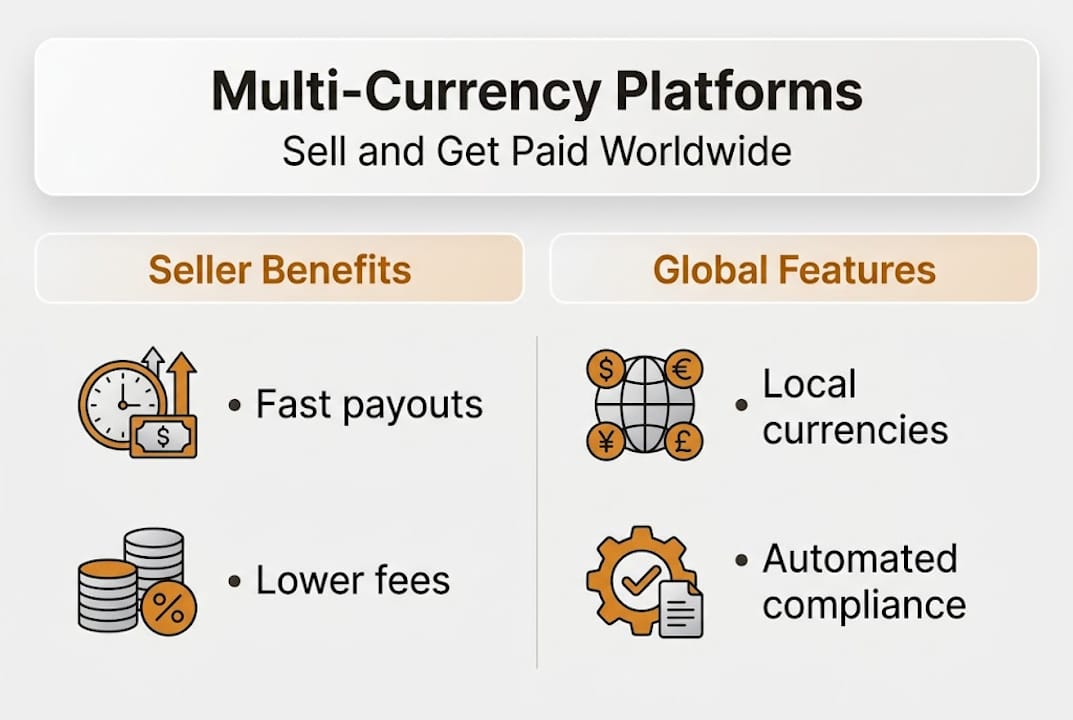
Stay22, a travel content monetisation platform, doubled its creator payouts per month after switching to a multi-currency payout infrastructure. The change reduced partner enquiries by 90% because creators stopped chasing missing or delayed payments. The operational overhead shrank while the payout reliability improved.
Stan, a creator economy platform, saved thousands of pounds in foreign exchange fees by routing international payouts through local rails rather than converting everything to USD first. That saving went directly back into platform development and creator support.
Skolmagi, an educational content business, saw a 20% revenue increase after enabling local currency pricing and local payment methods for their international student base. Buyers who previously bounced at checkout stayed and completed their purchases when they saw familiar pricing in their own currency.
At a macro level, leading platforms now process over 30 million orders with same-day payout rates of 93%, demonstrating that the infrastructure is mature, reliable, and built for volume.
Measurable results creators can expect after migration:
- Reduced transaction fees of between 1% and 2% per sale.
- Faster payouts with 90%+ delivered within one business day.
- Higher checkout conversion from local currency and payment method support.
- Fewer payment failures from improved cross-border approval rates.
- Lower administrative burden through automated tax and compliance tools.
What the successful case studies share is a pattern: they did not just switch platforms. They restructured their payout logic, enabled local payment methods, and configured compliance automation from the start. The distribution platform outcomes and publishing outcomes for educational creators show that the same approach works across content types and audience sizes.
Why most creators underestimate multi-currency platforms
The mainstream conversation about multi-currency platforms focuses almost entirely on payout speed and fee savings. Those matter, but they are not the full picture. What gets overlooked is the strategic complexity hiding just beneath the surface, and ignoring it is where creators quietly lose ground.
Take the choice between payout-focused platforms and full-stack solutions. Payout-focused tools like Hyperwallet are excellent at distributing earnings but lack the card issuing, wallet management, and checkout capabilities that full-stack platforms offer. Fintech platforms are often faster and cheaper than traditional banks, but they carry less regulatory protection, which matters when you are holding significant balances.
There is also a transparency and compliance trilemma that nobody discusses openly. Creators want privacy, regulators want visibility, and platforms sit in the middle trying to satisfy both. The way a platform resolves that tension directly affects how your account is treated during disputes, audits, or sudden volume spikes.
The real lesson from working with global creators is this: chasing the lowest fee without understanding what you are trading away is a short-term win with long-term costs. Success comes from matching the platform's architecture to your business model, not just your current transaction volume. Understanding what you actually need, rather than what looks best on a pricing page, is what separates creators who scale sustainably from those who rebuild their payment stack every 18 months. That clarity is worth far more than a half-percent fee reduction. For context on how this fits into building a global business, the principles remain consistent regardless of your content niche.
Unlock global sales with BibliOWLteca's marketplace
Putting these strategies into practice is simpler when your platform is already built for global distribution. BibliOWLteca gives content creators and educators everything covered in this guide, integrated into one place.
When you join the BibliOWLteca marketplace, you get multi-currency payment support, automated tax compliance, and local payout options without needing to stitch together separate tools. Whether you're publishing e-books, courses, or digital resources, the infrastructure is designed to reduce friction and expand your reach. The platform handles compliance so you can focus on creating. Explore BibliOWLteca today and see how straightforward global sales can be when the technology works for you, not against you.
Frequently asked questions
Can I accept payments in any currency with a multi-currency platform?
Most leading platforms support acceptance in over 100 currencies, enabling genuine global sales for content creators without requiring separate accounts per region.
How do multi-currency platforms handle VAT and tax compliance for digital content?
Platforms automate VAT/GST collection and tax form generation, applying correct rates per jurisdiction and simplifying compliance with EU OSS and international regulations.
Are payouts faster with a multi-currency platform compared to traditional banks?
Yes. Platforms use local payout rails to deliver 93% of payments same-day, cutting the 3 to 5 day processing times typical of traditional banking infrastructure.
Do multi-currency platforms reduce transaction fees for global sales?
Significantly. Modern platforms charge 0.25% to 1% in fees compared to traditional wire transfers that typically cost 2% to 3%, making them far more cost-effective at scale.
What mistakes should creators avoid when expanding globally with these platforms?
Not updating compliance settings, ignoring regulatory requirements, and underestimating payout differences across regions are the most common pitfalls that damage global revenue growth.