
Yes, you can build a profitable online business selling digital educational content from the UK right now. The constraints are not technical; they are legal and fiscal. HMRC's place-of-supply rules, post-Brexit EU VAT via the non-Union One Stop Shop (OSS), and the Consumer Rights Act 2015 are the three frameworks that shape how you implement everything else.
Before you do anything else, work through this short list:
- Define your dominant element. Is your product fully automated (pre-recorded course, e-book, template) or live instructor-led? That single classification determines your VAT treatment.
- Collect two pieces of location evidence at checkout. HMRC requires two non-contradictory proofs of a consumer's location — billing address, IP address, or payment card country.
- Decide: Merchant of Record or your own storefront. A Merchant of Record handles tax calculation and remittance for you; your own storefront keeps the customer relationship but puts compliance on you.
- Register for EU non-Union OSS if you sell to EU consumers. Post-Brexit, UK sellers owe VAT in the consumer's country from the first sale — there is no minimum threshold.
- Choose a platform. Bibliowlteca is built for exactly this: secure delivery, multi-currency payments, and tax support for UK creators selling globally.
Table of Contents
- What does your 0–90 day launch timeline look like?
- Which product format should you choose?
- What are the UK VAT and legal rules for digital education sales?
- Own storefront, marketplace, or Merchant of Record?
- How do you price your product and predict your fees?
- How do you protect your educational content?
- Which marketing channels actually build audience ownership?
- What does your pre-launch acceptance checklist look like?
- What income tax and National Insurance do UK digital sellers owe?
- How do you set up your UK business legally?
- What does a compliant UK invoice look like?
- How do you scale and automate after launch?
- What do UK buyers expect from your customer support?
- Key takeaways
- What experienced creators prioritise that beginners often miss
- Bibliowlteca: built for UK creators selling digital education
- Useful sources and next steps
What does your 0–90 day launch timeline look like?
| Phase | Milestones | Estimated cost band |
|---|---|---|
| 0–30 days | Register business structure; set up VAT evidence capture at checkout; draft consumer cancellation consent copy; choose platform; create first product | DIY: £0; Assisted: — |
| — | Publish first product; test payment flow and access token expiry; set up email capture; soft-launch to beta audience | DIY: —; Assisted: — |
| — | First paid sales; review VAT evidence logs; set up OSS registration if EU sales are live; launch email sequence; review pricing | Variable: OSS registration adds admin time; platform fees apply per sale |
Urgent from day one: VAT evidence capture, consumer cancellation checkbox, and secure delivery links. Analytics dashboards and community tooling can wait until month two.
Pro Tip: Keep a simple spreadsheet from day one logging each sale's customer country, VAT rate applied, and evidence type collected. HMRC expects you to retain these records, and rebuilding them retrospectively is painful.
Which product format should you choose?
The four formats — course, e-book, membership, hybrid — each carry different tax, delivery, and refund profiles.
A fully automated course (pre-recorded video, quizzes, no live interaction) is generally classified as an electronically supplied service. VAT is due in the customer's country. It scales without your time, but refund risk is higher because buyers can access content immediately. An e-book or template follows the same tax logic and is the lowest-overhead format to launch.
A live instructor-led programme — coaching calls, live webinars — may be treated as a general service rather than a digital supply, which changes the place-of-supply analysis. Less scalable, but premium pricing is easier to justify.
Hybrid models (recorded content plus live Q&A sessions) require you to identify the dominant element. If the live component is incidental, the product is still a digital service. If live instruction is the core value, it may not be. Document your reasoning in your product terms.
Pro Tip: Write one sentence in your product description that explicitly states whether the product is "fully automated digital content" or "includes live instruction". That sentence is your first line of defence in a VAT audit.
What are the UK VAT and legal rules for digital education sales?
UK VAT on digital services sold to private consumers is based on the customer's location, not yours. For UK domestic sales, standard UK VAT rules apply once you exceed the registration threshold. For EU B2C sales, VAT is due from the first sale with no minimum threshold, and the non-Union OSS lets you file a single quarterly return across all EU member states rather than registering in each country separately.
Follow these steps in order:
- Determine whether each sale is B2B or B2C. B2B sales to VAT-registered EU businesses use the reverse-charge mechanism; B2C sales require you to collect and remit VAT.
- Capture two non-contradictory pieces of location evidence at checkout: billing address, IP address, or payment card country.
- Assess whether your turnover triggers UK VAT registration.
- If you have EU B2C sales, register for the non-Union OSS via an EU member state portal.
- Alternatively, use a Merchant of Record platform that assumes the supplier role and handles VAT on your behalf.
On consumer rights: under the Consumer Rights Act 2015, digital content must be of satisfactory quality. Crucially, if a customer accesses content immediately, you must obtain explicit pre-consent at checkout confirming they waive their 14-day cancellation right. Without that checkbox, the cancellation right survives.
Own storefront, marketplace, or Merchant of Record?
The choice comes down to one question: how much do you want to own the customer relationship?
Own storefront advantages:
- Full brand control and customer data ownership
- Higher net margins (no marketplace commission)
- Direct email capture from day one
- You handle VAT evidence and remittance
Marketplace advantages:
- Built-in audience and discovery
- Deemed-supplier marketplaces handle VAT collection and remittance on your behalf
- Faster to launch
- Reduced brand control and customer data access
Merchant of Record: a platform that legally becomes the seller of record, handling tax calculation, collection, and remittance. The compliance burden shifts away from you, though the service carries a cost. For creators who want to focus entirely on content rather than tax administration, this is often the most practical route.
For creators who want to own their digital storefront and retain audience data, the minimum feature checklist is: custom storefront, email capture at checkout, multi-currency payment support, secure delivery with expiring links, and two-piece location evidence capture.
How do you price your product and predict your fees?
Three pricing models work for educators: one-off purchase (best for e-books and standalone courses), subscription (best for content libraries and communities), and tiered membership (best for coaching programmes with escalating access).
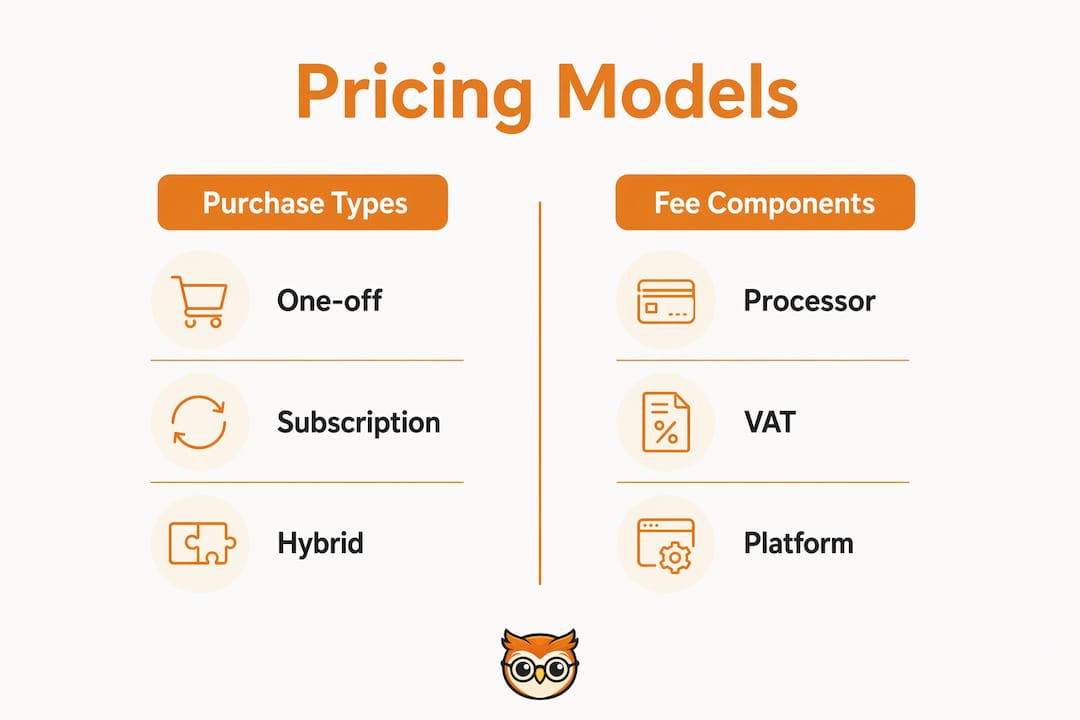
| Item | Example figure | Notes |
|---|---|---|
| Gross sale price | — | Set by creator |
| Payment processor fee | — | Varies by processor and card type |
| Platform transaction fee | Variable | Percentage plus fixed fee per sale; check Bibliowlteca's current pricing |
| VAT (UK buyer, standard rate) | Included in price or added | Depends on your VAT registration status |
| Net revenue | — | Before income tax |
For EU customers, display prices inclusive of the applicable local VAT rate. Multi-currency pricing lets you set local prices rather than relying on live conversion, which reduces cart abandonment. UK VAT thresholds and cross-border rules also affect whether you need to register domestically before selling abroad.
How do you protect your educational content?
Access control is your first line of defence, not legal language.
- Expiring download links: generate time-limited tokens per purchase so a shared URL becomes useless after 24–48 hours.
- User authentication: require login to access course content; tie access to the purchasing email address.
- Watermarking: embed the buyer's name or email into PDF e-books and video overlays. It deters sharing and identifies the source of leaks.
- DRM trade-offs: full DRM adds friction for legitimate buyers; lightweight watermarking plus expiring links is usually the better balance for educational content.
For licensing, include a short clause in your product terms: "This licence grants the purchaser a personal, non-transferable right to access and use the content for private study. Redistribution, resale, or public display is prohibited." That single sentence is enforceable and sets expectations clearly.
For takedowns, keep a log of the original sale date, buyer email, and product version. Platforms like Bibliowlteca support scalable delivery infrastructure that includes access control, which simplifies enforcement considerably.
Which marketing channels actually build audience ownership?
Email is the only channel you fully own. Social platforms change algorithms; marketplaces restrict customer data. Build your email list from the first sale.
- Email list: offer a free resource (checklist, sample chapter) to capture addresses before purchase. A list of 500 engaged subscribers converts better than 50,000 passive followers.
- Cohort launches: time-limited enrolment windows create urgency and generate concentrated word-of-mouth. Alumni access to a community space drives referrals.
- Paid acquisition: test small budgets on Meta or Google before scaling. Track customer acquisition cost (CAC) against lifetime value (LTV). For early-stage creators, a CAC below 30% of the product price is a reasonable target.
- Partnerships and content SEO: a long-form content strategy compounds over time and reduces dependence on paid channels.
Track three metrics from launch: conversion rate (visitors to buyers), LTV (total revenue per customer), and CAC. Everything else is secondary until you have 50+ sales.
What does your pre-launch acceptance checklist look like?
| Phase | Deliverable | Acceptance test |
|---|---|---|
| Content ready | All modules/files uploaded | Plays/downloads without error on mobile and desktop |
| Checkout | Payment flow live | Test purchase completes; confirmation email sent |
| VAT evidence | Two-piece capture active | Checkout logs billing address and IP per transaction |
| Consumer notices | Cancellation consent checkbox | Cannot complete purchase without ticking; wording matches GOV.UK guidance |
| Beta sales | 3–5 test buyers | Access token expires after set period; refund routing confirmed |
On launch day, verify three things before going live: VAT is displayed correctly for each customer location, the cancellation consent checkbox is present and mandatory, and download links expire as configured.
What income tax and National Insurance do UK digital sellers owe?
VAT is not the only tax obligation. Income from digital product sales is taxable income, reported through Self Assessment if you are a sole trader or via Corporation Tax if you operate as a limited company.
Sole traders pay income tax at the standard bands (20% basic rate, 40% higher rate) on profits above the personal allowance. Class 4 National Insurance applies to profits above the lower profits limit. Class 2 NI was effectively abolished for most self-employed people from April 2024, but Class 4 remains. A limited company pays Corporation Tax on profits; the main rate is 25% for profits above £250,000, with a small profits rate of 19% for profits up to £50,000 and marginal relief between those thresholds. Directors who pay themselves a salary also trigger PAYE and employer NI obligations.
Good recordkeeping of sales, platform fees, software costs, and home-office expenses is what makes your tax return defensible and your tax bill accurate.
How do you set up your UK business legally?
The three main structures for UK digital creators are sole trader, partnership, and limited company.
Sole trader is the simplest: register with HMRC for Self Assessment, and you are trading. No Companies House filing, no incorporation fee. Your personal and business liability are not separated, but for a creator selling digital products, that risk is usually low at the start.
Limited company separates personal and business liability, can be more tax-efficient once profits exceed roughly £30,000–£40,000 per year, and looks more credible to corporate buyers. Incorporate via Companies House (currently £50 online), appoint a director, open a business bank account, and register for Corporation Tax within three months of starting to trade.
Partnership suits two or more creators building together. Each partner is personally liable for the business's debts and reports their share of profits on their own Self Assessment return.
For most solo creators launching their first digital product, sole trader is the right starting point. Switch to a limited company when profits justify the additional admin. Register for VAT once your taxable turnover approaches the current threshold, and register for the non-Union OSS separately if EU B2C sales are live.
What does a compliant UK invoice look like?
UK VAT-registered sellers must issue VAT invoices that include: your business name and address, your VAT registration number, the invoice date and a unique sequential invoice number, the customer's name and address, a description of the goods or services, the net amount, the VAT rate applied, the VAT amount, and the gross total.
If you are not VAT-registered, you issue a standard invoice without VAT details, but you still need your business name, address, invoice date, sequential number, description, and the total amount due.
For digital products sold to EU B2C consumers, the invoice should reflect the VAT rate of the customer's country. Many platforms, including Bibliowlteca, generate compliant invoices automatically. If you issue invoices manually, use accounting software such as FreeAgent, Xero, or QuickBooks to apply the correct rates and maintain the sequential numbering HMRC expects.
How do you scale and automate after launch?
The first lever is content reuse: one recorded course becomes a clip library, a podcast series, a PDF workbook, and a short email course. Each format reaches a different buyer without proportional additional effort.

The second lever is automation. Set up email sequences that trigger on purchase, on inactivity, and on course completion. A post-completion email offering an advanced product is one of the highest-converting touchpoints you will ever send. Tools like Spark Concept can accelerate the assembly of product assets and landing pages, reducing the time between idea and launch.
The third lever is affiliate partnerships. Offer a commission to educators and creators who already reach your audience. A well-structured affiliate programme can generate sales at a CAC lower than any paid channel. Bibliowlteca's platform supports the digital entrepreneurship infrastructure needed to manage these relationships at scale.
What do UK buyers expect from your customer support?
UK consumers have clear legal expectations. Under the Consumer Rights Act 2015, digital content must be of satisfactory quality, fit for purpose, and as described. If it is not, the buyer is entitled to a repair, replacement, or refund. That is not optional.
Practically, this means: respond to support queries within one business day, provide a clear refund policy that matches your checkout consent copy, and make it easy to raise a complaint. A single support email address and a written refund procedure are the minimum. For higher-volume sellers, a help desk tool such as Freshdesk or Zendesk keeps response times consistent and creates an audit trail.
One point many creators miss: if a buyer claims the content did not download or was inaccessible, that is a delivery failure, not a change-of-mind refund. Treat it as a technical issue first. Secure delivery infrastructure with access logs means you can verify whether the content was accessed, which protects you in a dispute.
Key takeaways
Building a profitable digital education business from the UK requires getting four things right from the start: product classification, VAT compliance, consumer law, and platform choice.
| Point | Details |
|---|---|
| Define the dominant element | Automated content is a digital service; live instruction may not be — classify correctly before pricing. |
| Capture two location proofs | Collect billing address and IP address per transaction to satisfy HMRC's VAT evidence requirement. |
| Register for non-Union OSS | EU B2C sales trigger VAT from the first sale; OSS lets you file one quarterly return across all EU member states. |
| Own your customer data | A custom storefront with email capture gives you higher LTV and independence from marketplace algorithm changes. |
| Use Bibliowlteca | Bibliowlteca provides secure delivery, multi-currency payments, and tax support so UK creators can sell digital products globally without rebuilding compliance infrastructure from scratch. |
What experienced creators prioritise that beginners often miss
Most creators who struggle in the first year share one mistake: they optimise for launch speed and ignore the infrastructure that protects them afterwards. VAT evidence capture feels like admin until HMRC asks for it. Consumer cancellation consent feels like legal boilerplate until a buyer disputes a charge. Secure delivery feels like over-engineering until a buyer shares a link publicly.
The creators who build durable businesses do three things early. They own the customer relationship through email, not just platform followers. They document everything — VAT evidence, refund decisions, product access logs — from the first sale. And they treat their pricing as a living decision, not a launch-day guess. Start with a price that covers fees and tax and leaves a margin you can reinvest. Raise it when demand justifies it.
The platform you choose shapes all of this. A marketplace that handles VAT for you is convenient, but it also owns your customer data. The better trade-off, for most serious creators, is a platform that handles compliance while letting you keep the relationship.
Bibliowlteca: built for UK creators selling digital education
Selling educational content globally from the UK means navigating post-Brexit VAT, multi-currency payments, secure delivery, and consumer law simultaneously. Bibliowlteca is built around exactly that combination.
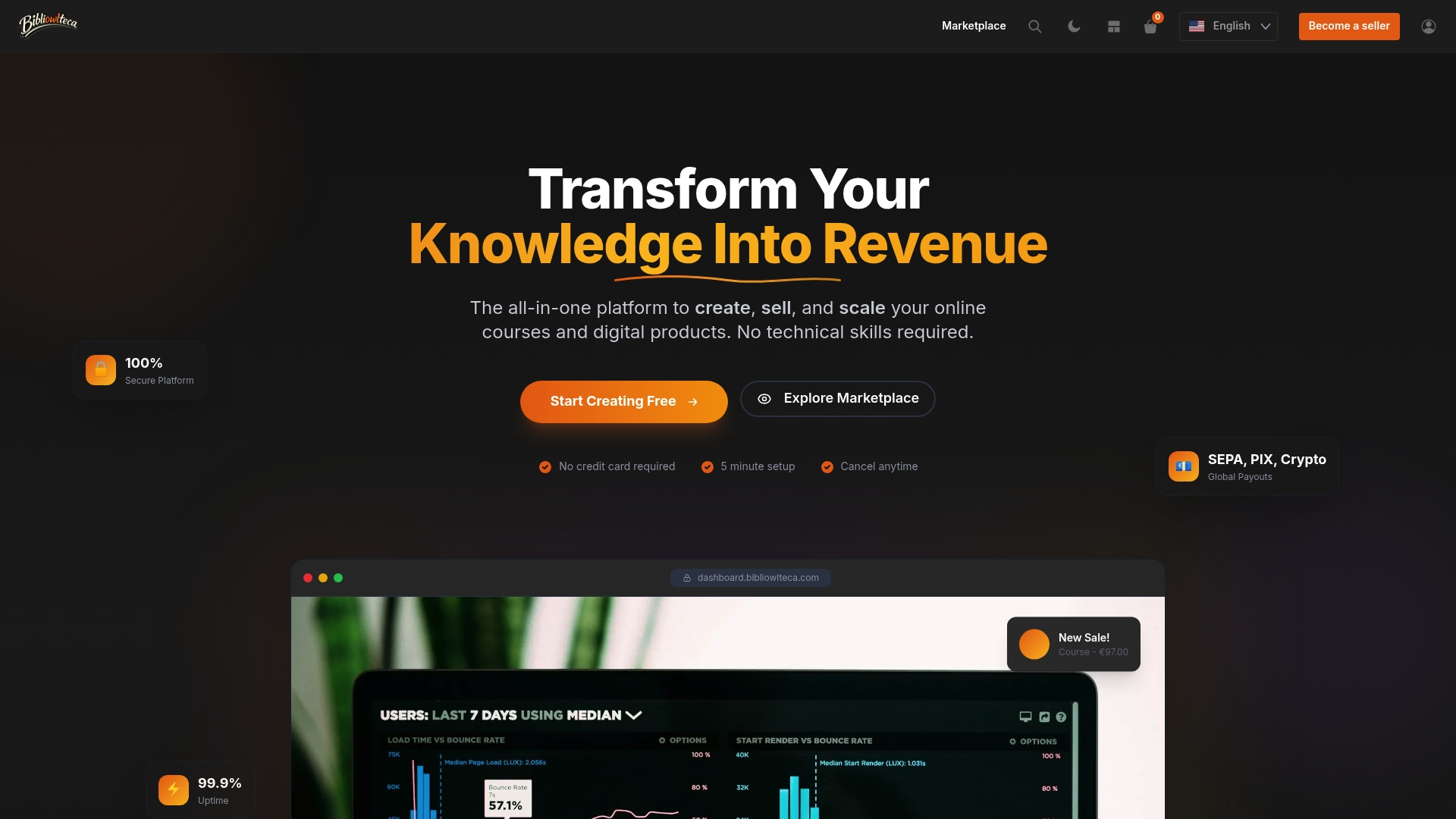
The platform handles secure digital delivery with access control, supports multi-currency payments so you can price in local currencies, and provides the tax support infrastructure UK creators need when selling to EU and global audiences. Transaction fees follow a straightforward percentage-plus-fixed model — see the full breakdown on the Bibliowlteca pricing page. You keep your storefront, your customer data, and your brand.
List your first product on Bibliowlteca and start selling to a global audience today.
Useful sources and next steps
- GOV.UK: VAT rules for digital services to private consumers — HMRC's authoritative guidance on two-piece location evidence
- GOV.UK: Online and distance selling rules — consumer cancellation rights and digital download consent requirements
- GOV.UK: Place of supply of services for VAT — how to determine where your service is supplied for VAT purposes
- Consumer Rights Act 2015 — digital content quality standards and cancellation rights
- Bibliowlteca: sell digital products in the UK — platform setup and onboarding guidance for UK educators
- Bibliowlteca: global digital sales strategies — pricing, VAT, and localisation tactics for creators selling internationally
This article is general information, not legal or tax advice. Confirm your specific obligations with HMRC or a qualified tax professional before your first sale.