
Promoting your business online is no longer optional for UK small businesses. Internet marketing, known in Spanish as marketing por internet and in the industry as online marketing, covers every technique you use to reach customers through digital channels: search engines, social media, email, and paid advertising. The core appeal is straightforward. You can target a specific postcode in Manchester, track exactly how many people clicked your ad, and adjust your budget the same afternoon. Traditional print or radio advertising offers none of that.
The benefits for small businesses are concrete:
- Broader reach: your website is accessible to anyone in the UK, or globally, around the clock.
- Precise targeting: platforms like Google Ads and Facebook Ads let you filter by location, age, interests, and behaviour.
- Real-time measurement: tools like Google Analytics show you which pages convert and which lose visitors.
- Cost control: you set daily spending limits, so there are no surprise invoices.
- Direct communication: email marketing accounted for 80% of all outbound marketing messaging in 2022, making it the dominant channel for retention.
Two UK-specific factors shape everything. First, audience localisation matters: British consumers respond differently to tone, humour, and cultural references than audiences elsewhere. Second, GDPR compliance is non-negotiable. Any email list, retargeting pixel, or data collection point must meet UK GDPR standards, which mirror the EU framework post-Brexit.
Key marketing por internet strategies for UK beginners
The four core categories that drive digital marketing success for small businesses are SEO, content marketing, social media marketing, and email marketing. Paid advertising sits alongside them as an accelerant once the organic foundations are in place. Here is how each works in practice for a UK audience.

1. Search engine optimisation (SEO)
SEO is the process of making your website appear higher in Google's results when someone searches for what you sell. For a small business in Birmingham or Edinburgh, that usually starts with local SEO: claiming and completing your Google Business Profile, collecting genuine customer reviews, and making sure your address and phone number appear consistently across the web.

Beyond local listings, keyword research is where most beginners should spend their first hour. Tools like SEMrush let you type in a phrase your customers might search, see how many people search for it monthly in the UK, and find less competitive variations worth targeting. Write a page or blog post that answers that question clearly, and Google has a reason to show it.

AI Overviews now appear on roughly 16% of Google searches, which means your content also needs to be structured for concise, quotable answers, not just traditional keyword placement. Short paragraphs, direct answers near the top of each page, and clear headings all help your content appear in AI-generated results.
Pro Tip: Start with your Google Business Profile before touching your website. It is free, takes under an hour to complete, and captures high-intent local searches immediately.
2. Social media marketing
Social media is where discovery and relationship-building happen simultaneously. For UK small businesses, the most productive platforms in 2026 are Facebook (still the largest by active UK users), Instagram (strong for visual products and lifestyle brands), LinkedIn (B2B and professional services), and TikTok (younger demographics and fast-growing for product discovery).
The common mistake is spreading thinly across all of them. Focused social media marketing on one or two platforms where your audience genuinely engages beats a thin presence across six. Pick the platform where your customers already spend time, post consistently, and reply to comments. That last part, the replies, is what builds the trust that eventually converts followers into buyers.
Influencer marketing fits naturally into social strategy. A micro-influencer with 5,000 highly engaged UK followers in your niche will often deliver better results than a celebrity with a million passive ones. Affiliate arrangements, where you pay a commission on sales rather than a flat fee, keep costs tied to actual results.
3. Email marketing
Email is the only channel you truly own. Your social following lives on a platform that can change its algorithm or terms overnight. Your email list does not. That ownership is why personalised marketing via owned data can drive meaningfully higher revenue than average outreach methods.
Mailchimp is the most widely used starting point for small businesses in the UK. Its free tier covers up to 500 contacts and includes basic automation, making it practical for a business just building its list. As your list grows, you can segment by purchase history, location, or engagement level and send messages that feel personal rather than broadcast.
UK GDPR requires explicit opt-in consent before you add anyone to a marketing list. A checkbox on a checkout page that is pre-ticked does not count. Make the sign-up clear, state what subscribers will receive, and keep an unsubscribe link in every email. Getting this right from the start saves considerable headaches later.
4. Content marketing
Content marketing means publishing material that genuinely helps your audience, rather than simply promoting your product. A plumber in Leeds who writes a blog post explaining how to spot early signs of a boiler fault will attract people searching that exact question. Some of those readers will become customers when they need a professional.
Dedicating the majority of your content to informative or educational value and only 20% to direct promotion is the ratio that builds trust without alienating your audience. Video, written guides, infographics, and podcasts all count. The format matters less than whether the content answers a real question your customers are asking.
Content also feeds SEO. Every useful page you publish is another entry point from search. Over time, a library of well-written articles compounds in a way that paid ads never do, because the traffic continues after you stop spending.
5. Pay-per-click advertising with Google Ads
Google Ads places your business at the top of search results for specific keywords, and you pay only when someone clicks. For a small business that needs customers quickly, it is the fastest route to visibility. A new bakery in Bristol cannot wait six months for SEO to take effect; Google Ads can put it in front of people searching "birthday cakes Bristol" by tomorrow morning.
The key discipline is match types and negative keywords. Broad match will show your ad to loosely related searches and burn through budget quickly. Phrase and exact match keep spending focused. Negative keywords exclude irrelevant searches entirely. A dog groomer, for instance, would add "DIY" as a negative keyword to avoid paying for clicks from people who want to groom their own pets.
Start with a modest daily budget, perhaps £10–£20, and let the campaign run for two weeks before drawing conclusions. Google's own data takes time to optimise delivery, and judging a campaign in its first three days rarely tells you anything useful.
6. Facebook Ads and paid social advertising
Facebook Ads (which also covers Instagram through Meta's advertising platform) offer targeting that Google Ads cannot match. You can reach people based on life events, interests, job titles, and even the pages they follow. For a business selling wedding stationery, targeting UK users who recently changed their relationship status to "engaged" is a genuinely useful capability.
Channels that run as an integrated system rather than isolated tactics consistently outperform siloed approaches. Running Facebook Ads to build awareness, then retargeting website visitors with a specific offer, then capturing those leads into an email sequence is a connected funnel. Each stage feeds the next.
Creative quality matters more than it used to. Meta's algorithm now rewards variety in ad formats and rewards advertisers who test multiple images, headlines, and calls to action. A single static image run for three months will fatigue quickly.
7. Influencer marketing
Influencer marketing works because a recommendation from someone your audience already trusts moves people in a way your own posts cannot. For UK small businesses, the most accessible entry point is micro-influencers: creators with between 1,000 and 50,000 followers in a specific niche, typically based in the UK, who charge far less than major names.
The practical approach is to search relevant hashtags on Instagram or TikTok, identify accounts whose audience matches your customer profile, and reach out with a clear, specific proposal. Gifting a product in exchange for an honest review is a common starting arrangement. As campaigns grow, affiliate links that pay a percentage of each sale align your costs with actual results.
UK Advertising Standards Authority (ASA) rules require influencers to disclose paid partnerships clearly, using labels like "#ad" or "#sponsored." Make sure any influencer you work with follows these rules, because the responsibility can fall on the brand as well.
8. Affiliate marketing
Affiliate marketing lets other people sell your product for you, in exchange for a commission on each sale. You provide a unique tracking link, the affiliate promotes your product to their audience, and you pay only when a sale completes. The risk is low because the cost is tied directly to revenue.
For a small UK business selling digital products, affiliate programmes are particularly effective. A creator with an engaged newsletter audience in your niche can drive consistent sales without any upfront advertising spend. Platforms that handle digital product delivery often include built-in affiliate tracking, which removes the technical complexity of setting it up yourself.
9. Video marketing
Video is the fastest-growing content format for UK audiences. YouTube remains the dominant long-form platform, while TikTok and Instagram Reels drive short-form discovery. A product demonstration, a behind-the-scenes look at your business, or a quick answer to a common customer question can all perform well.
You do not need professional equipment to start. A smartphone, decent lighting, and clear audio are enough for most small business video content. What matters more is consistency and relevance. A weekly 60-second video answering a question your customers regularly ask will build an audience more reliably than an occasional polished production.
10. Measurement and analytics
Treating campaigns as ongoing cycles rather than one-off projects is what separates businesses that improve from those that repeat the same mistakes. Google Analytics 4 (GA4) is the standard free tool for tracking website behaviour: which pages people visit, how long they stay, where they drop off, and which traffic sources convert best.
Set up conversion tracking before you spend a penny on advertising. Without it, you cannot tell whether your Google Ads campaign is generating enquiries or just clicks. Most platforms, including Google Ads and Meta, provide their own tracking pixels that feed data back into the ad platform for optimisation.
Review your numbers weekly, not monthly. A campaign that is quietly wasting budget on irrelevant clicks will cost you far more over a month than it would if you caught it in week one.
How to start internet marketing for your small UK business
Getting started does not require a large budget or a marketing team. What it requires is a clear plan, executed consistently. Follow these steps in order.
-
Define your objectives and KPIs. Decide what success looks like before you choose any channel. Do you want more phone enquiries, online sales, email subscribers, or foot traffic? Each goal points to different channels and different metrics. A KPI like "20 new email subscribers per week" is measurable; "get more customers" is not.
-
Identify and segment your audience. Who are your best customers? Where do they live in the UK? What do they search for? What social platforms do they use? The more specific your answers, the more precisely you can target your marketing spend. A useful exercise is to describe your ideal customer in a single paragraph, including their age, location, problem, and preferred way of finding solutions.
-
Choose your channels using the SES framework. The SES framework organises digital marketing into three pillars: Search, Email, and Social. Pick one strong play in each. For most UK small businesses starting out, that means local SEO plus a Google Business Profile (Search), a Mailchimp list with a simple welcome sequence (Email), and one social platform where your customers actually spend time (Social). Three channels done well beat ten done poorly.
-
Develop content aligned with UK cultural nuances. British audiences respond to directness, dry humour, and modesty. Overly salesy language tends to put people off. Write the way you would speak to a customer in person, and check that any imagery or references feel relevant to a UK context rather than imported wholesale from US marketing templates.
-
Set a realistic budget. A starting monthly budget of £200–£500 is workable for most small UK businesses. Allocate the majority to the channel most likely to generate direct enquiries for your specific business. A local service business will usually see faster returns from Google Ads than from social media; a lifestyle product brand may find the opposite.
-
Implement tracking before you launch. Install Google Analytics 4 on your website, set up conversion goals, and add the relevant tracking pixels for any paid platforms you use. This takes an afternoon and saves months of guesswork.
-
Iterate based on data. After four weeks, review what worked and what did not. Double down on the channel generating the best results, pause or adjust what is not, and test one new variable at a time. Changing everything at once makes it impossible to know what caused any improvement.
Pro Tip: Local SEO paired with an owned email list is the most effective starting combination for most small UK businesses. Local SEO captures high-intent nearby demand at low cost, while an email list gives you a direct line to customers that no algorithm can take away.
Which tools do you actually need for online marketing in the UK?
The tools below cover the core functions: research, advertising, email, and analytics. You do not need all of them immediately.
| Tool | Primary function | Best for | Cost |
|---|---|---|---|
| Google Ads | Paid search advertising | Businesses needing fast visibility | Pay-per-click; budget set by you |
| Facebook Ads (Meta) | Paid social advertising | Audience targeting by interest and behaviour | Pay-per-click; budget set by you |
| Mailchimp | Email marketing and automation | Building and nurturing an email list | Free up to 500 contacts |
| SEMrush | SEO keyword research and site audits | Finding search opportunities and tracking rankings | Paid; free trial available |
| Google Analytics 4 | Website traffic and conversion tracking | Understanding visitor behaviour | Free |
| Google Business Profile | Local search visibility | Service businesses with a physical location | Free |
Google Ads is the most direct route to paid search visibility in the UK. Its keyword planner doubles as a free research tool even if you are not yet running campaigns.
Facebook Ads (via Meta Ads Manager) gives you access to both Facebook and Instagram placements from one interface. The audience targeting options are the most granular available for social advertising.
Mailchimp remains the default starting point for email marketing among UK small businesses. Its free tier is genuinely useful, and the drag-and-drop editor requires no technical knowledge.
SEMrush is the most widely used SEO platform among UK digital marketers. Its keyword research, competitor analysis, and site audit tools cover most of what a small business needs to build organic visibility. For social media scheduling, tools like Buffer or Hootsuite handle multiple platforms from one dashboard, though these are optional additions rather than essentials.
Google Analytics 4 is non-negotiable. Every other tool generates data, but GA4 is where you see how all your channels combine to produce actual business outcomes.
Pro Tip: For GDPR compliance, use an email platform with built-in consent management and double opt-in settings. Mailchimp supports both. Document your lawful basis for processing data and keep a record of when and how each subscriber opted in.
For small businesses looking to sell digital products alongside their marketing efforts, digital entrepreneurship resources can help you understand how marketing principles apply specifically to online education and content businesses.
Key takeaways
Effective internet marketing for UK small businesses comes down to three owned channels working together: search to attract new visitors, email to retain them, and social to build the relationships that generate word of mouth.
| Point | Details |
|---|---|
| Email dominates outbound messaging | Email accounted for 80% of all outbound marketing messaging in 2022, making it the highest-priority retention channel. |
| Use the SES framework to start | Pick one play each in Search, Email, and Social before adding any other channel. |
| AI is reshaping search | AI Overviews appear on roughly 16% of Google searches; structure content for direct, quotable answers. |
| Content should be 80% educational | Dedicate 80% of content to informative or educational value and 20% to promotion to build audience trust. |
| Measure before you spend | Install Google Analytics 4 and set conversion goals before launching any paid campaign. |
Turn your knowledge into a digital business with Bibliowlteca
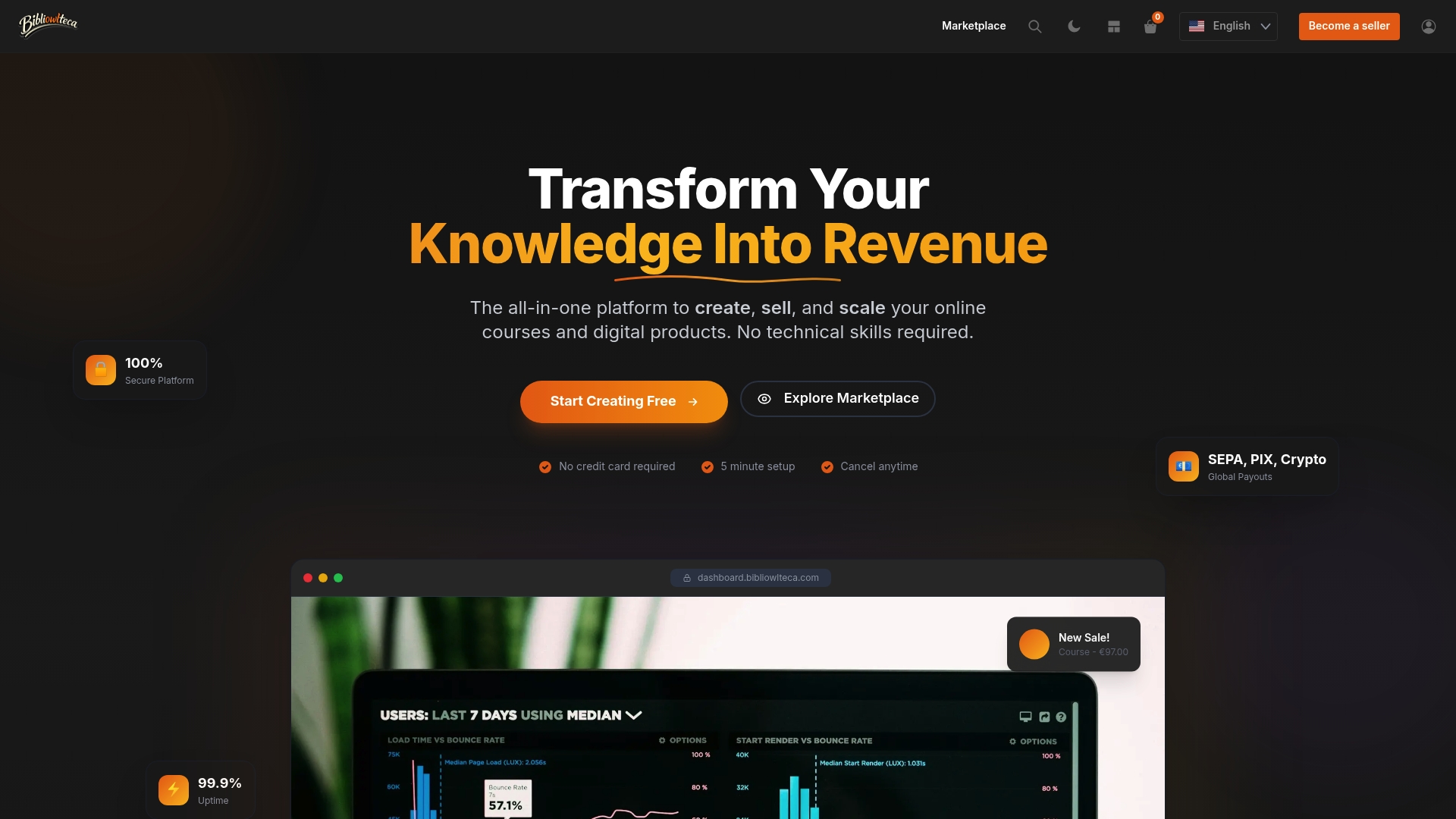
If you are creating educational content, guides, or courses alongside your marketing efforts, Bibliowlteca gives you the infrastructure to sell them directly to your audience. The platform handles payments in multiple currencies, digital delivery, and tax compliance, so you can focus on creating rather than on the technical side of running an online shop.
Whether you are selling an eBook, a course, or a digital resource pack, Bibliowlteca's digital marketplace is built for creators who want to reach a global audience without building a custom storefront from scratch. For those ready to scale, explore the full platform features to see how marketing and sales tools work together in one place.
For creator-focused marketing strategy and audience-building advice, Naomi Lennon's resources offer practical guidance tailored to the creator economy.