
A course sales funnel turns a browsing stranger into a paying student by moving them through four jobs: capture their attention, nurture their trust, convert them at checkout, and deliver on the promise. The minimal version that actually works is one lead magnet, one sales page with checkout, and a nurture sequence of three to seven emails. Everything else, tripwires, order bumps, automation, gets added later, once that basic version proves people will actually buy.
TL;DR:
- Building a lead magnet that accurately validates demand is crucial, as poor magnet performance indicates the main offer may also fail.
- Keep your sales funnel simple by focusing on a clear outcome, a single landing page, a short email sequence, and minimal checkout fields before adding complexity.
- Track key metrics such as visit-to-lead and lead-to-buyer conversions, and fix any step below a 2% conversion rate before scaling traffic.
- Most funnel failures stem from over-engineering, unclear outcomes, complicated checkout, or lack of a clear guarantee, which should be addressed first.
- Starting with a basic, validated funnel allows for gradual improvement and avoids months of wasted effort on untested automation or complicated setups.
Table of Contents
- What are the core components of a müügitunnel kursusele?
- How do you build a simple course funnel step by step?
- What makes an offer convert: lead magnets, tripwires and pricing
- Which email sequences actually move students to buy?
- Which metrics show where your funnel is leaking?
- Where do course creator funnels usually go wrong?
- Publisher perspective: why we recommend starting simple
- How Bibliowlteca turns your funnel into a working storefront
- Sources
What are the core components of a müügitunnel kursusele?
A working müügitunnel kursusele (sales funnel for a course) needs five parts pulling in the same direction. Miss one and the whole thing leaks, no matter how good your course content is.
- Lead magnet: a checklist, a short mini lesson, or a live webinar that solves one small problem fast enough that someone hands over their email for it, explained in detail in this lead magnet funnel guide.
- Landing or sales page: states the outcome clearly, shows who it's for, and carries social proof, testimonials, results, or a simple case description.
- Checkout: as few fields and clicks as the payment provider allows, with one optional order bump.
- Email nurture: the connective tissue between magnet and sale, this is where trust gets built and objections get answered.
- Tracking: UTM tags or a simple spreadsheet showing which link brought which sale.
Each part depends on the others. A brilliant lead magnet with a vague sales page wastes the traffic it generates. A well tagged email list with no checkout link converts nothing. Effective course funnels rely on these core components: a lead magnet, a nurturing sequence, a clear sales page, and a secure checkout, with automated enrolment and tripwires reserved for later stages.
How do you build a simple course funnel step by step?
Start smaller than feels comfortable. A funnel you can build in a week and test in two beats a polished system that takes three months and answers nothing.
- Define the offer and the one outcome it delivers. Skip "learn photography." Say "shoot a usable portrait in manual mode within 30 minutes." Specificity sells; vagueness doesn't.
- Build one landing page and one lead magnet. A single page, a single opt-in form, no distractions. The magnet should solve a sliver of the same problem the course solves fully.
- Write a 3 to 7 email nurture sequence that leads to one sales page with one checkout link. Each email answers a question a hesitant buyer would actually ask.
- Send traffic and watch what happens. Post organically, email your existing list, or run a small paid test. You need real numbers, not guesses.
- Read the data before touching anything else. Where do people drop off? Opt in but never open the first email? Read the sales page but abandon checkout?
- Add complexity only after validation. A tripwire, an order bump, or a second automation sequence, but only once the base funnel converts.
This mirrors how hands-on courses and meistriklased in Estonia teach the process: templates, quick feedback, short validation tests, not months of technical setup before the first sale.
What makes an offer convert: lead magnets, tripwires and pricing
The lead magnet's job is to validate demand, not to impress. If nobody downloads a free checklist on your topic, nobody is buying a €200 course on it either. That's a signal to fix before you fix your checkout button.
A tripwire, a low-priced mini-course or template sold immediately after opt-in, only makes sense once your main offer already converts on its own. Adding one too early just adds a second thing to debug.
- Order bumps and checkout add-ons raise average order value with almost no extra development, and creators using them see meaningful uplift in transaction value without needing more traffic.
- Anchor pricing (showing a higher "normal" price crossed out) works because it gives buyers a frame of reference, not because it's a trick.
- A short, specific guarantee ("14 days, no questions") reduces friction more than a vague "satisfaction guaranteed."
Pro Tip: *Test your lead magnet's opt-in rate before you write a single word of your sales page.
Which email sequences actually move students to buy?
Four sequences cover most course funnels. You don't need more until you've outgrown these.
- Welcome sequence: delivers the lead magnet immediately, sets expectations for what's coming.
- Value sequence: two or three emails teaching something real, building trust before any pitch appears.
- Pitch sequence: introduces the course, handles the most common objection, and links to the sales page.
- Follow-up sequence: for people who didn't buy, a reminder, a case example, a deadline if one genuinely exists.
Once someone buys, a short onboarding flow matters just as much: confirm access, point to the first lesson, and nudge engagement within 48 hours, since students who don't start quickly rarely finish.
Segmentation can wait. Add triggers, like tagging someone who clicks a pricing link but doesn't purchase, only once the base sequences are working. Automation for its own sake before the offer is proven just adds more things to break.
Which metrics show where your funnel is leaking?
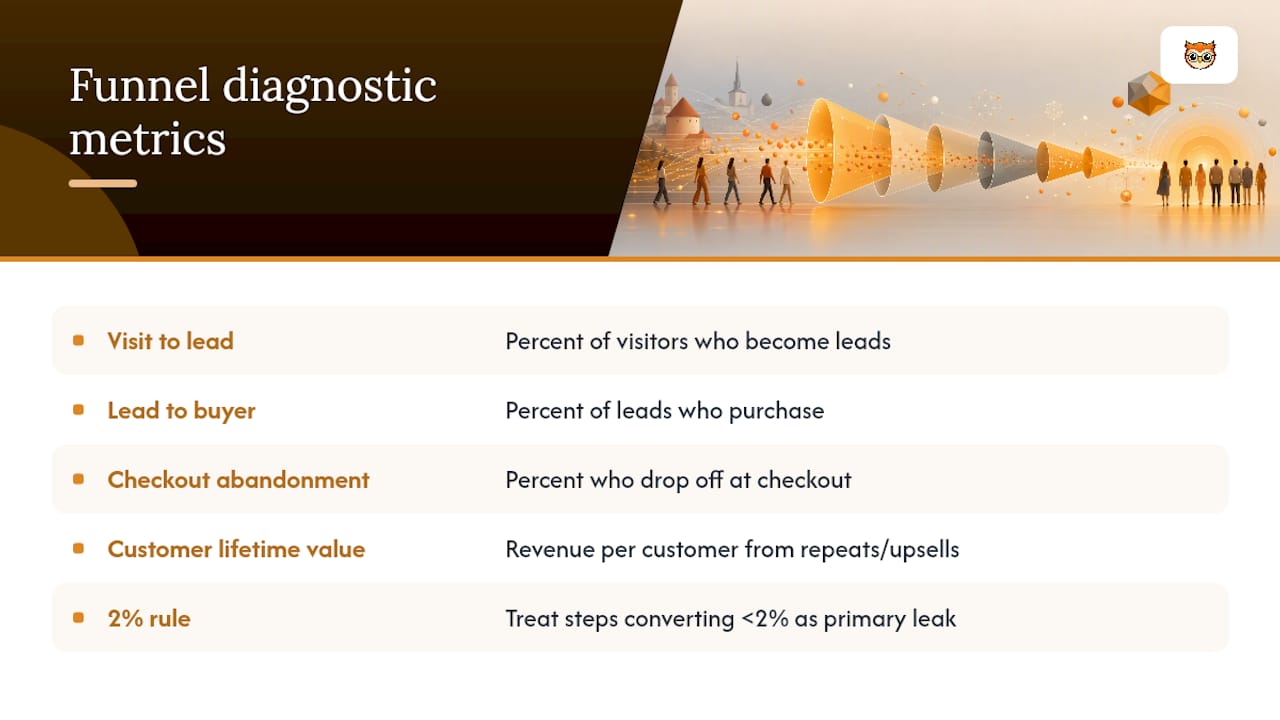
Three numbers tell you almost everything: visit to lead percentage, lead to buyer percentage, and checkout abandonment rate. Add customer lifetime value (CLV) once you have repeat buyers or upsells, and you've got a complete diagnostic set.
The 2% rule: treat any funnel step converting below 2% as your primary leak and fix it before touching anything else, including before spending more on traffic.
Set up tracking before you need it, not after. UTM parameters on every link, or even a simple spreadsheet logging source, date, and outcome, will tell you more than most analytics dashboards in the first month. Measuring conversion at each stage and tracking CLV is how you spot exactly where a funnel is losing people, rather than guessing.
Small experiments beat big rebuilds. Test one headline against another on the landing page. Test two subject lines on your first email. Only once your funnel converts consistently at every stage does it make sense to increase ad spend, scaling a leaky funnel just multiplies the leak.
Where do course creator funnels usually go wrong?
Most funnel problems trace back to one of four habits, and each has a fast fix.
- Over-engineering before validating the offer. Fix: strip the funnel back to one page, one email sequence, one checkout link.
- Unclear learning outcomes or thin social proof. Fix: rewrite the headline around one specific result; add even one real testimonial.
- Complicated checkout with too many fields or payment options. Fix: cut fields to the minimum, offer one or two payment methods, not five.
- No guarantee, which raises the perceived risk of buying. Fix: add a short, specific guarantee window.
Pro Tip: If your funnel isn't converting, don't rebuild it. Change one variable, headline, price, or guarantee, and retest before you touch anything else.
Publisher perspective: why we recommend starting simple
We've watched creators lose months building automation for offers nobody wanted yet. Funnels work best treated as living assets, reviewed and adjusted, not built once and left alone. A marketplace with integrated checkout removes the technical excuse for delay, letting you validate the offer itself instead.
— BibliOWLteca
How Bibliowlteca turns your funnel into a working storefront
Bibliowlteca is built so the funnel components above don't need five separate tools stitched together. A single storefront handles your sales page, checkout, and course delivery, with global payment processing built in, so a buyer in Berlin or Tallinn can pay in their own currency without you configuring anything extra.

Course hosting comes with video and quizzes ready to go, so once someone converts, onboarding happens inside the same platform rather than a separate login and a confusing welcome email. Check the feature overview to see how checkout, delivery, and analytics map directly onto the funnel stages covered above, then set up a free storefront and publish your first lead magnet page this week rather than next quarter.