
Enable bank links, card payments and at least one mobile wallet from day one. That combination covers most Estonian and international buyers without forcing anyone through an unfamiliar checkout. Add buy now, pay later or instalments only if you sell a higher priced programme where spreading the cost genuinely changes someone's decision. The single action to take today: pick a provider or platform that supports all three core methods and exports clean data for your accountant.
TL;DR:
- Supporting all core payment methods—bank links, cards, and wallets—ensures maximum conversion, especially for local Estonian and international buyers.
- International audiences require Visa and Mastercard acceptance, while mobile wallets like Apple Pay and Google Pay significantly reduce checkout abandonment on phones.
- Extra fees from instalments are justified only for high-value programs above around €200, where they can boost conversions.
- Proper integration, transparent fees, correct refund handling, and local language support are critical criteria for choosing a reliable payment provider.
- Using a platform like BibliOWLteca streamlines payment, delivery, and reporting processes, reducing operational risks for growing course creators.
Table of Contents
- Which makselahendus kursustele options actually convert
- How to choose a payment provider: a practical checklist
- What do course payment fees actually cost you?
- Tax rules, refunds and instant course access
- Launch checklist: testing your setup before going live
- Why platform payments beat piecing it together yourself
- Sell courses without building the payment stack yourself
- Sources
Which makselahendus kursustele options actually convert
Choosing the right makselahendus kursustele setup comes down to matching payment methods to who's actually buying. Get this wrong and you lose sales at the exact moment someone's ready to pay.
Bank links remain the default for Estonian buyers. They're familiar, instant, and carry none of the "will this card even work" hesitation that trips up first-time online shoppers. Aggregators like Maksekeskus and Montonio bundle every major Estonian bank under one contract, which saves you from negotiating separate agreements with each bank individually.

Card payments matter the moment you sell beyond Estonia. Visa and Mastercard acceptance is non-negotiable if you want students from Finland, Germany or further afield, since bank links simply don't exist for buyers outside your home banking network.
Mobile wallets deserve more attention than most course creators give them. A large share of course traffic arrives from a phone, often from a social media link, and mobile wallet support is a recognised high-impact lever for cutting checkout abandonment on smaller screens. Apple Pay and Google Pay turn a fiddly card-number entry into a single tap.
Instalments earn their place only on expensive programmes. Buy now, pay later usage has grown noticeably among Estonian consumers in recent years, and it can tip the balance for a €400 mentorship cohort. It rarely justifies the added complexity on a €29 mini course.
Map the mix to your audience:
- Local, budget-friendly courses: bank links plus cards cover almost everyone.
- International audiences: cards and wallets first, bank links as a bonus for domestic visitors.
- Premium programmes above roughly €200: add instalments and watch the conversion lift against the extra fees.
How to choose a payment provider: a practical checklist
Picking between providers gets easier once you stop comparing headline fees and start comparing operational fit. Five criteria decide whether a setup will still make sense a year from now, once you've stopped tinkering with it.
- Integration readiness. Check for a plugin for your platform, documented API access, and a staging sandbox you can test in before going live.
- Reporting and reconciliation. Ask for a sample export. It should include a consistent order or student reference in both the transaction log and the payout statement, so matching sales to bank deposits doesn't become a manual chore.
- Fee transparency and payout timing. Get the percentage, the fixed fee per transaction, and the payout schedule in writing, not summarised from a sales call.
- Refunds, chargebacks and fraud protection. Confirm how disputes are handled and how quickly refunds actually clear, not just how the policy reads.
- Local language support. Estonian-language checkout and customer service reduce abandonment and cut support tickets.
Pro Tip: Ask a prospective provider for a live demo export before you sign anything. If your accountant can't map it to your bookkeeping software in five minutes, that's a warning sign, not a detail to fix later.
What do course payment fees actually cost you?
Every provider's fee structure breaks down into three parts: a percentage of the sale, a fixed fee per transaction, and sometimes a monthly platform charge. Ignoring the fixed fee is the most common modelling mistake, because it eats a much bigger share of a cheap course than an expensive one.
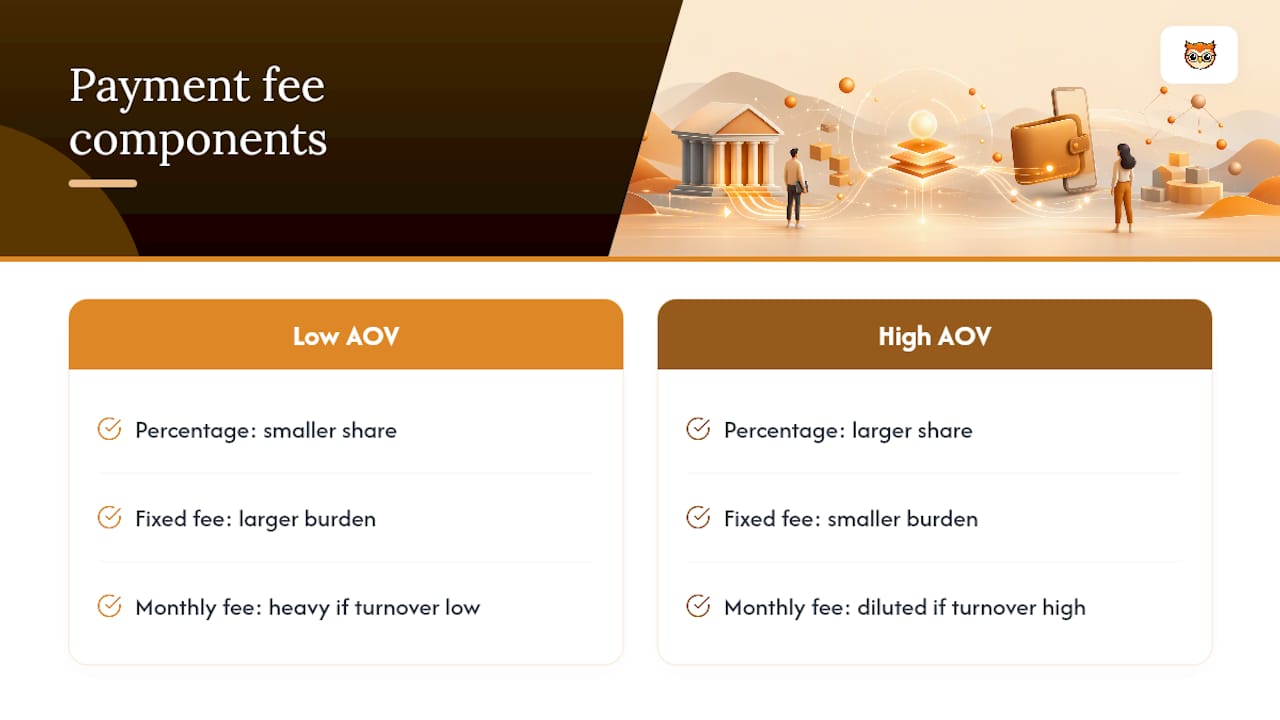
Vendor pricing comparisons show that monthly turnover and average order value change which fee profile actually wins, so run your own numbers rather than trusting the lowest advertised percentage.
Instalments only pay for themselves if the conversion uplift covers their extra processing cost. Offering a "pay in three" option can increase costs per sale and should be justified by a sufficient increase in conversions among hesitant buyers.
Tax rules, refunds and instant course access
Digital course sales carry specific consumer-rights and tax obligations that differ from physical goods. Estonian Tax and Customs Board guidance on electronic services sets out VAT expectations for digital products, and getting this wrong is an easy way to create accounting headaches months later.
- The standard 14 day right of withdrawal applies to digital purchases by default, but it can be waived if the buyer explicitly consents to immediate access before the withdrawal period ends.
- Best practice is to require a clear checkbox or confirmation at checkout stating the student agrees to lose their withdrawal right in exchange for instant course access.
- Document that consent alongside the transaction, since it's your evidence if a refund dispute arises later.
Launch checklist: testing your setup before going live
A payment setup that works in theory can still fail on launch day if you skip the testing stage. Run through this sequence before you take a single real payment.
- Run a full staging journey. Walk through the entire customer path, from checkout to automated course access to the accounting export landing correctly.
- Confirm export formats with your accountant. Involving your bookkeeper before launch, not after, avoids months of manual reconciliation on live sales.
- Test refunds and chargebacks with realistic timing. Staging refunds rarely mirror production speed or fees, so test again once you're live.
- Verify multilingual flows and fallbacks. Confirm Estonian and English checkout both work, and that a failed card payment gives the buyer a sensible next step.
Pro Tip: Book a real refund through your own staging checkout before launch. If it takes you fifteen minutes to find the refund button, your students will struggle too.
For a broader walkthrough of enrolment automation once payment clears, a creator's guide to selling an online course covers the operational side in more depth, and platforms like the ESG Training Institute show how another training provider structures automated enrolment.
Why platform payments beat piecing it together yourself
Most course creators underestimate how much time goes into stitching a gateway, a plugin, an accounting export and a delivery system into something that doesn't break under real sales volume. A marketplace approach removes that stitching entirely.
BibliOWLteca handles multi-currency payments, automated delivery the moment payment clears, and built-in reporting as core infrastructure rather than as add-ons you configure yourself. That matters most for creators selling internationally, where separating domestic bank links from international card and wallet flows gets complicated fast if you're managing it alone.
A standalone gateway can still make sense if you already run a mature store with existing traffic. For anyone starting out or scaling past their first few hundred students, a marketplace removes the operational risk of getting reconciliation or VAT handling wrong.
— BibliOWLteca
Sell courses without building the payment stack yourself
Every checklist in this guide, bank links, cards, wallets, reporting exports, refund handling, comes built into BibliOWLteca rather than requiring you to assemble it from separate vendors. That's the practical difference: instead of negotiating with an aggregator, wiring up a plugin, and configuring a reporting export by hand, you get all three running from a single storefront setup.

Use the checklist from earlier in this guide to evaluate BibliOWLteca the same way you'd evaluate any provider: check the features page for payment methods and automated delivery, then compare costs on the pricing page against the worked examples above. If you're ready to see how it handles a real course listing end to end, the marketplace is the place to set up your first storefront and start accepting payments.
Sources
- Platvormid
- Buy now, pay later growth in Estonia | Inbank
- Reliable payment gateway services in Estonia | Filuet
- VAT and electronic services guidance | Estonian Tax and Customs Board (EMTA)