
Selling an online course in the UK comes down to four moves: create a publishable minimum viable product, classify it correctly for VAT, publish it on a platform that handles payments and delivery, and promote it to a defined audience. Do those four things in order and you can take your first payment within weeks, not months.
Immediate next actions:
- Pick your course format (self-paced video, live cohort, downloadable workbook, or membership) because format determines VAT treatment
- Check whether your income will exceed the £1,000 trading allowance and whether you need to tell HMRC
- Draft a one-page terms document covering access, cancellation rights and IP ownership before you publish
- Set up a commerce-enabled platform that shows VAT-inclusive prices at checkout
Bibliowlteca is a practical first stop for UK creators: it handles multi-currency payments, secure digital delivery and basic tax display in one place, so you can focus on the course itself rather than the plumbing.
Key takeaways
Selling an online course in the UK requires the right VAT classification, written IP agreements, and a checkout that captures consumer consent before you take a single payment.
| Point | Details |
|---|---|
| VAT registration threshold | UK VAT becomes mandatory at £90,000 rolling 12-month turnover; standard rate is 20% for most digital products. |
| Place-of-supply rules | B2C sales are taxed where the consumer lives; EU sales require OSS registration after Brexit. |
| IP ownership | UK freelancers retain copyright by default; a written assignment is required to transfer ownership to your business. |
| Consumer rights at checkout | Express consent is required to waive the 14-day cancellation right when granting immediate digital access. |
| Bibliowlteca | Handles multi-currency payments, VAT display and secure delivery for UK course creators from a single platform. |
Table of Contents
- What decisions should you make before building your course?
- How to go from idea to first sale: a practical launch checklist
- Pricing and VAT for UK sellers: what HMRC expects
- Who owns your course content? IP and contributor agreements
- Where should you sell your course?
- Payments and technical delivery: what you must have in place
- High-impact marketing tactics that actually move courses
- What to do after the sale
- Immediate UK legal and tax actions to take in your first 90 days
- What creators consistently get wrong
- Bibliowlteca: built for creators who want to sell, not just publish
- Sources
What decisions should you make before building your course?
Format is the first fork in the road, and it has consequences that reach all the way to your VAT return. A self-paced video course with no human interaction is treated as an automated digital service for VAT purposes. A live cohort where you teach in real time may qualify as educational services, which can attract a different VAT classification. Apex Accountants note that mapping your delivery format to the correct VAT category is one of the most common compliance errors creators make, so this is not a decision to defer.
Decisions to make before you build:
- Format: self-paced video, live cohort, downloadable workbook, membership, or a hybrid
- Audience: who they are, where they live (affects place-of-supply VAT rules), and how they prefer to learn
- Business structure: sole trader or limited company, registered with HMRC for self-assessment
- IP ownership: will you use freelancers or guest experts? If so, you need written agreements before a single lesson is recorded
On the legal side, UK freelancers and contractors retain copyright by default unless a written assignment transfers it. Paying an invoice does not transfer copyright. Sort this before you record anything.
Pro Tip: If you plan to bundle live coaching sessions with pre-recorded modules, separate them in your checkout and terms from day one. Packaging them together without distinguishing the VAT treatment is a reliable way to create a compliance headache later.
How to go from idea to first sale: a practical launch checklist
A minimum viable course does not need to be polished. It needs to be complete enough that a student can learn something and you can collect payment legally.
- Outline your course into modules and lessons; aim for a logical sequence a student can follow without your help
- Record a minimum viable version: at least three video lessons, a transcript or notes document, and one worksheet or exercise
- Write your sales page with a clear outcome statement, a price and a checkout button; a high-converting sales page needs a specific promise, not a list of features
- Set up your platform and payment processor: configure VAT-inclusive pricing for UK consumers, connect a payment method and test the checkout end to end
- Prepare your terms: access policy, cancellation rights, IP licence granted to the student and express consent for immediate access
- Soft launch to a small group (10–20 people) at a discounted price; use their feedback to fix delivery issues before a public launch
- Collect testimonials and completion data from the soft launch; these become your primary marketing assets
- Open to the public with a defined launch window and a clear price
Pro Tip: Run a payment test with a real card before you go live. A checkout that fails on launch day is far more damaging than a course that is not quite finished.
Pricing and VAT for UK sellers: what HMRC expects
The UK VAT registration threshold is £90,000 on a rolling 12-month basis. Below that, VAT registration is optional. Show prices inclusive of VAT to UK consumers from the moment you register.
Place-of-supply rules determine which country's VAT applies to a sale:
- UK consumer (B2C): UK VAT applies if you are VAT-registered
- EU consumer (B2C): VAT is due in the consumer's EU country; the EU One Stop Shop (OSS) scheme lets you report all EU B2C sales in one return rather than registering in each member state separately. Since Brexit, UK sellers cannot use the UK MOSS and must use the EU OSS non-Union scheme or register individually in EU member states
- Non-EU consumer (B2C): no UK VAT applies
- Business customer (B2B): the reverse charge mechanism typically applies; the customer accounts for VAT in their own country
VAT callout: HMRC requires you to keep evidence of each customer's location for a specified period for cross-border digital service sales. That means IP address, billing address, or bank country at minimum, stored per transaction.
Platform operators may now report seller income to HMRC from 1 January 2024, with exemptions only for sellers with fewer than 30 sales or under €2,000 in receipts. Reconcile any platform-generated annual statement against your own records before filing.
Who owns your course content? IP and contributor agreements
The single most expensive mistake new course creators make is assuming they own everything in their course. They do not, unless they have paperwork that says so.
Assignment versus licence:
| Arrangement | What it means | When to use it |
|---|---|---|
| Assignment | Full ownership transfers to your business permanently | When you need to resell, sublicence or transfer the content freely |
| Exclusive licence | Creator retains ownership; you get sole commercial rights for a defined term and territory | When a guest expert wants to keep their rights but you need commercial control |
| Non-exclusive licence | Creator retains ownership; you can use the content but so can others | Rarely appropriate for paid course content |
Checklist before you publish:
- Signed IP assignment or exclusive licence from every freelancer and guest contributor
- Moral rights waiver in the same document (the right to be identified as author and to object to derogatory treatment)
- Warranties of originality: the contributor confirms the work does not infringe third-party rights
- Records of all third-party asset licences (stock photos, fonts, Canva templates); selling digital products means you sell a licence to your customer, not the underlying IP, so your own licence from the asset provider must permit resale or commercial use
Where should you sell your course?
Three broad channel types exist, each with different trade-offs:
| Channel type | Setup effort | VAT/checkout control | Discovery | Fees |
|---|---|---|---|---|
| Marketplace | Low | Limited | High | Revenue share |
| Hosted commerce platform | Medium | Good | Medium | Transaction fee |
| Self-hosted | High | Full | None | Hosting + payment costs |
A marketplace gets you in front of buyers quickly but limits how you display VAT, handle refunds and communicate with students. Self-hosting gives you full control but puts all marketing and technical responsibility on you. A hosted commerce platform sits in the middle: you own the relationship with your students, control the checkout, and the platform handles payment processing and delivery infrastructure.
What to ask any platform before you commit:
- Does it display VAT-inclusive prices to UK consumers automatically?
- Can it collect and store customer location evidence for cross-border sales?
- How does it handle refunds and access revocation?
- What are the transaction fees and are there volume tiers?
Bibliowlteca supports multi-currency payments, secure digital delivery and configurable pricing display, which covers the core friction points UK creators face at checkout.
Pro Tip: Prioritise checkout control over marketplace reach in your first launch. You need clean VAT records and enforceable terms from sale one. You can add marketplace distribution later once your compliance process is solid.
Payments and technical delivery: what you must have in place
Payment essentials:
- PCI-compliant payment processing (never handle raw card data yourself)
- Multi-currency pricing so international students see prices in their own currency
- Automated receipts that show VAT amount and your VAT number if registered
- Refund handling that aligns with your terms and UK consumer rights
Delivery requirements:
- Streaming or secure download for video content; avoid unprotected direct links
- Access control tied to purchase status, so a refunded student loses access automatically
- Content versioning so you can update lessons without breaking existing student access
- Automated delivery emails triggered by purchase confirmation
Launch day technical checklist:
- Complete a test purchase with a real card and verify the receipt shows correct VAT
- Confirm the delivery email arrives within two minutes of purchase
- Check that access control works: a non-purchaser cannot reach the content
- Verify customer location data is being recorded per transaction
High-impact marketing tactics that actually move courses
The simplest funnel that works: a free lead magnet (a short guide, a checklist, a mini-lesson) that attracts your audience, a short email nurture sequence that builds trust, a low-cost or free entry offer that proves your teaching style, and a main launch with a defined close date.
Pricing tactics worth knowing:
- Early-bird pricing: a lower price for the first cohort rewards early commitment and creates urgency without discounting permanently
- Payment plans: breaking a £497 course into three monthly payments of £166 removes the single-payment barrier for many buyers
- Bundles: pairing a course with a workbook or a live Q&A session increases perceived value; bundling courses with other digital products is one of the fastest ways to raise average order value
- Cohort pricing: a fixed intake with a start date creates natural scarcity and community, which tends to improve completion rates
Low-cost, high-leverage tactics: a free webinar that teaches one complete idea from your course, a guest lesson on someone else's platform, and a short email sequence to your existing list. Testimonials from your soft launch cohort belong on your sales page before the public launch opens.
What to do after the sale
Core metrics to track from day one:
- Conversion rate on your sales page (visits to purchases)
- Refund rate: above 5% usually signals a mismatch between the sales page promise and the course content
- Completion rate: low completion predicts high churn on subscriptions and weak word-of-mouth
- Net Promoter Score: a simple post-course survey question that tells you whether students would recommend you
On refunds: the Consumer Rights Act 2015 gives digital content buyers rights that your terms cannot override. If you grant immediate access at checkout, you must obtain express consent from the student to waive their 14-day cancellation right. Without that consent, a student who changes their mind within 14 days may be entitled to a full refund regardless of what your terms say.
A simple support process: a dedicated support email address, a 48-hour response commitment stated in your terms, and three standard response templates covering access issues, refund requests and technical problems. Standardising responses reduces disputes and keeps your refund rate predictable.
Immediate UK legal and tax actions to take in your first 90 days
Within 30 days of your first sale:
- Register for self-assessment with HMRC if you are a sole trader, or file your company's first accounts schedule if incorporated
- Check whether your income exceeds the £1,000 trading allowance and whether you need to report it
- Confirm your VAT classification for each product type (automated e-learning vs live instruction)
- Publish terms that include access policy, cancellation rights and express consent for immediate access
- Begin recording customer location evidence per transaction
When to hire a professional:
- An accountant: when your rolling 12-month turnover approaches £90,000, when you have EU B2C sales requiring OSS registration, or when platform-reported income does not reconcile with your own records
- A solicitor: when you have contributor contracts to draft or review, when a student raises a formal dispute, or when you want to assign or licence your course content to a third party
One legal reminder: the Consumer Rights Act applies to digital content regardless of what your terms say. Express checkout consent for immediate access is not optional.
What creators consistently get wrong
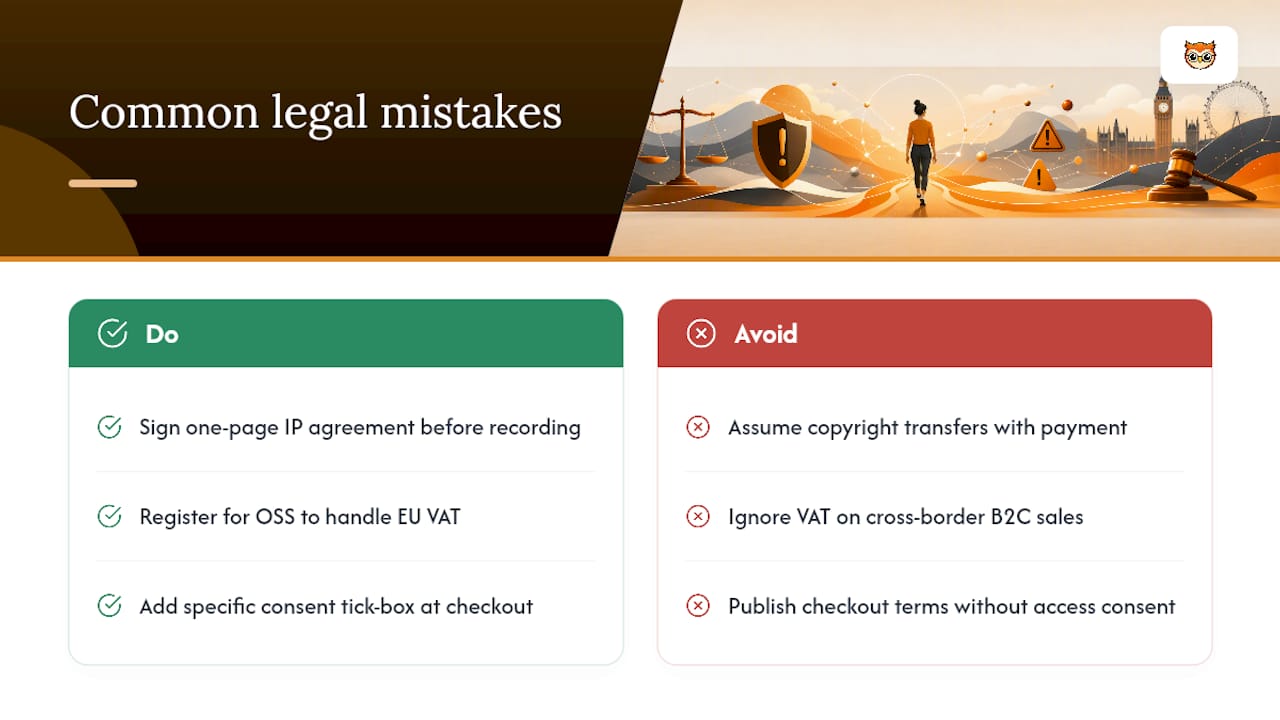
The three mistakes that come up repeatedly are assuming copyright transfers with payment, ignoring VAT on cross-border B2C sales, and publishing checkout terms that do not address immediate access consent.
On copyright: a creator who pays a guest expert £500 for a recorded module and receives an invoice does not own that recording. The guest retains copyright. If that creator later wants to sell the course to a third party or include the module in a new product, they have no right to do so without going back to the guest for a written assignment. The fix is a one-page IP agreement signed before recording starts, not after.
On VAT: a creator selling to EU consumers without OSS registration is not exempt from EU VAT. They are simply non-compliant. The OSS scheme exists precisely to make this manageable without registering in every EU member state.
On checkout terms: the 14-day cooling-off period under UK consumer rules is not waived automatically. It requires a specific consent tick-box at checkout. Creators who skip this step and then refuse refunds on the grounds that "the terms say no refunds" are in a legally weak position.
Bibliowlteca's platform addresses the practical side of these issues: configurable VAT display, location data capture at checkout, and access control tied to purchase status. The legal paperwork still needs to come from you, but the technical infrastructure does not have to be built from scratch.
Bibliowlteca: built for creators who want to sell, not just publish
Selling digital courses without the right infrastructure means spending more time on payment failures, VAT questions and delivery errors than on teaching. Bibliowlteca gives UK creators a single place to publish courses, accept payments in multiple currencies, display VAT-inclusive pricing and deliver content securely, without needing a developer.
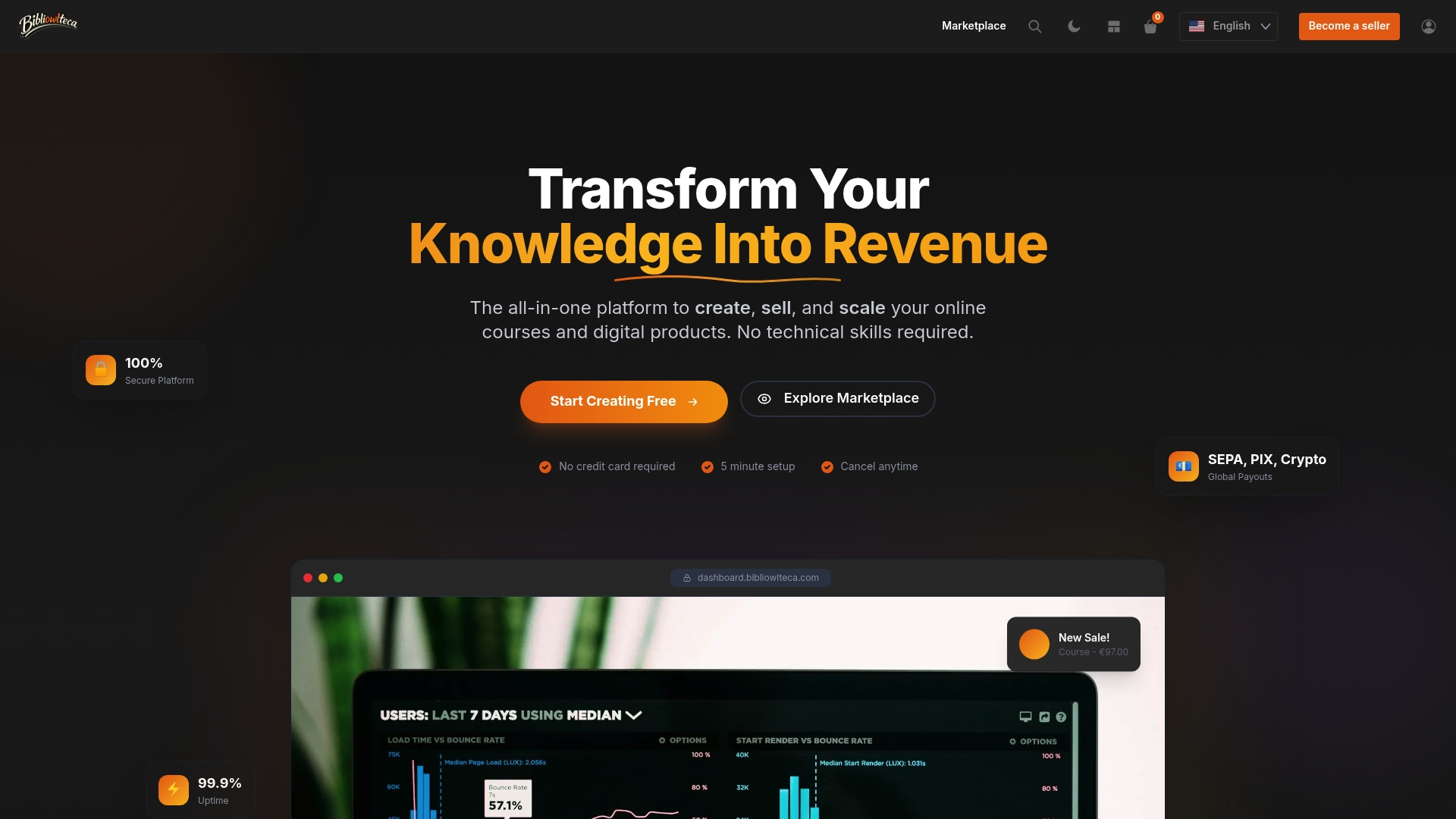
The platform handles transaction processing, automated delivery and basic tax display out of the box. Getting started takes four steps: create your product, configure pricing and VAT display, connect your payment method, and publish. For creators who also sell e-books, templates or mentorship sessions alongside their courses, Bibliowlteca's full feature set covers all of those product types under one storefront. Visit the Bibliowlteca marketplace to set up your creator account and take your first payment.
Sources
- Gov
- VAT on Digital Products & Online Courses | UK Guide 2026/27
- Who Owns Course Content in a UK Online Course Business? | Sprintlaw UK
This article is general information, not a substitute for advice from a qualified financial advisor. Consult a qualified financial professional about your own circumstances before acting on anything here.