
TL;DR:
- Success depends on effective preparation, platform choice, and ongoing promotion, not just content quality.
- Building methodology through validation, consistent promotion, and audience engagement drives higher earnings.
- Using the right platform and optimizing listings enhances discoverability and maximizes global sales potential.
You have spent months building an online course or e-book, pouring real expertise into every page and lesson. Then you hit publish and hear nothing. No sales, no audience, no clear path forward. This is one of the most common frustrations for educators and creators entering the digital marketplace. The good news is that the problem is rarely the content itself. It is nearly always the preparation, platform choice, and promotion strategy. This guide walks you through the exact steps to turn your knowledge into a scalable income stream, from formatting your materials correctly to reaching students and readers across the globe.
Table of Contents
- Prepare your digital content for global sales
- Choose the right platform: marketplace vs self-hosted
- List your content and optimise for discovery
- Promote your digital content for sustained sales
- What most guides miss about selling digital content
- Discover global opportunities with BibliOWLteca
- Frequently asked questions
Key Takeaways
| Point | Details |
|---|---|
| Choose the best platform | Marketplaces are easy for beginners while self-hosted platforms give scalability. |
| Optimise for discovery | Good titles, keywords, and metadata will help your content reach the right audience. |
| Promote consistently | Frequent, targeted promotion boosts sales far more than occasional marketing. |
| Follow proven methodology | Top earners use systematic steps, not just creative talent, to reach high revenue levels. |
Prepare your digital content for global sales
Now that you have seen the global opportunity, let us look at how to get your content ready for market. Preparation is where most creators cut corners, and it is also where the biggest gains are hiding.
Choosing the right format is the first decision that shapes everything else. Most platforms accept a core set of file types, and sticking to widely supported formats saves you enormous headaches later. PDFs work well for e-books and guides because they preserve your layout on any device. EPUB files are better suited for text-heavy books that readers want to reflow on e-readers. Video is the dominant format for online courses, while SCORM packages are the professional standard for interactive, trackable learning modules sold to organisations and institutions.
Before you upload anything, run through a quality checklist. Skipping this step is the single biggest reason new sellers receive refund requests.
- Editing: Proofread for grammar, clarity, and logical flow. Have at least one other person review it.
- Visuals: Use high-resolution images, clean fonts, and consistent branding throughout.
- Learning objectives: State clearly what the learner will be able to do after completing the content.
- Accessibility: Add alt text to images and captions to videos so your content reaches a wider audience.
- File size: Compress files without losing quality to ensure fast downloads for international buyers.
Next, prepare your metadata before you even open the upload page. Metadata includes your title, description, and keywords. These directly affect how your content appears in search results on both the platform and Google. Write a title that includes the core topic and a benefit. Write a description that addresses the reader's problem in the first two sentences. Research keywords using free tools like Google's autocomplete or paid tools like Ahrefs.
Pro Tip: Use the best e-book tools available to format your content professionally before listing it. A polished product converts significantly better than a rough one, even if the underlying knowledge is identical.
Finally, choose your platform based on content type and audience. Popular platforms for selling online courses and e-books include Thinkific, Kajabi, Teachable, Podia, Udemy, and Gumroad, each with different strengths depending on your goals. You can read more about the full landscape in this digital publishing guide to help narrow down your options.
| Format | Best for | Typical platform support |
|---|---|---|
| E-books, guides, worksheets | Universal | |
| EPUB | Long-form reading content | Most e-book platforms |
| MP4 video | Online courses | Thinkific, Teachable, Kajabi |
| SCORM | Corporate training | Specialised LMS platforms |
Choose the right platform: marketplace vs self-hosted
With your content prepared, you will need to find the right platform for launching your sales. This decision affects your revenue, your brand, and how much control you keep over your audience.
A marketplace is a platform that already has an existing audience of buyers. You list your content alongside other creators, and the platform promotes its catalogue as a whole. Think of it like selling books in a large bookshop. Buyers are already browsing. You benefit from existing traffic, built-in trust, and simplified setup. The trade-off is that marketplaces suit beginners for discovery but reduce your revenue share and control over your customer relationships.
A self-hosted platform means you set up your own store, usually through a tool like Kajabi or Podia, where your brand is front and centre. You own your customer data, set your own prices without interference, and keep more of every sale. The trade-off is that you are responsible for driving your own traffic.
The platform you choose now does not have to be the platform you use forever. Many successful educators start on a marketplace to validate demand, then migrate their audience to a self-hosted store once they have proof of concept.
Here is how the two options compare across key factors:
| Factor | Marketplace | Self-hosted |
|---|---|---|
| Setup speed | Fast | Moderate |
| Built-in audience | Yes | No |
| Revenue share | 30-70% to platform | Minimal fees |
| Brand control | Limited | Full |
| Customer data ownership | Restricted | Full |
| Scalability | Limited | High |
The earnings data across platforms is revealing. Average Udemy instructors earn around $3,306 per year, while Kajabi creators have collectively earned over $6 billion, and 70% of six-figure course creators run their own branded stores. This does not mean marketplaces are bad. It means that monetising e-books and courses at scale requires owning your platform eventually.
Key factors to consider when choosing:
- Your current audience size (zero audience favours marketplaces initially)
- Your content type (video courses, e-books, or bundled products)
- Your revenue goals and timeline
- Whether you want to build a brand or simply sell units
Explore how digital storefronts work in practice to understand what setup looks like at each stage. If you are an educator specifically, there is also useful context in how a digital marketplace empowers creators at different career stages.

List your content and optimise for discovery
Once you have chosen your platform, it is time to launch your content and maximise its discoverability. A great product sitting on a poorly optimised listing page will not sell. Discoverability is a skill, and it is entirely learnable.
Follow these steps to list your content effectively:
- Upload your files in the correct format and test the delivery experience yourself before going live. Download it as a customer would.
- Write your title with your primary keyword in the first three words. Avoid generic titles like "Beginner's Guide." Be specific: "Python for secondary school teachers" beats "Learn to code."
- Craft your description by addressing the reader's problem in sentence one, your solution in sentence two, and what they will gain by the end in sentence three.
- Set your price based on value, not hours spent. Pricing too low signals low quality. Research what comparable content sells for and price at or slightly above the midpoint.
- Add a cover image or thumbnail that communicates the topic clearly at a glance. Use bold text, high contrast, and minimal clutter.
- Select categories and tags carefully. These are how platforms route your content to the right searchers.
- Enable international access by checking currency and geo-restriction settings. If your platform restricts certain regions, you may be leaving a significant portion of the market unreached.
The economics of selling educational materials digitally are attractive. Profit margins above 90% are achievable for digital products, but the top earners get there through repeatable methodology rather than exceptional talent alone. This means your listing, your pricing logic, and your keywords all matter as much as the content inside.
Pro Tip: Study the top three listings in your category and reverse-engineer their titles, descriptions, and price points. You are not copying them. You are understanding the standard the market has already accepted.
For content types that work particularly well, consider how e-books support learner engagement across different subjects. You might also look at how free online books are used strategically as lead magnets to build an audience before selling premium content.
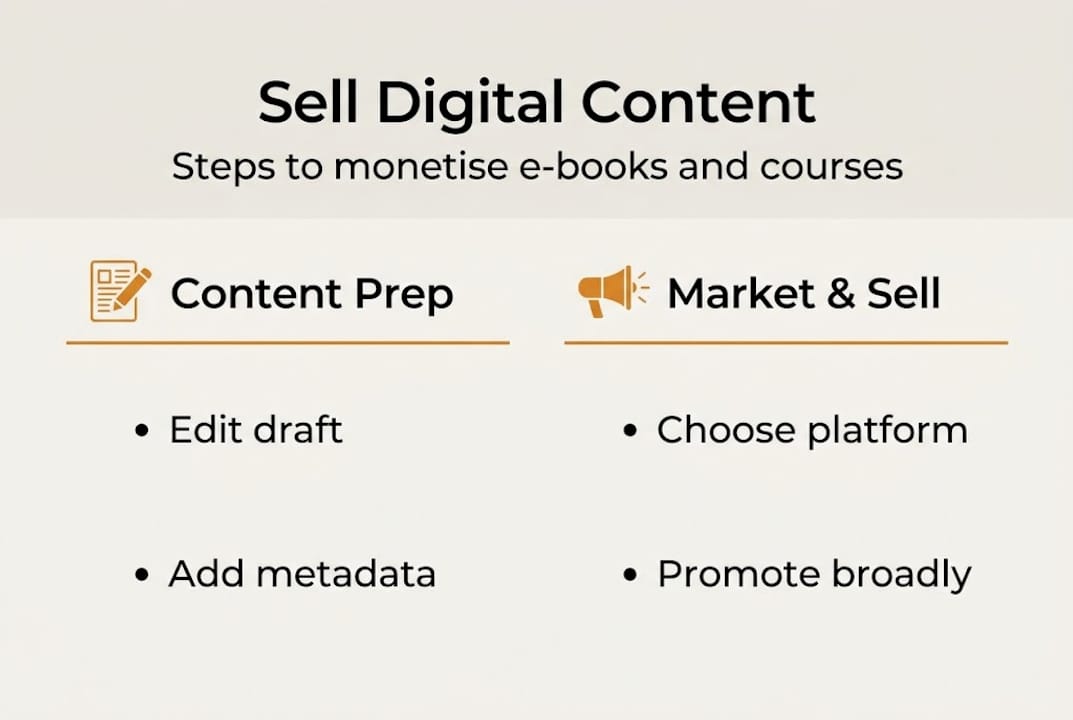
Promote your digital content for sustained sales
To turn listings into sales, you will need to let the world know about your digital content. Publishing without promoting is the most common and costly mistake new creators make.
The channels that consistently drive results for educators and creators include:
- Email marketing: Your email list is the only audience you fully own. Build it from day one, even before your first product is live.
- Social media: Choose one or two platforms where your target learners already spend time. Consistency matters far more than volume.
- Online communities: Facebook groups, Reddit communities, Discord servers, and forums in your niche are places where your ideal buyers already gather.
- Content marketing: Blog posts, YouTube videos, and podcasts that solve smaller problems for your audience create trust and drive organic traffic to your listings.
- Partnerships and affiliates: Other creators in adjacent niches can promote your content to their audiences in exchange for a commission.
The statistics are sobering but instructive. 63% of digital product creators earn less than $500 per month, but the top 9% who reach $10,000 or more per month do so through consistent promotion, product validation, and building multiple products rather than relying on a single launch.
Pro Tip: Set a weekly promotion schedule and treat it like a non-negotiable meeting. Post, email, engage, and analyse every single week. Sporadic promotion produces sporadic income.
Platform tools are underused by most creators. Nearly every major platform offers built-in coupon codes, affiliate programmes, and email notification features for students. Use them. A limited-time discount to your existing audience can generate a short burst of sales that also signals to the platform's algorithm that your content is performing, which increases organic visibility.
Avoid these common errors:
- Underpricing: It devalues your expertise and attracts buyers who are least likely to complete the course or leave a positive review.
- Neglecting existing customers: A student who finishes your course is your warmest potential buyer for your next product.
- Unclear messaging: If your landing page does not answer "what will I be able to do after this?" within five seconds, buyers leave.
For a broader view of reaching international learners, explore strategies around global content distribution and how to apply global sales strategies that top-earning creators use consistently.
What most guides miss about selling digital content
Most step-by-step guides treat digital content selling as a technical problem. Upload the file, set the price, share the link. But the uncomfortable truth is that the technical part is the easiest part. What separates the 9% who reach $10,000 or more per month from the 63% earning under $500 is not better content. It is better methodology.
Methodology drives top earners far more reliably than talent or creativity alone. This means validating your idea before spending months building it. It means running the same promotional activities week after week, even when it feels repetitive. It means treating your digital business like a system with inputs and outputs, not a creative project you launch and hope for the best.
We have seen creators with genuinely brilliant content earn almost nothing because they promoted once and moved on. We have also seen creators with fairly ordinary content build five-figure monthly incomes because they showed up consistently, tested their messaging, iterated on their products, and built an email list from their very first week.
The lesson is this: start smaller than you think you should, prove there is demand, then scale. Chasing the viral launch or the perfect flagship course before you have made a single sale is a trap. Your first product does not need to be your best product. It needs to exist and sell. Refine from there using real feedback from real customers. Explore expert sales strategies to build the repeatable systems that compound over time.
Discover global opportunities with BibliOWLteca
If you are ready to start selling, here is how BibliOWLteca can accelerate your journey. Turning knowledge into a global income stream is far simpler when your platform is built for exactly that purpose.
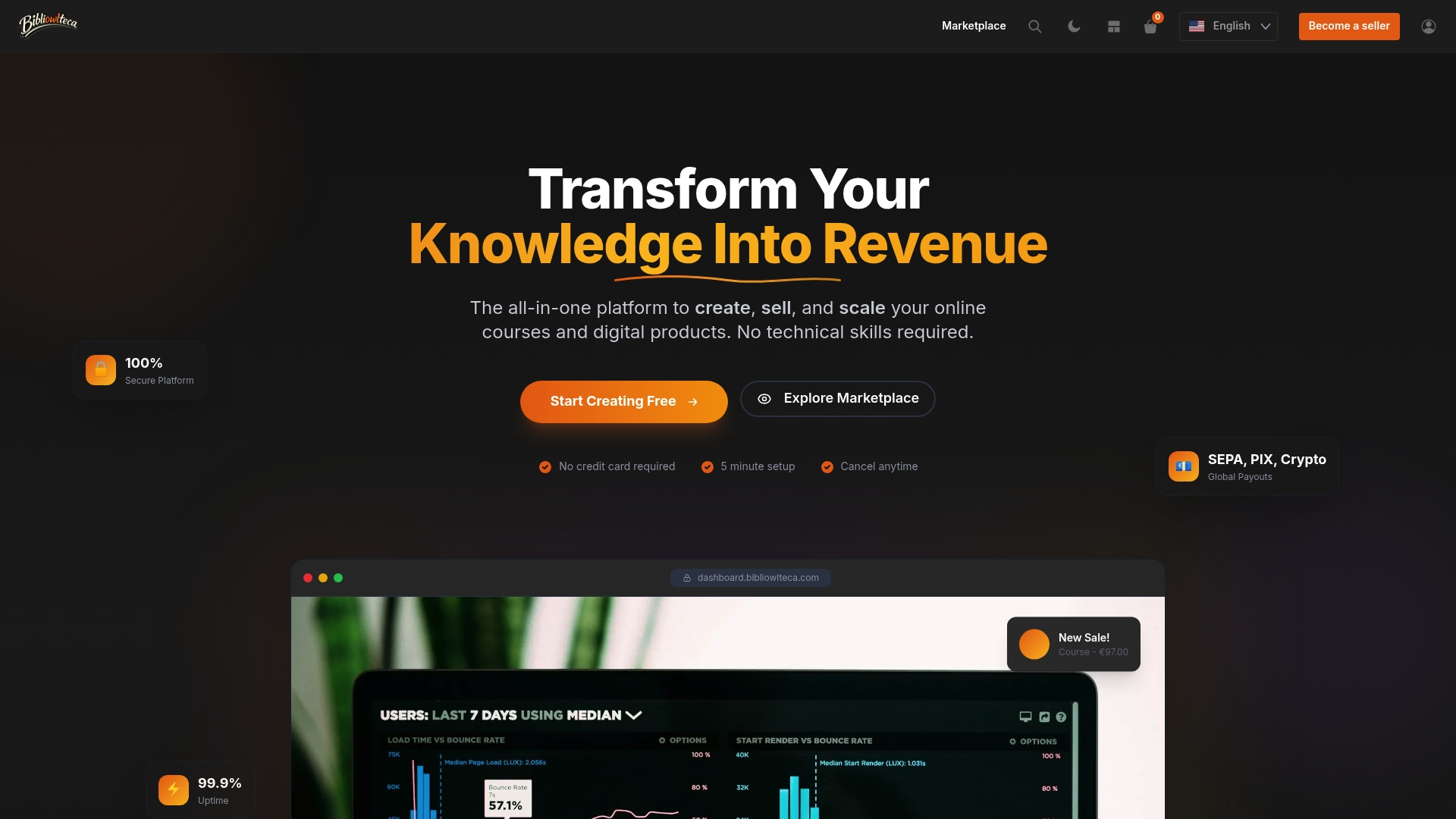
BibliOWLteca is designed for educators and creators who want to sell e-books, courses, and digital products to a worldwide audience without wrestling with complex technical setups. The platform handles payment processing in multiple currencies, digital delivery, and tax compliance, so you can focus entirely on creating and promoting. Built-in tools make it straightforward to set up your store, reach international buyers, and manage your growing audience in one place. Whether you are just listing your first e-book or scaling an existing course catalogue, the BibliOWLteca marketplace gives you the infrastructure to grow without limits. Join a community of creators already reaching students across the globe.
Frequently asked questions
Which digital content platforms are best for educators?
Thinkific, Kajabi, Teachable, Podia, Udemy, and Gumroad are widely used for selling courses and e-books, each suited to different goals and experience levels.
How much money can educators earn from digital content sales?
63% of creators earn under $500 per month, but those following consistent best practices, including product validation and regular promotion, can reach $10,000 or more monthly.
Is it better to use a marketplace or self-hosted platform?
Marketplaces offer fast setup and built-in discovery, which suits beginners, while self-hosted platforms give you full brand control and greater revenue per sale as you scale your reach globally.
What are the top mistakes creators make when selling digital content?
Underpricing, neglecting promotion, and unclear messaging are the most damaging errors. Top performers validate ideas first, build multiple products, and promote consistently rather than relying on a single launch.