TL;DR:
- Editors do much more than proofread; they shape structure, voice, coherence, and advocate for authors in publishing. Specialized genre expertise is essential because editors understand reader expectations, pacing, and market standards unique to each genre. In academic publishing, editors evaluate research quality and manage peer review, unlike creative editors who develop manuscripts collaboratively.
Most writers believe editors exist to catch typos and fix grammar. That framing undersells the role of editors in publishing by about ninety per cent. Editors are the people who decide whether a manuscript has a future, shape its structure before a single reader sees it, and advocate for the author inside a publishing house. They are architects, project managers, and creative partners rolled into one. Understanding what editors actually do, and how different types of editing serve different purposes, will change how you approach every manuscript you write or commission.
Table of Contents
- Key takeaways
- The role of editors in publishing
- Why genre expertise changes everything
- Editors in academic and journal publishing
- Working effectively with editors
- My perspective on editing as collaboration
- Take your publishing further with Bibliowlteca
- FAQ
Key takeaways
| Point | Details |
|---|---|
| Editors do far more than proofread | The editorial process in publishing spans structure, pacing, voice, coherence, and project management. |
| Genre expertise matters enormously | Authors benefit from seeking editors with deep knowledge of their specific genre, not generalists. |
| Academic editors are a separate discipline | Journal editors manage peer review and uphold research integrity without rewriting manuscripts. |
| Sample edits protect your investment | Requesting a sample edit before full engagement reveals whether an editor's style suits your work. |
| Editorial costs are predictable | Line editing a 100,000-word manuscript averages around £500, making budgeting straightforward for most authors. |
The role of editors in publishing
The word "editing" covers an enormous range of activity. To understand editor responsibilities in publishing, you need to break that activity into distinct stages, because each one serves a completely different purpose.
Developmental editing sits at the beginning of the editorial process. This is where an editor examines your manuscript at the macro level: the overall structure, the arc of your argument or story, character consistency in fiction, and the logical progression of ideas in non-fiction. A developmental editor will tell you when chapter three should be chapter one, or when your central argument collapses in the final quarter. This is the most demanding and transformative form of editing, and it requires the editor to hold your entire vision in mind while simultaneously assessing how a reader will experience it.
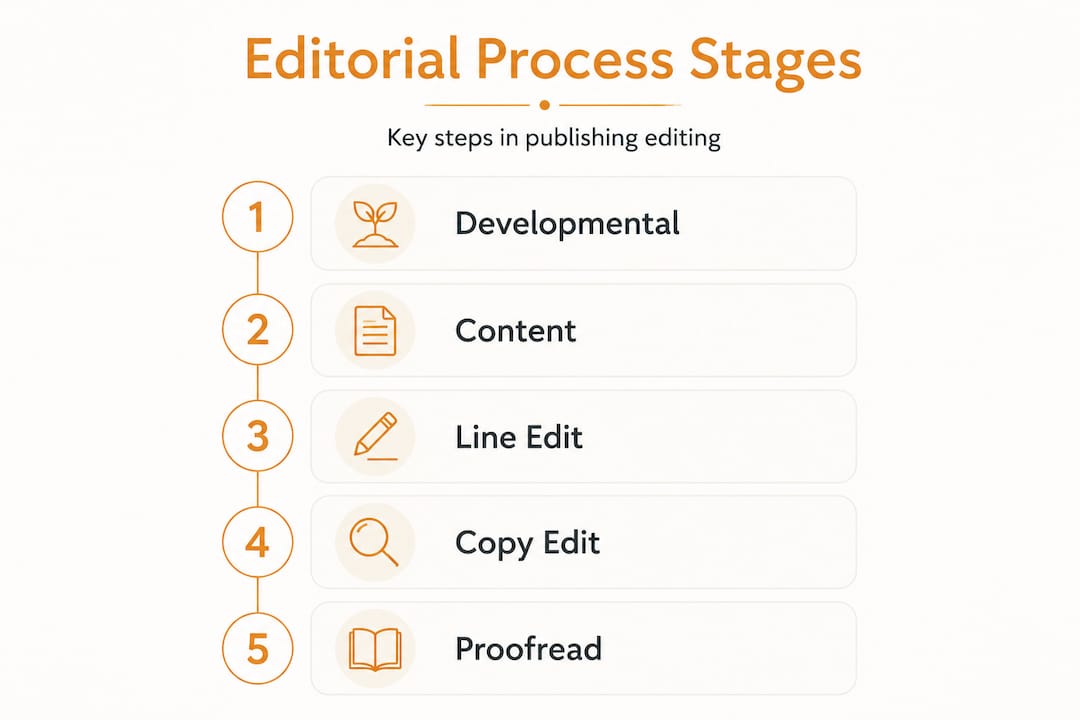
Content editing follows developmental work. Here the focus shifts to flow, consistency, and coherence within sections. Does each chapter earn its place? Do transitions hold? Are there internal contradictions the author missed because they were too close to the material?
Line editing and copyediting address the sentence-level craft. Line editing concerns rhythm, word choice, and clarity of expression. Copyediting handles grammar, spelling, punctuation, and adherence to a house style guide. These two stages are often confused, but they are distinct skills performed with different lenses.
Beyond these creative functions, editors act as project managers coordinating timelines, liaising between authors and production teams, and advocating for the book's commercial positioning inside a publishing house. That organisational role is invisible to most authors but shapes everything from a book's publication date to its marketing budget.
- Developmental editing: structure, arc, and macro-level clarity
- Content editing: flow, consistency, and section-level coherence
- Line editing: sentence rhythm, word choice, and expressive clarity
- Copyediting: grammar, punctuation, spelling, and style compliance
- Proofreading: final error-check before print or digital publication
- Project management: timelines, team coordination, and author liaison
Pro Tip: If you are commissioning editing independently, identify which stage your manuscript actually needs before you hire anyone. Paying for copyediting on a manuscript with structural problems is like painting a house that needs rewiring.
What separates great editors from competent ones is subtlety. The best editing is invisible, shaping clarity, tone, and structure so the author's voice shines through undisturbed. Readers never notice the editor's hand. They only notice when it was absent.

Why genre expertise changes everything
The functions of editors in publishing are not interchangeable across genres. A skilled romance editor and a skilled thriller editor are not the same person wearing different hats. They carry fundamentally different knowledge about reader expectations, pacing conventions, and what the market will and will not accept.
Consider the difference in practice. A romance editor knows that the emotional arc between protagonists must follow a recognisable pattern of conflict and resolution, and that subverting this pattern requires extraordinary craft. A thriller editor understands that the revelation of information to the reader is a precise technical skill. Get the sequencing wrong in either genre and the manuscript fails on its own terms, regardless of how clean the prose is.
Genre is a contract with readers on tone, pacing, and resolution. Specialised editors understand that contract from the inside. They have read hundreds of titles in the genre, they know what readers are buying right now, and they understand the difference between a genre convention and a cliché. That knowledge cannot be faked or quickly acquired.
The table below illustrates how editorial focus shifts between genres:
| Genre | Primary editorial focus | Common developmental concern |
|---|---|---|
| Literary fiction | Voice, prose rhythm, thematic depth | Pacing and commercial accessibility |
| Romance | Emotional arc, protagonist chemistry | Rushed resolution or underdeveloped conflict |
| Thriller | Information sequencing, tension management | Pacing inconsistencies and plot logic |
| Children's books | Age-appropriate language, illustration notes | Concept clarity and moral accessibility |
| Non-fiction (narrative) | Research integration, argument structure | Credibility and reader engagement |
Independent publishers frequently encounter quality problems precisely because they assign manuscripts to generalist editors rather than genre specialists. The result is technically clean work that still fails to connect with its intended readership. An effective editorial infrastructure matches manuscripts to editors with the genre expertise needed to meet market standards consistently.
Pro Tip: When searching for an editor, ask specifically what titles they have edited in your genre and whether those titles were commercially published. A portfolio in your genre is more telling than a general list of credentials.
The editorial checklist for developing educational books follows the same principle. Educational content has its own conventions around scaffolding, progression, and audience appropriateness that a general editor may miss entirely.
Editors in academic and journal publishing
The editorial process in academic publishing operates under a completely different set of rules from commercial book publishing. Understanding these differences matters enormously if you are a researcher, academic writer, or publisher working in a scholarly context.
Journal editors do not function as creative collaborators. Their role is evaluative and supervisory. They receive manuscript submissions, make initial assessments of relevance and quality, and then manage the peer-review process to ensure that expert reviewers assess the work fairly. Journal editors manage peer review to guarantee fairness, scientific integrity, and research quality without rewriting manuscripts themselves.
The layered structure of academic editorial boards works as follows:
- The editor-in-chief sets the strategic direction of the journal and makes final decisions on acceptance or rejection.
- Associate editors or handling editors manage individual submissions, select appropriate reviewers, and interpret reviewer feedback.
- Editorial board members provide disciplinary expertise, handle specialist submissions, and contribute to journal credibility within their fields.
- Managing editors oversee production timelines, correspondence, and administrative workflow.
- Copy editors (in academic publishing) check manuscript formatting, reference style compliance, and language accuracy before publication.
Journal editors also shape scientific disciplines by mentoring early-career researchers, safeguarding research ethics, and mediating peer-review decisions transparently. That influence on a field extends well beyond any individual paper they process.
For academic authors, understanding who sits at each level of this structure matters practically. When you receive a desk rejection, it came from a handling editor assessing fit and initial quality. When you receive a revise-and-resubmit decision with conflicting reviewer comments, the handling editor is responsible for synthesising those views and guiding your revision. Engaging constructively with the editor at each stage, rather than simply responding to reviewers, improves your odds of acceptance. You can explore publishing in academia in more detail if this context applies to your work.
The fundamental difference from commercial publishing is this: academic editors are gatekeepers who protect intellectual standards, not creative developers who shape your work's expression. Both roles are critical to their respective ecosystems, but confusing them leads to misplaced expectations in either context.
Working effectively with editors
Knowing how editors impact publishing is only useful if you can translate that knowledge into better professional practice. Here is what authors and independent publishers should know about building productive editorial relationships.
Distinguish what your project actually needs. A first-draft manuscript with structural problems needs developmental editing, not copyediting. Many authors skip straight to the surface level because it feels less confronting. That is almost always a false economy. Surface polish on a structurally flawed manuscript is effort wasted.
Always request a sample edit. Sample edits clarify fit and feedback style before you commit to a full engagement. A good editor will edit a short passage, typically the first 1,000 to 2,000 words, and return it with their approach made visible. This shows you whether their instincts align with your voice, whether their feedback is constructive and specific, and whether you can actually work with this person across a months-long project.
Know what to expect on cost. Line editing a 100,000-word manuscript costs approximately £500, though this varies with editor expertise and genre complexity. Developmental editing commands higher fees because of the depth of analysis required. Build editing costs into your publishing budget from the outset, not as an afterthought once the writing is finished.
Approach feedback as information, not criticism. Authors frequently overestimate self-editing effectiveness because proximity to a manuscript creates blind spots no amount of careful rereading can overcome. When an editor flags a pattern across multiple chapters, that is data about your reader's experience. Treat it as such. You do not have to accept every suggestion, but you should understand what reader problem each one is attempting to solve.
- Identify the type of editing you need before you engage anyone
- Vet editors through their genre portfolio, not just general credentials
- Request a sample edit of 1,000 to 2,000 words before committing
- Build editing costs into your initial publishing budget
- Respond to editorial feedback analytically rather than defensively
- Keep communication open throughout the process and ask for clarification when needed
Pro Tip: Ask your editor how they prefer to deliver feedback before the project starts. Some editors work through tracked changes in a document; others write detailed editorial letters. Knowing this in advance prevents misunderstandings about what deliverables to expect.
Good editorial relationships improve publication success not just in quality terms but in market terms too. A digital publishing guide will tell you that reader trust in educational and non-fiction content is built on credibility and clarity. Professional editing is one of the most direct investments in both.
My perspective on editing as collaboration
I have watched writers treat editorial feedback as an obstacle and others treat it as the most useful conversation they have had about their work. The difference in outcomes is striking, and it is not random.
The writers who get the most from editing are the ones who understand that an editor's job is to read as your reader will. Not as a fan. Not as a critic. As a person encountering your ideas or your story for the first time, with no prior investment in making it work. That perspective is genuinely rare, and it is something you simply cannot give yourself.
What I find consistently undervalued is the role of early editorial involvement. Most writers engage an editor once a manuscript is "finished," treating editing as a finishing stage rather than a developmental conversation. Getting editorial eyes on your structure early, even just an editorial letter on a first draft, routinely saves months of revision. The structural problems that feel like polish problems when you are deep in a draft are obvious to a skilled editor reading with fresh eyes.
I also think the conversation about editor-author relationships gets distorted by a fear of losing voice. Editors balance critic and collaborator, helping you articulate ideas without imposing their own. The best editors I know do not impose a voice. They ask questions until your voice becomes clearer to you. That is a very different thing from the "red pen" model most writers fear.
The writers who resist that conversation are usually the ones most in need of it. Proximity to your own work is not the same as clarity about it. An editor gives you the one thing you cannot manufacture for yourself: honest, informed distance.
— BibliOWLteca
Take your publishing further with Bibliowlteca
Understanding editorial roles is the foundation of professional publishing. Putting that understanding into practice is where Bibliowlteca can help.

Bibliowlteca is a digital marketplace built for creators, educators, and authors who want to publish and sell their work globally. Whether you are distributing an edited e-book, a course, or specialist educational content, sell your content online through a platform designed to handle payments, delivery, and tax compliance across multiple currencies. Professional editorial standards and a reliable distribution platform are two sides of the same coin. Your work deserves both. Explore what Bibliowlteca makes possible for your publishing goals and see how digital marketplaces empower creators at every stage of the process.
FAQ
What does an editor actually do in publishing?
Editors in publishing perform a range of functions from structural development and content review through to line editing, copyediting, and project management. Their role extends well beyond correcting errors to shaping the overall quality and market readiness of a manuscript.
How do I know which type of editing my manuscript needs?
If your manuscript has structural or narrative problems, start with developmental editing. If the structure is sound but prose clarity is inconsistent, move to line editing. Only commission copyediting once the larger issues have been resolved.
Why does genre expertise matter in an editor?
Genre is a reader contract on tone, pacing, and resolution. An editor without genre experience may produce technically clean work that still fails to meet reader expectations or perform commercially.
How much does professional editing cost?
Line editing a 100,000-word manuscript averages around £500, though rates vary by editor expertise and the complexity of the genre. Developmental editing typically costs more given the depth of structural analysis involved.
Are journal editors the same as book editors?
No. Journal editors in academic publishing manage peer review and uphold research integrity without rewriting manuscripts. Book editors work developmentally and collaboratively to shape an author's work for a commercial or general readership. The skills, responsibilities, and relationships involved are substantially different.