
TL;DR:
- Library automation significantly enhances efficiency and capacity by reducing manual task times and increasing workload throughput. It improves metadata quality, prevents catalogue drift, and transforms circulation processes, freeing staff for higher-value activities. Effective implementation requires phased rollout, staff training, and strong governance to ensure sustainable success.
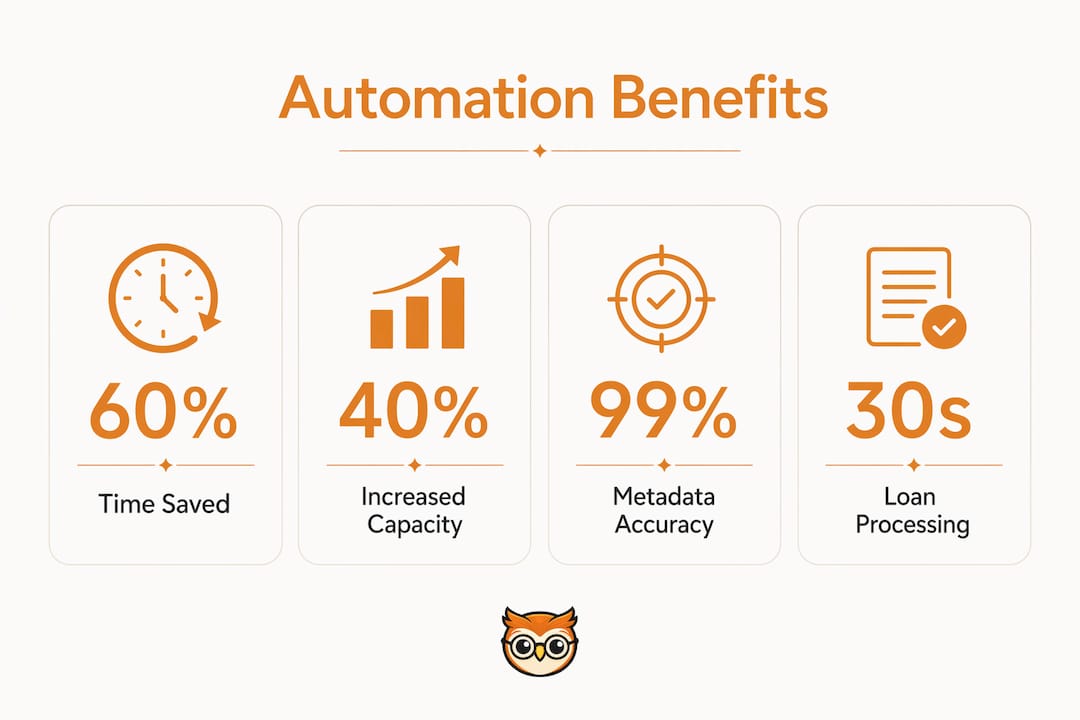
Library automation is the process of using technology to handle routine library operations, and it is now the primary reason libraries can meet growing user demands without proportional increases in staff. Studies from Clarivate in 2026 show that manual workflow time fell by 30–60% when academic AI tools were introduced. That figure represents hours returned to professional work every single day. Understanding why libraries need automation means understanding how tools like Ex Libris Alma, RFID self-service systems, and OCLC WorldShare Collection Manager are reshaping what library staff can actually accomplish.
Why libraries need automation: efficiency and capacity gains
The most direct benefit of library automation is time. Course reading list creation, which previously took 15–45 minutes per list, now takes 2–5 minutes with AI-assisted tools. That is not a marginal improvement. It is a structural change in what a team of five can accomplish in a working week.

The capacity gains extend beyond individual tasks. Libraries using AI-assisted workflows have reported workload increases of 2–4 times without adding staff. That means the same team processes significantly more requests, supports more users, and manages larger collections. For administrators facing budget constraints, this is the clearest argument for investing in automation.
Cataloguing speed at universidad tecnológica de bolívar
Universidad Tecnológica de Bolívar offers one of the most striking examples of automation's impact on cataloguing. After adopting AI-assisted workflows, the institution reduced cataloguing time by 70–80%, with initial transcription drafts generated in 30–60 seconds rather than hours. New books became available to users on the same day they arrived. That kind of turnaround was previously impossible without a much larger team.
The return on investment is strongest when automation targets workflows blocked by repetitive manual bottlenecks, particularly transcription and initial metadata assembly. These are the tasks where staff time disappears fastest and where technology delivers the clearest gains.
"Automation collapses drafting phases into minutes, reallocating staff time towards higher-value engagement activities." — Clarivate Academic AI Impact Study, 2026
Pro Tip: Before selecting an automation tool, audit your current workflows and identify the three tasks that consume the most staff time per week. Target those first. The ROI will be immediate and measurable.
Circulation processes benefit equally from automation. RFID-based systems handle loan and return transactions without requiring staff intervention at every step. This frees librarians from transactional duties and redirects their attention towards user support, collection development, and service improvement. The importance of automating libraries becomes clearest when you see what staff do with the time they recover.
How does automation improve metadata management?
Metadata quality is the foundation of a usable library catalogue, and automation is the most reliable way to maintain it at scale. OCLC's WorldShare Collection Manager synchronises holdings records against WorldCat programmatically, replacing outdated records with updated batch data. This process prevents catalogue drift, the gradual accumulation of inaccurate or incomplete records that makes collections harder to discover.
The technical logic matters here. Effective synchronisation extracts only records changed since the last update, reducing system load while maintaining accuracy. Without this kind of batch logic, libraries face repeated manual correction cycles that consume exactly the staff time automation is meant to free.
| Metadata Challenge | Manual Approach | Automated Approach |
|---|---|---|
| Holdings synchronisation | Periodic manual checks, prone to gaps | Programmatic batch updates via WorldShare |
| Accessibility metadata | Record-by-record review | ONIX to MARC 341 mapping at scale |
| Catalogue drift | Reactive correction after errors surface | Continuous synchronisation prevents drift |
| Record deduplication | Manual merge with metadata loss risk | Automated merge preserving all fields |
Accessibility metadata presents a particular challenge that automation addresses directly. OCLC's standard-based workflows enriched approximately 1.2 million accessibility records in 2026 by mapping ONIX accessibility elements into MARC 341 fields. That scale is simply not achievable through manual processes. The result is a catalogue that serves users with disabilities more effectively, without placing additional burden on cataloguing staff.
The critical risk in metadata automation is record merges. When records are deduplicated or consolidated, accessibility metadata must survive the merge intact. If it does not, librarians face repeated remediation work that negates the efficiency gains. Metadata automation at scale requires workflows specifically designed to preserve all fields through every transformation.
Pro Tip: When evaluating metadata automation tools, ask vendors specifically how their system handles record merges. Request evidence that accessibility fields such as MARC 341 are preserved through deduplication. This single question will separate capable platforms from superficial ones.
Standards-based workflows also improve discoverability for all users. When metadata is accurate, complete, and consistently formatted, search results improve across every interface the library uses. This is a direct service quality benefit that administrators can measure through user satisfaction surveys and search success rates.
What should decision-makers know before adopting automation?
Library automation is not a plug-and-play solution. The libraries that achieve the strongest results treat implementation as a phased programme with clear governance at every stage. Those that attempt broad, immediate deployment tend to encounter operational disruption that undermines confidence in the technology.
The following steps reflect best practice for a managed rollout:
- Identify high-friction workflows first. Target the tasks consuming the most staff time and producing the most errors. Cataloguing transcription and course list creation are the most common starting points.
- Pilot with a defined scope. Run the automation on a subset of your collection or a single department before full deployment. Measure transaction times and error rates against your baseline.
- Train staff before go-live. Staged staff training builds confidence and reduces resistance. Staff who understand what the system does and why are far more likely to use it correctly.
- Establish review protocols. Automation accelerates output but does not eliminate the need for professional judgement. Build in regular checks where qualified staff review automated decisions, particularly in cataloguing and metadata work.
- Monitor at the transaction level. Track processing times, error rates, and success rates from day one. System uptime is not a sufficient measure of automation performance.
Cost is a genuine barrier for many libraries, particularly public libraries with constrained budgets. RFID implementation, for example, requires hardware investment, tag application across an entire collection, and staff training. Operational readiness challenges including tag reading errors and technical setbacks are documented in university library studies from Indonesia. These are not reasons to avoid automation. They are reasons to plan for them.
Risk management means anticipating failure modes before they occur. RFID systems can misread tags in dense shelving. AI cataloguing tools can generate inaccurate metadata for unusual formats. Batch synchronisation can overwrite correct records if the extraction logic is poorly configured. Each of these risks has a known mitigation. Building those mitigations into your implementation plan is the difference between a successful rollout and a costly reversal.
Pro Tip: Allocate at least 15% of your automation project budget to staff training and post-launch review. Libraries that underinvest in this phase consistently report lower adoption rates and more remediation work in the first year.
How does circulation automation transform library services?
Circulation automation represents one of the most visible and measurable applications of library technology. RFID-based self-service systems at POLMAN Bandung demonstrated that loan processing speed improved by 65%, with individual loan transactions averaging 31.6 seconds per book at an 84% success rate. Return processing improved by 22%, averaging 47 seconds per book with an 88% success rate. These are transaction-level metrics that directly reflect user experience.
The comparison between manual and automated circulation makes the case clearly:
| Metric | Manual Processing | RFID Automated |
|---|---|---|
| Average loan time | Approximately 90 seconds | 31.6 seconds |
| Average return time | Approximately 60 seconds | 47 seconds |
| Loan success rate | Variable | 84% |
| Return success rate | Variable | 88% |
| Staff involvement required | Full | Minimal |
The shift to self-service models does more than reduce queue times. It fundamentally changes the role of frontline staff. When borrowing and returning no longer require staff intervention, librarians move from transactional roles to advisory and engagement roles. This is a service quality improvement, not merely an efficiency gain.
Key outcomes from circulation automation in practice include:
- Reduced queue lengths during peak periods, particularly at the start of academic terms
- Extended service hours without additional staffing, as self-service systems operate independently
- Improved collection tracking, with RFID providing real-time location data for items
- Reduced human error in loan recording, which decreases disputes and overdue notices
Universitas Negeri Padang's experience with RFID implementation confirms these benefits while also highlighting the importance of managing library resources effectively alongside the technology. Collection management improves when every item is tagged and tracked, but only if the tagging process is completed accurately and the system is maintained consistently.
Circulation automation should be evaluated as a service transformation, not merely a security upgrade. The question is not whether the gates are working. The question is whether users are completing transactions faster, with fewer errors, and with less need for staff assistance. Those are the metrics that justify the investment.
Key takeaways
Library automation delivers measurable efficiency, metadata quality, and service capacity gains when implemented with clear governance, phased rollout, and transaction-level performance monitoring.
| Point | Details |
|---|---|
| Efficiency gains are substantial | Workflow time falls by 30–60%, with course list creation dropping from 45 minutes to under 5 minutes. |
| Metadata automation prevents catalogue drift | Tools like OCLC WorldShare synchronise holdings programmatically, preserving accuracy at scale. |
| Phased adoption reduces risk | Starting with high-friction workflows and training staff before full deployment protects service continuity. |
| Circulation automation transforms staff roles | RFID systems cut loan times by 65%, freeing librarians from transactional duties to focus on user engagement. |
| Professional oversight remains non-negotiable | Automation accelerates output but requires qualified review at every stage to maintain standards. |
The uncomfortable truth about library automation
Most articles on this subject present automation as a straightforward upgrade. The reality is more demanding, and more interesting.
What I have observed is that the libraries achieving the strongest results are not the ones with the largest budgets or the most advanced technology. They are the ones where senior staff treat automation as a governance question, not just a procurement decision. The tools matter far less than the decisions about what gets automated, who reviews the output, and how performance is measured.
The shift in librarian roles is real and it is significant. When AI handles transcription and RFID handles circulation, the professional value of a librarian moves entirely into judgement, curation, and user engagement. That is a better use of expertise. But it requires administrators to actively redesign roles rather than simply deploying technology and hoping staff adapt.
The libraries that struggle with automation are almost always the ones that underestimated change management. They bought the system, ran a brief training session, and expected adoption to follow. It rarely does. The incremental approach, targeting one high-friction workflow at a time and measuring results before expanding, consistently outperforms the full-scale rollout. The evidence from Ex Libris and Clarivate's 2026 studies supports this directly.
My honest view is that the question is no longer whether to automate. The question is how quickly you can build the governance structures that make automation sustainable. Libraries that answer that question well will serve their communities far more effectively over the next decade than those still debating whether the technology is ready.
— Bibliowlteca
Take your library's digital operations further
Libraries investing in automation need platforms that match their ambition for efficiency and reach. Bibliowlteca is built for exactly that purpose.

Bibliowlteca gives library administrators and educational content creators the tools to publish and distribute digital resources including e-books, courses, and structured learning materials, across a secure and scalable infrastructure. With built-in payment processing, tax compliance, and multi-currency support, the platform removes the operational friction that slows digital content delivery. If your library is moving towards automated resource management and digital-first services, explore the full range of platform features designed to support that transition at every stage.
FAQ
What is library automation?
Library automation is the use of technology to handle routine library operations such as cataloguing, circulation, and metadata management. Tools like Ex Libris Alma, RFID systems, and OCLC WorldShare Collection Manager are the most widely adopted examples.
How much time can automation save library staff?
Studies from Clarivate in 2026 show that manual task time fell by 30–60% with academic AI tools. Course reading list creation specifically dropped from 15–45 minutes to 2–5 minutes per list.
What are the main challenges in library automation?
The primary challenges include high procurement costs, RFID tag reading errors, and the need for structured staff training. Operational readiness and phased implementation are the most effective ways to manage these risks.
Does automation replace librarians?
Automation does not replace librarians. It shifts their focus from repetitive transactional tasks to professional judgement, user engagement, and collection development. Human oversight remains a requirement at every stage.
Where should a library start with automation?
Start with the workflows that consume the most staff time and produce the most errors. Cataloguing transcription and course list creation are the highest-return starting points, as demonstrated by results from Universidad Tecnológica de Bolívar and the Clarivate 2026 study.