
The techniques that move the needle most consistently are consultative discovery, SPIN questioning, the Challenger approach, MEDDIC/MEDDPICC qualification, and value-based selling. The one-line selection rule: match complexity to method. Transactional deals need speed and clarity; complex, multi-stakeholder deals need diagnosis, insight, and qualification rigour.
Three behaviours separate high performers from the rest, according to research on what top reps actually do:
- Diagnose before you pitch. Ask about problems and consequences before presenting a solution. Buyers who feel understood tend to buy faster.
- Quantify the cost of inaction. "Staying as you are costs you £X per quarter" lands harder than any feature list.
- Multithread your buyers. Work three or more stakeholders simultaneously. Single-threaded deals stall when your champion goes quiet.
Key takeaways
The single most reliable improvement any seller can make is to diagnose the buyer's problem fully before presenting a solution, then quantify what staying in the current situation costs them.
| Point | Details |
|---|---|
| Start with diagnosis | Ask SPIN implication questions before pitching; buyers who articulate their own pain close faster. |
| Stack methodologies deliberately | Use MEDDIC for qualification, SPIN for discovery, and Challenger or value-based selling for differentiation. |
| Multithread every active deal | Work three or more stakeholders per deal; single-threaded deals stall when your champion goes quiet. |
| Run short experiments | Test one technique change over two to four weeks and measure qualification rate, deal velocity, and win rate in your CRM. |
| Match technique to context | Deal size, buyer sophistication, and sales cycle length determine which approach wins; situational fluency beats any single method. |
Table of Contents
- The 10 best selling techniques, with scripts you can use today
- How to choose the right technique for your deal
- How to practise techniques and measure what moves the needle
- Why consultative discovery and SPIN are the right place to start
- Sources
The 10 best selling techniques, with scripts you can use today
1. Consultative selling
What it is: You act as a diagnostician, not a vendor. The conversation centres on the buyer's situation, goals, and constraints before any solution is mentioned.
When to use it: Mid-market and enterprise deals where the buyer has a complex problem they haven't fully articulated. Works across B2B and high-value B2C.
Micro-script: "Before I show you anything, can I ask a few questions about how you're currently handling X? I want to make sure whatever I suggest is actually relevant to your situation."
This framing immediately separates you from reps who open with a deck. It also gives you the diagnostic data you need to tailor everything that follows.
2. SPIN selling
What it is: A structured questioning sequence developed by Neil Rackham: Situation, Problem, Implication, Need-payoff. The implication questions are where the real work happens.
When to use it: Discovery calls on deals with a meaningful budget and a genuine business problem. Particularly effective in B2B where the buyer hasn't yet connected their problem to a financial consequence.
Micro-script (implication question): "If that reporting gap continues for another six months, what does that mean for your team's ability to hit the Q3 target?"
The buyer answers their own objection. You haven't pitched anything yet, but urgency is building. SPIN and implication questions consistently rank among the highest-value discovery moves in practitioner research.
3. The Challenger sale
What it is: You teach the buyer something they didn't know about their own business, tailor the insight to their specific priorities, and then take control of the conversation toward a decision. The three moves are teach, tailor, take control.
When to use it: Enterprise deals where the buyer is complacent or stuck in the status quo. Challenger works when you can bring a genuinely surprising commercial insight. It fails when you can't, so don't attempt it without real data.
Micro-script: "Most finance teams we speak to assume their biggest cost is X. What we're finding is that it's actually Y, and here's why that matters for a business at your stage."
4. Sandler selling
What it is: A buyer-led method that flips the traditional dynamic. The rep qualifies hard upfront, surfaces the buyer's real pain and budget early, and avoids chasing deals that won't close.
When to use it: High-volume pipelines where reps spend too long on unqualified prospects. Also useful for sellers who tend to over-pitch and under-qualify.
Micro-script (pain question): "What's the personal impact on you if this problem isn't solved by the end of the year?"
Getting the buyer to articulate personal stakes, not just business stakes, changes the conversation entirely.
5. SNAP selling
What it is: Designed for busy, distracted buyers. SNAP stands for Simple, iNvaluable, Aligned, Priority. The goal is to reduce friction at every step so the buyer can say yes quickly.
When to use it: SMB deals, transactional B2B, or any situation where the buyer has limited time and a short attention span. Less suited to complex enterprise deals where thoroughness matters more than speed.
Micro-script: "I'll keep this to ten minutes. The one thing I want to show you is how we solved [specific problem] for [similar company] in under a week."
6. Value-based selling
What it is: Every conversation is anchored to measurable business outcomes, not features. You build a business case with the buyer, quantifying the return on their investment.
When to use it: Any deal where the buyer needs internal sign-off from finance or a committee. A clear ROI number gives your champion something to carry into rooms you're not in.
Micro-script: "Based on what you've told me, the current process is costing your team roughly 12 hours a week. At your average fully-loaded cost, that's around £X per month. Does that feel like a fair estimate?"
Co-building the number with the buyer makes it credible. They own it.
7. Storytelling (customer as hero)
What it is: You position a previous customer as the hero of a short story: they had a problem, they made a decision, here's what changed. You are the guide, not the protagonist.
When to use it: Proposals, demos, and any moment where you need to make an abstract outcome feel real. Particularly effective with buyers who are risk-averse or sceptical of vendor claims.
Micro-script: "A logistics manager in Manchester had almost the same situation. She was losing two days a month to manual reconciliation. Three months after switching, that was down to two hours. Want me to walk you through what she changed?"
8. Active listening, mirroring, and tactical empathy
What it is: Techniques drawn from negotiation practice: repeat the last three words the buyer says (mirroring), name the emotion you sense (labelling), and resist the urge to fill silence. These moves surface the real objection beneath the stated one.

When to use it: Any conversation where the buyer seems hesitant or is giving vague pushback. Also powerful in negotiation and objection-handling moments.
Micro-script (label): "It sounds like the timing feels off." Then stop. Let the buyer correct or confirm. What comes next is almost always the real issue.
Tactical empathy and mirroring are consistently cited as high-value moves in both discovery and late-stage negotiation.
9. Objection handling as reframing
What it is: Rather than countering an objection, you treat it as a signal of interest and reframe it as a shared problem to solve together.
When to use it: Every deal, every stage. The specific reframe changes by objection type: price objections need ROI context; timing objections need urgency creation; "we're happy with our current supplier" needs a differentiation insight.
Micro-script (price objection): "I hear you on the budget. Can I ask, is the concern the total cost, or is it about how the investment is timed across the year? Because there's usually a way to structure this that works."
10. Social selling and account-based marketing (ABM)
What it is: Using LinkedIn activity, intent signals, and content engagement to identify warm prospects and personalise outreach before the first call. ABM narrows the focus to a defined list of high-value accounts and coordinates marketing and sales around them.
When to use it: B2B deals with a defined ICP and a longer sales cycle. Signal-based outbound and ABM are among the highest-ROI motions for B2B teams, particularly when combined with multithreading across three or more stakeholders.
Micro-script (LinkedIn connection): "I noticed you published something on [topic] last week. We're seeing the same pattern with a lot of [role] teams in [sector]. Worth a quick conversation?"
Warm referrals convert faster than cold outreach and are still underused by most teams. If you have happy customers, ask them directly.
How to choose the right technique for your deal
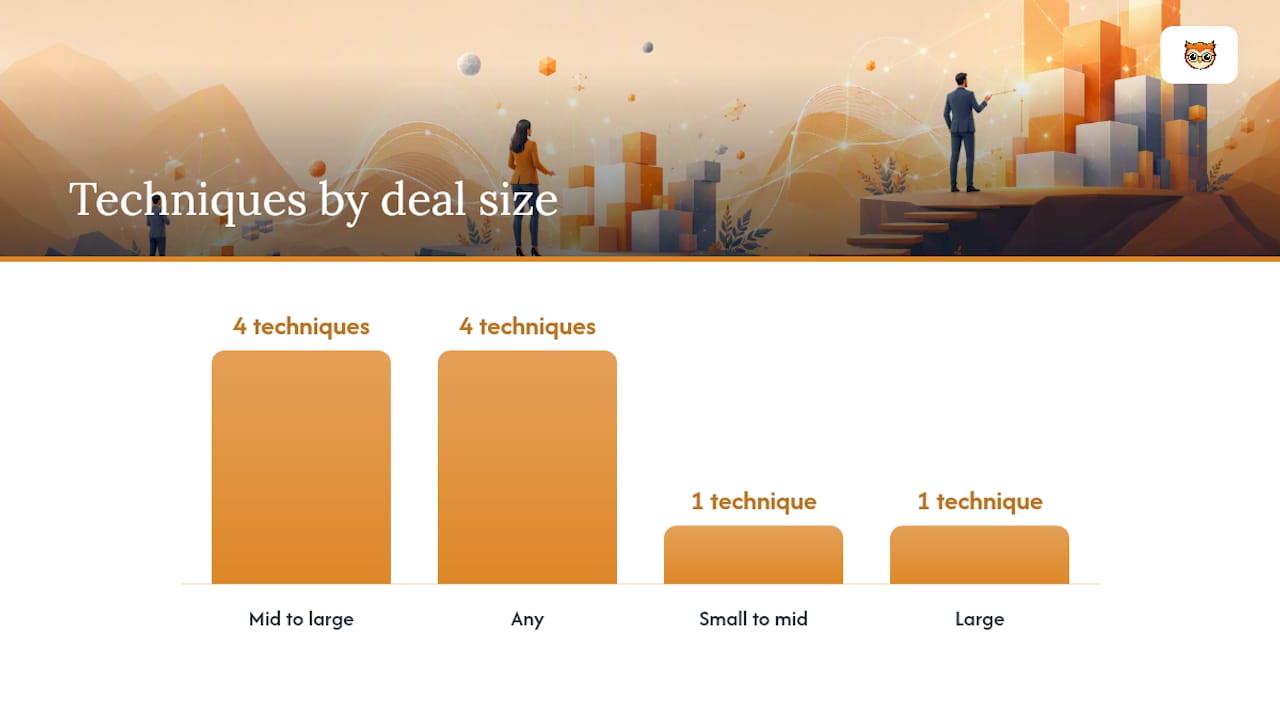
Applying techniques at random is one of the most common reasons pipelines stall. Top-performing teams use a deliberate stack: one methodology for qualification, one for discovery, and one for differentiation. The table below maps each technique to the context where it tends to win.
| Technique | Deal size | Sales cycle | Buyer sophistication | Best signal to use it |
|---|---|---|---|---|
| Consultative selling | Mid to large | Medium to long | Medium to high | Buyer has a complex, partially-defined problem |
| SPIN questioning | Mid to large | Medium to long | Medium to high | Discovery call; buyer hasn't quantified their pain |
| Challenger | Large | Long | High | Buyer is complacent; you have a commercial insight |
| Sandler | Any | Short to medium | Any | Pipeline bloated with unqualified deals |
| SNAP | Small to mid | Short | Low to medium | Busy buyer; short attention span |
| Value-based selling | Mid to large | Medium to long | High | Internal sign-off required; finance involved |
| Storytelling | Any | Any | Any | Buyer is risk-averse or sceptical |
| Active listening/mirroring | Any | Any | Any | Hesitation or vague pushback detected |
| Objection handling | Any | Any | Any | Stated resistance at any stage |
| Social selling / ABM | Mid to large | Long | Medium to high | Defined ICP; intent signals visible |
A short discovery checklist to pick your approach:
- What is the deal size and likely number of decision-makers?
- Has the buyer quantified the cost of their problem, or do they need help doing that?
- Is the buyer complacent (status quo bias) or actively looking for a solution?
- How much time does the buyer have? Are they distracted or engaged?
- Do you have a commercial insight they don't already know?
- Is there a champion who can carry your case internally?
On stacking methodologies: use MEDDIC or MEDDPICC for qualification on any deal with procurement involvement or multiple stakeholders. MEDDIC-style qualification reduces pipeline waste and sharpens forecast accuracy on complex deals. Layer SPIN on top for discovery, then use Challenger or value-based selling for differentiation once you've earned the right to challenge. Situational fluency, the ability to switch between transactional, consultative, and provocative styles by buyer and stage, is what separates good reps from great ones.
How to practise techniques and measure what moves the needle
Knowing a technique and being able to use it under pressure are different things. The most effective practice format is a short, structured role-play followed by immediate micro-feedback, not a half-day workshop you forget by Friday.
A 30-minute practice sprint (run weekly):
- Pick one technique (e.g. SPIN implication questions).
- One rep plays the buyer using a real objection from last week's pipeline.
- The seller runs the technique for ten minutes.
- Spend fifteen minutes on specific feedback: what landed, what broke the flow, what to change next time.
Rotate the technique each week. After four weeks, you'll have covered the core stack and reps will have muscle memory on the moves that matter most.
The four-step experiment template:
| Step | What to do |
|---|---|
| Hypothesis | "If I add an implication question in every discovery call this fortnight, my meetings-to-proposal rate will improve." |
| Run | Apply the behaviour consistently across all live deals for two to four weeks. |
| Measure | Pull qualification rate, deal velocity, and win rate from your CRM before and after. |
| Iterate | If the metric moved, embed the behaviour. If it didn't, adjust the question or the context. |
Short, measurable experiments of two to four weeks outperform long training programmes because they tie behaviour change to real pipeline data rather than training completion scores.
KPIs worth tracking in your CRM:
- Qualification rate: percentage of opportunities that meet your ICP criteria after discovery.
- Meetings-to-proposal: how many discovery calls convert to a formal proposal.
- Deal velocity: average days from first contact to close.
- Win rate: closed-won as a percentage of all closed deals.
- Multithread coverage: percentage of active deals with three or more stakeholder contacts logged.
- Average deal size: tracks whether value-based selling is moving the number upward.
Log these before you change anything. Without a baseline, you can't tell whether the technique worked or the market shifted. A structured sales strategy that defines goals and measures performance at each stage makes technique experiments far more reliable.
Coaching cadence for managers: one call-shadowing session per rep per fortnight, with written feedback on one specific behaviour. Weekly fifteen-minute pipeline reviews focused on technique application, not just deal status. The question to ask every rep: "Which technique did you use in that last call, and what would you do differently?"
Why consultative discovery and SPIN are the right place to start
Most sellers reach for the close too early. They pitch before they've diagnosed, and they mistake a buyer's polite engagement for genuine interest. The evidence is consistent: diagnosis-first discovery, quantifying the cost of inaction, and insight-led messaging are the behaviours that separate high performers from average ones. That's why consultative discovery combined with SPIN is the default starting stack for most sellers, regardless of industry or deal size.
SPIN's implication questions do something no pitch can: they get the buyer to articulate the cost of their own problem. Loss aversion is a powerful motivator. When a buyer says "if this isn't fixed by Q3, we'll miss our target," they've created urgency themselves. You didn't manufacture it.
The Challenger approach is genuinely powerful, but it's often misapplied. Use it only when you can bring a commercial insight the buyer hasn't already considered. Walking in with a generic "most companies in your sector are doing X wrong" without specific data for that buyer's situation reads as arrogant rather than insightful. Challenger earns its keep in enterprise deals where you've done the homework.
One non-obvious tip: multithreading is the highest-leverage behavioural change most B2B reps can make right now. A single champion is a single point of failure. Three engaged stakeholders means your deal survives a reorganisation, a budget freeze, or a champion going on leave.
For creators and instructors who sell educational products and digital courses, the same principles apply. Consultative discovery uncovers what a learner or buyer actually needs. Value-based framing makes the outcome of a course or e-book tangible. Bibliowlteca's platform gives creators the analytics and sales tools to track which messages and offers convert, so the measurement loop is built in.
Sources
These sources cover the core methodologies and measurement approaches in depth.
- 10 of the best sales techniques used by high-performing reps today (Highspot)
- Firstsales
- Proven sales techniques (Zendesk)
- Top sales methodologies & types of selling guide 2026 | Mindtickle