
TL;DR:
- Most info products fail due to lack of market validation and audience building.
- High earnings are achieved through systematic validation, multiple products, and consistent effort.
- Building a global audience and portfolio is key to scaling digital product income.
The uncomfortable truth about digital products is that most earn under £300 over their entire lifetime, with 68% making fewer than ten sales. That is not a reason to walk away; it is a reason to approach this differently. Creators who understand the mechanics of validation, audience building, and portfolio strategy consistently outperform that grim median. This guide walks you through the frameworks that separate those who build a sustainable digital income from those who publish once, wait, and wonder why nothing happened.
Table of Contents
- Understanding info products: what sells and why
- Validating and planning for demand
- Which info product business model suits you?
- Building audiences and multiplying revenue globally
- Pitfalls to avoid and habits of high earners
- What most info product advice misses
- Ready to launch your info product to a global audience?
- Frequently asked questions
Key Takeaways
| Point | Details |
|---|---|
| Validate before building | Testing and pre-selling your idea stops wasted effort and increases your odds of breaking average income. |
| Leverage multi-product portfolios | Creators with several related products earn far more than those with just one. |
| Cohort models boost outcomes | Courses with scheduled sessions and accountability drive much higher completion than self-paced formats. |
| Prioritise global reach | Using compliant platforms opens international sales and reduces payment or legal issues. |
| Persistence is key | It takes at least six months to see significant growth in info product income; quitting too early is the main reason for failure. |
Understanding info products: what sells and why
Not all information products are created equal, and understanding the differences can save you months of wasted effort. An info product is any digital asset that packages knowledge into a format buyers can use, such as e-books, templates, online courses, membership content, resource bundles, and toolkits. The format you choose shapes your price point, your production effort, and ultimately your earning potential.
Here is a quick comparison of the most common info product types and their typical performance benchmarks:
| Product type | Average sales | Average price | Revenue profile |
|---|---|---|---|
| Digital download / template | 293 sales | £37 | High volume, lower margin per unit |
| Online course (full) | 115 sales | £76 | Lower volume, higher value per sale |
| E-book | 293 sales | £12 | High volume, entry-level income |
| Mini-course | 180 sales | £45 | Balance of reach and revenue |
| Bundle / toolkit | 150 sales | £65 | Strong perceived value |
The empirical data from Gumroad paints a clear picture: digital downloads average 293 sales at around £37, while full courses average 115 sales at roughly £76. Templates sit in the £12 to £39 range, mini-courses at £23 to £77, and full courses between £77 and £237. These numbers are median figures; the top performers pull far ahead of these averages.
The financial appeal of this model is real. Profit margins in info products typically land between 90% and 95%, which is extraordinary compared to physical goods or service businesses. Once the product is built, every additional sale costs almost nothing to fulfil.
However, that margin advantage only matters if you are actually selling. Most creators focus entirely on production quality and almost nothing on audience. That is the wrong priority.
"The product is not the business. The audience is the business. Without people ready to buy before you launch, even the most polished course will sit unnoticed."
The creators who consistently publish and distribute info products successfully understand something fundamental: a mediocre product sold to an engaged audience will always outsell a brilliant product nobody knows about. This does not mean produce sloppy work; it means build your audience first and let product development follow the demand you uncover.
Here is what consistently sells in the creator economy right now:
- Practical templates that save buyers measurable time
- Actionable mini-courses that solve a single, specific problem
- Resource bundles combining tools, checklists, and guides
- Niche e-books targeting underserved professional audiences
- Step-by-step playbooks covering skills with clear outcomes
If you are serious about growing your online business through digital products, keep this list close. The common thread across all high-selling formats is that they promise a concrete, tangible outcome. Vague titles and generic content underperform every time.
Validating and planning for demand
Here is where most creators skip the most important step entirely. They spend weeks building a course, designing beautiful covers, and writing detailed sales pages before confirming anyone actually wants what they are selling. The result is predictable: low sales, confusion, and often giving up.
Validation before building is not optional. The data shows that 68% of info products make fewer than ten sales, and the primary reason is not poor quality; it is lack of demand confirmation. Pre-selling to five to ten buyers before you finish building is the single most effective way to avoid joining that majority.
Follow these steps to validate your idea before investing significant time in creation:
- Identify the specific pain point your product addresses. Write it in one sentence, no jargon allowed.
- Post about the problem in communities, forums, or on social media where your target audience gathers. Measure engagement honestly.
- Create a landing page describing the product and its outcome. Do not build the product yet; simply gauge interest.
- Offer a pre-sale at a discount, typically 30 to 50% off the intended launch price. Collect actual payments, not just email sign-ups.
- Set a minimum threshold, say five to ten confirmed buyers, before you commit to finishing the product. If you do not hit it, pivot or reframe.
- Run one-to-one interviews with people who did not buy. Their objections are more valuable than the opinions of those who did.
Pro Tip: Validation is not about getting permission; it is about gathering signal. If five people pay you for something that does not exist yet, you have proof. If nobody pays, you have learned something crucial at minimal cost.
The success of any info product hinges on audience and problem fit far more than on production quality. That is why 63% of creators earning less than £400 per month skipped validation entirely and moved straight to building. They invested weeks of effort chasing a product concept nobody confirmed wanting.

Feedback loops are equally important after your initial pre-sale. Ask early buyers what they expected versus what they received. Ask what would have stopped them buying. Ask what else they need. This information shapes not just the current product, but your entire roadmap. Testing assumptions about pre-selling and market testing continuously keeps your product catalogue aligned with what real buyers will actually pay for.
Which info product business model suits you?
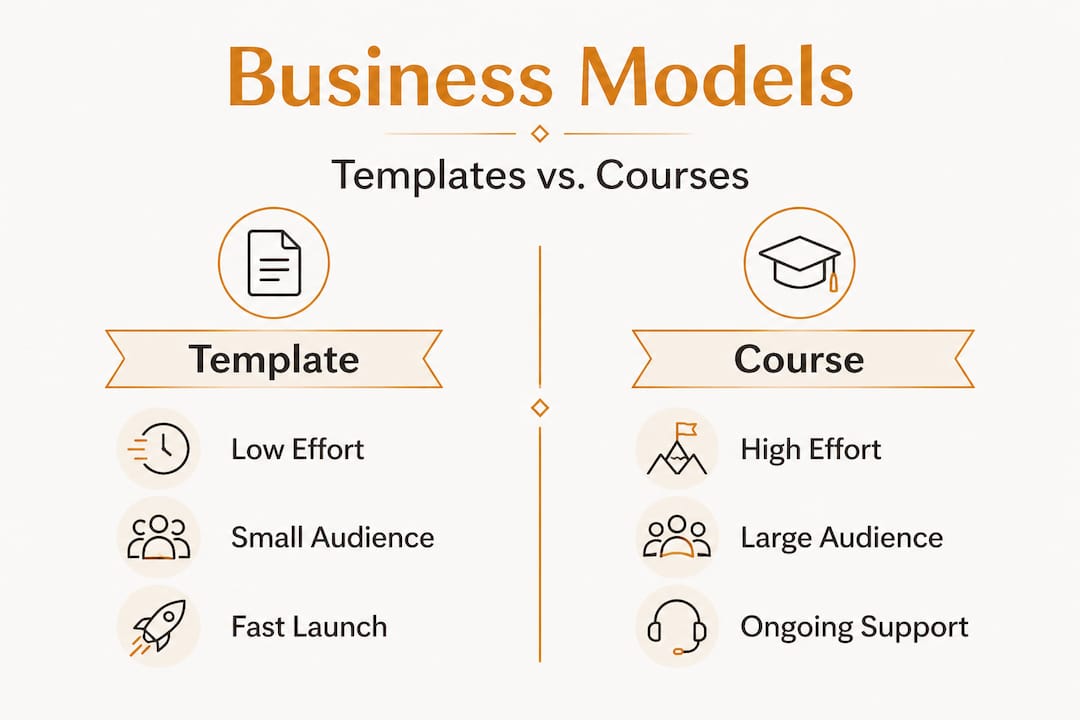
Once you have validated demand, the next decision is which business model to commit to. The wrong choice here does not mean failure, but it can mean months of slower progress. Two broad camps exist: low price and high volume, or high price and lower volume. Both work, but they require very different strategies.
Here is a direct comparison to help clarify the trade-offs:
| Model | Price range | Volume needed | Audience size needed | Effort per sale |
|---|---|---|---|---|
| Template / download | £12 to £39 | High | Large | Very low |
| E-book | £9 to £39 | High | Medium to large | Very low |
| Mini-course | £29 to £97 | Medium | Medium | Low |
| Full course | £97 to £297 | Low | Smaller, targeted | Medium |
| Cohort programme | £297 to £997 | Very low | Small, niche | High |
| Bundle | £49 to £197 | Medium | Medium | Low |
One counterintuitive finding from pricing research is that tiered pricing boosts mid-tier sales substantially. When you offer three versions of a product, a basic, a standard, and a premium, buyers anchor to the middle option. Testing a 20 to 50% price increase after your first successful round of sales frequently leads to better revenue without a proportional drop in conversions.
For course formats specifically, the choice between evergreen and cohort delivery matters enormously. Cohort-based programmes deliver completion rates of 50 to 60%, compared to less than 15% for self-paced evergreen courses. Higher completion rates mean better testimonials, more referrals, and a stronger reputation for your brand. The trade-off is that cohort delivery is significantly less passive than an automated evergreen funnel.
A blend works well for many creators: build the curriculum once, run it as a live cohort two or three times per year to generate testimonials and refine the content, then release an evergreen version between cohorts. This approach maximises both social proof and passive income potential.
Pro Tip: Do not treat your first product as your only product. Multi-product sellers offering eleven or more products earn nineteen times more than creators relying on a single item. Your first product is a proof of concept and an audience-building tool, not the finished business.
The strategic path most high earners follow involves moving from a low-cost entry product (an e-book or template to attract buyers) up to higher-priced offers as trust is established. If you plan to be selling globally as a creator, a tiered product range also helps you serve buyers across different income levels and markets. A buyer in South-East Asia may begin with your £15 template and later purchase your £197 course as confidence grows.
For those exploring formats for the first time, looking at ebook creation tools is a logical first step. E-books have the lowest barrier to creation and allow you to test your voice, your niche, and your ability to deliver value before committing to the significantly greater effort of a full video course.
Building audiences and multiplying revenue globally
Scaling an info product business beyond the median is fundamentally an audience problem. The quality of your content can hold the door open, but the size and engagement of your audience determines how far you walk through it. Creators who are systematic about audience building reach income levels that casual sellers never approach.
The numbers are striking. Data-driven creators who validate ideas, build multi-product catalogues, and persist for twelve to eighteen months regularly hit £8,000 to £10,000 per month in revenue. That is not a guarantee, but it is a documented trajectory for creators who treat this as a business rather than a side project.
Building globally adds another multiplier. A creator selling exclusively to a domestic audience is leaving substantial revenue on the table. English-language digital products in particular have enormous reach across Europe, Asia, Africa, and Latin America. But selling globally brings technical requirements you need to resolve early:
- Multi-currency pricing so buyers see costs in their local currency
- International payment processing that accepts cards, wallets, and regional methods
- Automated VAT and tax compliance to handle obligations in the EU, UK, and beyond
- Mobile-optimised product delivery since a large share of global buyers access content on phones
Platforms with built-in tax compliance and mobile apps handle the technical burden for you, which is why global monetisation works considerably better when you choose infrastructure rather than building it yourself from scratch.
Pro Tip: Price in the buyer's local currency wherever possible. Studies consistently show that seeing a familiar currency symbol removes hesitation and meaningfully increases conversion rates, particularly for buyers outside the US and UK.
The practical mechanics of audience building for info product creators involve several compounding actions:
- Email list building from day one, before your first product launches
- Content marketing through a blog, podcast, or video channel aligned to your product topic
- Community participation in forums, Discord groups, and social platforms where your buyers gather
- Strategic partnerships with other creators who serve the same audience but sell different products
- Affiliate programmes offering buyers a referral incentive to share your products with their networks
Good distribution and platform selection matters here too. The platform you choose shapes your discoverability, your buyer experience, and your ability to collect data about your customers. Keeping that data is non-negotiable; you should always own your email list, even if you use a third-party marketplace.
When setting up a digital storefront, resist the temptation to optimise for aesthetics over clarity. Buyers need to understand in five seconds what the product does, who it is for, and what result it delivers. Everything else is secondary.
Pitfalls to avoid and habits of high earners
Understanding what works is valuable. Understanding what consistently kills early-stage info product businesses is arguably more valuable. The mistakes are predictable and avoidable if you know what to look for.
Here are the most common reasons info products fail, in order of how frequently they appear:
- No validation before building. The creator assumes demand exists because the topic interests them personally.
- Front-loading theory. The product is dense with background information and light on actionable steps buyers can implement immediately.
- Single product reliance. One product launch, one window of promotion, and then waiting indefinitely for organic sales that never arrive.
- Quitting before six months. Most sustainable info product businesses take several months of consistent effort before revenue becomes meaningful.
- Ignoring buyer feedback. Early buyers tell you exactly what to build next, and most creators do not ask.
- Underpricing from fear. Setting prices too low does not attract more buyers; it reduces perceived value and attracts buyers who are unlikely to complete the product.
Common pitfalls like skipping action steps, front-loading theory, and quitting before hitting the six-month mark account for the vast majority of early failures. None of these are talent problems. All of them are strategy and patience problems.
Now look at the habits on the other side of that ledger. Creators who consistently earn above the median share several behaviours.
"The creators earning real money in digital products are not necessarily more talented. They are more systematic. They validate, iterate, build a catalogue, and keep showing up after most others have stopped."
Data-driven approaches that include validation, three or more products, and at least six months of consistent effort increase the likelihood of reaching £8,000 per month by roughly six times compared to creators who skip those steps. Six times. That is not a marginal advantage; it is a fundamentally different outcome.
Use this product development checklist as a reference point when building your next product. Systematic checklists reduce the errors that come from excitement-driven shortcuts, and they ensure that each product you release is positioned to succeed rather than simply existing.
High-earning creators also treat feedback as an asset. Every complaint, every refund request, every "I wish this included..." comment is product research. Treat your buyers as collaborators in your product roadmap and you will rarely struggle to find your next idea.
What most info product advice misses
Most articles about selling info products focus heavily on tactics: which platform to use, what price to set, how to write a sales page. These things matter, but they are not where the real leverage lives. The creators we see build durable digital businesses consistently focus on something less exciting and far more powerful: the long game.
The honest pattern in the data is that almost nobody succeeds with their first product alone. The product that matters most is usually the third or fourth one, built on the audience feedback and credibility earned by the first two. Yet almost every piece of beginner advice frames the first launch as the defining moment. It is not. It is the beginning of a research process.
There is also a widespread obsession with the launch. The launch day email sequence, the countdown timer, the limited-time offer. These tools can move sales, but they cannot rescue a product that lacks genuine audience-problem fit. We have seen creators invest enormous energy into a perfect launch for a product nobody validated, and the result is always disappointing. The excitement of launch mechanics is a distraction from the quieter, harder work of building trust with a specific audience over time.
Our perspective at BibliOWLteca, shaped by watching thousands of creators navigate this space, is that portfolio building is the actual business strategy. A single product is a test. Two or three products targeting the same audience at different price points is a business. From there, the compounding effect of reputation, referrals, and organic discovery starts to do real work.
This connects directly to the global sales perspective that often gets overlooked: creators who approach international markets early, rather than waiting until they have "proved" the concept locally, benefit from a much larger pool of potential buyers and faster audience growth. The world is the market. Waiting to go global is waiting to grow.
The mindset shift that separates serious creators from hopeful ones is simple: stop thinking about your next launch and start thinking about your next buyer's journey. What do they buy first from you? What do they need six months later? What problem emerges after they have used your first product? Answer those questions with products and you will always have something to sell.
Ready to launch your info product to a global audience?
Turning the insights from this guide into real income requires more than a plan; it requires the right infrastructure behind you.
BibliOWLteca is built specifically for creators and educators who want to sell e-books, courses, templates, and digital bundles to a worldwide audience without the administrative headaches of international payments, tax compliance, and multi-currency pricing. From your first product to a full catalogue, the platform scales with you. Explore what is possible for your knowledge business by visiting the BibliOWLteca marketplace and discovering the tools that make global digital sales straightforward, secure, and built for growth.
Frequently asked questions
What's the average income for info product creators?
The median info product earns roughly £290 lifetime across 28 sales, but top 1% creators take 77% of all revenue through multi-product portfolios and sustained audience building. The gap between median and top performers is almost entirely explained by catalogue size and consistency.
How can I increase my course completion rates?
Cohort-based delivery raises completion rates to 50 to 60%, compared to less than 15% for self-paced evergreen formats. Adding flexible deadlines within a structured cohort reduces drop-off without removing the accountability that drives completion.
Is it better to focus on a single product or multiple info products?
Focusing on a single product significantly limits your long-term revenue. Multi-product sellers offering eleven or more items earn nineteen times more than single-product creators, making portfolio growth one of the highest-leverage decisions in a digital products business.
What are common mistakes new info product creators make?
Skipping validation, relying on a single product, front-loading theory over actionable content, and abandoning the business before the six-month mark are the most frequently cited reasons why new creators fail to build sustainable income from digital products.