
A literature analysis must explain how a text produces meaning, not merely what it says. That single shift separates a strong analytical essay from a plot summary, and it is the foundation of every teachable lesson you can build around literary study.
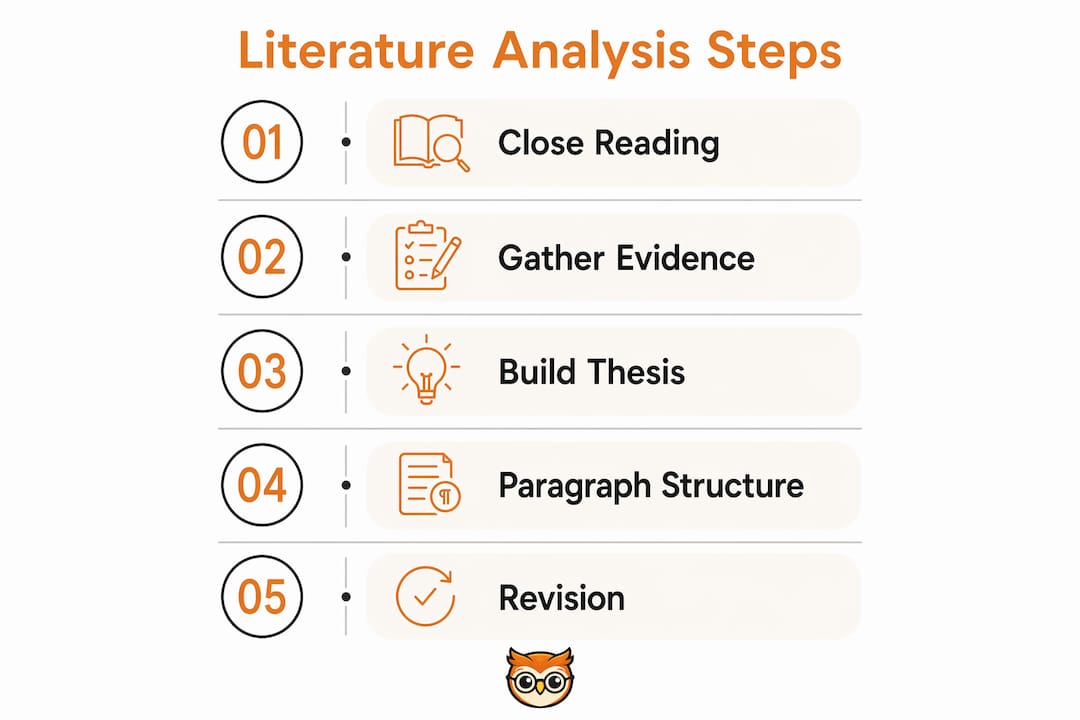
Four-step micro checklist:
- Close read the text, annotating for imagery, diction, tone, structure, point of view, symbolism, irony, and metre
- Gather evidence by extracting quotations, noting page or line references, and grouping patterns
- Build a working thesis from the evidence you have collected, not before it
- Write the analysis, ensuring every paragraph moves from claim to evidence to significance
A one-line thesis example: "In 'The Road,' McCarthy uses stripped syntax and absent colour to enact the moral desolation he describes." That is arguable, specific, and grounded in technique. The University of North Carolina Writing Center and LibreTexts both confirm this evidence-first approach as the standard for formal literary essays. Bibliowlteca's practical guides and templates are built using the same method.
Table of Contents
- What does a complete literature analysis checklist look like?
- How to write literature analysis: the full step-by-step method
- What does a strong analysis paragraph actually look like?
- What are the most common mistakes in literary analysis?
- How long does it take, and what should you check before submitting?
- How do you turn this lesson into a digital product to sell?
- Key takeaways
- Why "how" beats "what" every time
- Sell your literature-analysis lessons with Bibliowlteca
- Useful sources and further reading
What does a complete literature analysis checklist look like?
Use this checklist as a print-ready worksheet or the backbone of a micro-lesson.
Preparation
- Read the text once for overall impression, then re-read with a pen in hand
- Annotate for repeated imagery, tonal shifts, and structural anomalies
- Note any moments that surprise, confuse, or resist easy reading
Evidence gathering
- Extract five to ten quotations that support a potential argument
- Record page or line numbers alongside each quote
- Group quotes by technique or theme
Drafting
- Write a working thesis that is arguable and specific to technique
- Draft body paragraphs using the claim → evidence → analysis structure
- Keep each paragraph focused on one analytical point
Quoting and citation
- Introduce every quotation with a signal phrase
- Follow each quotation with analysis longer than the quote itself
- Use author–page referencing (MLA) or author–date (Harvard) as appropriate for your context; both are widely used in UK higher education
Final checks
- Confirm the thesis is answered, not just restated, in the conclusion
- Remove any sentences that only retell events
- Check that analysis outweighs quotation in every paragraph
Pro Tip: Convert this checklist into a two-column worksheet: left column lists each step, right column gives learners a blank box to complete. Sell it as a standalone printable or bundle it with a video lesson on Bibliowlteca.
How to write literature analysis: the full step-by-step method
Stage 1: close reading
Active annotation beats wholesale re-reading every time. Hunt for patterns rather than trying to absorb everything at once.
Focus your annotations on:
- Imagery and symbolism — what objects or scenes recur, and what do they accumulate?
- Diction — which word choices are unexpected, elevated, or deliberately plain?
- Tone and mood — does the narrator's attitude shift? Where?
- Structure and form — how are sections divided? Does the poem break its own metre?
- Point of view — is the narrator reliable? What do they withhold?
- Irony — where does the text say one thing and mean another?
The San Jose State University Writing Center puts it plainly: shift your reading focus from what the text says to how it says it. Technique and form are the raw material of analysis.
Stage 2: gathering and cataloguing evidence

Once you have annotated, extract your strongest quotations into a simple table: quote, technique it demonstrates, page or line reference, and a brief note on its potential significance. Three columns on a spreadsheet or a handwritten grid both work. This format is reusable as a learner worksheet.
Pro Tip: Give learners a pre-formatted evidence table as part of a worksheet pack. It forces them to articulate technique before they draft, which dramatically reduces summary-heavy writing.
Stage 3: building a working thesis
Delay finalising your thesis until you have gathered substantial evidence. A working thesis is a provisional claim you tighten as evidence accumulates, not a fixed statement you defend regardless of what the text shows.
Three thesis templates for learners:
- Thematic: "[Author] uses [technique] to argue that [theme], challenging the reader's assumption that [counterpoint]."
- Character-centred: "Through [character]'s [behaviour/speech/development], [Author] reveals [psychological or moral claim]."
- Comparative: "Where [Text A] uses [technique X] to [effect], [Text B] deploys [technique Y] to [contrasting effect], suggesting [broader claim]."
For creators designing exam-preparation modules, the AP English analysis essay guidance from David TC Tutoring Services offers complementary thesis-construction advice worth adapting.
Stage 4: paragraph structure
Every body paragraph follows the same spine: topic sentence → evidence quote → analysis → mini-conclusion. The quote sandwich is the practical mechanism: introduce the quote, present it, then analyse it in more depth than the quote itself occupies. The analysis must be longer than the quotation.
Stage 5: revision
Read each paragraph and ask: does this sentence advance the argument, or does it retell the story? Cut the latter. Check that the ratio of analysis to quotation favours analysis. Confirm the thesis is genuinely answered in the conclusion, not merely restated.
What does a strong analysis paragraph actually look like?
Model analysis paragraph:
Gibson's opening simile replaces natural imagery with a technological one, immediately signalling that nature has been displaced by machinery in this world. The phrase "dead channel" carries connotations of failure and vacancy rather than the neutral blankness a grey sky might suggest; the sky is not merely overcast but broken. The choice of a television — a domestic, passive object — as the vehicle for this comparison positions the reader inside a culture that mediates even its perception of the sky through screens.
Annotation callouts:
- Claim: the simile signals technological displacement of nature
- Why this quote: it is the first sentence, so it establishes the novel's entire perceptual framework
- How the language works: "dead channel" shifts the register from description to malfunction; "color of television" makes the comparison precise and era-specific
- So what? The reader is placed in a world where the natural and the artificial have already merged — before any plot has begun
Alternate reading: one could argue the simile is nostalgic rather than dystopian, evoking the analogue television era Gibson's first readers would recognise, which softens the technological alienation with familiarity. Teaching both readings shows learners that literary analysis is interpretive, not a search for a single correct answer.
What are the most common mistakes in literary analysis?
Plot summary instead of analysis
- Weak: "Hamlet sees his father's ghost and decides to get revenge."
- Stronger: "The ghost's command forces Hamlet into a role his language consistently resists, creating the play's central tension between action and reflection."
A thesis that states a fact rather than an argument
- Weak: "Love is a theme in Romeo and Juliet."
- Stronger: "Shakespeare frames romantic love as a force that accelerates rather than transcends social conflict."
Quote dumping — presenting three quotations in a row without analysis between them. Each quote needs its own analytical sentence before the next piece of evidence appears.
Premature thesis — writing a fixed claim before reading closely. The UNC Writing Center is explicit: let the working thesis emerge from evidence, not the other way around.
Ignoring form — analysing only content while overlooking metre, sentence length, narrative voice, or structural choices. Form is where technique lives.
Quick corrective activity for creators: give learners a weak paragraph and ask them to identify which of the five faults above it commits, then rewrite one sentence to fix it. Five minutes; high impact.
How long does it take, and what should you check before submitting?
| Stage | Short assignment | Longer essay |
|---|---|---|
| Close reading and annotation | at least 30 minutes or more | up to 90 minutes |
| Evidence gathering | 20 minutes | around 45 minutes |
| First draft | about an hour | 3–4 hours |
| Peer review | 15 minutes | at least 30 minutes |
| Revision | at least 30 minutes | about an hour |
| Final polish | 15 minutes | at least 30 minutes |
Editing checklist:
- Thesis is arguable and specific to technique, not theme alone
- Every body paragraph opens with a topic sentence linked to the thesis
- No paragraph ends on a quotation without following analysis
- Quotations are introduced, presented, and analysed (quote sandwich)
- Citations use a consistent referencing style throughout (MLA author–page or Harvard author–date are both standard in UK contexts)
- No sentences that only retell plot
- Conclusion restates the thesis in new language and explains its significance
Peer-review prompts for creators to distribute:
- Can you identify the thesis in one sentence? Is it arguable?
- Find one paragraph where the analysis feels thin. What question is it failing to answer?
- Is there any sentence that only summarises events? Mark it.
How do you turn this lesson into a digital product to sell?
The method above maps directly onto several sellable formats. For UK-based creators, the packaging decisions involve copyright, pricing, and VAT awareness.
Product ideas:
- Printable worksheet pack — evidence table, paragraph-structure template, editing checklist (three to five pages; low price point)
- Annotated-paragraph template pack — five worked examples across different genres with blank versions for learner practice
- 45–90 minute micro-course — screen-recorded walkthrough of the four stages, plus downloadable worksheets
- Mini-ebook with worked examples — a short guide (5,000–8,000 words) with annotated paragraphs and thesis templates
- Assessment rubric pack — marking criteria aligned to UK GCSE or A-level descriptors, sold to teachers
UK copyright note: when quoting literary passages in paid digital products, UK fair dealing provisions under the Copyright, Designs and Patents Act 1988 allow limited quotation for criticism and review, but the extent of "limited" is not precisely defined by statute. For any product containing substantial extracts, consult GOV.UK or a legal adviser before publishing. This is general information, not legal advice.
VAT: digital products sold to UK consumers by UK-registered sellers are subject to VAT. If your turnover exceeds the current registration threshold, you must charge VAT on digital sales. Check the current threshold and rules at GOV.UK.
Pricing shape (tiered suggestions):
- Single printable worksheet: £2–£5
- Template or worksheet bundle: £8–£15
- Micro-course with worksheets: £20–£45
- Mini-ebook: £5–£12
Bibliowlteca supports all of these formats: course hosting, e-books, and global payments are built into the platform, so you can sell a worksheet pack and a video course from the same storefront.
Pro Tip: For learners who need extra scaffolding, the ELA skills guide from David TC Tutoring Services offers accessible strategies you can adapt into differentiated worksheet versions of your product.
Key takeaways
A literature analysis succeeds when it explains how a text produces meaning through technique, not merely what it says, and every paragraph answers the "so what?" question explicitly.
| Point | Details |
|---|---|
| Analysis, not summary | Every paragraph must move from technique to significance, never just retell events. |
| Evidence-first thesis | Gather quotations before finalising your thesis; a working thesis tightens as evidence accumulates. |
| Quote sandwich | Introduce, present, then analyse each quotation; analysis must be longer than the quote itself. |
| Packaging for sale | A worksheet pack, micro-course, or mini-ebook can each be built directly from the four-stage method above. |
| Bibliowlteca for creators | Sell worksheets, e-books, and video courses from one storefront with built-in global payments and digital delivery. |
Why "how" beats "what" every time
The single most persistent problem in literary analysis teaching is not that learners lack intelligence. It is that they have been rewarded, for years, for demonstrating that they understood the story. Retelling the plot accurately feels like success. It is not.
The shift to asking how a text works is genuinely difficult to teach because it requires learners to trust that their observation of a technique is worth something before they can explain why. Most students abandon the observation the moment they cannot immediately articulate its significance. The fix is to make the "so what?" question a visible, named step in the process rather than an implicit expectation. When you build it into a worksheet as a labelled box, learners stop skipping it.
For creators packaging this as a course, that is the insight worth selling: not the content knowledge, but the habit of mind. A learner who can ask "how does this word choice change what I feel?" is equipped for every text they will ever encounter. That transferability is what justifies the price of a well-designed literary analysis course.
Sell your literature-analysis lessons with Bibliowlteca
You have built the method. Now the question is how to reach learners who will pay for it. Bibliowlteca gives creators a single place to host video courses, sell e-books and printable resources, and manage global payments without needing a separate payment processor or delivery system. The platform handles VAT compliance for digital sales across multiple jurisdictions, which removes one of the more tedious administrative barriers for UK creators selling internationally.

Three features that matter most for literature educators: course hosting with video and quizzes, secure digital delivery for worksheets and PDF packs, and a customisable storefront where your entire product range sits together. You can price a single worksheet at £3 and a full course at £40 on the same page, with no separate tools required. Start listing your first product at Bibliowlteca today.
Useful sources and further reading
The following sources informed this guide and are worth bookmarking for your own teaching notes or course bibliographies.
- University of North Carolina Writing Center — Literature & fiction tips — the clearest available guidance on the "so what?" problem and working-thesis development; ideal as background reading for learners
- San Jose State University Writing Center — Literary analysis handout — concise model paragraph and technique-focused reading advice; printable for classroom use
- University of Wisconsin — Close reading handbook — practical annotation method; adapt the annotation priorities directly into a learner worksheet
- LibreTexts — Writing a literary analysis essay — thorough overview of essay structure and the transition from response writing to formal analysis
- Bucks County Community College — How to write a literary analysis essay — the definitive source for the quote sandwich method; useful as a citation example in your own course materials
- SparkNotes — How to write literary analysis — accessible seven-step overview; good as a learner-facing reference or supplementary reading
- Scribbr — How to write a literary analysis essay — step-by-step guide with clear examples of thesis development and body paragraph structure
- Bibliowlteca — What is literary analysis? A guide for students — background on essay structures and formal writing protocols; useful for lesson notes
- Bibliowlteca — Literary critique step by step — practical steps creators can repurpose as lesson modules
- Bibliowlteca — How to summarise a book — contrasts summarising with analysing; useful for teaching the distinction to learners
How to use these in teaching: assign the UNC and SJSU handouts as pre-reading before a workshop, use the Bucks PDF as a citation-method reference, and direct learners to the Bibliowlteca blog posts for accessible follow-up reading after your course module.