

TL;DR:
- A literary critique systematically interprets how a text creates meaning, differing from a review that recommends reading.
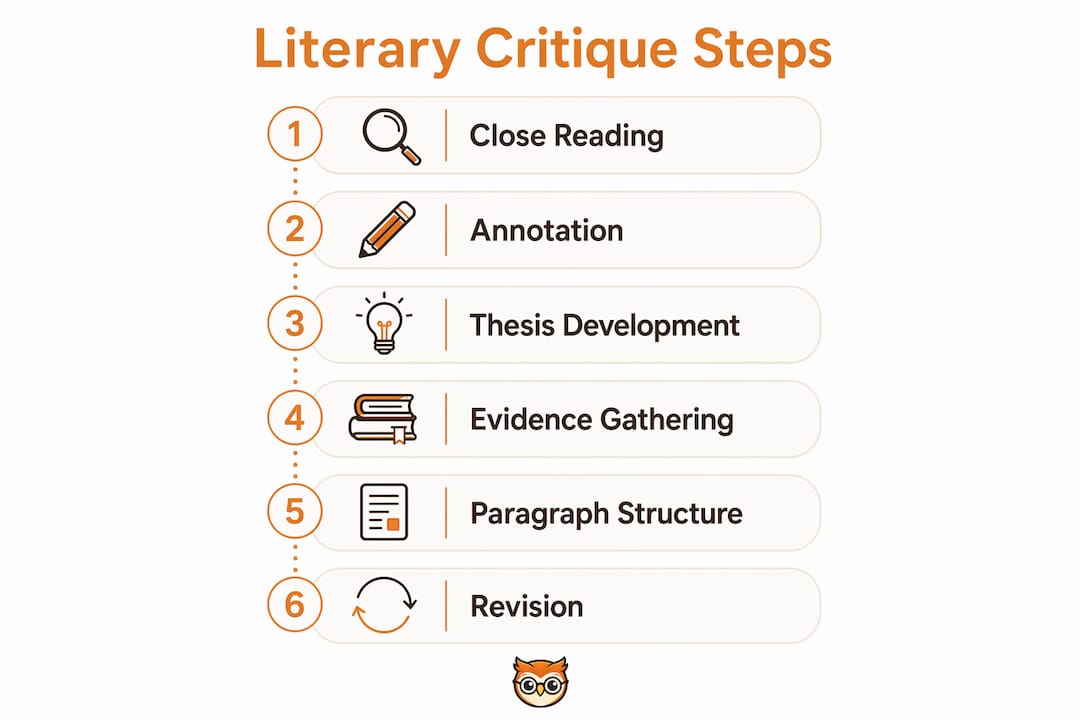
- The process involves close reading, thesis development, evidence gathering, structured writing, and revision, each stage building on the last.
A literary critique is a systematic interpretation and evaluation of a literary work, distinct from a book review in that it analyses how an author constructs meaning rather than recommending whether to read the text. Literary criticism focuses on interpretation and deep analysis, not subjective reaction. Students, aspiring writers, and literature enthusiasts who follow a literary critique step by step process produce sharper arguments, stronger evidence, and more persuasive writing. The standard academic term for this practice is literary criticism, and the two phrases are used interchangeably throughout this guide. The process moves through five clear stages: close reading, thesis development, evidence gathering, paragraph construction, and revision.
What does a literary critique step by step actually involve?
A step-by-step approach to literary criticism begins with close reading and ends with a polished, evidence-driven argument. Each stage builds on the last, so skipping one weakens the whole. The University of Texas at Arlington breaks the process into sequential actions, starting with reading and inquiry. That structure exists because literary analysis is not about personal opinion. It is about providing information, interpretation, and evaluation grounded in the text itself.
Literary criticism differs from a review in purpose and method. A review tells you whether a book is worth your time. A critique tells you how the text works and what it means. Keeping that distinction clear from the start shapes every decision you make, from the questions you ask while reading to the language you use in your final draft.
How do you perform close reading to uncover themes and style?
Close reading is the foundation of any literary analysis guide. It means reading slowly, with specific questions in mind, rather than absorbing plot. Targeted questions on theme, author intent, and style are the starting point for reliable literary criticism.
Questions to ask during close reading
Ask yourself the following while working through the text:
- What is the central theme, and how does the author develop it across the work?
- What narrative voice or point of view does the author use, and why?
- Which literary devices appear most frequently: metaphor, irony, symbolism, repetition?
- How do characters change, and what does that change reveal about the text's argument?
- What does the language itself do? Is it sparse, ornate, fragmented, or rhythmic?
- Where does the text create tension, and how is that tension resolved or left open?
These questions turn passive reading into active inquiry. They give you raw material for your thesis before you have written a single sentence of your critique.
Annotation techniques that capture your thinking
Annotation is the physical record of close reading. Write directly in the margins if the book is yours, or use sticky notes and a separate notebook. Mark passages where the language does something unexpected. Circle recurring words or images. Draw arrows between scenes that echo each other. Tools like Zotero help you organise digital annotations across multiple texts, and a simple spreadsheet can track page references, quotations, and initial observations.
The goal of annotation is not to summarise what happens. It is to record what you notice and what questions those observations raise. A well-annotated text becomes a map of your argument before you draft a single word. For a structured approach to this stage, the close reading workflow guide from Bibliowlteca walks you through each annotation step in detail.
Pro Tip: Read the text at least twice before you begin annotating seriously. The first read is for orientation. The second is where genuine close reading begins, because you already know where the text is going.
How do you develop a strong thesis for literary analysis?
A thesis in literary analysis is a specific, limited, and arguable claim about how a text works. Developing a specific, arguable thesis converts your reading observations into a focused argument. Without it, your critique becomes a catalogue of observations rather than a coherent interpretation.
Weak versus strong thesis statements
The difference between a weak and a strong thesis is the difference between description and argument.
- Weak: "George Orwell's Nineteen Eighty-Four is about a dystopian society where the government controls people."
- Strong: "Orwell uses the degradation of language in Nineteen Eighty-Four to argue that political oppression depends on destroying the capacity for independent thought."
The weak version summarises. The strong version makes a claim that requires evidence and analysis to prove. A strong thesis names a specific technique or pattern, connects it to a larger meaning, and invites disagreement. If no one could reasonably argue against your thesis, it is not analytical enough.
How to narrow your thesis scope
Broad theses produce shallow critiques. Narrow your focus by choosing one technique, one character arc, one recurring image, or one structural choice. Ask: what is the most interesting thing I noticed during close reading? Build your thesis around that observation. If you noticed that Toni Morrison's Beloved uses fragmented syntax whenever the protagonist confronts traumatic memory, that observation becomes the seed of a specific, provable claim.
Thesis statements benefit from revision as you gather evidence. Your initial thesis is a working hypothesis, not a fixed commitment. Adapt it when the evidence points in a slightly different direction. That flexibility is not weakness. It is how rigorous literary argument develops.
Pro Tip: Write your thesis on a separate card and keep it visible while you draft. Every paragraph you write should connect back to it. If a paragraph does not, cut it or revise the thesis.
How do you gather and integrate evidence effectively?
Effective critiques draw on both primary and secondary sources. Evidence from primary text and secondary critical sources forms the backbone of a persuasive literary argument. Primary sources are the literary texts themselves. Secondary sources include scholarly criticism, historical context, and theoretical frameworks.

Primary versus secondary sources: a comparison
| Source type | What it is | Example |
|---|---|---|
| Primary source | The literary text under analysis | A quotation from Mary Shelley's Frankenstein |
| Secondary source | Scholarly criticism or historical context | A journal article on Gothic conventions in Shelley's era |
| Primary source | Another work by the same author | Shelley's letters or prefaces |
| Secondary source | Theoretical framework | Feminist criticism applied to the novel |
Secondary sources do not replace your own analysis. They contextualise it. A critic's reading of Frankenstein as a birth anxiety narrative adds weight to your argument, but your job is to show how specific passages in the text support or complicate that reading.
Selecting and integrating quotations
Use concise quotes that do analytical work. A three-word phrase from a poem can carry more argumentative weight than a ten-line block quotation. Select the smallest meaningful passage that proves your point, then explain exactly what it does. Introduce quotations with context: name the speaker, the situation, and the significance before the quote appears. After the quote, analyse it. Never leave a quotation to speak for itself.
Paraphrase when the exact wording matters less than the idea. Use a critic's opinion when it supports or challenges your reading. Historical information works best when it explains why an author made a particular choice. For guidance on synthesising multiple sources, the literature review guide from Bibliowlteca covers source integration in depth.
Pro Tip: For every quotation you include, write at least two sentences of analysis. If you cannot explain what the quotation proves, replace it with one you can explain.
How do you write structured body paragraphs in a literary critique?
The most reliable paragraph structure for literary criticism is Point, Evidence, Analysis, Link. This structure places analysis at the centre, not quotation. Each element has a specific job.
-
Point. Open with a topic sentence that states the analytical claim of the paragraph. It should be specific enough to prove and directly connected to your thesis. Avoid opening with a quotation or a plot summary.
-
Evidence. Introduce your quotation or paraphrase with context. Name the character, situation, or moment. Then present the evidence itself, formatted according to your citation style, whether MLA, APA, or Chicago.
-
Analysis. This is where literary critique lives. Explanation and unpacking of textual evidence is where analysis truly happens. Explain what the evidence shows, how it works, and why it matters. Avoid phrasing your analysis as "I think" or "I feel." Ground every claim in the text. Evidence-based evaluation analyses purpose, organisation, and language rather than personal reaction.
-
Link. Close the paragraph by connecting your point explicitly back to the thesis. This sentence reminds the reader why this paragraph matters to the overall argument. It also creates a bridge to the next paragraph.
Build paragraphs around clear claims provable by evidence. A paragraph that presents a quotation without a clear claim produces disconnected evidence without argument. The claim comes first, always. Each paragraph in your critique should advance the thesis by one logical step, so that by the end of the essay, the reader has followed a complete line of reasoning from introduction to conclusion.
How do you revise and polish a literary critique?
Revision is where a competent critique becomes a strong one. Final editing strengthens clarity, coherence, and argument. Most writers underestimate how much revision changes a draft. A first draft proves you have ideas. A revised draft proves you can argue them.
Work through this checklist during revision:
- Argument: Does every paragraph connect to the thesis? Remove any paragraph that does not.
- Topic sentences: Does each paragraph open with a clear analytical claim? Rewrite vague openings.
- Quotation integration: Are all quotations introduced with context and followed by analysis?
- Transitions: Do paragraphs flow logically from one to the next? Add linking sentences where the logic jumps.
- Introduction: Does your opening paragraph establish the text, the critical approach, and the thesis clearly?
- Citation format: Are all quotations and paraphrases cited correctly in MLA, APA, or Chicago style?
- Grammar and spelling: Use Grammarly or the Hemingway Editor to catch surface errors, but read the draft aloud to catch awkward phrasing that software misses.
- Peer review: Ask a classmate or tutor to read for argument clarity, not just surface errors. A reader who does not know the text will quickly identify where your reasoning is unclear.
Revision is not proofreading. Proofreading fixes spelling. Revision fixes thinking. Treat them as separate stages, and always revise before you proofread.
Key takeaways
A literary critique step by step is most effective when close reading, thesis development, evidence gathering, structured paragraphs, and careful revision are treated as distinct, sequential stages rather than overlapping tasks.
| Point | Details |
|---|---|
| Close reading comes first | Ask targeted questions about theme, style, and intent before drafting anything. |
| Thesis must be arguable | A strong thesis names a specific technique and connects it to a larger meaning. |
| Evidence needs analysis | Every quotation requires at least two sentences of explanation to carry argumentative weight. |
| Paragraph structure matters | The Point, Evidence, Analysis, Link structure keeps analysis central and argument coherent. |
| Revision is a separate stage | Revise for argument strength before proofreading for grammar and citation format. |
What literary critique has taught me about reading and writing
The most common mistake students make is treating quotation as argument. They find a striking passage, drop it into a paragraph, and assume the text speaks for itself. It never does. The argument lives in the explanation, not the quote. A multi-step workflow from reading through annotation to revision exists precisely because each stage forces you to do different cognitive work. Skipping annotation means your thesis will be vague. Skipping revision means your argument will be incomplete.
The other mistake is treating the thesis as permanent. Writers who fix their thesis before gathering evidence spend the rest of the critique forcing the text to fit a claim it does not support. The thesis is a working hypothesis. Revise it when the evidence demands it. The best literary arguments I have encountered were written by people who changed their thesis at least once during drafting, because they were genuinely listening to what the text was doing.
Persistence matters more than initial insight. The first draft of a literary critique is almost always a discovery draft. You find out what you think by writing badly first. The critique that earns a strong mark is the third or fourth version, shaped by evidence, peer feedback, and honest revision. Students who treat the first draft as the final draft consistently underperform their own potential.
— Bibliowlteca
Bibliowlteca: digital resources for literary analysis
Bibliowlteca is a digital platform where educators and literary experts publish courses, e-books, and mentorship programmes for students and writers worldwide. If you are working through your first literary critique or refining your analytical writing at an advanced level, the platform gives you access to expert-led content on close reading, thesis development, and academic writing.

Bibliowlteca supports multiple currencies and international payments, so readers anywhere can access quality literary analysis content without friction. Explore the full range of courses and digital resources, or check the available plans and pricing to find the right level of support for your studies. The platform's features for courses and e-books are built for learners who want structured, expert guidance rather than scattered free content.
FAQ
What is a literary critique?
A literary critique is a systematic analysis and interpretation of a literary work that focuses on how the text creates meaning. It differs from a review by prioritising interpretation over recommendation.
How do I start a literary critique?
Start with close reading. Ask targeted questions about theme, authorial intent, and style, then annotate the text to record your observations before drafting a thesis.
What makes a good thesis for literary analysis?
A strong thesis is specific, limited, and arguable. It names a particular technique or pattern in the text and connects it to a broader interpretive claim, rather than summarising the plot.
How many sources does a literary critique need?
The text itself is your primary source. Most academic critiques also draw on two to four secondary sources, such as scholarly articles or historical context, to support and contextualise the argument.
How is literary criticism different from a book review?
Literary criticism focuses on interpretation, analysis, and evaluation of how a text works. A book review offers a subjective response and a recommendation about whether to read the book.