
TL;DR:
- A systematic literature synthesis involves evaluating, summarising, synthesising, and integrating sources into a coherent argument, rather than just describing each one. Students should clarify their review's purpose, narrow their topic, establish inclusion criteria, and develop a structured search strategy with detailed logging to ensure methodological rigor. Effective reviews synthesize themes across sources, organize around patterns, and develop a clear thesis after analyzing the literature, not before.
Most students approach a literature review the same way: open a search engine, collect a pile of papers, and start writing summaries. The result is a list disguised as an argument. Learning to conduct a literature review step by step changes that entirely. Formally known as a systematic literature synthesis, this process requires you to evaluate, summarise, synthesise, and integrate sources into a coherent scholarly argument, not merely describe what each paper says. This guide walks you through every stage, from defining your topic to final revision, with specific strategies that will sharpen both your thinking and your writing.
Table of Contents
- Key takeaways
- Literature review step by step: laying the groundwork
- Searching and collecting relevant literature
- Reading, evaluating, and organising your sources
- Writing and revising the literature review
- Troubleshooting common challenges
- What I have learned from guiding literature reviews
- Take your research further with Bibliowlteca
- FAQ
Key takeaways
| Point | Details |
|---|---|
| Define scope first | Clarifying your topic and purpose before searching saves considerable time and keeps results relevant. |
| Synthesis over summary | Organise your writing around themes and patterns across sources, not author-by-author description. |
| Use an iterative approach | Expect to revisit earlier stages as your understanding deepens and new patterns emerge. |
| Keep a search log | Recording your search terms and databases prevents duplication and strengthens methodological transparency. |
| Thesis comes after reading | Develop your central argument once you have identified clear patterns in the literature, not before. |
Literature review step by step: laying the groundwork
Before you read a single paper, you need clarity on two things: what your review is actually about, and why you are writing it. These sound obvious, but most weak reviews fail at exactly this stage.
Clarifying your review's purpose early shapes every decision that follows: which databases you search, which sources qualify, and how you organise what you find. Ask yourself whether your review is intended to provide background for a new study, map a contested debate, or demonstrate your familiarity with a field. Each purpose leads to a different scope and a different search strategy.
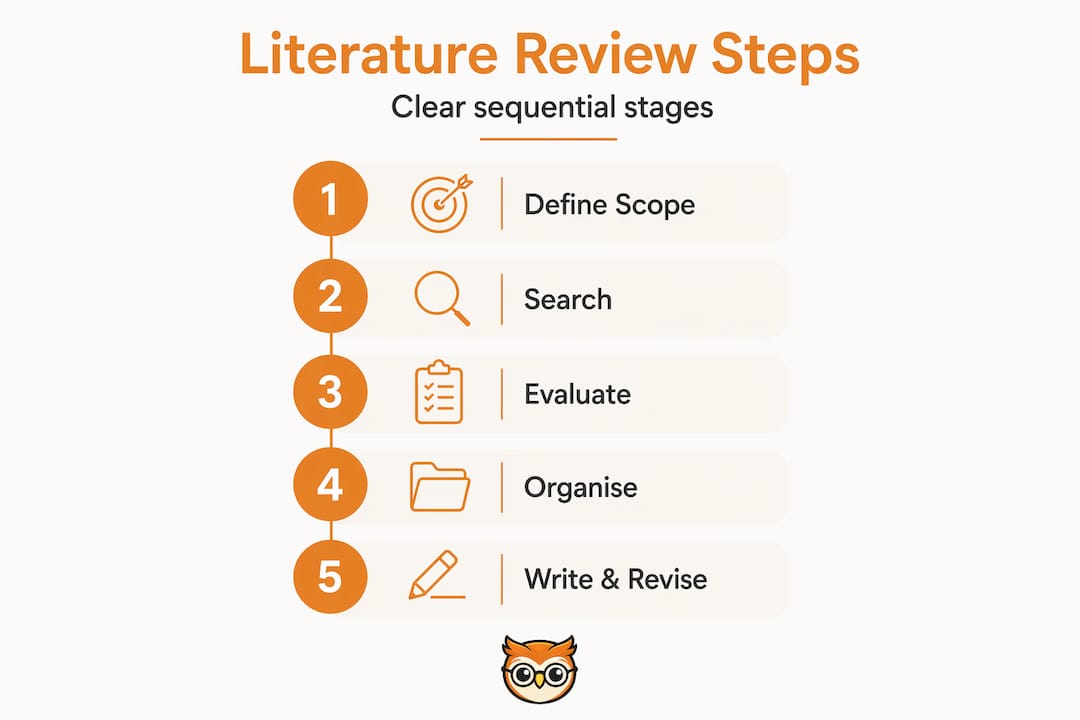
Narrowing your topic is equally non-negotiable. A topic like "mental health in young people" will bury you in thousands of papers. A topic like "the effect of social media use on anxiety in UK adolescents aged 13 to 18" gives you tractable boundaries. Use the PICO framework (Population, Intervention, Comparison, Outcome) if your field suits it, or construct a focused research question using who, what, where, and when.
Once your topic is clear, establish your inclusion and exclusion criteria before you search. These might include:
- Date range (e.g., publications from 2010 onwards)
- Language of publication
- Study design or methodology type
- Geographic context or population
- Peer review status
Write these criteria down explicitly. They prevent scope creep later and make your methodology defensible.
Pro Tip: Create a simple one-page research brief before searching. Include your research question, your review's purpose, your criteria, and the databases you plan to use. This document becomes your anchor when the process feels overwhelming.
Searching and collecting relevant literature
A thorough search strategy is what separates a credible literature review from a selective reading list. You need to know where to look, how to search, and how to manage what you find.
Start by identifying the databases most relevant to your discipline. Here are commonly used options by field:
- PubMed and MEDLINE for health, medicine, and biological sciences.
- PsycINFO for psychology and related behavioural sciences.
- ERIC for education research.
- Web of Science and Scopus for cross-disciplinary, citation-tracked searches.
- Google Scholar as a supplementary tool, particularly useful for finding grey literature and checking citation networks.
Once you have your databases, build your search strings using Boolean operators. Combine synonyms with OR (anxiet* OR worry OR psychological distress), join concepts with AND (social media AND adolescents AND anxiety), and exclude irrelevant terms with NOT. Use truncation symbols like * to capture word variants.
Pro Tip: Run your search in at least three databases, not just one. Different databases index different journals, and a single-source search introduces systematic gaps that reviewers and examiners will notice.
Keeping a detailed search log is not optional. Record every database you search, the exact search string you use, the date, and the number of results returned. This log is your audit trail. It lets you replicate the search later, demonstrate methodological rigour, and revise your terms if a search returns too many or too few results.
When selecting sources, consider recency, relevance, and credibility. Prefer peer-reviewed journal articles, but do not ignore high-quality reports from government agencies, professional bodies, or established research institutes. Identify reliable, recent, and relevant sources by checking the journal's impact factor, the author's credentials, and how often the paper has been cited. A paper cited 300 times in five years carries more weight than one never cited at all.
When you encounter contradicting viewpoints, do not discard them. Disagreement in the literature is a finding in itself. Note where authors disagree, what methodological differences might explain the disagreement, and what that tension means for your own research question.
Reading, evaluating, and organising your sources
Collecting papers is the easy part. The harder work is reading them critically and turning isolated findings into structured knowledge.

Active reading and note-taking
Do not read papers passively from start to finish. Use a structured template for each source that captures the following:
- Research question or objective of the study
- Methodology used (survey, experiment, qualitative interview, meta-analysis)
- Key findings and conclusions
- Limitations acknowledged by the authors
- How it relates to your own research question
This approach forces you to engage analytically with each text rather than simply absorbing it. Software such as Zotero, Mendeley, or Notion can help you store these notes alongside the reference details.
Evaluating quality and relevance
Not all sources deserve equal weight. Use a simple quality evaluation grid to assess each paper:
| Criterion | Questions to ask |
|---|---|
| Credibility | Is the journal peer-reviewed? Are the authors credentialled? |
| Methodology | Is the method appropriate for the research question? |
| Sample size | Is the sample large enough to support the conclusions? |
| Recency | Is the publication date appropriate for your field's pace of change? |
| Relevance | Does it directly address your research question or population? |
Narrative reviews may introduce bias through selective inclusion, so applying transparent quality criteria reduces that risk considerably. Even if you are not conducting a formal systematic review, using explicit criteria makes your judgements defensible.
Organising by themes, not by author
Once you have read and evaluated a solid body of sources, resist the urge to organise your notes by author or chronology. Instead, identify patterns and group themes dynamically as they emerge from your reading. A theme might be a recurring finding, a contested concept, a methodological trend, or a gap several studies have acknowledged.
Concept mapping works particularly well at this stage. Place your central research question in the middle of a page, then branch outward with the major themes you have identified, linking related papers to each branch. This visual structure becomes the skeleton of your literature review. You can also consult a guide on understanding literature gaps to spot where the existing research falls short.
Writing and revising the literature review
With your themes mapped and your notes organised, you are ready to write. But this stage has its own logic, and understanding that logic saves you from the most common pitfall: writing a series of summaries and calling it a review.
A true literature review synthesises across sources rather than listing what each one says. The distinction matters enormously. A summary says "Smith (2019) found that social media use correlates with anxiety." A synthesis says "Multiple studies confirm a link between heavy social media use and elevated anxiety, particularly in adolescent girls, though researchers disagree on the direction of causality."
Follow this sequence when drafting:
- Write a purpose or thesis statement. This articulates what your review argues or demonstrates. Importantly, your thesis develops after reading, once patterns are visible, not before you begin searching.
- Draft an introduction. Explain the scope of your review, the research context, and what the reader will find.
- Write thematic body sections. Each section should address one major theme, drawing on multiple sources. Open each paragraph with a claim, support it with evidence from several papers, and close with a sentence connecting back to your central argument.
- Synthesise, do not summarise. Every paragraph should mention at least two sources in relation to each other, not in isolation. Structure paragraphs around synthesis supported by multiple references.
- Write the conclusion. Identify what the literature collectively establishes, what remains contested, and why your own research is needed.
Pro Tip: When revising, read each paragraph and ask: "Am I describing what these papers say, or am I making an argument about what they mean?" If the answer is the former, rewrite the paragraph to lead with a claim.
Revising is not optional polishing. Plan for at least two full revision passes. The first pass focuses on structure and argument: does each section serve a clear purpose, and does the review build logically from one theme to the next? The second pass focuses on clarity and citation accuracy. Ask a peer or supervisor to read a draft and identify any sections that read as lists rather than arguments.
Good resources on summarisation and note-taking can help you sharpen how you condense source material without losing analytical depth.
Troubleshooting common challenges
Even with a solid plan, the literature review process rarely runs in a straight line. The process is inherently iterative, and working on multiple stages simultaneously is completely normal.
Here are the most frequent problems and how to handle them:
- Too many sources. If your search returns thousands of results, your scope is too broad. Return to your inclusion criteria and tighten the date range, population, or methodology type.
- Too few sources. Broaden your search terms or check whether related disciplines have addressed your question from a different angle.
- Scope creep. Every interesting tangent you follow adds time. If a paper is genuinely relevant, include it. If it is merely interesting, note it separately and move on.
- Structural confusion. If you cannot decide where a paper belongs, that is a signal your thematic categories need refining. Revisit your concept map.
- Stalled writing. Write rough, incomplete sentences to get ideas on the page. The revision stage will improve them. Waiting for perfect prose before writing is the surest way to miss your deadline.
Before submitting, use a checklist to verify your review is complete:
A strong literature review defines its scope clearly, demonstrates breadth of source selection, synthesises rather than summarises, acknowledges contradictions and gaps, and positions your research within the existing body of knowledge.
Ask yourself: does every section serve the argument? Are all sources cited correctly? Have you addressed competing viewpoints rather than only those that support your position? If the answer to all three is yes, your review is ready.
What I have learned from guiding literature reviews
In my experience working alongside researchers and students at different stages of their academic careers, the single biggest mistake I see is treating the literature review as a hoop to jump through rather than a genuine thinking tool. Writers who rush to collect fifty papers and start typing rarely produce reviews that hold up to scrutiny.
What I have found works is treating the organisation stage as part of the drafting process itself. When you let emerging themes shape your headings and claims, as the University of Guelph's seven-step model recommends, you stop forcing your sources into a predetermined structure and start listening to what the literature is actually telling you. That shift produces reviews with genuine analytical force.
I also think there is an underappreciated problem with students confusing a literature review with an annotated bibliography. They look similar on the surface, but they are fundamentally different tasks. An annotated bibliography describes. A literature review argues. Keeping that distinction sharp from the very beginning changes how you read, how you take notes, and how you write.
My honest advice: give the preparation and organisation stages as much time as the writing stage. Most students allocate 70% of their time to writing and 30% to everything else. Reversing that ratio consistently produces stronger, more defensible reviews.
— BibliOWLteca
Take your research further with Bibliowlteca
If this guide has shown you the shape of a proper literature review, the next step is building the skills and resources to execute it with confidence.

Bibliowlteca's digital research marketplace brings together e-books, guides, and structured courses created by educators and researchers who have navigated exactly the challenges described in this article. Whether you need a practical writing template, a methodology guide for your discipline, or a step-by-step workbook for academic synthesis, you will find targeted resources built for students and researchers at every stage. Browse the catalogue, buy directly, and start applying what you learn immediately. Your literature review does not have to be the hardest part of your research.
FAQ
What is a literature review?
A literature review is an evaluative synthesis of existing research on a specific topic, designed to contextualise your own study. Unlike a bibliography, it integrates sources to build an argument rather than simply list them.
How many steps does a literature review involve?
Most frameworks outline seven core steps: narrowing your topic, searching with criteria, evaluating sources, organising by themes, developing a thesis, writing, and revising. In practice, these steps often overlap and require revisiting.
What is the difference between synthesis and summary?
Summary describes what a single source says. Synthesis draws on multiple sources to make a claim about what the literature collectively means for your research question. Strong reviews are built on synthesis, not lists of individual findings.
When should I develop my thesis statement?
Your thesis or central argument should emerge after you have read and organised your sources. Developing your thesis after identifying patterns ensures it reflects the actual evidence rather than a preconceived idea.
How do I know when my literature review is finished?
Your review is ready when it clearly defines its scope, synthesises sources thematically, addresses contradictions in the literature, and positions your research within the existing field. A peer or supervisor read-through is the most reliable final check.