
TL;DR:
- Setting in literature is a multidimensional element that shapes characters, plot, and themes by encompassing location, time, cultural context, and atmosphere. Recognizing setting as an active force reveals how environmental pressures generate character decisions, influence relationships, and function symbolically or as a character itself. Effective analysis involves mapping each component, tracking shifts, and arguing how setting actively drives the story’s stakes and messages.
Setting is one of the most misunderstood elements in literary studies. Most readers treat it as a backdrop, the equivalent of painted scenery behind the real action. But the role of setting in literature runs far deeper than that. Setting shapes who characters become, why plots unfold as they do, and what a story ultimately means. From the fog-drenched moors of Wuthering Heights to the suffocating heat of Mississippi in As I Lay Dying, place and time are not incidental. They are structural. This guide unpacks how and why.
Table of Contents
- Key takeaways
- The role of setting in literature: definition and components
- How setting shapes character development
- Mood, symbolism, and theme through setting
- Setting as a character and framing device
- Practical strategies for analysing setting
- My perspective: setting is the story
- Explore literary content on BibliOWLteca
- FAQ
Key takeaways
| Point | Details |
|---|---|
| Setting is multidimensional | It includes time, place, cultural context, and atmosphere, not just a physical location. |
| Setting shapes character | Environmental pressures drive character decisions, resilience, and psychological growth. |
| Setting establishes mood | Sensory and temporal details generate emotional tone and help readers suspend disbelief. |
| Setting carries symbolic weight | Places and periods can embody abstract themes and foreshadow narrative developments. |
| Setting can act as a character | Advanced narratives treat setting as an agentive force with its own agenda and influence. |
The role of setting in literature: definition and components
When literary scholars define setting, they mean something considerably more layered than "where the story happens." Setting is multidimensional, encompassing location, historical time period, cultural context, and atmosphere. All four components interact. Removing or misreading any one of them produces an incomplete analysis.
Consider the components separately:
- Location: The physical geography, whether an urban street, a colonial plantation, or an imagined dystopian city. Location determines what is materially possible within the story.
- Time period: The historical moment in which events occur. A story set in 1930s Alabama carries social conditions that a story set in 1990s London does not.
- Cultural and social environment: The laws, customs, class structures, and belief systems operative in the world of the narrative. These often determine what characters can and cannot do.
- Atmosphere: The emotional quality of a place at a given moment, created through sensory detail, weather, light, and sound. Atmosphere is the element that makes readers feel where they are.
These four components do not sit independently. The foggy, isolated moors in Wuthering Heights are both a physical location and an atmosphere. They reflect the cultural remoteness of the Earnshaw world and anchor the story in a particular historical rural England. Analysing setting means understanding how these layers compound.
The importance of setting in stories also lies in its function as reader orientation. Before a reader can invest in character or plot, they need to know where they are standing and when. Setting provides that grounding, and when authors withhold or distort it deliberately, as Kafka does in The Trial, disorientation becomes the point.
Pro Tip: When beginning a literary setting analysis, map each of the four components separately before drawing connections between them. This prevents you from conflating atmosphere with location, which is one of the most common analytical errors at undergraduate level.
The role of setting is also foundational for understanding the significance of place in literature more broadly. No element of narrative operates in isolation, and setting is the element most tightly bound to all others simultaneously.
How setting shapes character development
Of all setting's functions, its influence on character is the subtlest and the most powerful. Characters do not exist in a vacuum. They are produced, constrained, and transformed by the worlds they inhabit.
Environmental pressures shape resilience and problem-solving approaches, which means the setting is not simply reacting to character choices. It is generating them. Here is how that process works in practice:
- Environmental constraint: A character born into poverty in Victorian London faces material and social limits that directly determine which choices the plot can plausibly offer them. Pip in Great Expectations does not aspire to wealth in the abstract. His setting makes wealth both visible and seemingly unreachable, and that tension drives the entire novel.
- Environmental pressure: Hostile or unstable settings test characters and reveal who they are under stress. The wilderness in Lord of the Flies does not create savagery in the boys, but it removes the social architecture that was suppressing it. The setting is the catalyst.
- Environmental motivation: Setting can give characters something worth fighting for or something worth escaping. The Deep South in Toni Morrison's Beloved is not just a location. It is the source of trauma that drives Sethe's every decision, making the setting inseparable from motivation.
- Environmental relationships: Two characters experiencing the same setting often respond differently, and that divergence is itself revealing. In Of Mice and Men, the California ranch binds George and Lennie together while isolating them from everyone else. The setting defines both their bond and their vulnerability.
The interaction between setting and psyche shapes narrative trajectory and character arcs in ways that plot mechanics alone cannot explain. This is why studying a character's backstory without studying their setting produces shallow analysis.
Setting also affects character relationships beyond the protagonist. Power dynamics between characters are frequently legible through their respective relationships to place. Who owns the land? Who is forbidden from entering certain spaces? In Jane Eyre, the locked room at Thornfield Hall is simultaneously a setting detail, a plot device, and a commentary on the gendered confinement of women in Victorian society.

Pro Tip: When writing an essay on setting's impact on character development, always ask: what would this character do if the setting were different? If the answer changes the character fundamentally, you have evidence that the setting is doing formative work.
Mood, symbolism, and theme through setting
Setting does not only shape what happens in a story. It shapes how the reader feels about what happens. This is where the effects of setting on mood become most apparent, and where setting begins to operate as a thematic element rather than a neutral container.
Creating emotional tone
Temporal and spatial details establish tension, emotion, and realism. Dickens opens Bleak House with fog. Not just fog as weather, but fog as a metaphor for the obfuscation of the legal system, the obscuring of justice, and the atmosphere of moral murk in which all the characters operate. The reader absorbs this before a single character appears.
Effective world-building, according to craft-focused analysis, relies on selective sensory details that create what critics call a dominant impression: a cumulative emotional effect that guides reader experience without overwhelming them with description.
Setting as symbol and foreshadowing
Symbolic settings convey thematic depth and enrich reader interpretation in ways that explicit statement cannot. The green light across the bay in The Great Gatsby is a setting detail before it is a symbol. Fitzgerald uses the geography of East Egg versus West Egg to encode the entire novel's argument about class, aspiration, and the American dream.
Consider how the following examples illustrate setting's symbolic and thematic functions:
| Work | Setting element | Symbolic meaning | Theme reinforced |
|---|---|---|---|
| Wuthering Heights | Moorland and storm | Passion, wildness, isolation | Nature vs civilisation |
| 1984 | Airstrip One, London | Decay, surveillance, oppression | Totalitarian control |
| The Great Gatsby | East vs West Egg | Class division, old vs new money | The limits of aspiration |
| Heart of Darkness | The Congo River | Moral ambiguity, colonial violence | Imperialism and its corruption |
In each case, the setting is not decorating the theme. It is the theme, rendered spatially.
Setting also foreshadows. When Hardy opens Far from the Madding Crowd with an expanse of open farmland, he is establishing both the freedom and the precariousness that will define Bathsheba's fate. The setting tells you what kind of story you are in before the plot confirms it.
- Atmospheric settings signal genre: gothic elements generate dread; pastoral settings invite irony when they are disrupted.
- Seasonal and temporal markers (winter, night, dawn) carry embedded cultural meaning that authors exploit deliberately.
- Settings in decay (ruined houses, dying towns) frequently signal moral or social collapse within the narrative.
Setting as a character and framing device
The most sophisticated way to understand the role of environment in storytelling is to consider setting not as a stage but as an actor. Setting can exert pressures and restrictions comparable to character agency. It has, in this reading, an agenda.
This is not merely a metaphor. Authors treat setting as a dynamic narrative force that actively influences plot, conflict, and character choice. When the setting of a story pushes back against characters, when the sea refuses to cooperate in Moby-Dick, when the wilderness in Jack London's work actively tries to kill the protagonist, we are watching setting function with the purposiveness of an antagonist.
"Setting transforms abstract emotional conflicts into tangible narrative barriers, enhancing story cohesion and impact."
This framing matters particularly for genre fiction. Gothic literature, science fiction, and magical realism all depend on settings that behave with something approaching consciousness. The house in Shirley Jackson's The Haunting of Hill House is the most famous example in English literature. Jackson does not just use the house as a backdrop for horror. The house is the horror. It warps perception, isolates inhabitants, and seems to respond to psychological states. Setting interacts with characters and evolves, particularly in place-driven narratives, making the milieu itself a kind of protagonist.
For students engaged in literary setting analysis, this advanced perspective opens significant analytical possibilities. When you treat setting as having agency, you begin asking different questions. Not "what does the setting tell us about the characters?" but "what is the setting doing to the characters, and why?"
The concept of setting as a framing device is equally important. In postcolonial literature, for instance, the role of environment in storytelling often carries the weight of political critique. Chinua Achebe's Nigeria in Things Fall Apart is not merely an authentic backdrop. It is an argument about whose world has narrative legitimacy, and about what is lost when that world is colonised and renamed. Setting frames whose story gets told.
Effective setting also shapes reader engagement before a single line of dialogue. An uneasy connection to place transports readers beyond their own reality, shaping expectations and calibrating emotional investment. This is why first paragraphs so often open with setting rather than character.
Practical strategies for analysing setting
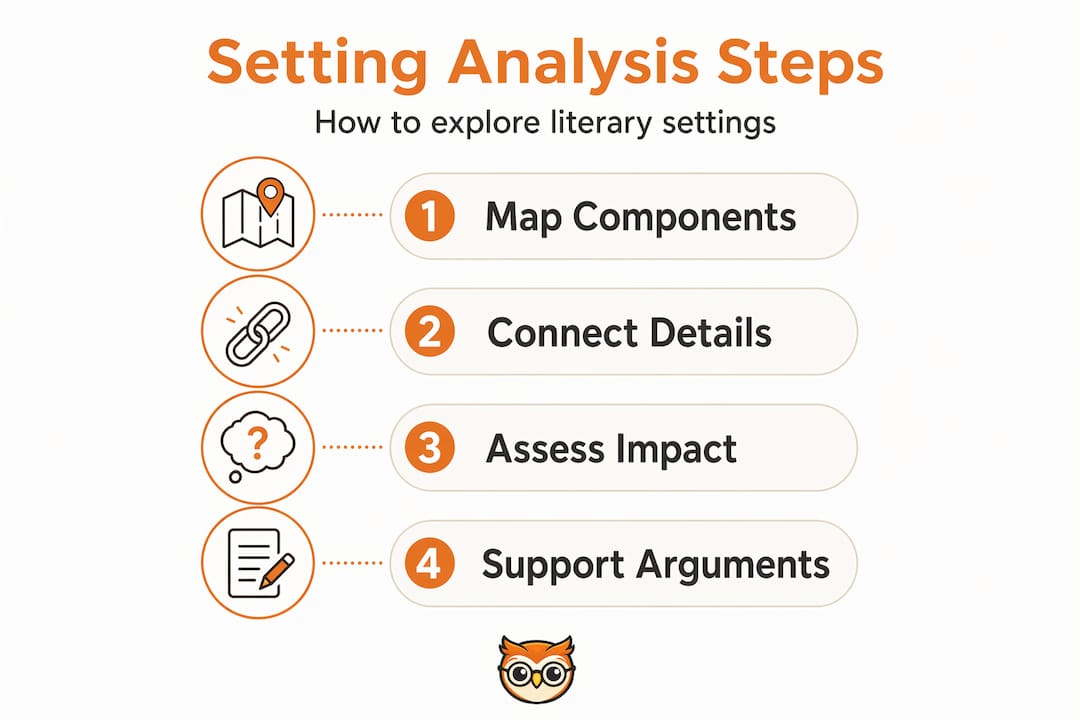
Knowing that setting is important is one thing. Knowing how to analyse it rigorously is another. Here are the steps that produce genuinely strong literary analysis of setting:
- Identify all four components. Note the location, time period, cultural context, and atmosphere separately before drawing connections. This prevents superficial readings.
- Track changes in setting. If the setting shifts during the narrative, ask why. Movement between settings often marks a change in a character's status, understanding, or moral position.
- Look for patterns of contrast. Many novels organise their settings in binary pairs: the country vs the city, the domestic vs the wild, the past vs the present. These contrasts carry thematic weight.
- Note what is absent from the setting. What the author chooses not to describe is often as telling as what they do describe. Minimalist settings frequently signal psychological or social constraint.
- Connect setting to social and historical context. Understanding the social dimensions of literature enriches setting analysis considerably. A setting is never apolitical; it reflects the conditions of its time.
- Use close reading techniques. Examining specific word choices in descriptive passages, through strategies covered in close reading analysis, reveals how authors construct setting's emotional and symbolic effects.
When writing essays, avoid summarising the setting and then moving on. Instead, argue for its function. "The moors represent Heathcliff's untameable nature" is a beginning. "The moors actively restrict and define the possibilities available to every character, making civilisation and wildness mutually exclusive in Brontë's moral universe" is an argument.
My perspective: setting is the story
I have spent a long time reading and thinking about literature, and the observation that changed how I see it most is deceptively simple. Setting is not where the story happens. Setting is how the story happens.
When I first encountered that reframing, I went back to novels I thought I understood and found I had been reading them wrong. I had been reading the moors in Wuthering Heights as atmosphere. I had been reading the plantation in Beloved as historical context. I had been reading Airstrip One as a world-building choice. All of those readings were correct, but they were incomplete. Once I started reading setting as active and agentive, the novels deepened dramatically.
What I have learned from teaching and studying literature is that passive and dynamic approaches to setting are not equally valid. A passive setting exists to be described. A dynamic setting exists to generate pressure. The writers who last, from Hardy to Morrison to Achebe, almost universally use setting dynamically. Place is not incidental to their stories. It is the engine.
The practical lesson for students is this: do not ask what the setting is. Ask what the setting wants. Ask what it is doing to the people inside it, what it is telling the reader about the story's stakes, and what it would mean for everything if the setting changed. That line of questioning will take your literary analysis somewhere most essays never reach.
— BibliOWLteca
Explore literary content on BibliOWLteca
If analysing setting has sparked a deeper interest in how literature works, there is a great deal more to explore. BibliOWLteca is home to a growing collection of digital literary content, from in-depth study guides and critical reading resources to e-books that support serious literary study at every level.

Whether you are preparing for an examination, writing a dissertation, or simply reading more thoughtfully, BibliOWLteca's digital literary resources are built to take your understanding further. You will find content covering narrative structure, thematic analysis, genre study, and character analysis, all curated for readers who want to go beyond the surface. Browse the full catalogue and find the resources that match where you are in your studies.
FAQ
What is setting in literature?
Setting in literature refers to the time, place, cultural context, and atmosphere in which a narrative takes place. It is a multidimensional element that shapes character behaviour, plot development, and thematic meaning.
How does setting influence character development?
Setting imposes environmental pressures that constrain or motivate characters, shaping their decisions and psychological growth. A character's personality and choices are often inseparable from the world they inhabit.
Why is setting considered a thematic element?
Setting reinforces themes by operating symbolically, with places and time periods embodying abstract ideas such as freedom, corruption, or social division. Symbolic settings also foreshadow narrative developments and deepen reader interpretation.
Can setting function as a character?
Yes. In advanced literary analysis, setting can exert agency comparable to a character, with its own pressures, restrictions, and effects on the narrative. Shirley Jackson's The Haunting of Hill House is the most frequently cited example in English literature.
How do I analyse setting in an essay?
Identify the four components of setting separately, track how setting changes across the narrative, and argue for its function rather than simply describing it. Connect setting choices to the novel's social, historical, and thematic context for the strongest analysis.