
TL;DR:
- Literary analysis involves deep, interpretative examination of texts by analyzing literary devices, themes, and structures. It emphasizes constructing arguments supported by textual evidence, contrasting with simple summaries or criticism. This skill develops critical thinking, empathy, and cultural awareness applicable across many disciplines and careers.
Literary analysis is defined as the deep examination of a literary work by breaking it into its component parts to understand how and why it creates meaning. Rather than retelling what happens in a text, analysis asks how a writer uses character, setting, plot, theme, point of view, and literary devices to construct a particular effect or argument. This practice sits at the heart of literary study at every level, from secondary school classrooms to doctoral seminars. Students who master it gain a skill that transfers directly into law, journalism, policy, and any field that demands careful reading and persuasive writing.
What is literary analysis and how does it differ from summary?
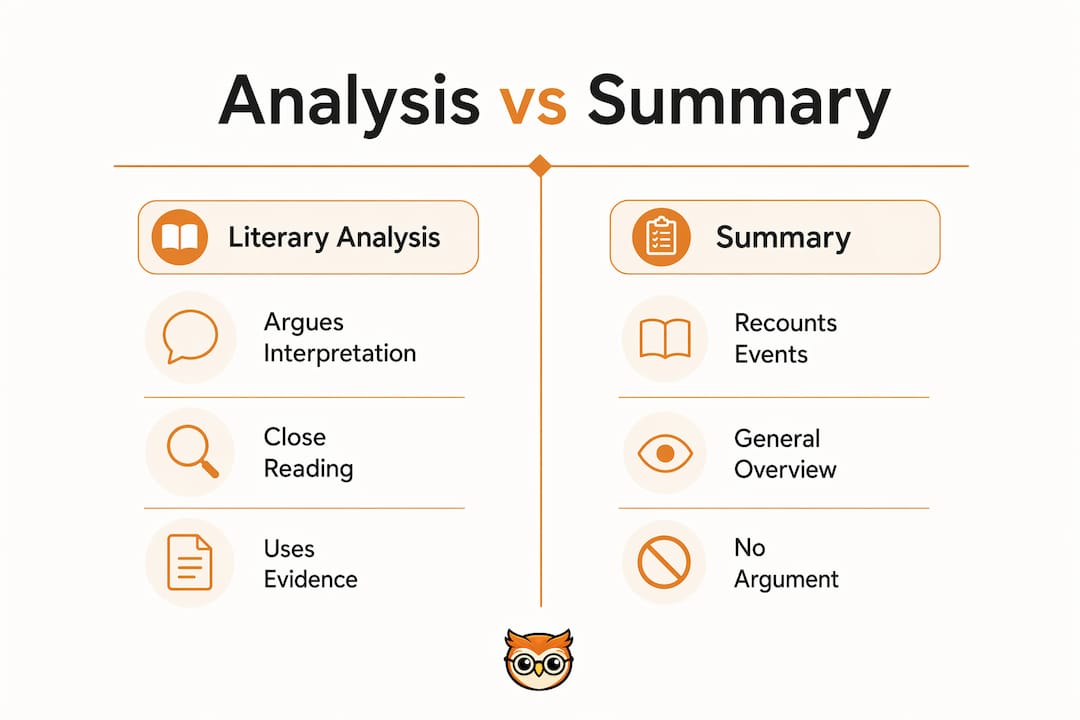
Literary analysis is a persuasive genre. Its goal is to argue an interpretation of a text, not to recount its events. Writing should support claims with textual evidence and avoid summarising story events. That distinction matters enormously in practice, because the single most common error students make is producing a sophisticated-sounding summary and calling it analysis.
Think of it this way: a summary of Hamlet tells you that a Danish prince discovers his father was murdered and struggles to act on that knowledge. An analysis asks why Shakespeare delays Hamlet's revenge through soliloquy rather than action, and what that structural choice reveals about interiority, moral responsibility, and theatrical convention. The two tasks share the same source material but demand entirely different thinking.
The literary analysis definition, as used in academic contexts, covers the close reading of a text alongside the construction of an argument about what that reading reveals. Close reading means slowing down, annotating, and questioning every significant word choice, image, and structural decision an author makes. It is the foundational practice on which all other analytical work depends. A step-by-step close reading workflow gives you a repeatable method for moving from raw observation to a defensible claim.
What is the difference between literary analysis and literary criticism?
These two terms are often used interchangeably, but they describe related and overlapping activities rather than identical ones. Understanding the distinction sharpens your analytical practice considerably.
Literary criticism is usually persuasive and written for a literary community already familiar with the text and its interpretative vocabulary. It involves evaluating a work from a particular critical perspective and frequently debates the readings of other critics. Literary analysis, by contrast, is the close reading and argument-building process that generates the raw interpretative material criticism then evaluates and theorises.
Put simply: analysis is what you do with the text. Criticism is what you do with the analysis, the text, and the broader conversation about both.
The table below captures the core distinctions:
| Feature | Literary analysis | Literary criticism |
|---|---|---|
| Primary focus | Close reading and interpretation of a specific text | Evaluation and theorisation of texts and interpretations |
| Audience | Educators, students, general readers | Academic and literary communities |
| Method | Textual evidence, argument construction | Critical frameworks, debate with other critics |
| Output | Essay, annotation, close reading | Journal article, monograph, review |
| Scope | Usually one text or passage | Often multiple texts, periods, or theories |
Key characteristics of each practice:
- Literary analysis identifies literary devices such as metaphor, irony, and foreshadowing, then argues what those devices accomplish within the work.
- Literary criticism applies theoretical schools, Marxist, feminist, postcolonial, to evaluate what a text reveals about power, gender, or culture.
- Both require textual evidence and a coherent argument. Neither accepts unsupported opinion.
- Criticism often positions itself against existing scholarly readings. Analysis does not require that scholarly context.
How do literary theories inform literary analysis?
Literary theories provide structured intellectual frameworks for interpreting texts in diverse ways. They function as intellectual maps guiding interpretation rather than rigid problem-solving formulas. Choosing a theoretical lens does not constrain your reading. It focuses it, the way a microscope setting determines which layer of a specimen you examine.
The five most widely used theoretical schools in literary study are:
-
Formalism concentrates on the internal structure of the text itself, its language, imagery, and form, without reference to the author's biography or historical context. New Criticism, associated with scholars such as Cleanth Brooks and Robert Penn Warren, is the most influential formalist school and remains the default approach in many secondary school curricula.
-
Feminist criticism examines how gender is constructed, represented, and contested within a text. A feminist reading of Charlotte Brontë's Jane Eyre might focus on how the novel simultaneously challenges and reproduces Victorian ideals of femininity, using Bertha Mason as a figure for repressed female desire.
-
Psychoanalytic criticism draws on the work of Sigmund Freud and later Jacques Lacan to explore unconscious desire, repression, and symbolism in texts. It treats literary characters as subjects with psychological depth and reads narrative structure as analogous to dream logic.
-
Reader-response criticism argues that meaning arises dynamically from the reader's interaction with the text rather than residing in the text alone. This challenges the idea of a single fixed meaning and encourages subjective but text-grounded readings. Stanley Fish's concept of "interpretive communities" is the most cited formulation of this position.
-
Marxist criticism reads literature as a product of economic and class relations. It asks whose interests a text serves, which voices it silences, and how it reflects or resists the ideological conditions of its production.
Some literary critics dismiss a single universal text meaning and prioritise individual reader experience, mood, and prior knowledge. This pluralism is not a weakness of literary study. It is precisely what makes the discipline generative: the same text yields different, equally defensible readings depending on the lens applied.
Pro Tip: Choose your theoretical lens before you begin drafting. A feminist reading of Pride and Prejudice will lead you to different passages and different claims than a Marxist reading of the same novel. Committing to a framework early prevents the common error of producing a scattered analysis that gestures at several theories without developing any of them.
What techniques are essential for effective literary analysis?
Effective literary analysis rests on a small number of repeatable techniques. Mastering them transforms reading from a passive activity into an active, argumentative one.
Close reading and annotation
Close reading means reading slowly, with a pen or digital annotation tool in hand. Mark every passage that surprises you, every image that recurs, every moment where the language becomes unusually dense or simple. Annotation is not highlighting. It is a running dialogue with the text in which you record observations, questions, and tentative interpretations. Tools such as Hypothesis, Adobe Acrobat's comment function, or even a physical notebook all serve this purpose well.

When annotating, ask three questions of every significant passage: What does this say? How does it say it? Why does it matter to the whole? The third question is where analysis begins.
Identifying and interpreting literary devices
Literary devices are the technical vocabulary of analysis. Metaphor, simile, alliteration, irony, foreshadowing, symbolism, and free indirect discourse are not decorative features. They are the mechanisms through which meaning is made. Identifying a metaphor is observation. Explaining what that metaphor does, what it reveals, conceals, or complicates, is analysis.
The table below shows common devices and the analytical questions each one prompts:
| Literary device | Analytical question to ask |
|---|---|
| Metaphor | What two things are being compared, and what does that comparison imply about both? |
| Irony | Who knows what, and what does the gap between knowledge and ignorance reveal? |
| Foreshadowing | What does this anticipation tell us about the text's view of fate or agency? |
| Free indirect discourse | Whose values are being expressed, the narrator's or the character's? |
| Symbolism | What does this object or image carry beyond its literal meaning? |
Building an argument from evidence
Experienced literary analysts avoid taking quotes out of context and integrate passages smoothly to support their own argument. Proper framing ensures readers understand the significance of a passage within the whole work's architecture. This means every quotation you use must be introduced, quoted accurately, and then interpreted. The interpretation sentence is the most important one you will write. It tells the reader what the quotation proves, not what it says.
A common structural failure is the "quote sandwich" without the filling: a student introduces a quote, presents it, and then moves on without explaining its significance. The interpretation is the filling. Without it, you have not analysed anything.
- Introduce the quotation with a framing sentence that tells the reader what to look for.
- Quote accurately and briefly. Use the shortest excerpt that still supports your point.
- Interpret by explaining what the language choice, image, or structural feature reveals about the text's meaning.
- Connect the interpretation back to your thesis or central argument.
Pro Tip: If you can remove a quotation from your essay and your argument still makes sense without it, the quotation is not doing analytical work. Every piece of textual evidence should be load-bearing.
Understanding how to summarise a book is a useful baseline skill, but analysis demands that you move beyond summary at every stage. The moment your writing begins retelling rather than interpreting, stop and ask: what claim am I making about this passage?
Why is literary analysis important in education and beyond?
Reading and discussing literature expands imagination, empathy, and critical skills, enhancing the ability to interpret diverse texts across disciplines. Educational standards in the United Kingdom, the United States, and Australia all emphasise literary analysis for these cognitive and cultural benefits, recognising that the skill extends well beyond the English classroom.
The case for literary analysis in education rests on three distinct but connected arguments. The first is cognitive: close reading trains the mind to attend to detail, hold multiple interpretations simultaneously, and construct evidence-based arguments. These are transferable intellectual habits. A student who can analyse a passage from George Orwell's Nineteen Eighty-Four for its rhetorical strategies is also better equipped to read a political speech, a legal contract, or a scientific abstract with critical precision.
The second argument is empathetic. Literature places readers inside the consciousness of characters whose lives, cultures, and historical moments differ radically from their own. Analysis deepens that encounter by asking not just what a character feels but how the author constructs that feeling and to what end. This is not a soft skill. Organisations including the Harvard Business Review have cited empathy as a core competency in leadership, negotiation, and team management.
The third argument is cultural. Literary analysis is the primary means by which a society examines its own stories, myths, and values. When students analyse texts from the Western canon alongside postcolonial literature, Indigenous writing, or working-class fiction, they develop a more accurate and complex picture of human experience.
"Good literary analysis is akin to thoughtful, patient listening that considers the author's thoughts charitably to reach deeper understanding. It is neither impersonal nor a cold technical exercise but a collaborative conversation between reader and text."
That framing matters for educators in particular. When literary analysis is taught as a mechanical exercise in device-spotting, students disengage. When it is taught as a form of attentive, charitable reading, it becomes one of the most intellectually rewarding activities in the curriculum. Exploring why study literature reveals just how far these skills reach beyond the classroom.
Key takeaways
Literary analysis is the practice of arguing an interpretation of a text through close reading, textual evidence, and the application of a coherent analytical framework.
| Point | Details |
|---|---|
| Analysis is not summary | Literary analysis argues an interpretation using evidence; it does not retell plot events. |
| Theory focuses your reading | Choosing a framework such as feminist or Marxist criticism directs you to specific textual features and questions. |
| Evidence must be interpreted | Every quotation requires a framing sentence and an interpretation sentence; bare quotes prove nothing. |
| Analysis builds transferable skills | Close reading develops critical thinking, empathy, and persuasive writing applicable across professions. |
| Criticism extends analysis | Literary criticism evaluates and theorises interpretations within a scholarly conversation; analysis is its raw material. |
Literary analysis as a conversation, not a dissection
The term "literary analysis" has always struck me as slightly misleading. The word "analysis" implies cold dissection, the kind of thing done to specimens under fluorescent lighting. In practice, the best literary analysis I have encountered, and the best I have helped creators and educators produce through BibliOWLteca, looks nothing like that.
What it looks like is a careful, generous conversation with a writer who is not in the room. You bring your full attention to what they have written. You resist the temptation to strip-mine the text for evidence that confirms what you already believe. You ask what the author is trying to do, and you give them the benefit of the doubt before you start arguing with them.
This matters practically. Students who approach analysis as a hunt for predetermined conclusions produce thin, circular essays. Students who approach it as patient listening produce essays that surprise even themselves, because the text leads them somewhere they did not expect to go. That is when analysis becomes genuinely exciting rather than a mechanical exercise.
The other error I see repeatedly is quoting out of context. A passage that appears to support a reading of Macbeth as a straightforward morality tale can look very different when you restore the forty lines surrounding it. Framing your evidence within the architecture of the whole work is not a stylistic nicety. It is the difference between a credible argument and a misleading one.
Literary analysis, done well, is one of the most rigorous and rewarding intellectual practices available to students and educators. It teaches you to read the world as carefully as you read a page.
— BibliOWLteca
Deepen your literary analysis with BibliOWLteca

BibliOWLteca offers a growing catalogue of eBooks, courses, and mentorship programmes designed specifically for students and educators who want to move beyond surface-level reading. Whether you are preparing for an examination, developing curriculum materials, or building your own literary analysis course to sell globally, the platform gives you the tools to publish, distribute, and monetise your knowledge. With support for multiple currencies and international payments, your content reaches learners wherever they are. Browse the full range of digital literature resources available now, or explore the complete set of creator and educator features to see how BibliOWLteca supports your work at every stage.
FAQ
What is the literary analysis definition in simple terms?
Literary analysis is the close, detailed examination of a literary text to argue an interpretation of how and why it creates meaning. It focuses on elements such as character, theme, setting, and literary devices rather than retelling the plot.
How does literary analysis differ from literary criticism?
Literary analysis is the practice of close reading and building an argument from a specific text. Literary criticism is a broader evaluative genre that applies theoretical frameworks and engages with other scholars' interpretations of that text.
What are the main steps in literary analysis?
The core steps are: read and annotate closely, identify significant literary devices, form an interpretative claim or thesis, select supporting textual evidence, and construct an argument that interprets rather than summarises the evidence.
Which literary theory should I use for my analysis?
Choose the theory that best fits the questions the text raises. Formalism suits structural and linguistic analysis; feminist criticism suits texts centred on gender and power; reader-response theory suits texts where the reader's experience is central to meaning.
Why is literary analysis important beyond school?
Close reading and evidence-based argument are transferable skills used in law, journalism, policy, and leadership. Educational standards emphasise literary analysis precisely because these cognitive and cultural benefits extend well beyond the classroom.