

The fastest way to increase course revenue is a small, context-aware upsell shown at the post-purchase moment, paired with a modestly priced bundle offered before checkout. Skip the scattergun approach. Pick one post-purchase, one-click offer and one low-price in-lesson order bump, launch both this week, and measure attachment rate before adding anything else. Bundles, templates, and coaching reviews outperform generic "buy more" banners because they solve a problem the learner already has.
TL;DR:
- Focus on a single post-purchase, one-click upsell and a low-priced in-lesson order bump, and measure their attachment rates before expanding.
- Bundles should be framed as learning pathways to increase perceived value, while instant-delivery downloads perform best as straightforward order bumps.
- Show upsells at strategic moments like checkout, post-purchase, or in-lesson when learners are most receptive and avoid stacking multiple offers on a single page.
- Discount bundles carefully by limiting deep discounts to combined or lower-priced offers, maintaining the core perceived value of the main course.
- Use a unified platform for setup, payment processing, and delivery to reduce friction and optimize post-purchase upsell performance.
Table of Contents
- What upsell types work best for online courses?
- When should you show a course upsell?
- How much should you discount a course bundle?
- Which checkout details actually reduce cart abandonment?
- How do bundles and memberships build recurring revenue?
- Which metrics prove an upsell is working?
- How does Bibliowlteca support course upsells?
- What most creators get wrong about upselling
- Sell your next upsell without the extra tooling
- Sources
What upsell types work best for online courses?
Not every add-on earns its place in a checkout flow. Some formats convert because they feel like the obvious next step; others feel bolted on and get ignored. Here's what actually moves the needle for creators selling digital courses.
Bundles work when you frame them as a pathway rather than a discount. A beginner course paired with an advanced module and a template pack reads as "the complete route to a result," not "buy two, save a bit." Course bundles increase perceived value and can lift average order value when priced below the sum of individual items, and framing them as a learning pathway rather than a discount raises that perceived value further.
Instant-delivery digital downloads are the best order bumps you have. Cheat sheets, swipe files, and worksheets convert well because there's zero delay between purchase and use, and small, immediately usable items tend to outperform bigger add-ons at the order-bump stage.
Coaching and capstone reviews suit your most engaged learners. A 1:1 session, a small group critique, or a recorded capstone review works as a premium upsell precisely because it's scarce and personal.
Certificates and credentials appeal to professional learners who need proof of completion for an employer or a licensing body. Price these as a premium add-on, not a default inclusion.
Membership tiers convert casual buyers into recurring revenue, especially when access includes new lessons or live sessions rather than a static archive.
- Bundles: best for learners planning a multi-step outcome
- Digital downloads: best as low-price checkout add-ons
- Coaching: best for advanced or professional learners
- Certificates: best for career-driven audiences
- Memberships: best for ongoing, recurring revenue
When should you show a course upsell?
Timing decides whether an offer feels helpful or intrusive. Four moments matter most, and each suits a different kind of offer.
- At checkout — a small order bump (a template or worksheet under $20) shown before the buyer confirms payment.
- Immediately post-purchase — a one-click upsell on the thank-you page, while motivation is at its highest.
- In-lesson, tied to a specific difficulty — a resource offered on the exact lesson where learners typically get stuck.
- At a milestone — after Module 1 or after a quiz/capstone, when the learner has proven commitment.
Post-purchase is the strongest slot of the four. Buyers who've just paid are in an active decision-making state, and one-click post-purchase flows with card-on-file reduce friction compared with sending someone back through a full checkout.
Cap yourself at one or two offers per touchpoint. Stacking three upsells onto a single thank-you page invites decision fatigue and buyer hesitation, not extra revenue.
Pro Tip: Show a resource only on the lesson page where learners genuinely struggle. A template bundle offered on the exact module where students start building their deliverable converts far better than the same offer dropped randomly across the course.
How much should you discount a course bundle?
Discounting protects perceived value only when it's disciplined. Go too deep and buyers start questioning what your core course is really worth.
- Small discounts suit bundles of closely related content, where the main appeal is convenience rather than savings.
- Larger discounts suit bundles combining a flagship course with lower-priced extras like templates or a mini-course, where the bundle needs to look like a clear win.
- Avoid very large discounts on your primary course as this can cheapen the standalone price and make future full-price sales harder to justify.
A simple three-tier ladder makes this concrete:
| Tier | What's included | Positioning |
|---|---|---|
| Starter | Core course only | Entry point, no discount |
| Most popular | Core course + templates + certificate | around 20% cheaper than buying separately |
| Premium | Everything above + 1:1 coaching or cohort access | Priced at a premium, limited spots |
Honest scarcity earns trust: cap cohort-based coaching at a real number, and gate premium tiers behind a genuine prerequisite (such as course completion) rather than an artificial countdown timer.
Which checkout details actually reduce cart abandonment?
Friction kills upsells faster than a bad offer does. Most drop-off happens in the mechanics of checkout, not the pitch itself.
Checkout improvements such as guest purchase, minimal form fields, visible coupon entry, and trust badges reduce abandonment because they remove small points of hesitation that add up during payment.
A quick checklist for your own checkout:
- Offer guest checkout; don't force account creation before payment
- Keep form fields to name, email, and payment details only
- Make any active coupon or discount code visible, not hidden
- Display trust badges (secure payment, refund policy) near the payment button
- Deliver access instantly: course enrolment and downloads should trigger the moment payment clears
One-click post-purchase upsells with card-on-file consistently perform better than sending buyers back through a second full checkout, because the payment details are already stored and the extra click is the only barrier left. That single design choice often accounts for the difference between a five percent and a fifteen percent attachment rate on a well-placed offer.
How do bundles and memberships build recurring revenue?
Average order value and lifetime value respond to different structures. Bundles lift the first sale; memberships lift what happens after it.
- Pathway bundles (foundation course + advanced module + templates) suit learners who want a complete outcome in one purchase.
- Archive bundles (several older courses packaged together) suit clearing out a back catalogue at a lower average price.
- Instant-access bundles work for self-paced learners who want everything immediately.
- Drip-fed or cohort bundles work when peer interaction or pacing matters more than speed.
Membership retention depends on cadence, not just content volume. Creators running weekly or monthly releases, live Q&As, and active community spaces report stronger retention than those offering a passive, static archive. A membership without a reason to log in monthly will churn regardless of how good the original course was.
Which metrics prove an upsell is working?
Five numbers tell you almost everything: attachment rate (percentage of buyers who take the upsell), upsell conversion rate, average order value, refund rate, and lifetime value. Refund rate matters as much as conversion. An offer that lifts revenue but doubles refunds isn't a win.
Run these three tests first:
- Placement test — compare post-purchase versus in-lesson for the same offer.
- Price point test — try two price points on the same bundle to find where conversion holds without hurting perceived value.
- Flow test — one-click upsell versus a standard checkout redirect.
Decision rules keep this simple: if attachment rate holds above your baseline and refunds stay flat, scale the offer to more of your audience. If refunds climb, pause and re-check the price or the placement. If a test shows no meaningful lift after a fair sample size, kill it and try a different format rather than tweaking copy endlessly.
How does Bibliowlteca support course upsells?
Running these tactics manually across separate checkout tools, email platforms, and payment processors is where most creators lose momentum. A unified infrastructure that handles the mechanical side lets the offer itself stay the focus.
- Bundle and membership setup built into the storefront
- Payment processing supporting multiple currencies for selling to buyers internationally
- Secure digital delivery that triggers access or file downloads promptly after payment
- Tools to help with tax compliance for cross-border sales
For the practical groundwork before you launch an offer, a seven-day funnel validation process helps confirm demand before you build a full bundle. Payment setup guidance, including multi-currency and mobile wallet configuration, removes one of the more common blockers creators hit when selling internationally. For structuring higher-touch offers like live workshops alongside a self-paced course, comparing workshop and course formats is worth a look before pricing a coaching tier.
What most creators get wrong about upselling
Most advice on this topic treats upselling as a pricing problem. It isn't. The creators who see real lift treat it as a placement problem first and a pricing problem second. A perfectly priced bundle shown on the wrong page converts worse than an average bundle shown at the post-purchase moment, because timing captures intent that pricing alone can't manufacture.
The overrated tactic is the sitewide banner or generic "you might also like" block. It ignores where a learner actually is in their journey, and it trains buyers to ignore your offers entirely. The underrated tactic is the single, ugly, unglamorous order bump on the exact lesson where students get stuck. It's not creative. It works because it solves a problem at the moment the problem exists.
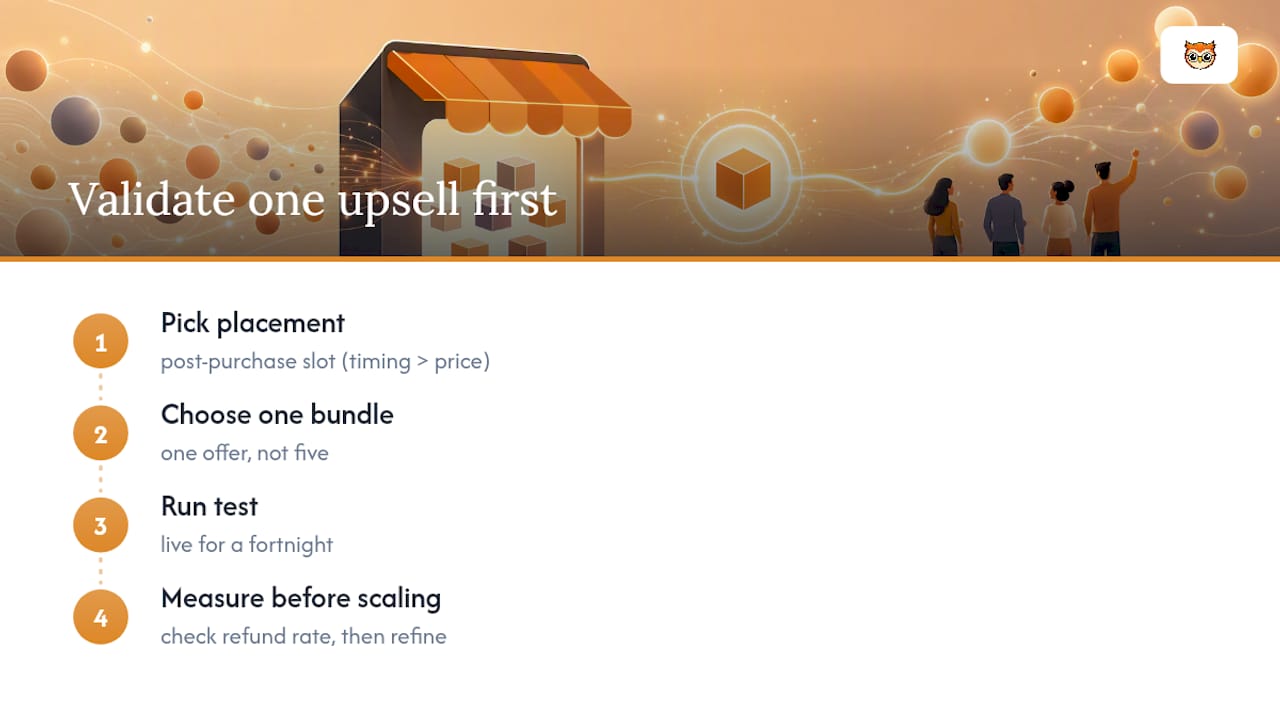
If you take one thing from this: don't build five upsells before you've validated one. Pick the post-purchase slot, pick one bundle, run it for a fortnight, and read your refund rate before you scale anything. Everything else is refinement.
— BibliOWLteca
Sell your next upsell without the extra tooling
Course creators can run bundles, memberships, and instant digital delivery from one storefront, instead of combining separate checkout tools, delivery systems, and payment processors for each currency sold. That matters most once you start layering order bumps and post-purchase offers, because each extra tool is another place a sale can quietly fail.
If you're building your first bundle or setting up a membership tier, the platform's features cover payment processing, secure delivery, and course hosting in one place. Creators ready to list a course, bundle, or coaching offer can set up a storefront on the Bibliowlteca marketplace and start testing an upsell this week.
Sources
- How to Sell More Courses – Bundles, Coupons, Upsells, and Memberships (Platform Tactics) – YB.Digital
- 7 instant upsell opportunities for your online course | MemberMouse