
TL;DR:
- Most creators use Rayyan for screening, Zotero for managing references, Elicit for data extraction, and Covidence for full review workflows. NVivo is valuable for qualitative coding but not suitable for systematic screening or extraction tasks. Selecting tools by workflow stage and ensuring audit trails improve review reproducibility and compliance.
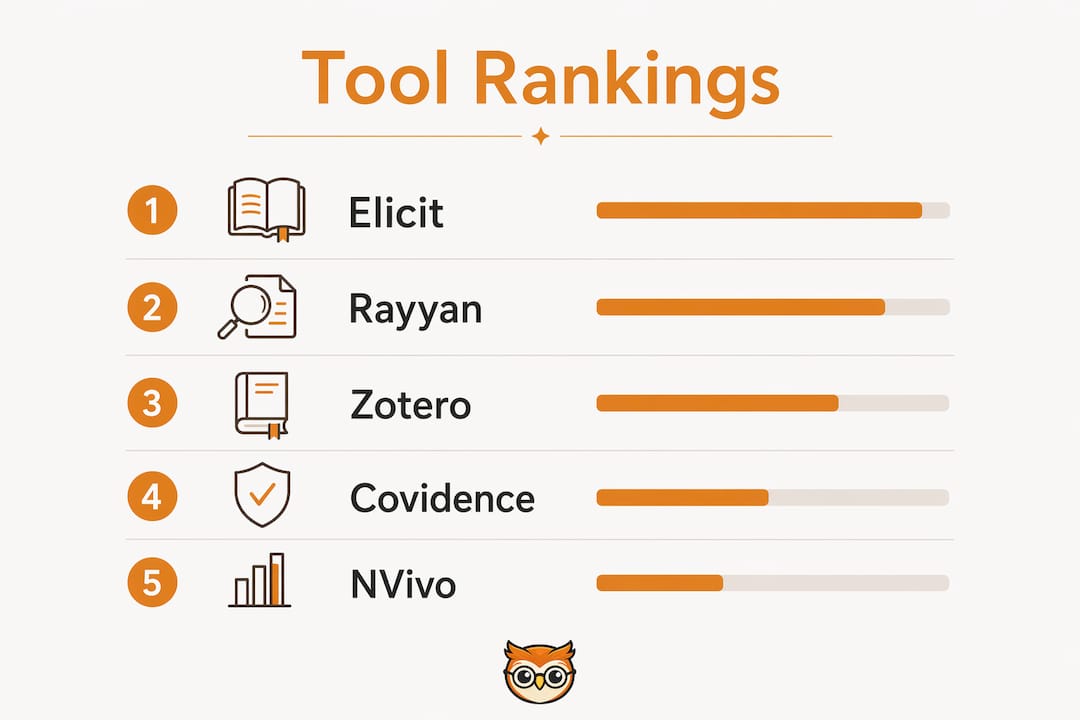
For most creators and educators, four tools cover the essential bases: Rayyan for audit-ready screening, Elicit for automated extraction and evidence tables, Zotero for reference management and citation exports, and Covidence for full Cochrane-style workflows. Add NVivo if your synthesis involves qualitative coding or thematic analysis.
- Rayyan — blinded dual screening, PRISMA-friendly exports, and reviewer logs make it the go-to for reproducible systematic reviews.
- Elicit — citation-linked extraction and automated evidence tables suit teams who need structured outputs fast.
- Zotero — open-source, free, and best-in-class for keeping PDFs, notes, and metadata tied to a single citable record.
- Covidence — the integrated screening-to-extraction pipeline is built for Cochrane submissions and institutional procurement.
- NVivo — qualitative coding and visualisation for mixed-methods or thematic synthesis work.
TL;DR: For reproducible workflows, start with Rayyan for screening and Zotero for library management. Add Elicit for extraction. Covidence if you need a full audit trail for publication or regulatory submission. NVivo only when qualitative coding is central to your synthesis.
Table of Contents
- Which tool wins the literature review tools comparison?
- How this comparison was put together
- Turn your literature review into a product with Bibliowlteca
- Key takeaways
Which tool wins the literature review tools comparison?
| Tool | Best for | Primary function | Collaboration & audit trail | AI-assisted features | Pricing & free tier | Integrations & exports | Learning curve | GDPR / UK data notes |
|---|---|---|---|---|---|---|---|---|
| Elicit | Automated extraction & evidence tables | Extraction / synthesis | Shared projects; exportable tables | Citation-linked extraction from own library | Free tier; paid plans available | RIS, CSV, Excel | Low–medium | US-based; check data-processing terms |
| Rayyan | Screening-heavy systematic reviews | Screening | Blinded dual screening, reviewer logs, PRISMA counts | AI screening suggestions | Free for basic; team plans available | RIS, CSV, PRISMA export | Low | Cloud-based; GDPR compliance stated |
| Zotero | Reference management & citation exports | Reference management | Group libraries; version history | None native | Free; storage plans available | RIS, BibTeX, CSV | Very low | Open-source; local storage option |
| Covidence | Cochrane-style full-workflow reviews | Full workflow | Structured forms, conflict resolution, audit trail | Limited | Institutional & individual plans; no permanent free tier | RevMan, RIS, CSV | Medium | Cochrane-affiliated; institutional procurement common in UK |
| NVivo | Qualitative & mixed-methods synthesis | Qualitative analysis | Project sharing; audit log | None native | Paid only; academic licensing via UK HEIs | NVivo, Excel, various | High | Lumivero (US parent); check institutional data agreements |
Elicit pulls structured data from papers in your uploaded library, reducing hallucination risk by working from your own sources rather than a generic web index. The evidence tables export cleanly to CSV and Excel, which is exactly what you need before building a course module or evidence brief. The free tier covers light use; heavier extraction workloads require a paid plan.
Rayyan is where most systematic review teams start their screening stage. Blinded dual screening means two reviewers work independently before conflicts surface, and every decision is logged. Audit trails and PRISMA-friendly exports are core features, not add-ons. Mobile access is available via browser; offline use is limited.
Zotero remains the backbone of most reproducible workflows. It keeps attachments, notes, and generated citations tied to a single item record, which is the foundation of citation traceability. It is free, open-source, and syncs across devices. The browser connector captures metadata automatically. No AI features, but that is rarely a problem at the library-management stage.

Covidence covers the full pipeline from title-abstract screening through to data extraction and RevMan export. A PMC feature analysis found Covidence among the tools offering all four extraction features assessed, a distinction fewer than a third of reviewed platforms achieved. UK universities frequently procure it institutionally, so check with your library before paying individually.
NVivo sits apart from the others. It does not screen or extract in the systematic-review sense; it codes qualitative data and builds thematic frameworks. For educators creating mixed-methods courses or evidence-informed teaching materials, it adds a layer of analytical depth the other tools cannot match. The learning curve is steep and licensing costs are significant outside academic settings.
How this comparison was put together
The tools were selected by mapping each against four criteria: workflow-stage coverage, audit-trail quality, export format breadth, and GDPR or UK data-handling transparency.
- Workflow coverage — tools were assessed against the four core stages: discovery, screening, extraction, and synthesis. Most tools specialise in one stage rather than the full pipeline, so stage-fit drove inclusion.
- Audit trail and reproducibility — preference given to platforms with exportable exclusion reasons, reviewer IDs, and PRISMA-compatible outputs. Speed of extraction is not a substitute for traceable decisions.
- Export formats — RIS, BibTeX, CSV, Excel, and RevMan compatibility checked against vendor documentation.
- GDPR and UK data handling — vendor privacy pages and data-residency statements reviewed; gaps noted in the table above.
Limitation: Pricing tiers change frequently. Enterprise-only features (single sign-on, advanced admin controls) were not independently verified. Validate current plans directly with each vendor before procurement.
Independent evaluations flag variable recall and reproducibility for AI-assisted extraction tools. Treat AI outputs as a first pass, not a final record.
Turn your literature review into a product with Bibliowlteca
A completed literature review is more than just a research artefact. Exported evidence tables, annotated bibliographies, and structured synthesis notes are the raw material for sellable educational products: course modules, evidence briefs, or annotated e-books that practitioners and learners will pay for.

Bibliowlteca gives creators the infrastructure to publish and sell those products globally, with course hosting, e-book delivery, and multi-currency payments built in. Before you publish, prepare your exported citations (RIS or BibTeX), check third-party copyright permissions, and confirm any data-sharing obligations under UK GDPR. Then list your product on Bibliowlteca's platform and reach a global audience from day one. For a full look at what the platform supports, the features page covers course hosting, payments, and delivery in one place.
General information only. Confirm current data-handling obligations with the ICO and verify tool pricing with vendors before purchase.
Key takeaways
For reproducible, audit-ready literature reviews, match each tool to a specific workflow stage rather than seeking one platform to do everything.
| Point | Details |
|---|---|
| Stage-fit beats feature lists | Choose tools by workflow stage: Zotero for library management, Rayyan for screening, Elicit for extraction, Covidence for full-pipeline reviews. |
| Audit trails are non-negotiable | Exportable exclusion reasons and reviewer logs are what make a review reproducible and publishable. |
| AI outputs need verification | Independent evaluations show variable recall for AI-assisted extraction; always verify against source papers. |
| GDPR matters for UK teams | Check data-residency and processing terms for every cloud-based tool before uploading sensitive or institutional data. |
| Bibliowlteca for monetisation | Convert exported evidence tables and synthesis notes into sellable courses or e-books via Bibliowlteca's global creator platform. |