
For a euro-area recipient, SEPA instant clears in seconds. For anywhere outside the EEA or in a different currency, expect SWIFT or correspondent banking, usually taking up to three business days. Whichever route you take, you need three things correct before you touch "send": the beneficiary's IBAN, their BIC/SWIFT code where the bank asks for one, and a payment reference clear enough that the recipient can match it against an invoice.
The fee question usually comes down to one choice: who pays for what. Most senders default to SHA (shared costs), where you pay your bank's fee and the receiver usually absorbs theirs. Choose OUR only if the recipient must land an exact, uncut amount, since your bank will generally charge you higher fees to cover it.
- Euro-area, standard amount: SEPA or SEPA instant, SHA cost-sharing
- Non-EEA or different currency: SWIFT transfer, expect 1 to 3 business days
- Exact amount required at destination: OUR, confirmed with your bank first
TL;DR:
- Using SEPA instant within the euro area generally costs only shared fees (SHA) and clears in seconds, making it the fastest and cheapest option for euro transfers.
- Outside the EEA or in different currencies, transfers rely on SWIFT and can take up to three business days, with costs varying based on fee-sharing arrangements.
- Providing accurate beneficiary details, including IBAN, BIC/SWIFT, and a clear payment reference, reduces delays and prevents holds in international transactions.
- For payments above €50,000, depositors must declare the transaction to Eesti Pank within specific monthly reporting windows to comply with regulations.
- Recurring international payouts are simplified and made transparent through platforms that automatically present a detailed breakdown of fees and exchange margins across multiple currencies.
Table of Contents
- What is the quickest way to make rahvusvahelised maksed?
- What details do banks need to process the payment?
- How much will an international payment actually cost you?
- How long do rahvusvahelised maksed take to arrive?
- Why do payments get delayed or blocked?
- When do you need to declare a payment to Eesti Pank?
- Which payment method fits your situation?
- Final checks before you hit send
- Key Takeaways
- Sources
What is the quickest way to make rahvusvahelised maksed?
The route depends entirely on where the money is going and what currency it needs to arrive in. Three practical channels exist for most Estonian bank customers and businesses: internet banking or a mobile app, an in-branch transfer, and specialist payment services that route around traditional bank corridors. Nearly all everyday international payments now go through the first option, and for good reason. It's faster, cheaper, and gives you a paper trail automatically.
Here's the sequence that avoids the most common hiccups:
- Gather the beneficiary's details first. IBAN, BIC/SWIFT code if requested, full legal name matching their bank account, and address if the form asks for it.
- Pick the payment type and currency. SEPA for euro transfers within the EEA, SWIFT for everything else, and confirm whether the recipient wants the payment in their local currency or euros.
- Choose your cost-sharing option. SHA, OUR, or BEN, based on whether the receiver needs the full sum or can absorb their own bank's cut.
- Check the exchange rate before confirming. Banks apply their own margin on top of the mid-market rate, so glance at what you're actually being charged.
- Submit and keep the receipt. You'll need this if the payment is queried, delayed, or if you're reporting it to Eesti Pank later.
Branch visits still make sense for large or unusual payments where staff can verify sanctions screening in person, or where you need a signed confirmation for compliance purposes. For businesses paying overseas suppliers or contractors repeatedly, setting up a beneficiary template inside your internet bank saves rekeying details every month and cuts the chance of a typo triggering a hold.
Specialist payment services can also beat standard bank rates on FX margin for certain currency corridors, particularly if you're moving money regularly to the same country.
Pro Tip: Save recurring beneficiaries as templates the first time you pay them correctly. Retyping an IBAN from memory a second time is where most transposition errors creep in.
What details do banks need to process the payment?
Missing or mismatched information is the single biggest cause of delay. Banks generally need:
- The beneficiary's full legal name, exactly as it appears on their bank account
- IBAN, or account number plus country code where IBAN isn't used
- BIC/SWIFT code, requested for most transfers outside SEPA
- Beneficiary address, sometimes required by the receiving bank's own compliance rules
- A clear payment reference or invoice number
Businesses sending payments close to reporting thresholds should attach the underlying invoice or contract, along with a payment purpose code if their bank's form has one. This matters doubly once a transaction nears €50,000, where documentation speeds up any compliance check rather than triggering one.
Write references the way you'd want to receive them: invoice number, your business name, and the month if it's a recurring payment. A vague reference like "payment" forces the recipient's finance team to chase you for reconciliation, and that delay is entirely avoidable.
How much will an international payment actually cost you?
Fees stack in layers most people never see broken down. A typical cross-border transfer can carry a sending bank fee, one or more intermediary fees if the payment routes through correspondent banks, a receiving bank fee, and the exchange rate margin your bank applies on top of the mid-market rate. That last one is often the biggest cost and the least visible, buried inside the rate rather than itemised as a charge.
Cost-sharing options decide who absorbs which layer:
- SHA (shared): you pay your bank's fee, the beneficiary pays theirs. This is the default at most Estonian banks and works fine for most personal and business payments.
- OUR (sender pays all): you cover every fee, including any intermediary deductions, so the beneficiary receives the full invoiced amount. Confirm with your bank whether intermediary charges are guaranteed to be refunded if the receiving bank still deducts something. This option typically costs more upfront.
- BEN (beneficiary pays): the receiver absorbs everything, including your bank's sending fee. Rare outside specific commercial arrangements.
If you're sending the same amount regularly to the same country, it's worth comparing your bank's FX margin against a specialist payment provider, which often quotes closer to the mid-market rate. For a one-off payment or where you value having everything inside one banking relationship, the convenience of your existing bank usually outweighs a marginal FX saving.
How long do rahvusvahelised maksed take to arrive?
Timing depends almost entirely on the rail and the destination bank, not on how much you're sending.
| Payment rail | Typical delivery time | What can slow it down |
|---|---|---|
| SEPA instant | Seconds, when both banks participate | Receiving bank not enrolled in the instant scheme |
| Standard SEPA | Same business day or next business day | Weekend or public holiday cut-offs |
| SWIFT / correspondent banking | Up to 3 business days | Currency conversion, intermediary banks, beneficiary bank processing |
SWIFT GPI has changed what senders can reasonably expect to know mid-transfer. Participating banks provide end-to-end tracking, so instead of wondering whether a payment has vanished into a correspondent chain, you can see where it sits and roughly when it will land. Ask your bank whether they support GPI tracking before you send a large or urgent payment. It's a small question that saves a lot of anxious follow-up calls.
Why do payments get delayed or blocked?
Every international payment passes through automated sanctions screening, checking beneficiary names, IBANs, and sometimes payment references against restricted-party lists. Most transfers clear this instantly and you never notice it happened. A hold usually comes down to one of a handful of causes.
- A name or IBAN partial match against a sanctions list, requiring manual review even when it's a false positive
- Correspondent banks in the chain running their own compliance checks, which adds a layer you don't control
- Mismatched beneficiary details, where the name on the payment doesn't quite match the name on the receiving account
- An unusual payment purpose or a reference that reads as vague or suspicious to an automated system
If your payment gets held, contact your bank immediately rather than waiting to see if it resolves itself. Have invoices, contracts, or counterparty details ready, and ask for the case or reference number so you can follow up without starting the conversation from scratch. Verifying beneficiary details before you send remains the single most effective way to avoid triggering a manual review in the first place.
When do you need to declare a payment to Eesti Pank?
Estonian residents must declare international payments or receipts of €50,000 or more, or the equivalent in another currency, within specified monthly reporting windows. This isn't a penalty threshold. It's a statistical reporting requirement that keeps Eesti Pank's balance-of-payments data accurate, and timely submission avoids any administrative follow-up.

The resident party, sender or receiver depending on the transaction, carries the declaration responsibility, typically submitted electronically or through payment order metadata your bank collects automatically.
Before a payment near this threshold goes out, prepare:
- The relevant transaction code for the payment's purpose
- Counterparty residency status
- A short explanatory note describing what the payment is for
Planning this a day ahead of sending is far less stressful than reconstructing it after the fact.
Which payment method fits your situation?
Match the rail to what you actually need: speed, cost control, or certainty over the amount received.
- Euro payroll within the EEA: SEPA or SEPA instant, SHA cost-sharing, low fees and near-instant delivery.
- One-off vendor payment outside the EEA: SWIFT, checked FX margin, SHA unless the contract specifies an exact net amount.
- Recurring payouts to creators or contractors abroad: a platform or provider offering multi-currency accounts, reducing repeated FX conversion costs.
- Large payment near €50,000: confirm declaration requirements first, then choose SHA or OUR based on the underlying contract terms.
Before sending, ask your bank directly about their cut-off times, whether intermediary banks are likely on that corridor, and what their FX margin looks like against the mid-market rate that day.
Final checks before you hit send
Run through this before confirming any transfer, especially one you haven't sent before:
- Double-check the IBAN and BIC/SWIFT against the original source, not a saved draft you're not sure is current
- Confirm the currency and amount match what was agreed with the recipient
- Choose your cost-sharing option and glance at the FX rate being applied
- Attach the invoice or contract if the amount or purpose calls for it
- Save the transaction receipt somewhere you can find it in three months, not just three days
For payments approaching the declaration threshold, confirm the reporting timing and keep supporting documents to hand. If anything about the payment feels uncertain, a two-minute call to your bank beats hours spent chasing a held transfer later.
Pro Tip: Screenshot the confirmation screen before you close the app. Some banking apps don't let you retrieve full transaction details later without contacting support.
Why payment transparency matters more for creators than banks admit
Predictable payouts aren't a nice extra for a creator selling courses or e-books abroad. They're the difference between planning next month's content and guessing at it. When fees are hidden inside an FX margin, sellers spend hours reconciling what they expected against what actually landed. Platforms that show the breakdown upfront remove that guesswork entirely.
— BibliOWLteca
Getting paid globally without the reconciliation headache
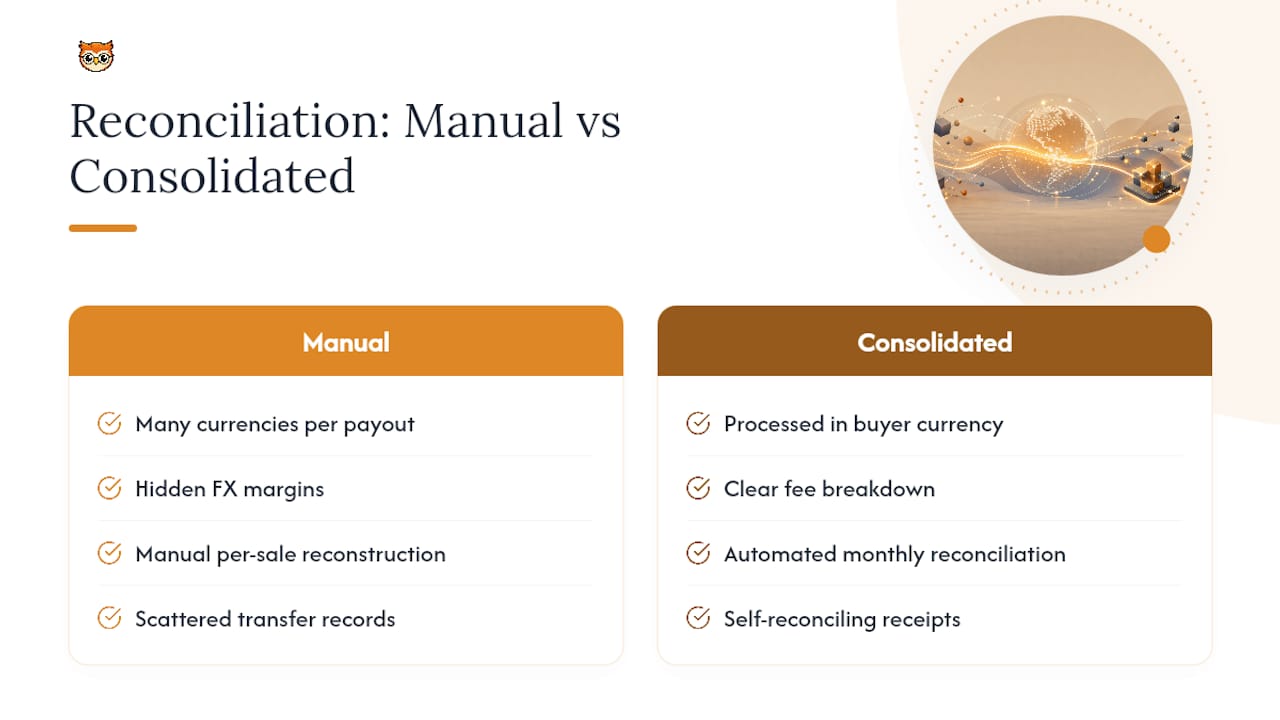
Everything covered above, IBAN accuracy, fee transparency, tracking, declaration thresholds, is manageable one payment at a time. It gets genuinely difficult once you're a creator receiving payouts from buyers in a dozen currencies every month, each with its own fee structure and FX margin buried somewhere in the transfer.

Bibliowlteca handles this differently. Instead of you tracking separate bank transfers, currency conversions, and fee deductions across every sale, the platform processes payments in the buyer's currency and gives you a clear breakdown of what you're actually receiving, no reconstructing hidden FX margins after the fact. That's the same clarity this guide has been walking through, applied automatically to every transaction rather than something you calculate manually per payment. It maps directly onto the checklist above: verified beneficiary details, transparent cost-sharing, and a receipt trail that reconciles itself.
If you're currently selling courses or e-books and manually tracking payouts across currencies, take a look at the platform's global payment features and see what a consolidated payout process would save you each month.
Key Takeaways
Correct beneficiary data and the right cost-sharing choice determine both how fast an international payment arrives and how much it actually costs.
| Point | Details |
|---|---|
| Get the data right first | IBAN, BIC/SWIFT and a clear reference prevent the vast majority of delays and holds. |
| Choose cost-sharing deliberately | SHA suits most payments; use OUR only when the beneficiary needs the exact full amount. |
| Expect SEPA fast, SWIFT slower | SEPA instant clears in seconds; SWIFT transfers can take up to three business days. |
| Declare at €50,000 | Eesti Pank requires declaration of payments at or above this threshold within set monthly windows. |
| Multi-currency payouts simplify reconciliation | Bibliowlteca gives creators a transparent fee breakdown across currencies instead of manual bank reconciliation. |
Sources
- Payments | SWIFT
- Rahvusvaheliste maksete deklareerimise juhendmaterjalid — Eesti Pank
- Välismaksed — SEB