
TL;DR:
- Effective keyword use in research enhances discoverability and citation potential through precise, aligned terminology. Selecting five to ten targeted keywords early in writing and revising them post-publication ensures better search relevance across databases. Proper keyword strategy bridges authors' research with the search habits of their target audience and increases research impact over time.
Keywords in research are defined as targeted metadata that describe the core subject matter of a study, enabling indexing services and search engines to classify and retrieve academic content accurately. Without well-chosen keywords, even high-quality research risks being invisible to the scholars who need it most. Platforms such as Scopus and Web of Science rely on these terms to match papers with relevant search queries, making keyword selection a direct driver of discoverability and citation potential. The role of keywords in research extends far beyond a simple label. They are the bridge between what a researcher writes and what a reader can find.
How do keywords influence research discoverability in academic databases?
Keywords influence how databases classify and retrieve academic papers, affecting search relevance and audience reach in platforms like Scopus, Web of Science, and Google Scholar. Each of these platforms uses keyword matching as a primary signal to rank and surface results. A paper on "machine learning in clinical diagnostics" will appear in far more relevant searches than one tagged only with "advanced computing methods," even if the underlying research is identical.
The mechanism works through indexing algorithms that scan keyword fields, titles, and abstracts to build a searchable record of each paper. When a researcher types a query into Google Scholar, the algorithm compares that query against indexed keyword metadata. Papers whose keywords align closely with the query receive higher relevance scores and appear earlier in results. This is why keyword precision is not a cosmetic concern. It is a functional one.
Discipline-specific terminology matters enormously here. A cardiologist searching for research on "myocardial infarction biomarkers" will not find your paper if you have used the informal term "heart attack markers" in your keyword field. The gap between the language a researcher uses to search and the language an author uses to describe their work is where discoverability is lost.
Keywords also function as what indexing specialists call "controlled hints." They signal to the database which subject categories a paper belongs to, which in turn determines which curated lists, journal alerts, and citation networks the paper enters. A paper indexed under the wrong subject category reaches the wrong audience, regardless of its scientific merit.
- Precision over breadth: Specific terms like "CRISPR gene editing" outperform broad terms like "genetic research" in retrieval accuracy.
- Audience alignment: Use the terminology your target readers actually type into search bars, not the internal shorthand common within your research group.
- Database-specific norms: Scopus and Web of Science each have subject thesauri. Aligning keywords with these thesauri improves classification accuracy.
- Title and abstract consistency: Keywords that appear verbatim in the title and abstract reinforce relevance signals across multiple metadata fields.
Pro Tip: Before finalising your keyword list, run each term as a search query in your target database. If the results page returns papers similar to yours, the term is well-calibrated. If it returns unrelated work, revise.
What are the best practices for selecting effective keywords in research papers?
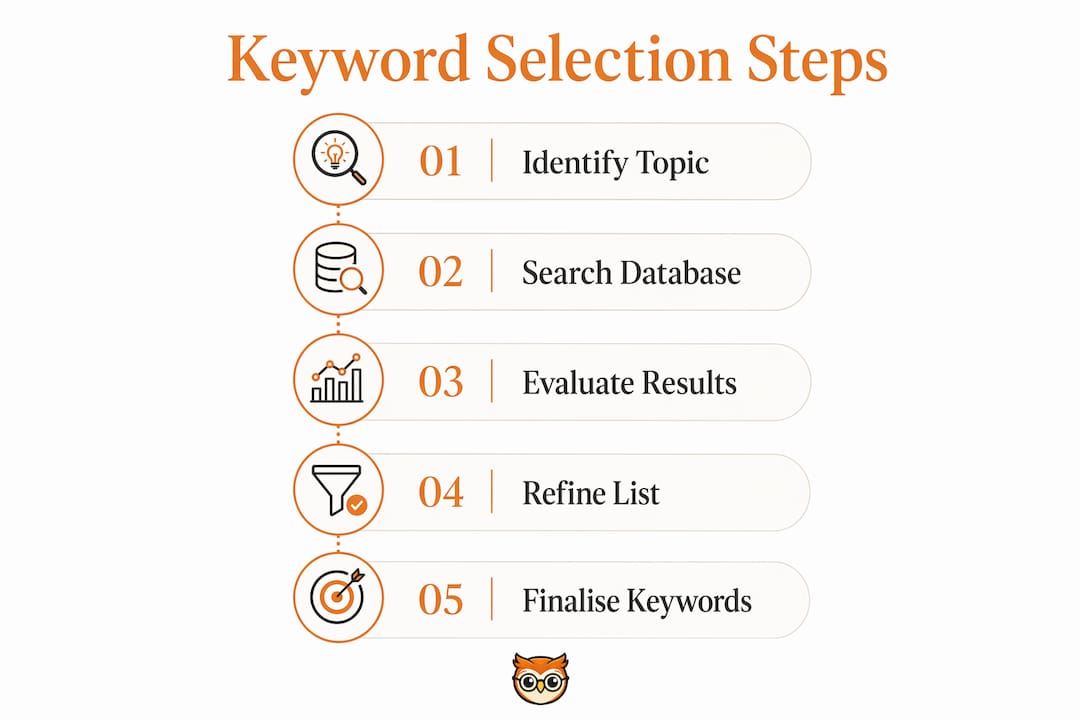
The importance of keywords in research is most clearly felt when authors follow a structured selection process rather than choosing terms at random. The following practices reflect current 2026 scholarly indexing standards and apply across disciplines.
Choose the right number of terms
Authors should select between 5 and 10 keywords to effectively represent all aspects of their research for optimal indexing. Fewer than five leaves significant subject areas unrepresented. More than ten dilutes the relevance signal and risks keyword stuffing, which harms clarity and discoverability rather than helping it.
Follow a structured selection process
- Identify core concepts. List the three or four central ideas your paper addresses. These become your anchor terms and should appear verbatim in your title or abstract.
- Reflect your methodology. If your study uses a randomised controlled trial, "randomised controlled trial" belongs in your keyword list. Methodological terms attract researchers who filter by study design.
- Add contextual terms. Include the population, setting, or discipline your research addresses. "Paediatric oncology" is more retrievable than "cancer research" for a study focused on children.
- Incorporate synonyms. Different researchers use different terms for the same concept. "Cardiovascular disease" and "heart disease" both belong in a keyword set targeting a broad clinical audience.
- Use controlled vocabularies where applicable. In medical and life sciences research, MeSH terms enable standardisation and better retrievability by aligning your paper with established subject categories used by databases like PubMed.
- Avoid internal jargon. Terms coined within your research group or institution rarely appear in external search queries. Replace them with the standard terminology your audience uses.
- Test each term. Search your proposed keywords in your target database before submission. Confirm that the results align with your paper's subject matter.
Common pitfalls to avoid
Overly broad terms such as "science," "research," or "analysis" return thousands of unrelated results and provide no meaningful subject signal. Single-word keywords suffer from the same problem. Conversely, terms so narrow that no other researcher uses them produce zero retrieval. The goal is specificity within the vocabulary your audience actually employs.
Well-chosen keywords improve academic visibility by enhancing database indexing, which correlates directly with increased citation potential. This correlation is not incidental. When your paper appears in more relevant searches, more researchers read it, and more of them cite it.
Pro Tip: Check the keyword lists of the five most-cited papers in your target journal. The terms they use reveal the vocabulary your audience searches with. Align your keywords with that vocabulary.
How does keyword strategy integrate with the overall research writing process?
Most researchers treat keyword selection as a post-writing task, added after the manuscript is complete. This approach misses the most effective window for keyword integration. Keyword strategy should begin during the drafting of the title and abstract, where the foundational language of the paper is set.
The earliest stages of manuscript development are crucial for setting keyword strategy. The title and abstract are the two fields that indexing algorithms weight most heavily. When core keywords appear naturally in both the title and the abstract, they reinforce each other across multiple metadata fields, producing a stronger relevance signal than keywords listed only in the dedicated keyword field.
A practical framework for integrating keywords into the writing process uses what researchers call a dual-role approach. Anchoring core terms and expanding semantic reach together maximise both precision and breadth of keyword impact. Anchor terms are the exact phrases that define your paper's primary subject. Expansion terms are synonyms, related phrases, and interdisciplinary variants that capture searches from adjacent fields.
The table below illustrates how this dual-role framework applies across different research types.
| Research type | Anchor term (core) | Expansion terms (semantic) |
|---|---|---|
| Clinical study | "type 2 diabetes management" | "insulin resistance," "glycaemic control," "metabolic syndrome" |
| Educational research | "formative assessment" | "classroom feedback," "learning evaluation," "student progress monitoring" |
| Environmental science | "microplastic contamination" | "plastic pollution," "marine debris," "polymer particles in water" |
| Computer science | "neural network architecture" | "deep learning models," "artificial intelligence systems," "machine learning frameworks" |
Balancing verbatim repetition with synonyms also supports interdisciplinary citation. A paper on "behavioural economics" that also uses "decision-making psychology" and "cognitive bias in finance" reaches economists, psychologists, and finance researchers simultaneously. Each audience finds the paper through its own preferred terminology, and each citation from a different discipline increases the paper's cross-field impact.
Aligning keywords with research objectives requires one additional step: confirming that each keyword accurately reflects what the paper actually delivers. A keyword that attracts readers who then find the paper irrelevant to their needs produces a high bounce rate in database analytics and can reduce the paper's ranking over time. Accuracy and relevance must govern every keyword choice.
What are the consequences of poor keyword selection?
Poor keyword choices cause search invisibility, reducing the impact of quality research regardless of its scientific merit. A paper that cannot be found cannot be cited, taught, or built upon. The consequences compound over time as citation counts influence journal rankings, researcher profiles, and funding decisions.
The most common keyword failures fall into recognisable patterns:
- Vague terms: "Modern approaches," "recent developments," and "new methods" describe almost any paper in any field. They provide no subject signal and attract no targeted traffic.
- Overly technical jargon: Terms used exclusively within a narrow subfield exclude the broader audience that might benefit from and cite the research.
- Keyword stuffing: Keyword stuffing harms clarity and discoverability by overwhelming the relevance signal with noise. Databases penalise papers that appear to game their indexing systems.
- Misaligned terminology: Using "automobile" when your target audience searches for "vehicle" or "car" creates a vocabulary gap that prevents retrieval.
- Ignoring synonyms: Selecting only one term for a concept when multiple terms are in common use cuts off entire segments of your potential readership.
Irresponsible keyword selection causes research to be invisible in search despite its quality. This highlights the importance of aligning keyword choices with the common terminology your audience uses rather than the language most familiar to you as the author.
Auditing an existing keyword set is straightforward. Search each current keyword in your target database and examine the results. If the papers that appear are unrelated to your work, replace that keyword with a more precise or better-aligned alternative. Repeat this process after each major revision of the manuscript, since the paper's focus may shift during editing in ways that affect keyword relevance.
The relationship between poor keyword choices and reduced citation rates in academic publishing is well-established. Researchers who invest time in keyword auditing after publication, not just before submission, consistently maintain stronger discoverability over the full lifespan of their work.
Key takeaways
Effective keyword selection is the single most controllable factor in determining whether quality research reaches its intended audience and accumulates citations over time.

| Point | Details |
|---|---|
| Keywords as metadata | Keywords are indexed metadata that determine how databases classify and surface your research in search results. |
| Optimal keyword count | Select 5–10 keywords per paper to represent all core aspects without diluting relevance signals. |
| Start early | Begin keyword strategy during title and abstract drafting, not after the manuscript is complete. |
| Use the dual-role framework | Combine anchor terms with semantic expansion synonyms to reach both specialist and interdisciplinary audiences. |
| Audit after publication | Review and update keyword sets post-publication to maintain discoverability as search behaviour evolves. |
Keywords and research visibility: what I have learned from working with creators
The conversation about keywords in academic publishing tends to focus on submission checklists. Choose five to ten terms, avoid jargon, submit. What that framing misses is that keyword strategy is a living practice, not a one-time decision.
Working with researchers and content creators across disciplines, I have noticed a consistent pattern. The researchers who attract the most citations are not always producing the most original work. They are producing work that is findable. They think about keyword relevance in studies the way a skilled editor thinks about headlines: every word must earn its place, and the reader's vocabulary matters more than the author's.
One insight that surprises most researchers is that keyword optimisation starting early in the writing process changes the manuscript itself for the better. When you commit to a core keyword during the title draft, you write a tighter, more focused abstract. The discipline of keyword clarity forces conceptual clarity. The two are inseparable.
The other shift I would encourage is treating keyword selection as an ongoing responsibility. Search behaviour changes. New terminology enters a field. A term that was precise in 2023 may now be superseded by a more widely adopted phrase. Researchers who revisit their keyword sets annually, and update them where the platform allows, maintain discoverability long after publication. Subject indexing practices evolve alongside search algorithms, and your metadata should evolve with them.
The balance between scientific quality and metadata clarity is not a compromise. A well-written paper with well-chosen keywords outperforms a well-written paper with careless keywords every time. Metadata is not a bureaucratic afterthought. It is part of the work.
— BibliOWLteca
How Bibliowlteca helps researchers publish and reach wider audiences
Producing research that deserves to be read is only half the challenge. Getting it in front of the right audience requires the same attention to metadata and discoverability that this article has outlined.

Bibliowlteca is a digital platform built for creators and researchers who want to distribute educational content globally without the friction of traditional publishing infrastructure. From publishing e-books and courses to managing international payments and tax compliance, Bibliowlteca handles the operational layer so you can focus on the knowledge itself. The platform supports metadata management as part of its digital delivery tools, giving researchers practical control over how their content is described, categorised, and found. Visit Bibliowlteca to see how its content distribution features support researchers at every stage of the publishing process.
FAQ
What is the role of keywords in research?
Keywords are metadata that describe a study's core subject matter, enabling indexing platforms like Scopus and Web of Science to classify and retrieve the paper in relevant search results. They directly affect how many researchers find and cite the work.
How many keywords should a research paper include?
Authors should select between 5 and 10 keywords to represent all aspects of their research effectively. Fewer than five leaves subject areas unrepresented, while more than ten dilutes the relevance signal.
What is keyword stuffing in academic research?
Keyword stuffing is the overuse of terms in an attempt to game indexing algorithms. It harms clarity and discoverability, and databases are designed to penalise it.
How do controlled vocabularies like MeSH improve keyword selection?
Controlled vocabularies such as MeSH terms standardise terminology across a discipline, aligning a paper with established subject categories used by major databases and improving retrievability for researchers searching within those categories.
When should researchers begin their keyword strategy?
Keyword strategy should begin during the drafting of the title and abstract, not after the manuscript is complete. Early integration produces stronger relevance signals across multiple metadata fields and often improves the clarity of the manuscript itself.