
TL;DR:
- Indexing organizes scholarly documents into searchable systems, ensuring research is discoverable, cited, and valued. Researchers must actively understand indexing strategies, including delays, to access the most recent literature and improve research visibility. Publishing in properly indexed journals enhances a study's impact, credibility, and career prospects.
Indexing is defined as the process of organising scholarly documents into structured, searchable systems so that researchers can retrieve them efficiently. The role of indexing in research extends far beyond simple cataloguing. It determines whether your work gets discovered, cited, and taken seriously by the academic community. Databases such as Web of Science, PubMed, and the Cochrane Handbook represent the gold standard for indexed scholarly content. Without indexing, even the most rigorous study can disappear into obscurity, never reaching the researchers who need it most.
What is indexing in research and how has it evolved?
Indexing in information retrieval is the systematic process of describing, classifying, and organising documents so they can be found through a search. The term originates in library science but now sits at the heart of every academic database, search engine, and digital repository. Understanding its evolution explains why modern research retrieval works the way it does.

The earliest form of academic indexing was manual cataloguing. Librarians assigned subject headings by hand, drawing on classification systems such as the Dewey Decimal System to group related materials. This approach was thorough but slow. A single cataloguer might process dozens of items per day, and coverage was always incomplete. The Library of Congress Subject Headings (LCSH) later provided a controlled vocabulary that standardised how subjects were described across institutions.
Automation changed everything. From the 1960s onwards, databases began using machine-readable records, and by the 1990s, full-text digital indexing had become standard. Automated systems could process thousands of documents per hour, assigning keywords based on frequency and position within the text. The trade-off was precision. Machines excelled at exhaustive coverage but struggled with conceptual nuance.
The primary role of indexing has evolved into balancing recall and precision through a mix of human concept abstraction and automated large-scale indexing. This balance enables effective retrieval by reducing irrelevant results while maximising relevant coverage.
Recall refers to how many relevant documents a search retrieves. Precision refers to how many of those retrieved documents are actually relevant. A search that returns 10,000 results has high recall but low precision. A search that returns 12 highly relevant results has high precision but may miss important work. Modern indexing systems aim to optimise both simultaneously, combining human-assigned subject headings with machine-generated metadata.
Pro Tip: When searching a database, use both controlled vocabulary terms (such as MeSH headings in PubMed) and free-text keywords. This dual approach compensates for the gap between what indexers assign and what authors actually write.
The shift towards subject indexing in education and other disciplines reflects a broader recognition that human intellectual judgement remains irreplaceable. Automated indexing handles scale. Human indexers handle meaning.
How does indexing affect research visibility and academic impact?
Publishing in non-indexed journals renders academic work effectively invisible to the global scholarly community. This is not a minor inconvenience. It directly affects citations, grant eligibility, promotion decisions, and institutional funding. The stakes are high for every researcher who submits a manuscript.
Indexing functions as a proxy for quality. When a journal appears in Web of Science or Scopus, it signals that the publication has passed independent vetting for editorial standards, peer review rigour, and transparency. Researchers and institutions use this signal when evaluating the credibility of a paper. A study published in an indexed journal carries more weight than the same study published elsewhere, regardless of its actual content.
The connection to citation metrics is direct. Your h-index, which measures both the productivity and citation impact of your published work, depends entirely on your papers being discoverable. If a database cannot find your article, it cannot count its citations. This matters enormously when funding bodies or tenure committees assess your academic output.
Key ways indexing shapes academic impact:
- Discoverability: Indexed articles appear in database searches. Non-indexed articles do not, regardless of their quality.
- Citation counting: Metrics such as the h-index rely on citation data drawn from indexed sources. Missing from an index means missing from the count.
- Grant eligibility: Many funding bodies require applicants to demonstrate publication records in recognised indexed journals.
- Institutional rankings: University rankings incorporate research output metrics that draw exclusively from indexed databases.
- Peer credibility: Researchers judge the trustworthiness of a source partly by its indexing status.
Indexing also acts as an independent quality marker that enhances journal and article trustworthiness in the research community. Indexed journals attract stronger submissions and wider readership. This creates a virtuous cycle: better papers attract more citations, which strengthens the journal's metrics, which attracts more high-quality submissions.
The distinction between scientific indexes and general research databases matters here. A scientific index such as Web of Science or Scopus applies rigorous selection criteria before admitting a journal. A general database may aggregate content without the same vetting. Researchers should verify which category a database falls into before treating its coverage as a quality signal.
What are the main types of indexing strategies researchers should know?
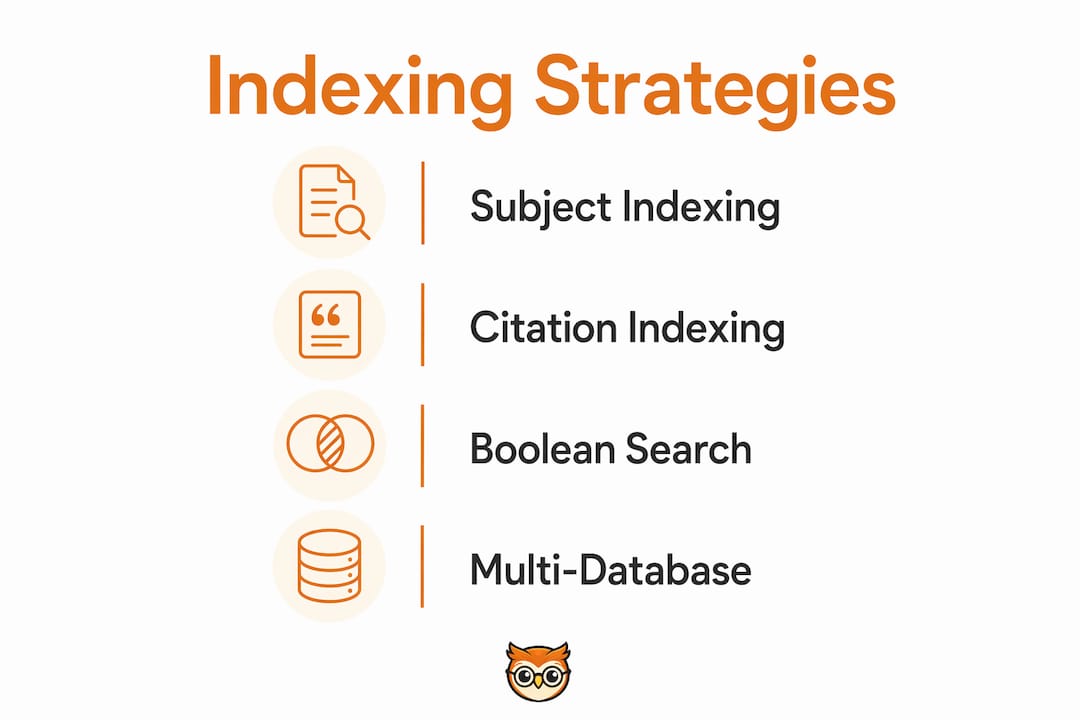
Three indexing approaches shape how researchers search and how their work gets found: subject indexing, citation indexing, and Boolean search strategies. Each serves a different purpose, and using all three together produces the most complete results.
Subject indexing and controlled vocabularies
Subject indexing assigns standardised terms to documents based on their content. The Medical Subject Headings system, known as MeSH, is the most widely used controlled vocabulary in health and life sciences. PubMed uses MeSH to index every article it holds. When you search for "myocardial infarction," MeSH maps that term to a defined concept and retrieves all articles indexed under it, regardless of whether the author used that exact phrase.
Indexing terminology varies across platforms and disciplines, and researchers should consult thesauruses or controlled vocabulary browsers for accurate searching. The term "Latino" in one database may appear as "Hispanic" in another. These differences are not trivial. A search that uses the wrong term for a given database can miss a substantial body of relevant literature.
Citation indexing
Citation indexing allows researchers to trace citations forward and backward in time, mapping knowledge influence and scholarly connections. If you find a landmark paper from 2005, citation indexing lets you identify every subsequent paper that cited it. This is invaluable for literature reviews because it reveals how a field has developed and which ideas have been most influential.
Web of Science pioneered citation indexing in the 1960s under Eugene Garfield. The approach transformed bibliometrics and gave rise to the Journal Impact Factor. Today, citation indexing underpins most academic evaluation systems. Tracing citation influence over time is now a standard part of systematic review methodology.
Boolean search and multi-database strategies
| Strategy | Description | When to use it |
|---|---|---|
| Boolean operators | Combine terms with AND, OR, NOT to control search scope | All database searches |
| Controlled vocabulary | Use database-specific subject headings (e.g., MeSH) | Subject-specific searches |
| Free-text keywords | Search title, abstract, and full text for author's own terms | Recent or niche topics |
| Citation chaining | Follow references forward and backward from a key paper | Literature mapping |
| Multi-database searching | Search across two or more databases to capture unique titles | Systematic reviews |
The Cochrane Handbook mandates that systematic reviews search a minimum of two bibliographic databases, preferably three to five, because each database holds unique titles and applies different indexing conventions. This standard exists because no single database covers all relevant literature. Relying on one source guarantees gaps.
Pro Tip: Newly published articles often lack assigned MeSH terms for several weeks or months after publication. Always combine controlled vocabulary searches with free-text keyword searches to capture the most recent literature before subject headings are assigned.
Indexing delays affect retrieval of recent articles by weeks or months when researchers rely solely on controlled vocabularies. This is a known limitation of subject indexing systems, not a flaw in any particular database. Compensating for it requires the dual-search approach described above.
A further challenge is that incomplete integration of open access repositories with search engines causes significant delays in research discovery. Articles in repositories that are not fully indexed may take weeks to months longer to surface in database searches compared to articles in well-indexed journals. Researchers conducting time-sensitive reviews should account for this gap.
How do journals become indexed and what does this mean for you?
Journal indexing is not automatic. Major indexes apply strict selection criteria, and the process takes time. Understanding this helps researchers make better submission decisions and avoid wasting effort on journals that will not advance their visibility.
Indexing is typically a reward earned after consistent, quality publishing. Major indexes require journals to demonstrate sustained publication over at least one year, with five or more articles published annually. Attempting to gain indexing too early almost always fails. The track record matters more than any single issue.
Criteria that major indexes assess before admitting a journal:
- Publication consistency: Regular, on-schedule publishing over a sustained period, typically one to three years.
- Peer review rigour: A documented, transparent peer review process with named editorial board members.
- Author and editorial diversity: International authorship and editorial representation, not a single institution or country.
- Metadata standards: Proper DOI assignment, structured abstracts, and machine-readable metadata for each article.
- Ethical compliance: Adherence to COPE (Committee on Publication Ethics) guidelines and clear conflict-of-interest policies.
- Scope clarity: A well-defined subject scope that does not shift between issues.
For researchers, the practical implication is straightforward. Before submitting a manuscript, verify the indexing status of your target journal in Web of Science, Scopus, or PubMed's journal list. A journal that claims to be "in the process of indexing" is not yet indexed. That distinction matters for your citation record and your career.
Research databases play a central role in connecting indexed journals to the researchers who need them. Choosing the right database for your discipline, and understanding its indexing coverage, is as important as choosing the right journal for submission.
The benefits of publishing in an indexed journal compound over time. Your article becomes permanently searchable, citable, and visible to researchers in your field worldwide. Each citation it receives feeds back into your h-index and strengthens your academic profile. The initial effort of targeting indexed journals pays dividends across your entire career.
Key takeaways
Indexing determines whether research gets found, cited, and evaluated fairly. Without it, even high-quality work remains inaccessible to the scholars who need it most.
| Point | Details |
|---|---|
| Indexing defines discoverability | Articles in non-indexed journals are invisible to most researchers and citation tracking systems. |
| Recall and precision must balance | Effective searching combines controlled vocabularies with free-text keywords to capture both broad and recent literature. |
| Citation indexing maps influence | Tracing citations forward and backward reveals how ideas develop and which works shape a field. |
| Multi-database searching is mandatory | Systematic reviews require at least two databases; the Cochrane Handbook recommends three to five. |
| Journal indexing takes time | Major indexes require a sustained publication track record before admission; verify status before submitting. |
Indexing in 2026: what I have learnt from working with researchers
The single most common mistake I see researchers make is treating indexing as someone else's problem. They write the paper, submit it, and assume the system will handle the rest. It will not. Indexing is an active concern that shapes every stage of the research process, from database selection at the literature review stage to journal choice at submission.
What strikes me most is how few researchers understand the indexing delay problem. They run a database search, find nothing recent on their topic, and conclude the field is dormant. Often, the field is active but the latest articles simply have not yet received their subject headings. The fix is simple: add free-text keyword searches alongside your controlled vocabulary terms. That one adjustment can surface months of literature you would otherwise miss.
The other pattern I notice is over-reliance on a single database. Google Scholar feels comprehensive because it returns so many results. But coverage is uneven, quality signals are absent, and citation counts are inflated by non-peer-reviewed sources. Discipline-specific databases with rigorous indexing standards give you cleaner, more reliable results. For health research, that means PubMed. For social sciences, it means PsycINFO or Sociological Abstracts. For multidisciplinary work, it means combining Web of Science with at least one subject-specific source.
Looking ahead, I expect automated indexing to become more sophisticated, particularly with large language models assigning subject headings with greater conceptual accuracy. But the fundamentals will not change. Recall, precision, controlled vocabularies, and multi-database coverage will remain the core of effective research retrieval. Researchers who understand these principles now will adapt to new tools far more easily than those who rely on any single platform.
— BibliOWLteca
Sharpen your research skills with Bibliowlteca
Mastering indexing strategies takes more than a single article. Bibliowlteca offers a growing library of research-focused ebooks that go deep on academic search methods, citation management, and systematic review techniques.

Whether you are a postgraduate student building your first literature review or an experienced researcher refining your search strategy, Bibliowlteca's courses and mentorships give you structured, practical guidance. The platform supports global access with multiple currencies and instant digital delivery, so you can start learning without delay. Visit Bibliowlteca to find the resources that match your research goals.
FAQ
What is the role of indexing in research?
Indexing organises scholarly documents into searchable databases so researchers can retrieve relevant work efficiently. It also determines whether a paper is discoverable, citable, and visible to the academic community.
Why does publishing in non-indexed journals harm researchers?
Non-indexed journals make articles invisible to most database searches, which prevents citations from accumulating and can negatively affect h-index scores, grant applications, and promotion decisions.
What is the difference between subject indexing and citation indexing?
Subject indexing assigns controlled vocabulary terms to documents based on their content, while citation indexing tracks which papers cite which, allowing researchers to trace the influence of ideas forward and backward through time.
How many databases should a systematic review search?
The Cochrane Handbook recommends searching a minimum of two bibliographic databases, and preferably three to five, because each database holds unique titles and applies different indexing conventions.
How long does it take for a journal to become indexed?
Major indexes typically require journals to demonstrate at least one year of consistent, quality publishing before admission. Attempting indexing too early almost always fails, as a sustained track record is the primary criterion.