
TL;DR:
- Understanding library resources enhances research credibility and efficiency across disciplines.
- Reference works provide authoritative summaries, serving as essential starting points for unfamiliar topics.
Library resources are defined as the organised categories of materials, tools, and collections that libraries provide to support research, teaching, and learning across every discipline. Students, educators, and researchers who understand the full range of types of library resources gain a decisive advantage: they know when to reach for an encyclopedia, when to search JSTOR, and when a government document outperforms a textbook. The major categories include reference works, books and eBooks, periodicals, digital databases, special collections, and open educational resources (OER). Complementary tools such as Zotero and EndNote help manage what you find. Knowing the difference between these categories is not a minor detail. It shapes the credibility, depth, and efficiency of every research project you undertake.
1. What are reference works and their role in research?
Reference works are curated, authoritative sources designed to provide concise, vetted background information rather than extended argument or narrative. They are the correct starting point for any unfamiliar topic because they compress expert knowledge into accessible summaries. Examples include encyclopedias, dictionaries, glossaries, almanacs, yearbooks, bibliographies, handbooks, manuals, and geographical sources such as atlases.

The distinction between print and digital formats matters here. Print reference works such as the Oxford English Dictionary or Encyclopaedia Britannica carry decades of editorial rigour. Digital equivalents, including Oxford Reference Online and Credo Reference, add the advantage of hyperlinked cross-references and regular updates. Both formats serve the same core function: giving you reliable, quick-access facts before you commit to a deeper search.
Typical uses for reference works include:
- Defining terms before writing a literature review
- Gaining a topic overview to identify key themes and scholars
- Locating bibliographies that point toward primary literature
- Checking facts such as dates, statistics, or geographical data
- Finding subject-specific handbooks for technical disciplines like medicine or law
The advantage of reference works over a general web search is editorial control. Every entry in a subject encyclopedia such as Grove Music Online or the International Encyclopedia of the Social Sciences has been written and reviewed by a named expert. That accountability is absent from most open web sources.
Pro Tip: Use subject-specific encyclopedias rather than general ones when your topic is narrow. A psychology student researching cognitive load theory will find more targeted, citable content in the APA Handbook of Experimental Psychology than in a general encyclopedia.
Reference works also serve as a gateway to credible research foundations. The bibliographies embedded in encyclopedia articles are often the fastest route to the most authoritative books and journal articles on a subject.
2. How books and eBooks serve academic needs in libraries
Books remain the most in-depth format available in any library collection, offering sustained argument, contextual analysis, and comprehensive coverage that shorter formats cannot match. The key is understanding which type of book serves which purpose.
The main categories you will encounter are:
- Monographs: Single-author or co-authored works presenting original research or extended argument on one topic. A monograph by a university press carries significant academic weight.
- Anthologies and edited collections: Multiple authors contributing chapters on related themes, curated by an editor. Useful when you need perspectives from several scholars in one volume.
- Textbooks: Designed for teaching rather than original research. They synthesise existing knowledge and are excellent for building foundational understanding, though they update slowly.
- Series: Multi-volume works published under a unifying theme, such as the Cambridge Companions or Routledge's Critical Concepts in Sociology series. Ideal for tracing a field's intellectual development.
- Popular books: Written for general audiences without peer review. Useful for context and narrative but should not replace scholarly sources in academic work.
The distinction between scholarly and popular books is one of the most consequential judgements a student makes. A scholarly monograph published by Oxford University Press or MIT Press has undergone peer review and editorial scrutiny. A popular title from a trade publisher may be well-written but lacks that verification layer.
eBooks have changed access patterns significantly. Platforms such as EBSCO eBooks, ProQuest Ebook Central, and Springer eBooks allow simultaneous multi-user access, full-text search, and annotation tools. The limitation is that eBook licences vary: some allow downloading, others restrict printing, and a few expire after a set number of loans.
Pro Tip: Search your library catalogue using subject headings rather than keywords. Subject headings such as "Climate change, Economic aspects" retrieve books catalogued specifically on that topic, filtering out loosely related results.
For students building an annotated bibliography, understanding how to cite library books correctly from the outset saves significant revision time later.
3. Periodicals: journals, magazines, newspapers, and trade publications
Periodicals are publications issued at regular intervals, and they represent the most current layer of any library collection. The term covers four distinct types, each serving a different audience and purpose.
| Type | Audience | Purpose | Review process |
|---|---|---|---|
| Scholarly journal | Researchers, academics | Original research, theory, methodology | Peer-reviewed |
| Magazine | General public | News, features, commentary | Editorial only |
| Newspaper | General public | Current events, opinion, reporting | Editorial only |
| Trade publication | Industry professionals | Sector news, product updates, practice guidance | Editorial only |
Scholarly journals such as Nature, The Lancet, and Journal of Educational Psychology publish peer-reviewed articles. Peer review means that independent experts in the field have evaluated the methodology and conclusions before publication. This process makes journal articles the gold standard for academic citation, though it also means publication can lag behind current events by months or years.
Magazines such as The Economist or New Scientist translate complex topics for informed general readers. They are useful for contextualising research within broader public discourse but are not appropriate as primary academic sources.
Newspapers such as The Guardian or The Financial Times provide real-time coverage of events, policy changes, and public opinion. For research on current affairs, media representation, or policy analysis, newspapers are primary sources in their own right.
Trade publications such as The Bookseller, Times Higher Education, or Nursing Times address practitioners within a specific industry. They carry practical, sector-specific knowledge that neither academic journals nor newspapers typically cover.
Most libraries provide electronic access to periodicals through databases. JSTOR covers archived journal content across humanities and social sciences. ScienceDirect focuses on science, technology, and medicine. Factiva and ProQuest Historical Newspapers provide newspaper archives stretching back centuries.
4. Digital and specialised resources that extend library collections
Libraries acquire and subscribe to a broad range of digital and specialised resource types beyond books and journals, including databases, government documents, maps, streaming video, and special collections. These categories are growing in importance as research becomes increasingly interdisciplinary and digitally mediated.
Academic databases are the primary discovery tool for journal articles and reports. JSTOR, ScienceDirect, PubMed, and ERIC each specialise in different subject areas. A database is not a resource itself but a searchable index that connects you to resources, often with full-text access included.
Streaming video platforms licensed by libraries, such as Kanopy and Alexander Street Press, provide access to documentaries, feature films, and educational video content. These are particularly relevant for media studies, history, and social science research.
Government documents are among the most underused resources in any library. Publications from bodies such as the Office for National Statistics, the World Health Organization, and the United States Census Bureau contain primary statistical data unavailable elsewhere. Many are freely available online, but library subject guides help you locate the most relevant ones quickly.
Maps and geographical information systems (GIS) data are held by many academic libraries. Ordnance Survey maps, historical cartography collections, and digital GIS datasets support research in geography, urban planning, environmental science, and history.
Special collections deserve particular attention:
- Archives and manuscripts: Original, unpublished documents including letters, diaries, institutional records, and photographs. These are primary sources in the strictest sense.
- Theses and dissertations: Special collections including theses represent original research conducted at degree level. ProQuest Dissertations and Theses Global provides access to millions of these works.
- Rare books: Pre-modern printed works held under controlled conditions, accessible by appointment at most research libraries.
Access rights and licensing govern what you can use and how. Institutional logins through your university or public library portal typically unlock far more content than a personal subscription would provide.
Pro Tip: Before assuming a resource is unavailable, check your library's interlibrary loan service. Most academic libraries can obtain almost any item within days, at no cost to you.
5. What are open educational resources (OER) and why do they matter?
Open Educational Resources are learning, teaching, and research materials that carry no-cost access and legal permissions to reuse, repurpose, adapt, and redistribute. UNESCO's formal recommendation establishes this definition, distinguishing OER from simply "free" content by emphasising the legal permissions attached to the material.
OER span more than 90 types across three broad categories. This breadth means OER is far more than a collection of free PDFs. It represents a structured ecosystem of reusable educational content.
The three categories are:
- Educational content: Courses, course materials, textbooks, lesson plans, learning objects, simulations, and assessments. MIT OpenCourseWare and OpenStax are well-known examples.
- Software: Open-source tools for creating, delivering, and managing educational content. Moodle and H5P fall into this category.
- Complementary materials: Licences, design principles, and standards that enable the creation and sharing of OER. Creative Commons licences are the most widely used framework here.
For educators, OER reduces the cost barrier for students and allows curriculum customisation without copyright infringement. For students, it means access to textbooks and course materials that would otherwise cost hundreds of pounds per year. For researchers, OER datasets and open-access publications accelerate knowledge sharing.
The critical caution is licensing verification. Not all openly available content is legally reusable. A Creative Commons CC BY licence permits almost any reuse with attribution. A CC BY-NC-ND licence restricts commercial use and prohibits modifications. Misreading a licence can create legal and academic integrity problems. For a deeper understanding of how open access intersects with OER, the open access guide for researchers provides a clear framework.
6. How to choose the right library resource for your research
Selecting a library resource should be requirement-driven: the right choice depends entirely on what the resource must do for your specific task. This principle cuts through the confusion that arises when students treat all library materials as interchangeable.
The following table maps common research tasks to the most appropriate resource types:
| Research task | Best resource type | Why |
|---|---|---|
| Quick fact or definition | Reference work (encyclopedia, dictionary) | Concise, vetted, immediately accessible |
| In-depth understanding | Monograph or edited collection | Sustained argument, full context |
| Latest research findings | Peer-reviewed journal article | Current, methodologically verified |
| Current events or policy | Newspaper or government document | Real-time, primary source data |
| Primary historical evidence | Archive, manuscript, or special collection | Original, unmediated sources |
| Free, adaptable teaching material | OER (OpenStax, MIT OCW) | Legally reusable, no cost |
Beyond task-matching, three evaluation criteria apply to every resource type. First, credibility: peer-reviewed journals and university press books carry the highest academic credibility. Second, currency: a 2019 textbook may be authoritative but outdated for a fast-moving field like machine learning or public health policy. Third, depth versus overview: reference works provide breadth; monographs and journal articles provide depth. Choosing the wrong format for the wrong stage of research wastes time and weakens your argument.
Comparing resource types by primary versus secondary status also matters for citation strategy. A newspaper article reporting on a study is a secondary source. The study itself is the primary source. Citing the primary source is almost always preferable in academic work.
Research workflows benefit from a sequential approach. Start with reference works to scope the topic and identify key terminology. Move to databases and bibliographies to build your literature. Then turn to primary sources, archives, or theses for original evidence. This sequence, described in library resource management guides, prevents the common mistake of jumping straight to a Google Scholar search without adequate grounding.
Pro Tip: Most university libraries employ subject librarians who specialise in specific disciplines. A ten-minute consultation with a subject librarian typically saves hours of unfocused searching and surfaces resources you would not find independently.
Key takeaways
Understanding the full range of library resource categories is the single most effective way to improve research quality, reduce wasted time, and build credible academic arguments.
| Point | Details |
|---|---|
| Start with reference works | Use encyclopedias and handbooks to scope a topic before searching databases. |
| Match resource to task | Journals suit original research; newspapers suit current events; archives suit primary evidence. |
| Verify OER licences | Free access does not equal free reuse; check Creative Commons licence terms before adapting. |
| Use digital databases strategically | JSTOR, ScienceDirect, and PubMed each cover distinct subject areas; choose accordingly. |
| Consult subject librarians | Expert guidance surfaces specialist resources that keyword searches routinely miss. |
The resource type most researchers ignore
After years of working with educators and researchers building digital knowledge products, the pattern I see most consistently is this: people default to journal articles and textbooks, then wonder why their research feels thin or their course materials feel dated. The problem is not effort. It is range.
Government documents are the most systematically underused resource type I encounter. The Office for National Statistics, Eurostat, and equivalent bodies publish primary datasets that no journal article can replicate. When an educator wants current, authoritative figures on literacy rates, employment, or public health, the answer is almost never a textbook. It is a government statistical release published last quarter.
The second misconception I see regularly is treating OER as a budget compromise rather than a legitimate resource category. The OER typology research makes clear that open educational resources span software, simulations, and full course frameworks, not just free PDFs. An educator who builds a course around OpenStax materials and H5P interactive elements is not cutting corners. They are using a sophisticated, legally structured resource ecosystem.
My practical recommendation is to treat resource selection as a deliberate decision, not a default. Before any research project, write down what the resource must do: provide background, supply data, offer primary evidence, or deliver current developments. That single question will direct you to the right category faster than any search engine.
— BibliOWLteca
Discover and share knowledge with BibliOWLteca
Students, educators, and researchers who want to go beyond traditional library collections now have a powerful complement in digital content platforms. BibliOWLteca enables creators to publish and sell eBooks, courses, and educational materials to a global audience, with built-in tools for digital delivery, payment processing, and tax compliance.
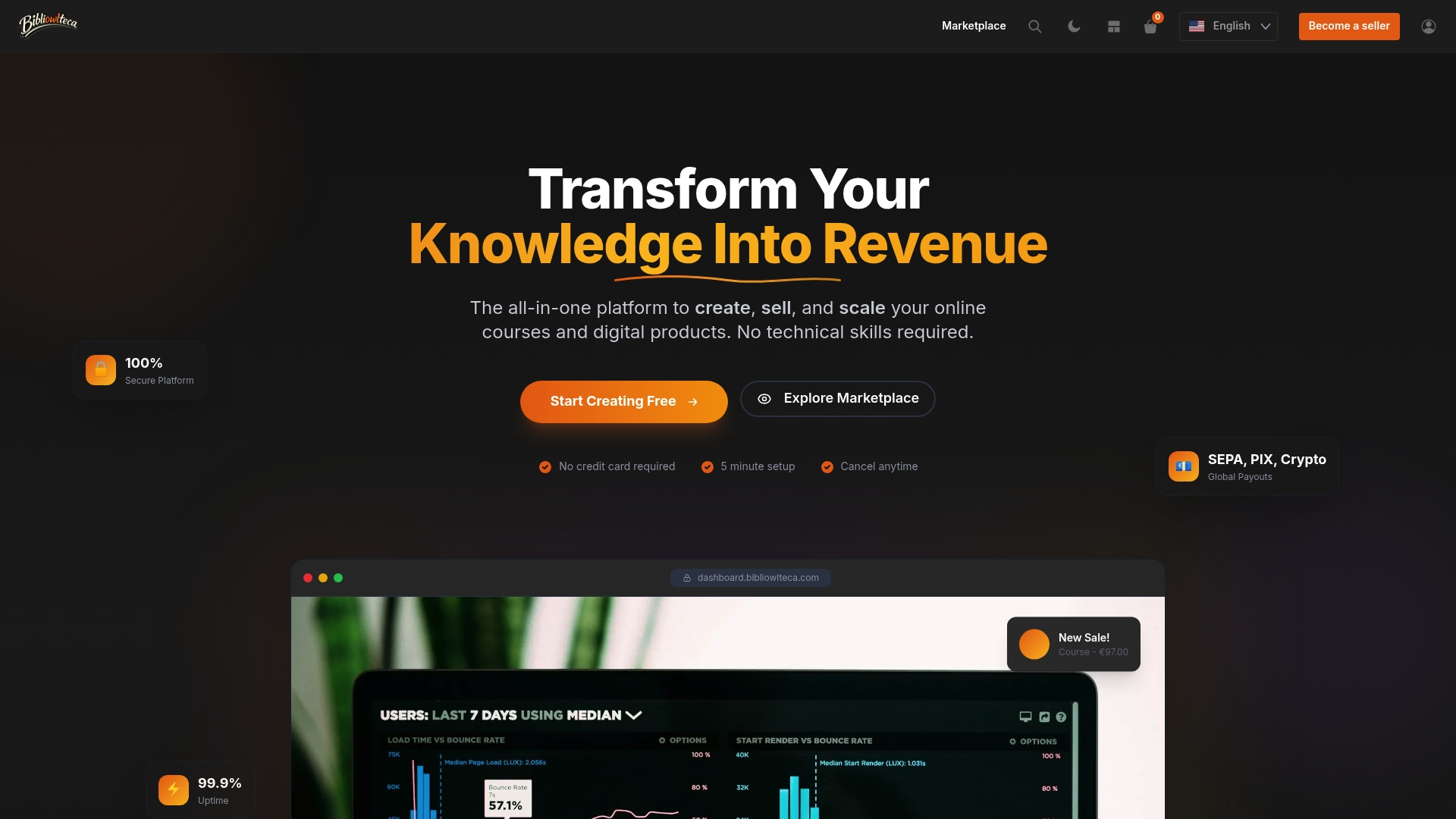
Whether you are an educator building a course around OER principles or a researcher turning your expertise into a distributable eBook, BibliOWLteca provides the infrastructure to reach learners worldwide. The platform supports multiple currencies and international payments, removing the friction that limits traditional publishing. Explore BibliOWLteca's full feature set to see how courses, eBooks, and mentorships can extend the reach of your knowledge beyond any single library or institution. Start sharing what you know at BibliOWLteca.
FAQ
What are the main types of library resources?
The main types of library resources are reference works, books and eBooks, periodicals (journals, magazines, newspapers, and trade publications), digital databases, government documents, maps, special collections, and open educational resources. Each category serves a distinct research purpose and audience.
How do I choose between a journal article and a book?
Choose a journal article when you need the most current peer-reviewed findings on a specific question; choose a book or monograph when you need sustained argument, historical context, or comprehensive coverage of a broad topic. The research stage and depth required determine the better fit.
What makes OER different from other free online content?
OER carries explicit legal permissions to reuse, adapt, and redistribute, as defined by UNESCO's formal recommendation, whereas general free online content may be freely viewable but legally restricted from modification or redistribution. Always verify the Creative Commons licence before adapting any OER material.
Are special collections only available in large research libraries?
Special collections including archives, manuscripts, and theses are held by many university and national libraries, and a growing number are digitised and accessible online through platforms such as ProQuest Dissertations and Theses Global or institutional repositories. Physical access to rare materials typically requires an appointment.
How do digital databases differ from search engines?
Academic databases such as JSTOR, PubMed, and ScienceDirect index peer-reviewed, editorially controlled content with structured metadata, enabling precise subject and author searches. General search engines index the open web without quality filtering, making them less reliable for academic research.