
TL;DR:
- Abstracts summarize the purpose, methods, results, and conclusions of scholarly articles while affecting discoverability and acceptance. They must be written last, follow the IMRaD structure, and be entirely self-contained without citations or unexplained acronyms. Properly crafted abstracts enhance research visibility across databases, aid in screening, and influence citation potential throughout the research lifecycle.
An abstract is a self-contained summary of a scholarly article that reports its purpose, methods, results, and conclusions in 150–300 words. The role of abstracts extends far beyond convenience. Abstracts determine whether editors accept manuscripts, whether databases index research, and whether other academics read your work at all. Tools like Grammarly help with clarity, but no writing aid compensates for a poorly conceived abstract. The IMRaD structure (Introduction, Methods, Results, and Discussion) sets the standard across biomedical, social, and physical sciences. Understanding what an abstract must do is the first step to writing one that works.
What is the role of abstracts in academic articles?
Abstracts serve as the research 'shop front.' They give editors, peer reviewers, and readers the information they need to decide whether to engage further with a paper. Abstracts are often the second most read section after the title. Poor abstract quality leads to dismissal regardless of a paper's underlying merit.

The function of abstracts goes well beyond summary. Abstracts generate the metadata that search engines and academic databases use for indexing. Search engines like Google Scholar index only titles and abstracts, not full texts. A weak or keyword-poor abstract effectively hides your research from the scholars who need it most.
Abstracts also carry a screening function. Conference committees, grant panels, and journal editors use them to filter submissions before reading a single page of the full manuscript. A well-written abstract signals professional rigour. It tells a reviewer that the researcher understands their own work clearly enough to explain it in under 300 words.
"Abstracts are not mere formalities but active tools that shape bibliographic collections and enable efficient scholarly communication." — LIS Academy
The importance of abstracts also shows up in interdisciplinary work. Researchers outside your specialism rely on abstracts to judge relevance without wading through technical methodology sections. A clear abstract broadens your potential readership and increases citation potential across disciplines.
Key functions abstracts perform:
- Discoverability: Keywords in abstracts drive indexing in databases such as PubMed, Scopus, and Web of Science.
- Screening: Editors and committees use abstracts for initial acceptance or rejection decisions.
- Bibliographic control: Abstracts allow librarians and researchers to organise scholarly resources without reading full texts.
- Standalone comprehension: Abstracts must communicate the core contribution to readers who never access the full paper.
- Metadata generation: Abstracts feed the metadata fields that determine how research appears in search results.
How is a standard abstract structured?
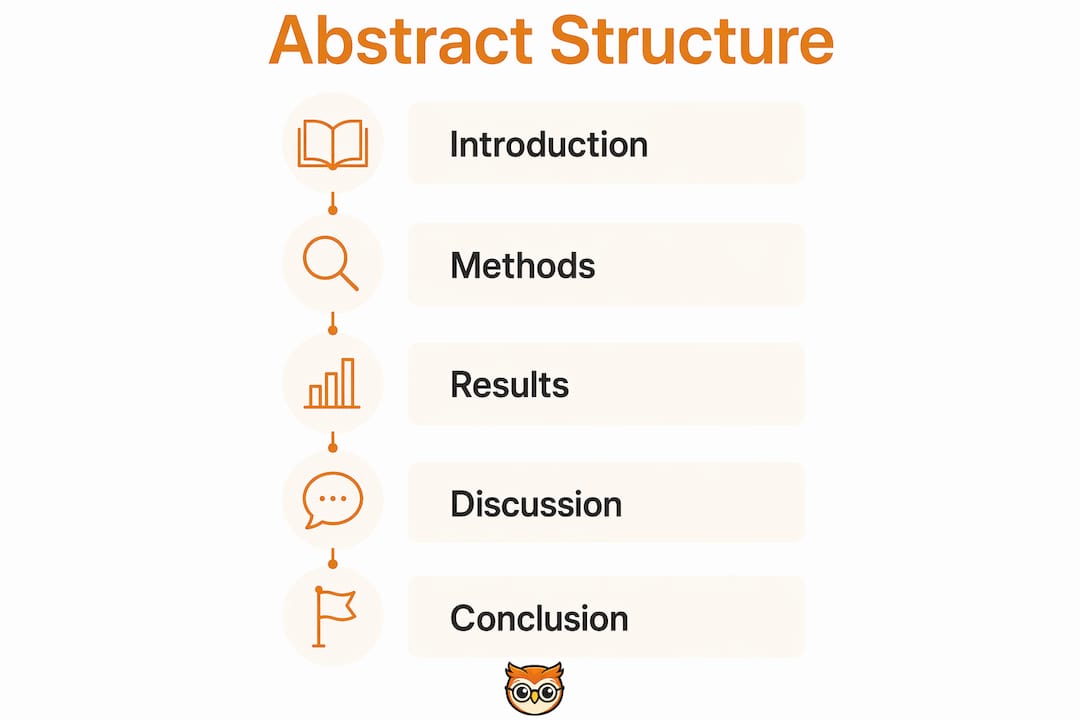
The IMRaD format is the industry-standard structure for academic abstracts across the sciences and social sciences. IMRaD stands for Introduction, Methods, Results, and Discussion. Each element answers a specific question: why the research was done, how it was conducted, what was found, and what it means.
Types of abstract: descriptive, informative, and critical
Not all abstracts follow the same format. The type you write depends on the discipline and the publication's requirements.
| Abstract type | Typical length | Purpose | Common use |
|---|---|---|---|
| Descriptive | Up to 100 words | Outlines scope and purpose only; does not report results | Humanities, social sciences |
| Informative | 150–300 words | Reports purpose, methods, results, and conclusions fully | Sciences, medicine, engineering |
| Critical | Up to 400–500 words | Evaluates the research alongside reporting it | Review articles, meta-analyses |
Informative abstracts are the most common type in peer-reviewed publishing. They give readers everything they need to assess the research without opening the full paper. Descriptive abstracts suit shorter works or conference proposals where full results are not yet available. Critical abstracts are less common but appear in systematic reviews where evaluative commentary adds value.
Word count and standalone requirements
Standard academic abstracts range 150–300 words and must function as entirely independent documents. This means no citations, no internal references to figures or tables, and no unexplained acronyms. Readers encounter abstracts in isolation through database searches, so every term must be self-explanatory.
Abstracts must be completely standalone because they are indexed and read independently of the full paper. A sentence like "as shown in Figure 3" is meaningless to a researcher reading only the abstract in a database result. Write every sentence as if the full paper does not exist.
Pro Tip: Draft each IMRaD section of your abstract by answering one question per sentence: What gap did you address? How did you study it? What did you find? What does it mean? Four sentences give you a working draft.
What are the best practices for writing effective abstracts?
Writing an effective abstract requires discipline and a clear process. The following steps reflect established academic writing guidance.
-
Write the abstract last. Writing the abstract last ensures it accurately reflects final results and conclusions rather than initial plans. Drafting it early risks misalignment with the completed work.
-
Use the verbal summary technique. The verbal summary method involves answering each major research question in one or two sentences. This keeps the abstract focused and prevents over-explanation. Answer: What was the problem? What did you do? What did you find? What does it mean?
-
Include primary keywords deliberately. Failing to include primary keywords significantly reduces discoverability. Choose terms that reflect how other researchers in your field search for literature. Place keywords naturally within sentences rather than listing them awkwardly.
-
Exclude citations and internal references. Abstracts must never include citations, footnotes, or references to tables and figures within the paper. These elements break standalone integrity and confuse readers who encounter the abstract in isolation.
-
Avoid unexplained acronyms. Spell out every acronym on first use, even if it appears in full in the paper. A reader who finds your abstract through Google Scholar has no access to your abbreviations list.
-
Do not introduce new information. The abstract reports what is in the paper. Any claim, finding, or conclusion in the abstract must appear in the full text. Adding new data or interpretations in the abstract misleads readers and undermines credibility.
-
Match the journal's required format. Many journals specify structured abstracts with labelled headings such as Background, Objective, Methods, Results, and Conclusion. Always check the author guidelines before writing.
Pro Tip: Read your abstract aloud after writing it. If you stumble or lose the thread, the sentence is too complex. Aim for clarity at the level of a well-informed colleague outside your immediate specialism.
Common errors researchers make include writing the abstract before the paper is finished, padding word count with background context, and burying the key finding in the final sentence. The finding should appear early. Reviewers read quickly and decide fast.
How do abstracts shape the research lifecycle?
Abstracts influence research at every stage, from initial literature searching through to publication, citation, and archiving. Their impact on the research lifecycle is direct and measurable.
Literature reviews and bibliographic control
Abstracts are the primary tool researchers use when conducting a literature review. A typical systematic review screens hundreds or thousands of papers. Researchers read abstracts to decide which papers merit full reading. Without clear, accurate abstracts, this process becomes unworkable.
Abstracts function as a working tool of bibliographic control that manages overwhelming literature volumes and allows rapid identification of relevant studies. Librarians use abstracts to build and maintain research collections. They enable scanning without reading full texts, which is the only practical way to manage modern literature at scale.
Discoverability and academic visibility
Abstracts act as primary metadata for academic works, directly influencing visibility and citation potential in scholarly databases. A paper with a keyword-rich, clearly written abstract appears higher in database search results. Higher visibility leads to more citations. More citations increase a researcher's academic profile and can influence funding decisions.
The table below shows how abstracts affect different stages of the research lifecycle:
| Stage | Abstract's role | Impact |
|---|---|---|
| Literature search | Enables rapid relevance screening | Saves researcher time; improves review quality |
| Submission review | First filter for editors and peer reviewers | Determines whether manuscript advances |
| Database indexing | Supplies keywords and metadata | Controls discoverability in Scopus, PubMed, Web of Science |
| Grant and conference applications | Standalone summary for panels | Influences funding and presentation acceptance |
| Post-publication citation | Drives search engine ranking | Increases citation count and academic reach |
Grant panels and conference committees
Grant panels at bodies such as the UK Research and Innovation (UKRI) and the European Research Council (ERC) routinely use abstracts to screen applications before reading full proposals. A vague or poorly structured abstract signals unclear thinking. Conference committees at events like the British Educational Research Association (BERA) annual conference apply the same logic. The abstract is the first and sometimes only document a decision-maker reads.
Researchers who treat abstracts as an afterthought pay a real cost. Papers with weak abstracts receive fewer citations, appear lower in search results, and face higher rejection rates at submission. The abstract is not a summary you write when the real work is done. It is part of the real work.
Key takeaways
Abstracts are the single most important short piece of writing a researcher produces, because they control discoverability, acceptance, and citation across every stage of the research lifecycle.
| Point | Details |
|---|---|
| Write abstracts last | Drafting after completion ensures alignment with final results and conclusions. |
| Follow IMRaD structure | Use Introduction, Methods, Results, and Discussion to meet journal and database standards. |
| Prioritise keywords | Place primary search terms naturally in the abstract to maximise database discoverability. |
| Keep abstracts standalone | Exclude all citations, acronyms, and internal references so the abstract reads independently. |
| Abstracts drive acceptance | Editors and grant panels use abstracts as the primary filter before reading full submissions. |
Abstracts in 2026: what experience actually teaches you
Working with researchers across disciplines, one pattern stands out. New academics consistently underestimate how much weight an abstract carries. They spend weeks on methodology sections and write the abstract in twenty minutes the night before submission. The result is a mismatch between the quality of the research and the quality of its shop front.
The rise of academic databases and AI-assisted literature tools has made this problem worse, not better. When a researcher uses a tool like Elicit or Semantic Scholar to scan literature, the abstract is often the only text the tool processes. A poorly written abstract does not just reduce human readership. It removes the paper from AI-assisted discovery entirely.
Graphical abstracts are gaining traction in journals published by Elsevier and Springer Nature. These visual summaries sit alongside the text abstract and improve engagement on social platforms and journal websites. They do not replace the written abstract. They extend it. Researchers who ignore this trend are leaving visibility on the table.
The most persistent mistake I see is burying the key finding. Researchers trained in narrative writing often build to a conclusion. Academic abstracts work in reverse. State the finding first, then explain how you reached it. Reviewers are busy. They read the first two sentences and decide. Make those sentences count.
Digital tools like Grammarly and the Hemingway Editor help with sentence-level clarity, but they cannot fix structural problems. If your abstract lacks a clear result, no grammar tool will save it. Write the result sentence first, then build the abstract around it.
— Bibliowlteca
Academic writing resources on Bibliowlteca
Researchers who want to sharpen their abstract writing skills will find practical support on Bibliowlteca's platform.

Bibliowlteca hosts academic writing resources including e-books and courses covering abstract structure, IMRaD formatting, and scholarly publishing best practices. The platform supports global payments and multiple currencies, so researchers worldwide can access materials without friction. Whether you are preparing a journal submission, a conference proposal, or a grant application, Bibliowlteca's creator-led courses and mentorships offer structured guidance from academics with real publishing experience. Turn the theory in this article into a submission-ready abstract.
FAQ
What is an abstract in academic writing?
An abstract is a self-contained summary of a scholarly article, typically 150–300 words, that reports the purpose, methods, results, and conclusions of the research. It functions as the primary point of contact between a paper and its potential readers.
Why is the role of abstracts so critical for discoverability?
Search engines like Google Scholar index only titles and abstracts, not full paper texts. Abstracts that lack primary keywords effectively hide research from relevant literature searches in databases such as Scopus and PubMed.
What are the main components of an abstract?
The standard components follow the IMRaD format: Introduction (the research problem), Methods (how the study was conducted), Results (what was found), and Discussion (what the findings mean). Informative abstracts cover all four; descriptive abstracts cover only scope and purpose.
Should an abstract include citations or references?
No. Abstracts must be completely standalone and free of citations, internal references, and unexplained acronyms. They are indexed and read independently, so every term must be self-explanatory without access to the full paper.
When should you write the abstract?
Write the abstract last, after the full paper is complete. Writing it early risks inaccuracy because the final results and conclusions may differ from initial plans or hypotheses.