
TL;DR:
- A bibliography is a structured list of all sources consulted during research, crediting original ideas and aiding verification. Its scope varies by style, with Chicago including all sources and APA or MLA listing only cited works, reflecting scholarly conventions. Properly creating and verifying a bibliography enhances academic integrity, credibility, and research transparency.
Most students first encounter a bibliography as a chore — something bolted onto the end of an essay with little thought. But what is a bibliography, really? It is a structured list of every source a writer consulted during research, from books and journal articles to websites and digital media. Far from being a formality, it serves as the backbone of credible academic work: it credits original thinkers, protects you from plagiarism, and gives your readers a clear trail to follow. This guide unpacks the bibliography definition, its different forms, and exactly how to create one accurately.
Table of Contents
- Key takeaways
- What is a bibliography and why does it matter?
- Bibliography vs works cited vs reference list
- Annotated bibliographies: what they are and when to use them
- How to create a bibliography: a practical guide
- Bibliographies and academic integrity
- My honest take on bibliographies
- Take your research further with Bibliowlteca
- FAQ
Key takeaways
| Point | Details |
|---|---|
| Bibliography vs other lists | A bibliography can include all consulted sources, while reference lists and works cited pages list only cited works. |
| Style guides matter | APA, MLA, and Chicago each use different source list formats; using the wrong label can cost you marks. |
| Annotations add depth | An annotated bibliography includes a brief evaluation of each source, helping develop critical reading skills. |
| Accuracy is non-negotiable | Complete and consistent entries — author, title, publisher, date — build your credibility as a researcher. |
| Tools help but require checking | Citation generators save time, but manual verification against style guides is still necessary for accuracy. |
What is a bibliography and why does it matter?
A bibliography is a comprehensive list of sources a writer consulted during research, including books, journal articles, websites, and digital media. Its purpose is threefold: to credit original ideas, to protect the writer from plagiarism, and to allow readers to locate and verify sources independently.
Every entry typically records the same core details: the author's name, the title of the work, the publisher, and the date of publication. The precise order and formatting of these details varies depending on which style guide you follow, but the underlying logic is always the same. You are giving your reader enough information to find exactly what you read.
This matters more than most students realise. A well-constructed bibliography signals to your lecturer or peer reviewer that your claims are grounded in real sources. It shows intellectual honesty. It also allows future researchers to trace the lineage of an argument, building on the same foundations or challenging them with counter-evidence.
The three style guides most commonly used in academic writing each have their own conventions:
- APA (American Psychological Association): Primarily used in the social sciences. Entries are arranged alphabetically by author surname, with the publication year placed prominently after the author's name.
- MLA (Modern Language Association): Favoured in humanities subjects. Author names are listed surname-first, and the format places emphasis on the medium of publication.
- Chicago: Used widely in history and fine arts. It offers two systems: notes and bibliography, or author-date. The bibliography version can include sources the writer consulted but did not directly cite.
"Consistency in citation formatting fosters reader trust and enhances the scholarly quality of a paper by clearly signalling the sources used." — APA style guidelines
APA 7th edition places particular emphasis on consistency, because clear formatting helps readers immediately identify source types and extract key citation details without having to decipher the entry. Getting this right does not just satisfy a technical requirement. It is a direct contribution to the readability and credibility of your work.
Bibliography vs works cited vs reference list
Here is where many writers go wrong. The terms "bibliography", "works cited", and "reference list" are often used interchangeably in casual conversation, but they carry distinct meanings in formal academic writing.
The core distinction comes down to scope. APA uses a reference list containing only sources directly cited in the text. MLA uses a works cited page, which operates on the same principle. Chicago style bibliographies, by contrast, can include every source the writer consulted during research, even those not explicitly referenced in the text.
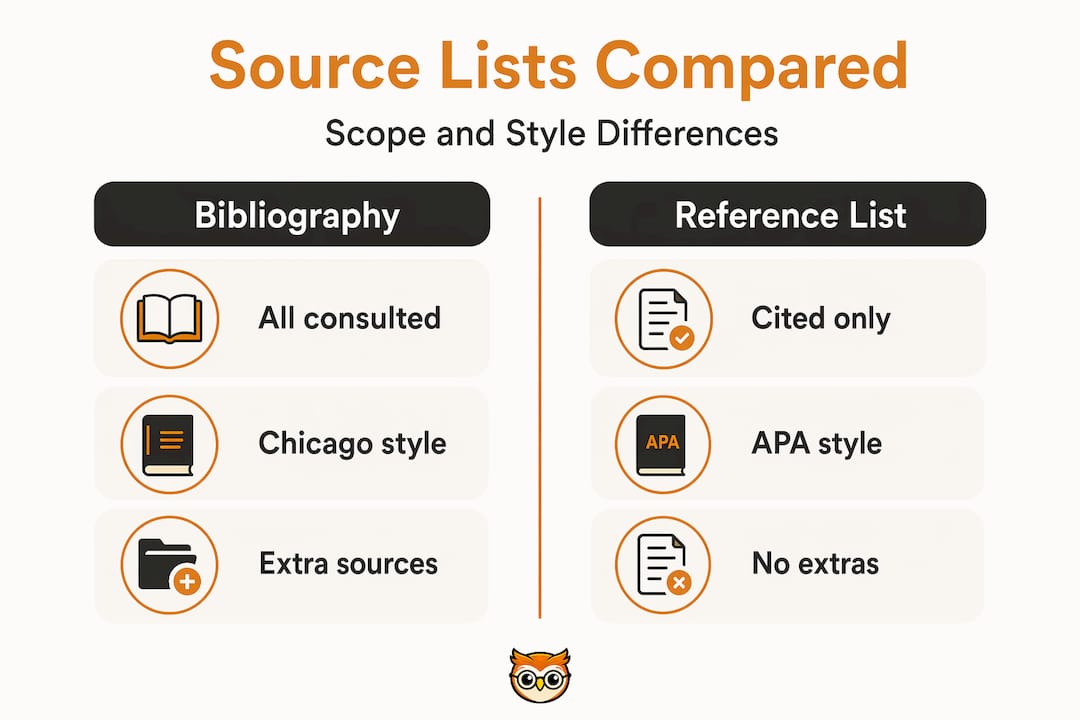
This table illustrates the key differences:
| Term | Style association | Scope | When to use it |
|---|---|---|---|
| Bibliography | Chicago | All consulted sources | History, fine arts, and some humanities courses |
| Reference list | APA | Only directly cited sources | Social sciences, psychology, education |
| Works cited | MLA | Only directly cited sources | Literature, language, humanities |
Using the wrong term is not merely a cosmetic error. Misuse of these terms in academic submissions is a recurrent problem and can affect grading or professional credibility. If your assignment brief says "APA format", submitting a document with a page labelled "Bibliography" signals to your marker that you have not understood the style guide.
Here are some practical examples to illustrate the distinction:
- You write a history essay and consult six books, but only cite four. In Chicago style, all six go into the bibliography.
- You write a psychology report and consult six journal articles, citing five. In APA format, only the five cited sources appear in your reference list.
- You write a literature essay in MLA format and cite three novels and two critical essays. All five appear on your works cited page.
Understanding the differences among source lists is one of those details that separates competent academic writers from exceptional ones. It reflects a genuine grasp of scholarly conventions, not just surface-level compliance.
Annotated bibliographies: what they are and when to use them
An annotated bibliography takes the standard source list and adds a short paragraph beneath each entry. That paragraph, known as the annotation, is where the real intellectual work happens.
Annotated bibliographies include summaries or evaluations of each source, typically around 100 words per entry. A good annotation does three things: it summarises the main argument or findings of the source, evaluates the credibility and reliability of the author or publication, and explains how the source relates to your specific research question.
Universities and colleges assign annotated bibliographies for a clear reason. They force you to engage with your sources critically rather than passively collecting them. Reading something carefully enough to summarise and evaluate it is a fundamentally different cognitive process from skimming it for quotable lines.
There are two broad annotation styles you will encounter:
- Descriptive annotations: These summarise the content of the source without passing judgement. Useful for mapping out a body of literature before you begin writing.
- Evaluative annotations: These go further, assessing the strengths and weaknesses of the source and its usefulness for your argument. Most university assignments require this type.
A practical tip: write your annotations immediately after you finish reading each source, not all at once at the end of your research phase. Details fade quickly, and a fresh annotation is far more accurate and specific than one written from memory three weeks later.
Pro Tip: Keep a running document as you research. Paste each source citation at the top of a new section and write three sentences beneath it: what the source argues, whether you trust it and why, and how it connects to your thesis. You will have a draft annotated bibliography before you even realise you have started it.
How to create a bibliography: a practical guide
Knowing the theory is only half the battle. Creating a bibliography that is accurate, consistent, and formatted correctly requires a methodical approach from the very beginning of your research process.
Follow these steps to avoid the last-minute scramble that produces sloppy, error-filled entries:
- Record source details as you go. Every time you open a new book, article, or website, note the full citation details immediately. Author, title, publisher, date, URL, and page numbers where relevant. Waiting until you have finished writing makes it far harder to track everything down.
- Confirm your required style guide. Check your assignment brief or institutional guidelines before you format a single entry. Using Chicago formatting in an APA paper wastes time and earns you deductions.
- Format each entry according to the style guide. The Chicago Manual of Style advises citing exactly what is printed on the title page of a source to maintain accuracy. Do not paraphrase titles or infer details. Transcribe them precisely.
- Use a citation tool to draft entries. Tools like Zotero offer word processor integration and drag-and-drop features, producing formatted bibliography entries quickly across multiple output formats. Use them to create a working draft.
- Verify every entry manually. Citation tools like Zotero require manual verification because they frequently introduce errors in punctuation, capitalisation, or omit necessary details. Cross-reference each entry against the official style manual before submitting.
- Alphabetise and check consistency. Most styles require alphabetical ordering by author surname. Read through your entire bibliography and confirm that formatting is consistent across every entry. One entry missing an issue number or using a different date format disrupts the whole list.
Pro Tip: Print your bibliography and read it line by line against a checklist for your chosen style guide. On-screen proofreading misses errors that printed text catches. Pay particular attention to punctuation: a missing full stop or a comma in the wrong place can change an entry from correct to incorrect.
Researchers often face difficulty finding complete publication details, particularly for older sources or grey literature. When core details such as the year, volume, and issue number are present and verified, omission of minor secondary details is sometimes acceptable. Always make a note of what you could not find, so you can explain the gap if questioned.
Bibliographies and academic integrity
A bibliography does considerably more than satisfy a formatting requirement. It is one of the primary mechanisms through which academic integrity is maintained and demonstrated.
When you list every source that shaped your thinking, you are doing several important things at once:
- Crediting original thinkers. Ideas do not emerge from a vacuum. Acknowledging your sources honours the intellectual labour that preceded yours.
- Preventing plagiarism. A complete bibliography makes it transparent which ideas belong to you and which come from elsewhere. This protects both you and the original authors.
- Enabling verification. Readers who question your claims can follow your sources back to the original texts and assess whether your interpretation is sound.
- Demonstrating research scope. A thorough bibliography shows the breadth of literature you engaged with. Thin or one-sided bibliographies raise questions about the quality of the underlying research.
"Using what is printed on the original source ensures bibliographies serve as reliable guides for locating materials, preserving academic integrity." — Chicago Manual of Style
The importance of a bibliography extends into digital and open access publishing, where sources can be updated, moved, or deleted. In these contexts, including a digital object identifier (DOI) or an access date for web sources is no longer optional best practice. It becomes the difference between a verifiable citation and a dead link.
There is also a less discussed benefit: compiling a careful bibliography forces you to reflect on the quality of your sources. If your list is dominated by unreviewed websites and decades-old editions of textbooks, that is a signal worth acting on before you submit, not after.
My honest take on bibliographies
I have worked with a huge range of students and researchers through Bibliowlteca, and the pattern I see repeatedly is this: most people treat bibliographies as something they create after their real work is done. That framing is the root of almost every bibliography problem I encounter.
When you leave citation tracking until the end, you forget where ideas came from. You rely on citation generators without checking them. You discover at 11pm that a key source has no listed author and you have no idea how to handle that edge case in Chicago format.
The writers who produce genuinely strong bibliographies are the ones who treat source documentation as part of the research process itself, not a tax they pay at the end. They record source details in real time, write annotations while reading, and check entries against style manuals as they go rather than in one frantic session.
I also want to challenge the idea that citation generators make manual checking unnecessary. In my experience, they make it more necessary, not less. When you type an entry by hand, you notice what is missing. When software generates it, you trust it, and that trust is frequently misplaced. I have seen submitted work where an automated tool rendered every book title in sentence case instead of title case, or listed a corporate body as an individual author, and the student never noticed.
The distinction between a bibliography, a reference list, and a works cited page is not pedantic. I have personally seen students lose marks not because their ideas were weak, but because they labelled their source list incorrectly for the required style. Getting this right is genuinely that simple and genuinely that consequential.
Think of your bibliography as part of your academic voice. It tells your reader exactly where you have been, what you read, and how seriously you engaged with the existing literature on your topic.
— BibliOWLteca
Take your research further with Bibliowlteca
If this guide has clarified what a bibliography is and how to approach one, you are already ahead of most students who never stop to think about why they are writing one at all. Bibliowlteca is built for exactly this kind of learner: people who want to go beyond the surface level and actually understand the tools of academic writing.

Explore the Bibliowlteca platform to find educational resources, guides, and digital content from educators who specialise in research methodology, academic writing, and citation practice. Whether you are navigating your first annotated bibliography or overhauling your citation habits before a major submission, the blog at Bibliowlteca offers practical depth on source credibility, bibliographic methods, and the foundations of strong academic work.
FAQ
What is a bibliography in simple terms?
A bibliography is a list of all the sources a writer consulted while researching a piece of writing, including books, articles, and websites, formatted according to a specific style guide such as APA, MLA, or Chicago.
What is the difference between a bibliography and a reference list?
A reference list contains only sources directly cited in the text and is used in APA style, while a bibliography can include all sources consulted and is typically associated with Chicago style. Using the wrong term for your required style may cost you marks.
How do I create a bibliography correctly?
Record full citation details for each source as you research, confirm your required style guide, and format entries accordingly. Use a citation tool like Zotero to draft entries, then verify every entry manually against the official style manual before submitting.
What is an annotated bibliography?
An annotated bibliography includes a short paragraph beneath each citation, typically around 100 words, that summarises the source, evaluates its credibility, and explains its relevance to the research question.
Why is a bibliography important in academic writing?
A bibliography credits original authors, prevents plagiarism, and allows readers to verify the sources behind your claims. It also demonstrates the breadth and quality of your research to markers and fellow scholars.