
TL;DR:
- Libraries are active drivers of academic growth, supporting research, literacy, and lifelong learning beyond passive collections.
- Their broad roles—including data curation, digital scholarship, and research impact—are often underestimated, limiting recognition and resources.
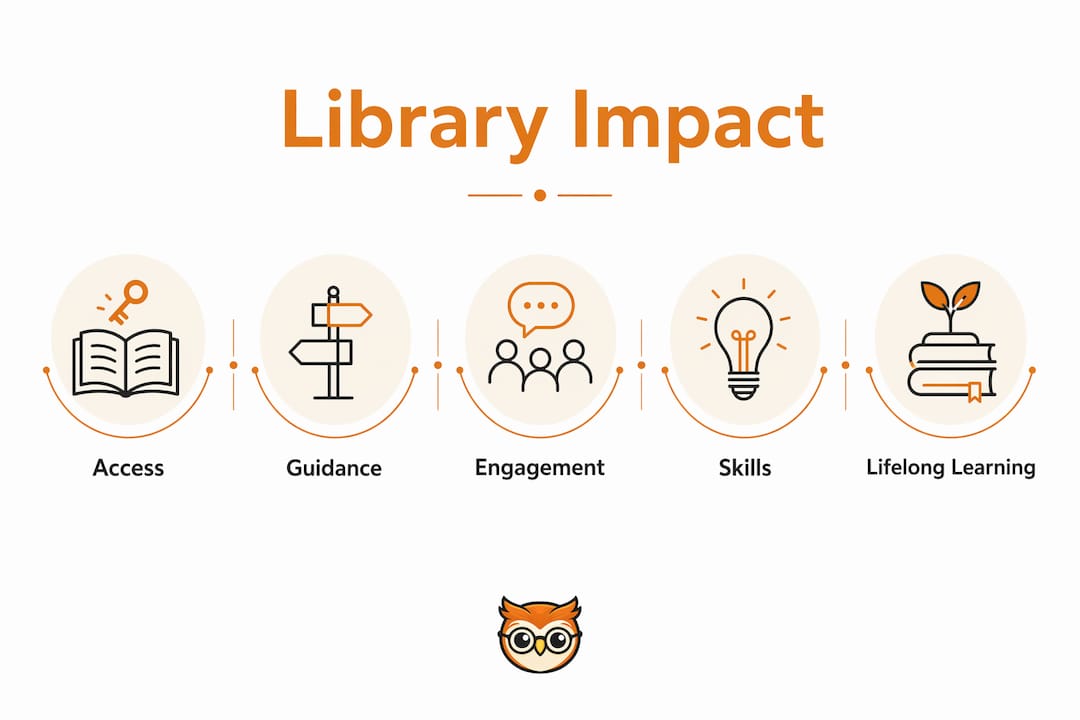
Libraries are far more than rooms full of books. The role of libraries in academic growth spans resource provision, skills development, research support, and the cultivation of habits that shape how students think for the rest of their lives. Yet most people, including many educators, still picture libraries as passive storage spaces rather than active drivers of intellectual progress. That gap between perception and reality costs students, institutions, and researchers enormously. This article unpacks the full breadth of what libraries actually do, drawing on recent research to show why they deserve far more recognition than they typically receive.
Key takeaways
| Point | Details |
|---|---|
| Libraries drive engagement | Library use correlates directly with student concentration, goal management, and self-regulated learning. |
| Perception gaps limit value | Most stakeholders see libraries as collection stewards, missing their expanded roles in data curation and research support. |
| Evidence must be communicated | Libraries that align impact stories with institutional goals secure better resources and greater visibility. |
| Students define success broadly | Research shows students value effort and knowledge gained, not just grades, and libraries support this wider definition. |
| Digital and physical roles converge | Modern libraries combine physical study spaces with digital scholarship tools, making them irreplaceable learning centres. |
The role of libraries in academic growth
When scholars discuss the importance of libraries in education, they tend to speak in abstractions. Collection size. Opening hours. Borrowing statistics. What the research actually reveals is both more specific and more surprising. Libraries function as the infrastructure underpinning how students learn to learn.
At the most foundational level, libraries provide access to academic materials that students cannot easily obtain elsewhere. Peer-reviewed journals, specialist databases, government reports, historical archives, and primary sources all sit behind paywalls or physical barriers that only well-resourced libraries can clear. For students at under-funded institutions, library access is often the deciding factor between a research essay grounded in credible evidence and one built on whatever appears on the first page of a search engine.
Beyond collections, librarians themselves play a role that is routinely undervalued. Information literacy, meaning the ability to locate, evaluate, and use information effectively, does not develop automatically. Library-led programmes on information literacy, critical thinking, and digital skills significantly enhance academic growth by equipping students with the competencies that underpin all serious research. A librarian who teaches a student to interrogate a source is doing something a textbook cannot do.

Libraries also shape reading habits in ways that accumulate over time. A student who reads widely across disciplines thinks differently, writes with more nuance, and approaches problems from multiple angles. The library is the environment that makes wide reading practically possible and socially normalised.
Pro Tip: When beginning any research project, spend thirty minutes with a subject librarian before touching a search engine. The referral to one specialist database or archive can save hours of frustration and dramatically improve your source quality.
Key academic benefits of library resources include:
- Access to subscription databases and journals unavailable through open web searches
- Guidance from subject librarians on search strategy and source evaluation
- Curated reading lists aligned with specific courses and research questions
- Quiet, structured environments designed to support sustained concentration
- Interlibrary loan services that extend access beyond a single institution's holdings
How libraries shape student engagement
The evidence connecting libraries and student success is more concrete than most people assume. Survey data from two universities found that libraries are the most frequently visited campus service, and that participation in library activities correlates positively with student engagement and self-regulated learning. That is not a soft finding. Self-regulated learning, the capacity to plan, monitor, and adjust one's own study process, is one of the strongest predictors of academic performance across disciplines and levels.
What makes this particularly interesting is that the correlation holds for both academic and social library use. Physical library use for both study and breaks or socialising relates to engagement and goal management. Students who use the library as a social space, not just a silent study hall, still show higher engagement scores. The building itself, and the culture it creates, appears to do something important.
The research also complicates how we measure student success. Qualitative findings show students define academic success not only by grades but also by effort and knowledge gained. Libraries support this broader understanding by providing spaces and resources where students pursue goals on their own terms, not just the terms set by assessment schedules.
Here is what the data reveals about specific student behaviours linked to library use:
- Students who attend library programmes report stronger concentration during independent study sessions.
- Regular library users demonstrate better goal management across multiple courses simultaneously.
- Students using libraries for social breaks show higher overall campus engagement than those who do not use the library at all.
- Participation in information literacy workshops links to improved research assignment scores over subsequent semesters.
- Students who visit educational reading resources curated by libraries report greater confidence in academic writing.
Library activities influence not only academic achievement but also behavioural and engagement factors that are essential to sustained academic growth. The implication for educators is direct. Embedding library use into course design, rather than treating it as optional, is likely to improve outcomes across the full range of metrics institutions care about.
Libraries beyond collections: evolving research roles
Here is where perception and reality diverge most sharply. Ask most university administrators what their library does and they will describe a collection. Ask a research librarian what they actually do on any given day and the answer looks nothing like that.
OCLC Research's framework outlines what it calls the "Library Beyond the Library," addressing the gap between how libraries are perceived and the services they actually provide. Modern academic libraries now support data curation, grant development, digital scholarship, research impact analysis, and open access publishing. These are not peripheral activities. They are central to how research institutions function.
The table below illustrates the contrast between traditional and expanded library roles:
| Traditional perception | Expanded reality |
|---|---|
| Managing book and journal collections | Supporting the full research data lifecycle |
| Providing quiet reading spaces | Facilitating digital scholarship and maker spaces |
| Processing loans and returns | Assisting with grant applications and funder compliance |
| Cataloguing acquisitions | Analysing and communicating research impact metrics |
| Answering reference questions | Building cross-campus research partnerships |
The consequences of this perception gap are significant. When institutional decision-makers see libraries primarily as collection stewards, they allocate resources accordingly. Libraries that do not actively communicate their expanded roles risk diminishing influence and restricted resources despite real service improvements. The problem is not capability. It is visibility.
Effective library advocacy aligns stories of impact with strategic institutional goals to improve visibility and resourcing. A library that can show how it contributed to a successful grant application, or how its data management support improved a department's research output, speaks a language that administrators understand.
Pro Tip: If you manage or work within a library, keep a rolling log of specific researcher requests you fulfilled that went beyond collection access. These stories become your most persuasive advocacy material when budget cycles arrive.
Demonstrating library impact
Knowing what libraries do and proving it to the people who control budgets are two entirely different challenges. The ACRL's advocacy toolkit for student success recommends embedding library assessment data in institutional planning and learning analytics platforms for maximum impact on decision-making. This is sound advice, and it shifts libraries from being described in isolation to being understood as part of the broader student success system.
Embedding library data into student success analytics enhances the narrative of the library's contribution and influences budgeting positively. When library usage data sits alongside retention rates, graduation timelines, and engagement scores, decision-makers can see causal patterns rather than isolated statistics.
Practical strategies for libraries looking to demonstrate their contribution:
- Track granular usage data: not just loans, but database queries, librarian consultations, workshop attendance, and study room bookings
- Connect usage metrics to student outcomes data using shared institutional identifiers where privacy allows
- Use qualitative case studies alongside quantitative data to show the human impact of library support
- Align reporting language with the terminology used in institutional strategic plans and accreditation frameworks
- Build relationships with colleagues in student services, academic departments, and senior leadership to ensure library evidence reaches the right conversations
- Present findings in formats suited to each audience: concise summaries for senior leaders, detailed reports for academic committees
The challenge is not a lack of evidence. Most libraries generate enormous amounts of data about how they are used. The challenge is translating that data into a narrative that connects library activity to outcomes that institutions are already tracking and reporting. Libraries that curate educational resources effectively and document that curation process are already halfway to a compelling advocacy story.
Libraries as centres for lifelong learning
The academic benefits of library resources extend well past the years spent in formal education. What libraries genuinely cultivate, at their best, is a disposition towards learning itself. That disposition, once formed, persists.
Digital literacy is one of the clearest examples. Libraries that integrate technology into their services teach students not just how to use specific tools, but how to approach new tools critically and adapt when platforms change. This matters enormously in an environment where the tools of research and communication shift faster than any curriculum can track. Modern libraries integrate technology and collaborative learning environments that aid broad educational development, preparing students for contexts that do not yet exist.
Research skills developed through library engagement, including the ability to construct search strategies, evaluate sources, synthesise arguments, and cite evidence correctly, transfer directly to professional and civic life. A graduate who knows how to find reliable information and assess it carefully is better equipped for almost any role they might take on.
The role of public libraries in education extends this further still. Public libraries serve communities that academic libraries cannot reach, providing resources and guided learning to people at every stage of life. For adults returning to education, first-generation students preparing for university, and lifelong learners pursuing curiosity outside formal structures, public libraries are often the only institutional support available.
"Libraries store the energy that fuels the imagination. They open up windows to the world and inspire us to explore and achieve, and contribute to improving our quality of life." — Sidney Sheldon
That framing captures something important. Libraries are not neutral repositories. They are active participants in how people develop intellectually. The educational success they support across all ages depends on treating them as partners in learning rather than as support services on the margins of academic life.
My perspective: what we keep getting wrong about libraries
I've spent years watching institutions underinvest in libraries while simultaneously complaining that students lack research skills, critical thinking, and information literacy. The irony is not subtle.
What I've observed is a persistent category error. Libraries are classified as infrastructure, like IT networks or maintenance services, rather than as academic departments. That classification determines budgets, staffing ratios, and whether library leadership has a seat at the table when academic strategy is discussed. Change the category and almost everything else follows.
In my view, the most damaging thing about the current situation is not the underfunding itself. It is the feedback loop it creates. When libraries receive inadequate resources, they cannot expand services. When they cannot expand services, stakeholders see only the collection, which confirms their existing perception, which justifies the same level of funding. Breaking that loop requires libraries to be more assertive about communicating what they actually do.
What I've learned is that the most effective library advocates do not simply present data. They tell stories in institutional language. They show up at the meetings where strategic decisions are made. They align their own reporting with the questions administrators are already trying to answer.
My advice to students is simpler. Use your library more than you think you need to. Not because it is expected of you, but because the skills you build there, specifically the ability to navigate information with precision and scepticism, are among the most transferable you will develop during your education.
The libraries that thrive in the coming years will not be the ones with the largest collections. They will be the ones that make themselves indispensable to the processes their institutions care most about.
— BibliOWLteca
Extend your learning beyond the library walls
For students and educators who want to deepen their engagement with academic content outside traditional library hours, BibliOWLteca offers a digital platform where creators publish e-books, courses, and educational resources that complement formal library collections. Whether you are looking for specialist guides, research-oriented reading, or course-aligned materials, BibliOWLteca brings scholarly content directly to you.

The platform supports learners globally, with tools for digital delivery and access to materials that are not always available through institutional subscriptions. If you are a creator or educator, you can publish and sell digital content to reach students and researchers who need exactly what you know. Discover how BibliOWLteca connects knowledge creators with curious learners around the world.
FAQ
Why are libraries important for academic success?
Libraries provide access to credible resources, skilled guidance from librarians, and structured environments that support self-regulated learning. Research shows library participation correlates directly with higher student engagement and better academic outcomes.
How do libraries support student engagement?
Survey findings from two universities found that library use, including both study and social activity within library spaces, correlates with stronger concentration and goal management in students.
What is the role of public libraries in education?
Public libraries extend educational support beyond academic institutions, serving communities at all stages of life with resources, digital access, and guided learning for those outside formal education systems.
How can libraries prove their value to institutions?
The ACRL advocacy toolkit recommends embedding library assessment data within institutional learning analytics and student success platforms, connecting library usage directly to retention and achievement metrics.
Do libraries contribute to skills beyond academic qualifications?
Libraries cultivate digital literacy, critical thinking, source evaluation, and research skills that transfer directly to professional and civic contexts, making them contributors to lifelong intellectual development.