
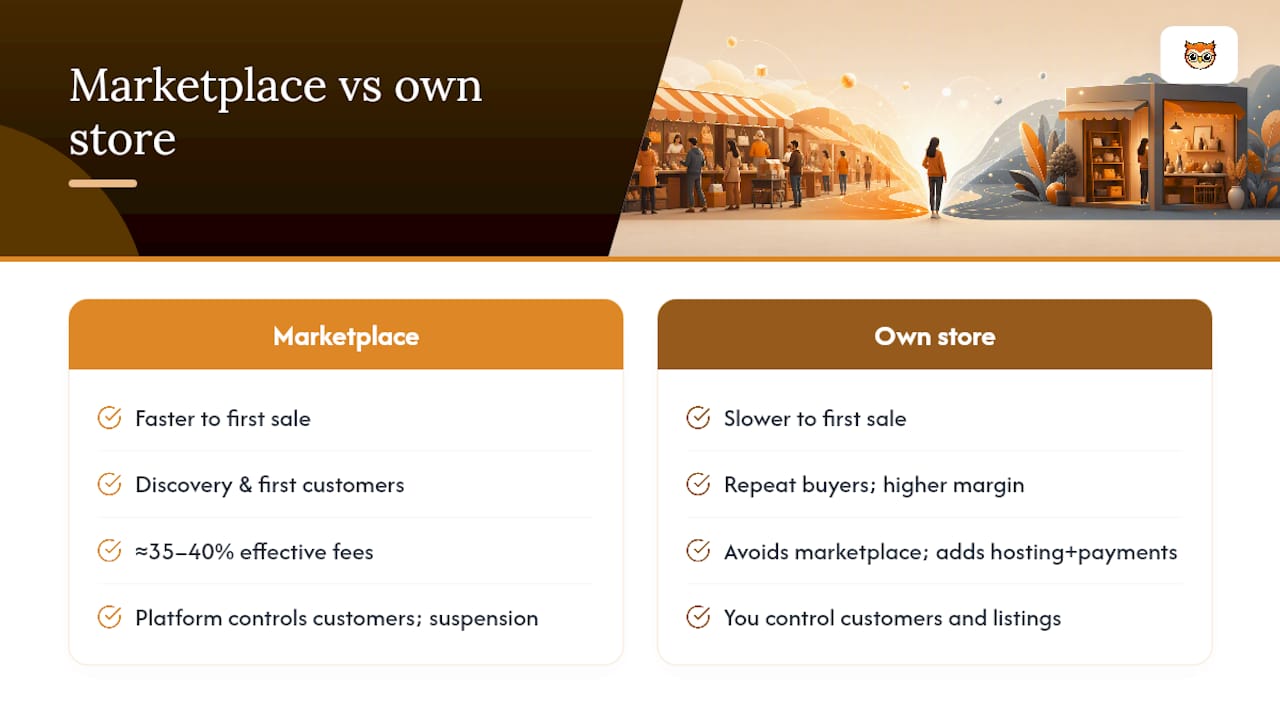
If you have no audience yet, list on a marketplace first. If you already have people who trust you (an email list, a following, past students), build your own store from day one. If you're somewhere in between, run both, but treat the marketplace as a discovery engine and your own store as the place you actually build a business.
That's the whole decision, stripped of the noise. Everything else in this article is detail that helps you execute it well.
Here's why it holds up. Marketplace commissions, advertising fees, and returns can strip out a large chunk of your revenue. One seller account documented an effective cost of 35–40% of the selling price once referral fees, ad spend, and returns were all counted. Your own store avoids most of that, but you pay for it in traffic responsibility, payment-processor KYC checks, and VAT handling you'd otherwise let the marketplace absorb. A platform like Bibliowlteca is built to close that gap, giving creators secure digital delivery, global payments, and tax compliance tools without needing to stitch together five separate services.
The rule that actually matters: marketplaces buy you discovery, storefronts buy you ownership. Pick based on which one you're missing right now.
- No audience, need to validate an idea: start on a marketplace.
- Existing audience or traffic source: start with your own store.
- Growing audience, still testing formats: run both, and treat the marketplace as your top-of-funnel.
Key Takeaways
Choosing between a marketplace and your own store comes down to one question: do you already have a way to reach buyers directly, or do you need the marketplace to find them for you.
| Point | Details |
|---|---|
| Start where your audience is | No audience yet: list on a marketplace. Existing audience: build a store page immediately. |
| Track the real cost per sale | Marketplace fees, ads, and returns can take 35–40% of your revenue, so calculate your actual margin before scaling. |
| Capture emails from day one | Every marketplace sale should trigger an email capture, regardless of which channel you're using. |
| Migrate your best buyers within 90 days | Offer an exclusive bundle on your own store to convert repeat marketplace customers early. |
| Use Bibliowlteca for the hybrid path | Bibliowlteca supports marketplace-style discovery and an owned storefront together, with digital delivery, global payments, and tax tools built in. |
Table of Contents
- Turg vs oma pood: quick side-by-side comparison
- What are the pros and cons of selling on a marketplace?
- What are the pros and cons of running your own store?
- Seven questions to decide your path
- How to validate on a marketplace, then migrate to your own store
- How do fees actually change your margin?
- What payment, VAT, and delivery rules should you know?
- Why Bibliowlteca recommends starting with ownership in mind
- Start listing and building in parallel with Bibliowlteca
- Frequently asked questions about turg vs oma pood
- Sources
Turg vs oma pood: quick side-by-side comparison
Here's the trade-off in one pass, before you get into pros and cons for each model.
| Factor | Marketplace | Own store |
|---|---|---|
| Best for | Small or no existing audience; needs instant discovery | Established audience or reliable traffic source |
| Costs & fees | Referral fees, advertising fees, return costs | Payment processing, hosting/platform fee, no per-sale commission |
| Control & branding | Limited; platform sets layout and rules | Full control of storefront, pricing, and bundling |
| Conversion & margins | Lower margin per sale; competition on the same page | Community-reported figures suggest better conversion without competing listings nearby |
| Time-to-market | Fast; list and sell within days | Slower; requires setup, payment integration, and traffic building |
| Customer data & marketing | Platform owns the buyer relationship | You own emails, purchase history, and repeat-buyer targeting |
| Payments & tax | Marketplace usually handles VAT collection and processor risk | You manage KYC, VAT registration, and processor reserves yourself |
| Scalability | Capped by platform fees and rules | Higher long-term asset value; margin compounds as you grow |
The micro-verdict per column is simple. If you need discovery today, the marketplace wins. If you need margin and a durable asset, your own store wins every time you already have somewhere to send buyers.
What are the pros and cons of selling on a marketplace?
Marketplaces solve a real problem: getting in front of buyers who don't know you exist yet. That's genuinely valuable when you're launching your first e-book or template pack.
Pros:
- Built-in demand and search traffic without running your own ads
- Instant trust transfer: buyers trust the platform's reviews and dispute system more than an unknown seller
- Fast to validate: you can test a product idea within days, not months
- Lower technical overhead: no need to build checkout, hosting, or delivery systems
- Dispute mediation and automatic digital delivery are handled for you, which matters when a buyer claims non-receipt
Cons:
- Layered fees stack quickly: referral commission, advertising spend to stay visible, and returns all eat into revenue
- The platform owns the customer relationship, not you, so repeat buyers are harder to reach directly
- Listing rules can change, and account suspension is a real operational risk if you breach policy
- Limited room for branding, upsells, or bundling your own products together
That first cost point deserves a number. One documented seller experience put the true effective cost of a marketplace sale at 35–40% once fees, returns, and advertising were all factored in. Picture a £20 e-book: after those layered costs, you might clear £12 to £13 per sale, before you've spent a penny reaching new buyers beyond what the platform already sends you.
If you do sell on a marketplace, discovery still comes down to basics: sharp keyword-matched titles, strong cover visuals, and pricing that doesn't sit wildly above comparable listings. Marketplaces reward products that look native to the platform, not products that look like an afterthought.
What are the pros and cons of running your own store?
Owning the storefront changes the economics entirely, but it shifts real work onto you.
Pros:
- You keep customer data: emails, purchase history, and behaviour you can use for remarketing
- Margins improve over time because there's no per-sale commission eating into revenue
- Full control over branding, pricing, and how you bundle products together
- You can run loyalty campaigns and upsells that compound lifetime value, which matters enormously for education products where a buyer of one course is a strong candidate for the next
Cons:
- You're responsible for all your own traffic: no built-in browsing customers
- Technical setup and maintenance become your job, or your platform's job
- Payment processors run their own KYC checks and can hold reserves against chargebacks, so you don't fully escape platform-style risk, you just relocate it
To run a credible own-store operation, a few features aren't optional. You need secure digital delivery so buyers get instant access without manual intervention, support for global payments in multiple currencies, and built-in VAT or tax handling so you're not filing manually for every region you sell into. Analytics and simple upsell tools matter too, especially for course creators bundling video lessons with templates or mentorship add-ons.
Bibliowlteca was built around exactly that feature set, and creators are already using it for real products. Osso Mastigavel and VIGORIUM LEGEND both run live storefronts on the platform, combining course hosting, secure delivery, and multi-currency payments without needing five separate tools stitched together.

Pro Tip: Don't build a full custom storefront before you've validated demand. Start with the minimum setup, a hosted checkout and delivery system, and only add complexity once you've proven people will actually pay.
Seven questions to decide your path
Work through these in order. Each answer points you towards marketplace, own store, or a hybrid of both.
- Do you have an existing audience? No: start on a marketplace. Yes: build a store page now, even a simple one.
- Do you need instant discovery this month? Yes: list on a marketplace immediately. No: invest the time in your own store's SEO and email capture first.
- What's your product type? A single low-price e-book validates fast anywhere. A multi-module course with mentorship benefits more from an owned store where you control the upsell flow.
- How sensitive are you to margin? If every percentage point matters, the own-store commission-free model wins as soon as you have any traffic of your own.
- How comfortable are you with technical setup? Low comfort: an all-in-one platform reduces friction. High comfort: you can layer more customisation later.
- Do KYC or regulatory constraints worry you? If yes, a marketplace or platform that handles compliance for you removes a genuine headache.
- How soon do you need cashflow? Urgent: marketplace, because time-to-first-sale is shorter. Flexible: own store, because the long-term payoff is higher.
Score yourself roughly: more "marketplace" answers means start there and migrate later. More "own store" answers means skip the marketplace stage entirely and go straight to building your list and storefront.
How to validate on a marketplace, then migrate to your own store
The decisive rule of thumb is simple: if you can acquire a buyer to your own store for less than the marketplace commission you'd otherwise pay, the store wins on margin every time.
- Pick one candidate product with clear demand signals, not your whole catalogue.
- Optimise the listing with sharp titles, honest previews, and pricing in line with comparable products.
- Measure conversion and unit economics over four to six weeks before drawing conclusions.
- Collect evidence of demand: repeat buyers, email sign-ups, and reviews all count.
- Embed an email capture into every marketplace delivery or follow-up message.
- Offer an exclusive bundle on your own store that isn't available through the marketplace listing.
- Shift paid promotion gradually from marketplace ads towards your store once conversion data justifies it.
A realistic timeline: months 0 to 3 for marketplace validation, months 3 to 6 for building your store in parallel, and months 6 to 12 for actively migrating your best customers across.
Pro Tip: You don't need a complex CRM to track this. UTM tags on every link, a basic email automation sequence, and a shared spreadsheet of which channel each buyer came from are enough to see the migration working.
How do fees actually change your margin?
Numbers make this concrete. Here's what a typical cost breakdown looks like for the same product sold two ways.
| Cost component | Marketplace sale | Own-store sale |
|---|---|---|
| Referral/commission fee | Present, often the largest single cost | None |
| Advertising to stay visible | Common, ongoing cost | Optional, depends on your channel mix |
| Payment processing | Bundled into platform fee | Separate, typically 2% to 3% |
| Hosting/platform fee | None separate | Monthly or per-transaction fee |
| Refunds/chargebacks | Absorbed partly by platform | Your responsibility directly |
On your own store, after payment processing and hosting, you might clear £13 or more, assuming you already have a way to reach the buyer.
Example two: a £150 course bundle. Marketplace fees at similar rates leave you with roughly £90 to £98. On your own store, minus processing fees, you could clear £140 or close to it, but only if your customer acquisition cost per sale stays below what the marketplace commission would have cost you.
That's the breakeven test in practice: your own store overtakes the marketplace the moment your cost to acquire a buyer directly is lower than the commission you'd have paid to have that buyer sent to you.
What payment, VAT, and delivery rules should you know?
You don't need a law degree, but a short checklist saves real headaches later.
- Payment-processor KYC: expect identity verification before you can accept payments directly, whether through a standalone processor or a platform like Bibliowlteca.
- VAT and sales tax treatment: digital goods are often taxed differently to physical products, and marketplaces frequently handle VAT collection differently to how an own store must.
- Regional invoicing rules: some jurisdictions require specific invoice formats for digital sales, even for small creators.
- Delivery timestamps: record exactly when a digital product was delivered. It's your strongest evidence against a chargeback claim.
- Processor reserves: payment processors can hold back a percentage of your revenue as a reserve against disputes, particularly for new accounts.
Pro Tip: Before you register for VAT or assume you're below a threshold, check your local tax authority's current guidance directly. Rules and thresholds vary by country and change over time, so don't rely on a blog post, including this one, as your final word.
This is general guidance, not tax or legal advice. Confirm current rules with your local tax authority or a qualified adviser before making registration or invoicing decisions.
Why Bibliowlteca recommends starting with ownership in mind
Creators who come through Bibliowlteca tend to follow a familiar arc: list a first product to see if anyone bites, then realise within a few months that the platform doing the selling also owns the relationship with every buyer who liked their work enough to come back. That's the moment most of them start asking how to build something that's actually theirs.
We built the platform around that realisation rather than against it. A creator can open a storefront, run secure digital delivery, accept global payments, and handle VAT obligations without hiring a developer or a tax adviser for every new market. Osso Mastigavel and VIGORIUM LEGEND are both running live on the platform today, proof that the hybrid model, marketplace discovery paired with an owned store, works in practice, not just on a whiteboard.
We'll say the honest part too: if you have zero interest in owning a brand, don't want to think about your own marketing, and just want the fastest possible route to a first sale, a pure marketplace listing elsewhere might suit you better for now. Bibliowlteca is built for creators who eventually want the storefront to be theirs, not for those who never intend to build one.
Start listing and building in parallel with Bibliowlteca
You don't have to choose between renting reach and owning your business, not when the same platform can do both. Bibliowlteca gives you marketplace-style discovery and a fully owned storefront running side by side, so you're not stuck migrating platforms later just to keep your margin.
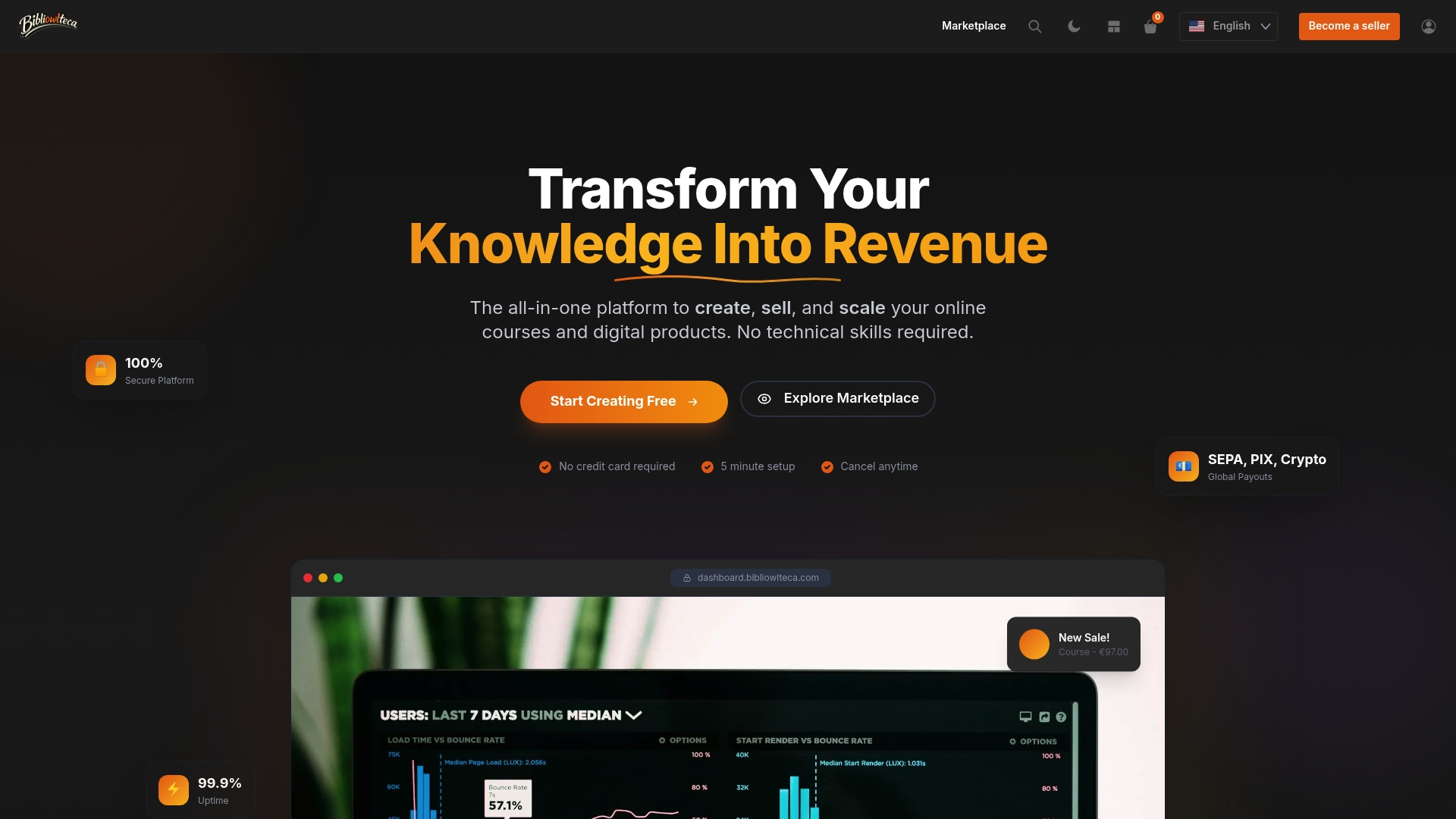
The features that matter most for this decision are already built in: secure digital delivery so buyers get instant access, global payments across multiple currencies, and tax compliance tools that handle the parts most creators dread. You can list a course or e-book to test demand, then switch on your own store pages without rebuilding anything from scratch. If you sell templates or a mentorship product, the same platform features cover course hosting, quizzes, and community tools without needing five separate subscriptions.
If e-books are your main format, the e-book product category is the fastest place to start listing today. Ready to see the whole thing in action? Explore BibliOWLteca's marketplace and storefront tools and list your first product this week.
Frequently asked questions about turg vs oma pood
Is a marketplace or own store better for a first digital product? For a first product with no existing audience, a marketplace is usually the faster route to your first sale. Once you have proof of demand, moving toward your own store protects your margin.
Can I run turg and oma pood selling at the same time? Yes, and many creators do exactly this. Use the marketplace for discovery and your own store for repeat buyers and higher-margin sales.
How much do marketplace fees typically cost compared to running my own store? Documented seller experience puts the effective cost of marketplace fees, including referrals, ads, and returns, at around 35–40% of the selling price. Your own store avoids most of that but adds payment processing and hosting costs instead.
What's the biggest risk of relying only on a marketplace? Account suspension or policy changes can cut off your income overnight, since the platform, not you, controls the customer relationship and the listing rules.
When should I migrate customers from a marketplace to my own store? Once you've validated a product over four to six weeks and have evidence of repeat interest, start capturing emails and offering exclusive bundles on your own store to begin the migration.
Sources
- Marketplace Vs Own Online Store: Where Should A Creator Sell First?
- Techsslaash
- Marketplace vs Own Store for Digital Goods (2026) | FoxReload