
TL;DR:
- Open access ensures scholarly publications are freely available online with legal permissions for reuse beyond mere access.
- It encompasses various models, such as gold, green, hybrid, and diamond, each with different cost and licensing structures.
- Recent policy shifts, like NIH 2025, mandate immediate open access, but economic and equity challenges persist, especially regarding financing.
Open access is defined as the free, unrestricted online availability of scholarly publications, giving anyone the right to read, download, copy, distribute, and reuse research outputs without financial, legal, or technical barriers beyond internet access. UNESCO's authoritative definition makes clear that open access is not merely about removing paywalls. It requires irrevocable user rights, proper attribution, and immediate deposit in recognised repositories. For researchers, students, and academics, understanding what open access means in practice shapes every decision from where to publish to how to comply with funder mandates.

What is open access publishing and how does it work?
Open access publishing is the practice of making peer-reviewed scholarly work freely and permanently available online, with defined legal permissions for reuse. The Budapest Open Access Initiative, launched in 2002, first formalised this principle, and the movement has since grown into a global infrastructure spanning thousands of journals, repositories, and institutional mandates.
The two foundational variants are gratis open access and libre open access. Gratis means free to read but with no additional reuse rights. Libre goes further: libre access includes reuse rights such as text and data mining, translation, and redistribution, typically granted through Creative Commons licences. This distinction matters enormously for downstream users. A researcher who wants to run computational analysis across thousands of papers needs libre access, not merely gratis.
The main open access models
The funding mechanism behind a journal determines its model. The four most common are:
- Gold open access. The final published version is immediately freely available on the journal's website. Costs are typically covered by author processing charges (APCs), which can range from a few hundred to several thousand pounds per article.
- Green open access. The author deposits a version of the manuscript, usually the author-accepted manuscript, in an institutional or subject repository such as PubMed Central or arXiv. The journal version may remain behind a paywall.
- Hybrid open access. A subscription journal offers authors the option to pay an APC to make their individual article open. Critics argue this model results in "double dipping," where institutions pay both subscription fees and APCs.
- Diamond open access. Diamond OA provides immediate access without fees to either readers or authors, supported by shared digital infrastructure, academic societies, or public funding. It is the model least distorted by commercial incentives.
Pro Tip: When selecting a journal, check whether it is listed in the Directory of Open Access Journals (DOAJ). Listing requires journals to meet quality and transparency criteria, which filters out predatory publishers.
The principles underpinning all legitimate open access models are consistent: content must be peer-reviewed, legally reusable under a recognised licence, and deposited in a repository that guarantees long-term preservation. A journal that makes articles freely readable for six months and then locks them behind a paywall does not meet the open access definition.
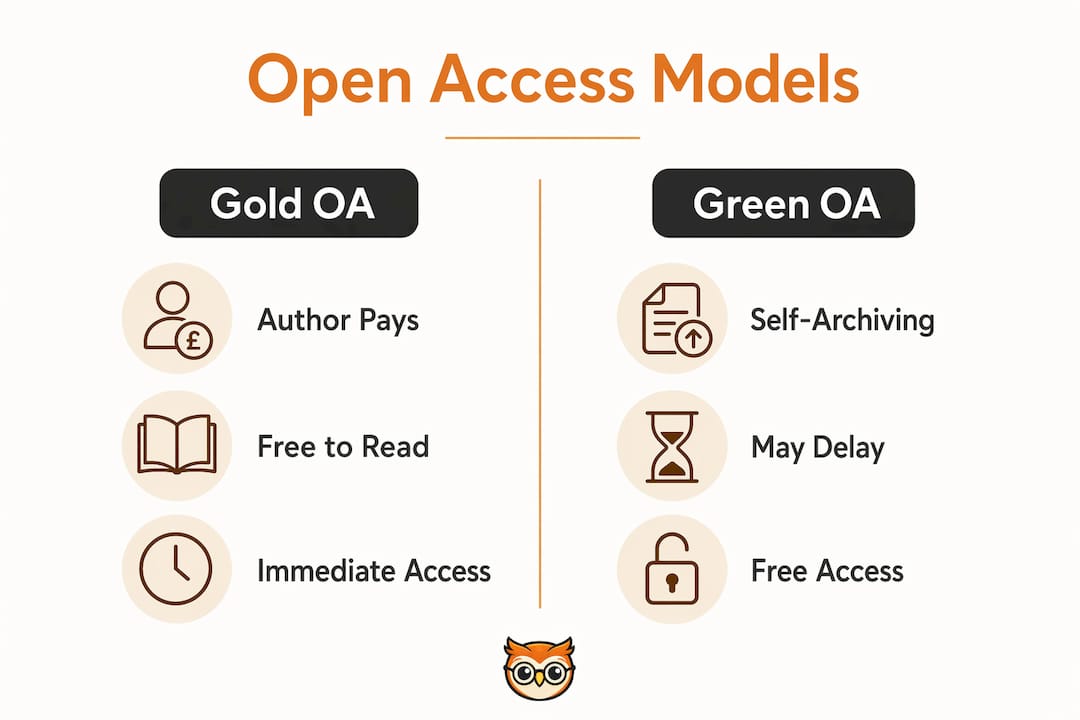
| Model | Cost to author | Cost to reader | Immediate access |
|---|---|---|---|
| Gold OA | APC required | Free | Yes |
| Green OA | None | Free (repository) | Sometimes delayed |
| Hybrid OA | APC required | Free (article only) | Yes |
| Diamond OA | None | Free | Yes |
How does open access differ from other content types?
Open access is frequently confused with public domain content, freely available web pages, or articles shared informally on academic networks. These categories are legally and practically distinct.
University libraries define open access as digital content that is peer-reviewed, legally reusable, and accessed without technical restrictions, which separates it clearly from content that is merely free to read. A news article, a Wikipedia entry, or a preprint shared on a personal website may all be free to read, but none automatically carries the reuse permissions that define open access.
Key distinctions to understand
- Public domain content has no copyright restrictions because the copyright has expired or was never applied. Open access content retains copyright, typically held by the author, but grants specific permissions through licensing.
- Freely available content describes anything accessible without payment at a given moment. This includes articles shared on ResearchGate or Academia.edu, which are often posted without the publisher's permission and carry no formal reuse rights.
- Embargoed content is research that will eventually become open access after a waiting period, commonly six to twenty-four months. During the embargo, the work is paywalled even if the underlying funder mandate requires eventual open access.
- Paywalled content requires institutional subscription or individual purchase. Much of the world's peer-reviewed literature remains in this category, which is precisely why open access mandates from funders such as NIH, Wellcome Trust, and the European Research Council carry such weight.
The practical implication is that compliance requires both deposit and licensing, not merely online availability. A paper posted to a personal university webpage without a Creative Commons licence does not satisfy most funder open access requirements, regardless of whether anyone can read it for free.
| Content type | Free to read | Legally reusable | Peer-reviewed | Persistent URL |
|---|---|---|---|---|
| Open access | Yes | Yes (with licence) | Usually | Yes |
| Public domain | Yes | Yes (no restrictions) | Varies | Varies |
| Freely available | Sometimes | No | Varies | No |
| Paywalled | No | No | Usually | Yes |
Understanding publishing models in academia is the first step to navigating these distinctions with confidence.
What are the latest policy developments in open access?
Policy is now the primary driver of open access adoption, and the pace of change has accelerated significantly since 2023. Researchers funded by major public bodies face binding mandates, not optional guidelines.
The most consequential recent development is the NIH 2025 Public Access Policy, which requires immediate public availability of all NIH-funded research articles, ending the previous twelve-month embargo period. This affects tens of thousands of publications annually and applies to articles accepted for publication from January 2025 onwards. The zero-cost compliance pathway remains depositing the author-accepted manuscript in PubMed Central, provided the journal permits this under its policies.
However, the policy's ambition creates a structural tension. Immediate access mandates raise equity concerns because they do not address the affordability of APCs or the concentration of publishing power among a small number of commercial publishers. Researchers at well-funded institutions in wealthy countries can absorb APC costs. Researchers in lower-income settings, or those without grant funding, face a genuine barrier to publishing in gold open access journals.
UNESCO's broader framework addresses this through its Recommendation on Open Science, which emphasises open licensing and FAIR principles for data, trusted repositories, and equitable participation across all countries and disciplines. Open access, in UNESCO's framing, is one pillar of a wider commitment to making all research outputs, including data, software, and educational resources, openly available and reusable.
The numbered steps below summarise the compliance logic most researchers now face:
- Check whether your funder has a public access mandate and its specific requirements.
- Identify whether your target journal supports green, gold, or hybrid open access.
- Determine whether an APC waiver or institutional agreement covers publication costs.
- Deposit the author-accepted manuscript in the required repository at acceptance, not at publication.
- Verify that the deposited version carries a permissive licence, typically CC BY, to satisfy libre open access requirements.
Pro Tip: Many universities have negotiated "read and publish" agreements with major publishers, which cover APCs for corresponding authors affiliated with that institution. Check with your library before paying an APC out of pocket.
"Open access is not just about free access, but also involves legal permissions for reuse and the removal of barriers beyond internet access." — UNESCO Open Access Policy
The role of libraries in academic research has expanded considerably as institutions take on the administrative work of tracking compliance, negotiating publisher agreements, and maintaining repositories.
How can researchers navigate open access publishing effectively?
Knowing the principles of open access is one thing. Applying them to a specific manuscript, journal, and funder mandate is another. The practical decisions researchers face are more granular than the policy documents suggest.
The starting point is always the journal's self-archiving policy. Tools such as Sherpa/RoMEO aggregate publisher policies and show which versions of a manuscript can be deposited, where, and under what conditions. A journal may permit green open access for the author-accepted manuscript but prohibit deposit of the final typeset PDF. Depositing the wrong version can create compliance problems and, in some cases, copyright disputes.
Understanding the difference between manuscript versions matters more than most early-career researchers realise. Depositing author-accepted manuscripts in PubMed Central or an institutional repository is the standard zero-cost compliance route for NIH-funded work. The author-accepted manuscript is the peer-reviewed, final text before the publisher applies typesetting and formatting. It is not the submitted preprint, and it is not the published PDF.
Practical steps for navigating open access publishing:
- Identify your compliance obligations before submission. Funder mandates, institutional policies, and journal agreements all interact. Knowing these in advance prevents last-minute problems.
- Use subject repositories where appropriate. arXiv serves physics, mathematics, and computer science. bioRxiv and medRxiv serve life sciences. SSRN serves social sciences. These repositories provide immediate visibility even before peer review.
- Negotiate licence terms where possible. Some journals default to restrictive licences unless authors actively request CC BY. The licence attached to the published version determines what others can legally do with your work.
- Apply for APC waivers proactively. Most major publishers offer waivers for authors from low-income countries or those without grant funding. These are underused because researchers do not know they exist or assume they will be refused.
- Leverage digital library resources at your institution. Librarians increasingly act as open access advisers, helping researchers identify compliant routes and manage deposit workflows.
Diamond OA journals offer a sustainable model that avoids cost barriers entirely, and their number is growing. Journals supported by learned societies, universities, or public funding bodies often operate on this basis. For researchers in fields where such journals exist, they represent the most equitable publishing option available.
Pro Tip: Before signing a publishing agreement, read the licence section carefully. If the agreement assigns copyright to the publisher rather than retaining it with the author, you may lose the right to deposit your own work in a repository without permission.
The broader benefits of open access publishing extend beyond individual compliance. Research published openly receives more citations on average, reaches practitioners and policymakers who lack institutional access, and contributes to a scientific record that is genuinely public. For academics building a research profile, these advantages of open access are concrete, not theoretical.
Key takeaways
Open access requires both free availability and legally defined reuse permissions, making licence choice and repository deposit as important as removing the paywall.
| Point | Details |
|---|---|
| Open access definition | Free online availability of scholarly work with legal rights to read, reuse, and redistribute under defined permissions. |
| Model differences matter | Diamond OA costs neither authors nor readers; Gold OA shifts costs to authors via APCs; Green OA uses repositories. |
| Gratis vs libre | Gratis means free to read; libre adds reuse rights such as text mining, which many research workflows require. |
| Policy compliance | NIH's 2025 policy requires immediate deposit; depositing the author-accepted manuscript in PubMed Central is the zero-cost route. |
| Equity remains unresolved | APC-based models risk excluding researchers without institutional or grant funding from participating in open publishing. |
The uncomfortable truth about open access progress
From where Bibliowlteca sits, working with educators and researchers who are trying to share knowledge globally, the open access movement has achieved something remarkable and left something important unfinished at the same time.
The remarkable part is the infrastructure. Twenty years ago, a researcher in Nairobi or Bogotá had no realistic path to reading the latest findings in their field without institutional access. Today, PubMed Central, arXiv, and thousands of open repositories have changed that. The free access to educational books and research that was unthinkable in 2005 is now routine.
The unfinished part is the economics. The shift from subscription models to APC models has not democratised publishing. It has transferred the financial barrier from readers to authors, and in doing so has concentrated publishing power further among institutions and countries that can afford to pay. A researcher at a well-funded university in the United Kingdom or the United States can publish open access without thinking twice. A researcher at a public university in sub-Saharan Africa or Southeast Asia faces a genuine choice between paying an APC they cannot afford and publishing in a journal that will not reach the audience they need.
Diamond open access is the most honest answer to this problem, and it is growing too slowly. The model works. Journals like Atmospheric Chemistry and Physics and eLife (in its earlier form) demonstrated that high-quality, high-impact publishing does not require either subscription fees or APCs. What it requires is sustained institutional commitment and shared infrastructure. That commitment is still patchy.
My advice to researchers navigating this now: do not treat open access as a compliance checkbox. Understand the licence you are agreeing to, know your repository options, and push back when publishers default to restrictive terms. The principles behind open access are sound. The market structures that have grown up around it are not always aligned with those principles.
— BibliOWLteca
Discover and share scholarly content with Bibliowlteca
Bibliowlteca is a digital platform built for creators and educators who want to share knowledge beyond institutional walls. Whether you are a researcher publishing course materials, an academic turning your expertise into an e-book, or an educator building a global audience, Bibliowlteca provides the infrastructure to publish and sell digital content with built-in payment processing, tax compliance, and multi-currency support. The platform complements open access goals by making educational resources genuinely accessible to learners worldwide. Explore Bibliowlteca's full feature set, including courses, e-books, mentorships, and global payments, to see how it supports the wider mission of open knowledge sharing.
FAQ
What is the open access definition in simple terms?
Open access means scholarly research is freely available online for anyone to read, download, and reuse without paying subscription or access fees. UNESCO defines it as availability without financial, legal, or technical barriers, provided proper attribution is given.
What is the difference between gold and green open access?
Gold open access makes the final published article immediately free on the journal's website, usually funded by an APC paid by the author or their institution. Green open access involves depositing a version of the manuscript, typically the author-accepted manuscript, in a repository such as PubMed Central or an institutional archive.
What are the main advantages of open access publishing?
Open access publishing increases the visibility and citation rate of research, removes barriers for readers without institutional subscriptions, and supports compliance with funder mandates from bodies such as NIH and the Wellcome Trust. It also makes research accessible to practitioners, policymakers, and the public.
What does the NIH 2025 Public Access Policy require?
The NIH 2025 policy requires immediate public availability of all NIH-funded research articles, ending the previous twelve-month embargo. Authors can comply at zero cost by depositing the author-accepted manuscript in PubMed Central, provided their journal permits this.
Is open access the same as open science?
Open access refers specifically to free availability of scholarly publications. Open science is a broader concept that includes open access to publications plus open data, open software, open educational resources, and open research methods, as outlined in UNESCO's Recommendation on Open Science.