

TL;DR:
- Peer-reviewed literature is scholarly research that has undergone independent expert evaluation to ensure quality and originality. Although peer review enhances accuracy, it does not guarantee correctness, requiring critical engagement and assessment of methodologies and funding sources. Researchers should utilize verified databases and understand disciplinary standards to effectively find, interpret, and depend on peer-reviewed sources in their work.
Peer-reviewed literature is academic research that has been critically evaluated by independent experts before publication to confirm its validity, quality, and originality. This process, formally known as scholarly peer review, sits at the heart of academic publishing and is the primary mechanism by which journals like Nature, The Lancet, and the Journal of the American Medical Association maintain their authority. Top-tier journals reject over 90% of submissions, which tells you immediately that peer review is not a rubber stamp. It is a rigorous filter. Understanding how it works, where it applies, and where it falls short will make you a sharper, more credible researcher.
What is peer-reviewed literature and why does it matter?
Peer-reviewed literature consists of scholarly articles, studies, and reports that have passed evaluation by two or more qualified experts in the relevant field before being accepted for publication. The term "refereed literature" is used interchangeably in many academic contexts, particularly in library science and database cataloguing. Both terms describe the same quality-assurance mechanism.
The role of peer review in publishing is to act as a professional self-regulation mechanism, balancing expert scrutiny with objectivity to uphold quality standards. Without it, any researcher could publish any claim without independent verification. Journals like PLOS ONE, Cell, and Physical Review Letters each operate their own peer review systems, yet all share the same foundational goal: to publish research that has withstood critical examination.
One common misconception worth addressing immediately is that peer-reviewed status means a paper is correct. It does not. Peer review improves quality and catches errors but does not make research infallible. Fraudulent data, flawed methodology, and publication bias have all appeared in peer-reviewed journals. The process is a quality checkpoint, not a guarantee of truth.
For students and researchers, understanding this distinction is the difference between using academic literature well and using it naively. Peer-reviewed sources form the core of credible academic work, but they demand your critical engagement, not your unconditional trust.
How does the peer review process work step by step?
The journey from manuscript submission to published article typically spans several months and involves multiple rounds of expert evaluation. Here is how the process unfolds in practice.
-
Manuscript submission. The author submits a completed manuscript to a journal via an editorial management system such as ScholarOne or Editorial Manager. The submission includes the full paper, an abstract, and often a cover letter explaining the research's significance.
-
Initial editorial screening. The journal's editor-in-chief or a handling editor reviews the submission for scope, formatting, and basic quality. Papers that do not fit the journal's remit or fall below a minimum standard are desk-rejected without external review. This stage alone filters out a substantial proportion of submissions.
-
Reviewer selection. The editor identifies 2 to 3 anonymous expert reviewers with relevant expertise. Reviewers are typically academics or practitioners who volunteer their time. Conflicts of interest are declared and managed at this stage.
-
Expert evaluation. Reviewers assess the manuscript against four core criteria: clarity of writing, methodological rigour, originality of contribution, and validity of conclusions. Each reviewer submits a detailed report with a recommendation.
-
Editorial decision. Based on reviewer reports, the editor issues one of three outcomes: accept as submitted, request revisions (minor or major), or reject. Outright acceptance at first submission is rare in competitive journals.
-
Author revision. When revisions are requested, the author responds to each reviewer comment systematically, revising the manuscript and submitting a point-by-point response letter. This iterative revision process/01%3A_Chapters/1.02%3A_The_purpose_of_a_literature_review) can involve multiple rounds before acceptance.
-
Final acceptance and publication. Once the editor is satisfied, the manuscript enters production: copyediting, typesetting, and online publication, often as an advance article before the print issue.
Single-blind, double-blind, and open peer review
The three dominant models differ in how much anonymity is preserved. In single-blind review, reviewers know the authors' identities but authors do not know the reviewers'. In double-blind review, both parties remain anonymous, which is the standard in many social science and humanities journals. Open peer review, increasingly adopted by journals such as eLife and F1000Research, publishes reviewer names and reports alongside the article, making the entire process transparent.
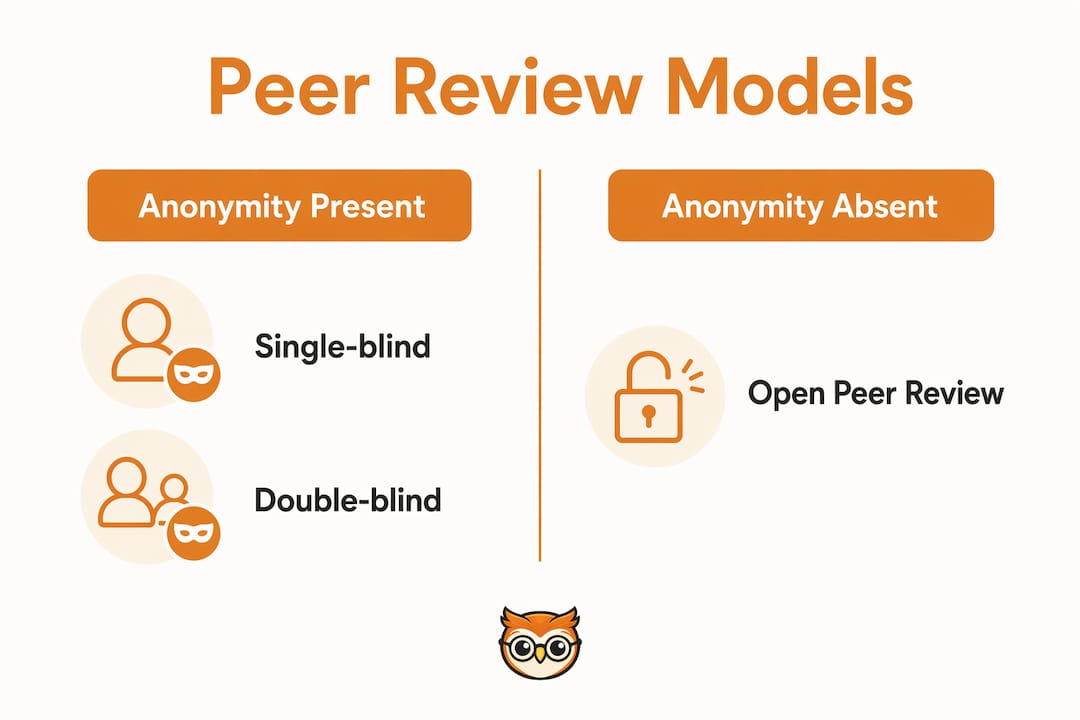
Disciplinary variation in peer review is significant. Medicine and the health sciences rely heavily on formal double-blind review, while physics and mathematics have long used preprint servers like arXiv, where papers circulate publicly before formal review. Law journals often rely on editorial boards of students rather than external experts. Knowing which model a journal uses helps you interpret the weight of its published findings.
Pro Tip: Before submitting to any journal, check its website for the peer review model it uses. Double-blind review offers the strongest protection against reviewer bias, which matters most when your research challenges established positions in your field.
Why peer-reviewed sources are important, and how to read them critically
Peer-reviewed articles are the foundation of academic literature because they represent the closest thing scholarship has to a shared standard of evidence. When you cite a peer-reviewed source, you signal to your reader that the claim you are making has been independently verified by qualified experts. That credibility is not trivial. It is the currency of academic argument.
That said, critical reading remains necessary even with peer-reviewed material. Students frequently mistake peer-reviewed status for a mark of being error-free, but experts consistently stress that it is a quality improvement check, not a guarantee of truth. Several high-profile retractions in journals like Science and The Lancet have demonstrated that peer review can miss fraud, selective reporting, and undisclosed conflicts of interest.
Here are the key habits for reading peer-reviewed literature critically:
- Check the methodology section first. A paper's conclusions are only as strong as its methods. Look for sample sizes, control groups, statistical approaches, and whether the study design matches the claims being made.
- Identify the funding source. Industry-funded research in fields like nutrition and pharmacology has a documented pattern of producing results favourable to the funder. Disclosure statements are usually found at the end of the paper.
- Cross-reference with related studies. A single peer-reviewed paper rarely settles a question. Use databases like PubMed or Scopus to find papers that replicate, contradict, or extend the findings.
- Consider the journal's reputation and impact factor. A paper in The New England Journal of Medicine has passed a more demanding review process than one in a newly established open-access journal with no track record.
- Recognise disciplinary norms. A qualitative study in sociology is evaluated differently from a randomised controlled trial in medicine. Apply the evaluative standards appropriate to the field, not a one-size-fits-all checklist.
Pro Tip: Use the master critical reading guide from Bibliowlteca to build a structured habit of evaluating sources analytically rather than accepting them at face value.
The importance of peer-reviewed articles extends beyond individual papers. Collectively, peer-reviewed literature builds the cumulative record of human knowledge in a field. Literature reviews, systematic reviews, and meta-analyses synthesise this record to produce higher-order evidence. Understanding how to read individual papers critically is the prerequisite for engaging with that broader body of work.
What types of sources count as peer-reviewed literature?
Not all academic sources are peer-reviewed, and not all peer-reviewed sources are journal articles. The table below clarifies the distinctions.

| Source type | Typically peer-reviewed? | Characteristics | Best used for |
|---|---|---|---|
| Journal article | Yes | Formal review by 2 to 3 experts, published in academic journals | Primary evidence, empirical findings |
| Book chapter | Sometimes | Varies by publisher and discipline; common in humanities | Theoretical frameworks, historical context |
| Conference paper | Sometimes | Often reviewed by programme committee; less rigorous than journals | Emerging research, preliminary findings |
| Technical report | Rarely | Produced by government bodies or research institutes; internal review only | Policy context, applied research data |
| Newspaper article | No | Journalistic standards, not academic review | Background context only |
| Blog post or website | No | No formal review process | Opinion, commentary, informal updates |
| Wikipedia article | No | Community-edited; no expert peer review | Initial orientation only, never as a citation |
Peer-reviewed literature forms the foundation/01%3A_Chapters/1.02%3A_The_purpose_of_a_literature_review) of academic scholarship, but books and technical reports serve complementary roles depending on the discipline and research question. In the humanities, a peer-reviewed monograph published by Oxford University Press or Cambridge University Press carries comparable authority to a journal article. In the sciences, journal articles dominate because they communicate findings faster and more precisely.
Conference proceedings occupy a middle ground. In computer science, conferences like NeurIPS and ICML are considered highly prestigious and their papers undergo rigorous review. In other fields, conference papers are treated as preliminary work that has not yet reached the standard of a journal publication. Always check the norms of your specific discipline before deciding how much weight to give a conference paper.
Working papers and preprints, such as those posted on SSRN or arXiv, are not peer-reviewed but are widely read and cited in some fields. They represent research in progress. Treat them as provisional evidence until the work has completed formal review. For a broader view of how cited books compare to other academic resources, the distinction between peer-reviewed and non-peer-reviewed sources becomes especially clear when building a literature review.
How to find peer-reviewed articles using databases and tools
Locating peer-reviewed sources efficiently is a skill that separates productive researchers from those who waste hours on unreliable material. The good news is that most university library systems and major academic databases have built-in tools to make this straightforward.
- Use the peer-reviewed filter in your library database. Platforms such as EBSCO, ProQuest, and JSTOR include a checkbox or filter labelled "Peer-reviewed" or "Refereed." Activating this filter immediately restricts results to articles that have passed editorial review. This is the fastest first step.
- Search PubMed for health and life sciences. PubMed, maintained by the US National Library of Medicine, indexes only peer-reviewed biomedical literature. Every result is from a reviewed source, which removes the need for additional verification in most cases.
- Use Scopus or Web of Science for cross-disciplinary research. Both databases index thousands of peer-reviewed journals across all major disciplines and allow you to filter by journal, date, citation count, and subject area.
- Verify journal status using Ulrich's Periodicals Directory. Ulrich's Directory lists whether a journal is refereed and provides publisher information. It is the definitive reference tool for confirming peer-review status when you are unsure.
- Check the journal's own website. Legitimate peer-reviewed journals publish their editorial board, submission guidelines, and review process on their website. If this information is absent or vague, treat the journal with caution.
- Watch for predatory journals. Predatory journals mimic the appearance of legitimate peer-reviewed publications but charge authors fees and conduct little or no genuine review. The Think. Check. Submit. initiative provides a checklist for identifying them.
Pro Tip: Combine database filters with Google Scholar's "Cited by" feature. If a paper has been cited hundreds of times by other peer-reviewed articles, that citation record is itself a signal of quality and influence, even before you read the paper.
For a structured approach to building a literature review using verified sources, the step-by-step literature review guide from Bibliowlteca walks you through the process from database search to synthesis.
Key takeaways
Peer-reviewed literature is the gold standard of academic evidence, but its value depends entirely on how critically and strategically you engage with it.
| Point | Details |
|---|---|
| Definition of peer review | Academic research evaluated by 2 to 3 independent experts before publication to confirm quality and originality. |
| Not infallible | Peer review improves quality but does not guarantee truth; critical reading of methodology and funding is always required. |
| Source types vary | Journal articles are the most rigorously reviewed; books, conference papers, and technical reports vary by discipline. |
| Finding sources | Use EBSCO, PubMed, Scopus, or Ulrich's Directory with peer-reviewed filters to locate and verify scholarly articles. |
| Disciplinary differences | Norms differ significantly across fields; always apply evaluative standards appropriate to the discipline you are researching. |
Peer review as a conversation, not a verdict
At Bibliowlteca, we work with researchers, educators, and content creators every day, and the most common mistake we see is treating peer-reviewed status as a binary judgement. Either a source is peer-reviewed and therefore trustworthy, or it is not and therefore worthless. That framing misses the point entirely.
Peer review is a months-long iterative exchange/01%3A_Chapters/1.02%3A_The_purpose_of_a_literature_review) between authors and reviewers that refines methods, sharpens arguments, and forces researchers to defend their conclusions. The published paper is not the end of that conversation. It is an invitation for the wider academic community to test, replicate, and build on the work. That is how knowledge actually advances.
What concerns us more than the occasional flawed paper is the growing tendency to outsource critical thinking to the peer review label. Publication bias, where journals favour positive results over null findings, remains a structural problem across disciplines. The reproducibility crisis, most visible in psychology and nutrition science, has shown that peer-reviewed findings can fail to replicate at scale. These are not reasons to distrust peer review. They are reasons to engage with it more actively.
Our recommendation is straightforward. Use peer-reviewed literature as your primary evidence base. Supplement it with well-sourced books, technical reports, and preprints where the discipline warrants it. Apply the critical reading habits outlined in this article every time, regardless of where the paper was published. And when you are building educational content or research resources of your own, hold your sources to the same standard you would want applied to your work.
— BibliOWLteca
Build your academic resource library with Bibliowlteca
Researchers and students who want to go beyond individual articles need a reliable source of structured educational content, from in-depth courses on research methodology to curated eBooks on academic writing and source evaluation.

Bibliowlteca is a digital platform where educators and academic creators publish and sell courses, eBooks, and mentorship programmes to a global audience. Whether you are looking to deepen your understanding of scholarly publishing or build your own research skills library, Bibliowlteca connects you with quality educational content across disciplines. The platform supports multiple currencies and international payments, so access is not limited by geography. Explore the full range of features and content types available to researchers and educators today.
FAQ
What is the definition of peer review in academic publishing?
Peer review is the systematic evaluation of a research manuscript by independent subject-matter experts before publication. Its purpose is to assess the work's methodology, originality, and validity to maintain quality standards in academic journals.
How is peer-reviewed literature different from non-peer-reviewed sources?
Peer-reviewed articles have been assessed by qualified experts and accepted by an editorial board, whereas non-peer-reviewed sources such as blogs, news articles, and Wikipedia have no formal expert evaluation process. The distinction matters because peer-reviewed sources carry a higher standard of evidential credibility in academic work.
How do I know if a journal article is peer-reviewed?
Use the peer-reviewed filter in databases such as EBSCO, PubMed, or ProQuest, or verify the journal's status using Ulrich's Periodicals Directory. You can also check the journal's own website for its editorial board and submission guidelines.
Does peer-reviewed mean the research is definitely correct?
No. Peer review is a quality improvement process, not a guarantee of accuracy. High-profile retractions in journals including The Lancet and Science confirm that errors, fraud, and methodological weaknesses can pass through review. Critical reading of every source remains necessary.
What are some examples of peer-reviewed journals?
Nature, The Lancet, Cell, Physical Review Letters, PLOS ONE, and the Journal of the American Medical Association are all well-known peer-reviewed journals. Each operates its own review process with editorial boards and independent expert reviewers.