
TL;DR:
- Publishing standards are essential for establishing credibility, trust, and accuracy in educational content creation.
- They encompass ethical conduct, transparent methods, rigorous gatekeeping, and multi-stage peer review to protect reputation and reliability.
Publishing standards are defined as the established criteria and processes that determine whether content is accurate, credible, and fit for its intended audience. For content creators, educators, and digital entrepreneurs, these standards are not bureaucratic formalities. They are the difference between educational materials that build lasting trust and those that quietly erode it. As AI-generated content risks grow, the importance of publishing standards has become impossible to ignore. This article explains why publishing standards matter, how they work in practice, and what you can do to apply them in your own educational content.
Why publishing standards matter for credibility and trust
Publishing standards build credibility by creating verifiable checkpoints between the creation of content and its delivery to an audience. Without those checkpoints, readers have no basis for distinguishing informed analysis from confident-sounding guesswork. This is not an abstract concern. It is the operational reality facing every educator who publishes a course, e-book, or digital resource today.

The most widely recognised mechanism for establishing credibility is peer review. Frontiers journals, for example, implement a seven-stage peer review process that includes AI integrity checks, editor evaluations, structured peer dialogue, and multiple rounds of revision. Each stage functions as a quality gate, catching errors that earlier stages missed. For educators, the lesson is direct: a single review pass is rarely sufficient. Multi-stage evaluation catches what a single reader overlooks.
Gatekeeping at the front end of the publishing process is equally significant. The Scholarly Kitchen notes that increased submission volume without stronger front-end screening weakens credibility and wastes reviewer resources. Rejecting unsuitable content early prevents low-quality material from diluting a publisher's reputation. For a digital educator, this translates directly: screening your own content rigorously before release protects the reputation you have spent years building.
Transparency is the third pillar. PLOS Medicine requires authors to share underlying research code with sufficient documentation so that independent readers can verify findings rather than simply accept them on authority. This principle applies beyond academic journals. When you cite your sources, document your methods, or explain how you arrived at a conclusion, you give your audience the tools to trust you rather than demanding they do so blindly.
Pro Tip: Before publishing any educational module, ask yourself whether a knowledgeable peer could independently verify your core claims using the sources and methods you have made visible. If the answer is no, your transparency standard needs strengthening.
The role of editors in publishing is often underestimated in digital content creation. Editors do not simply correct grammar. They enforce the standards that make content reliable, catching logical gaps, unsupported claims, and structural weaknesses that authors rarely spot in their own work.
What are the core types of publishing standards?
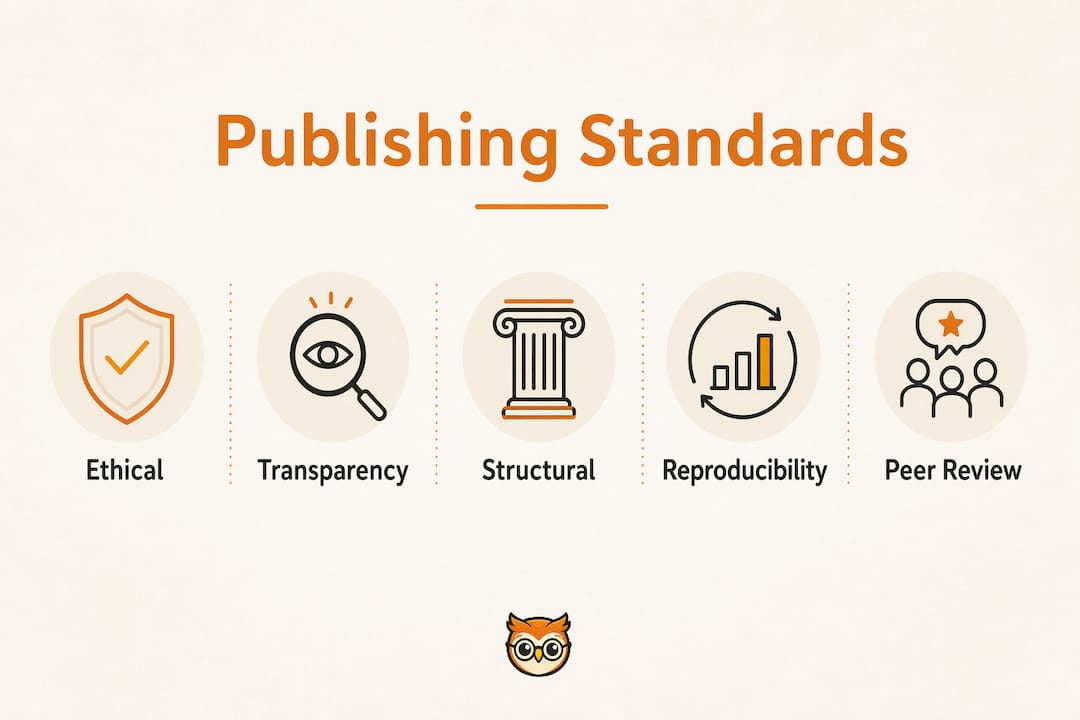
Publishing standards fall into several distinct categories, each addressing a different dimension of quality. Understanding the difference between them helps you decide which apply most directly to your work as an educator or creator.
Ethical standards govern conduct throughout the publishing process. The Committee on Publication Ethics, known as COPE, formalises these through its Code of Conduct. The 2026 COPE Code replaces earlier core practices to address persistent challenges including authorship disputes, undisclosed conflicts of interest, plagiarism, and peer review manipulation. These are not issues confined to academic journals. Any educator who collaborates with others, uses third-party content, or accepts sponsorship faces the same ethical questions.
Transparency and reproducibility standards require that the evidence behind claims is accessible and verifiable. NSF-supported metascience research establishes that trustworthiness depends on measurable factors including accountability, evaluability, bias control, and evidence alignment. Standards are not simply ethical compliance. They are the mechanism by which readers can correctly interpret what a claim actually means and how much weight to give it.
Structural and methodological standards shape how content is designed before it is written. Nature highlights that Registered Reports requiring pre-specified analysis plans improve transparency and reduce biased data reporting. The analogy for educators is direct: publishing your learning objectives, assessment criteria, and content methodology upfront reduces the temptation to cherry-pick evidence that supports a preferred conclusion.
The table below compares the major categories of publishing standards and their primary function.
| Standard type | Primary focus | Practical application for educators |
|---|---|---|
| Ethical standards (COPE) | Authorship, plagiarism, conflicts of interest | Disclose collaborators, cite sources, declare sponsorships |
| Transparency standards (PLOS Medicine) | Data and method sharing | Publish sources, document content methodology openly |
| Methodological standards (Registered Reports) | Pre-specified analysis and evaluation plans | State learning objectives and assessment criteria before publishing |
| Editorial gatekeeping (Scholarly Kitchen) | Front-end quality screening | Review content against criteria before release, not after |
| Multi-stage peer review (Frontiers) | Sequential quality assurance | Use multiple reviewers or expert readers at different stages |
Each standard type addresses a specific failure mode. Ethical standards prevent misconduct. Transparency standards prevent unverifiable claims. Methodological standards prevent outcome bias. Gatekeeping prevents low-quality content from reaching audiences. Multi-stage review prevents errors that single-pass checking misses. Together, they form a system rather than a list.
How does the digital era change the stakes for publishing quality?
The digital publishing environment has fundamentally altered the risk profile for educational content. Volume has increased faster than quality controls. AI-generated text can produce fluent, confident-sounding material that contains factual errors, fabricated citations, and logical inconsistencies that are invisible to a casual reader. For educators, this creates a specific problem: your audience cannot easily distinguish your carefully verified content from a plausible-sounding alternative produced in seconds.
Oxford University Press states directly that rigorous editorial standards and independent review act as safeguards, demonstrating that content has been checked, challenged, and verified by leading experts rather than being unchecked assertions. This is the core value proposition of publishing standards in 2026. They are not about slowing down production. They are about making your content distinguishable from the noise.
The volume problem is structural. When incentives prioritise output over accuracy, credibility suffers across an entire field, not just within a single publication. The Scholarly Kitchen identifies this as a systemic risk: incentives favouring volume over quality jeopardise credibility and make front-end screening tools a necessary investment. For a digital entrepreneur building a catalogue of educational products, the same logic applies. Publishing ten mediocre courses damages your brand more than publishing three excellent ones.
"Publishing standards should be understood as a workflow comprising multiple stages of evaluation, interaction, and revision, rather than a one-time checklist." This framing, drawn from Frontiers' editorial model, is the most useful mental shift a digital educator can make. Standards are not a box you tick before publishing. They are a process you run throughout creation.
For educators creating online courses, e-books, or digital resources, the practical implication is that digital publishing guides that address quality assurance are as important as those covering distribution and monetisation. Getting your content to market quickly matters far less than getting it to market credibly.
Pro Tip: When using AI tools to assist with content creation, treat every output as a first draft requiring fact-checking against primary sources. AI-generated text is a productivity tool, not a quality assurance mechanism.
How can creators and educators implement publishing standards?
Implementing publishing standards does not require a journal-sized editorial team. It requires a structured approach applied consistently. The greatest gains in credibility come from standards applied before publication, because mitigating flaws early avoids costly corrections and reputational damage later. The following process applies to e-books, online courses, and any educational digital product.
-
Define your quality criteria before you write. Specify what claims require citations, what level of expertise qualifies a reviewer, and what constitutes a factual error in your subject area. This prevents you from adjusting standards to fit what you have already written.
-
Screen content at the outline stage. Review your structure, sources, and core claims before investing time in full production. Catching a weak argument at the outline stage costs minutes. Catching it after a course is live costs credibility.
-
Apply at least two independent reviews. One review by a subject-matter expert and one by a representative of your intended audience catches different categories of problem. The expert spots factual errors. The audience representative spots clarity failures.
-
Document your sources and methods openly. For educational content, this means citing your references visibly, explaining how you selected them, and acknowledging the limits of your evidence. The principle behind reference source credibility is that transparency builds trust more reliably than authority alone.
-
Declare conflicts of interest and affiliations. If you have a commercial relationship with a product you recommend, or if your content was sponsored, say so. Audiences notice omissions. Disclosure protects trust rather than undermining it.
-
Publish your evaluation criteria upfront. State your learning objectives, the evidence base you drew on, and the methodology you used to select content. This is the educator's equivalent of a pre-registered analysis plan. It signals intellectual honesty before the audience has read a single word.
-
Review and update content on a defined schedule. Standards do not end at publication. Outdated information in an educational product is a credibility risk. Build a review cycle into your publishing workflow from the start.
Common pitfalls include treating peer review as a formality rather than a genuine quality check, relying on a single reviewer who shares your perspective, and conflating polished presentation with verified accuracy. A well-designed course that contains factual errors is more damaging than a plainly presented one that is correct, because the production quality signals authority the content does not deserve.
Pro Tip: Use bibliographies as credibility signals in your educational materials. A visible, well-constructed bibliography tells your audience that your claims are traceable, not just asserted.
Key takeaways
Publishing standards are the non-negotiable foundation of credible educational content, requiring ethical rigour, transparent methods, front-end gatekeeping, and multi-stage review to protect both audience trust and creator reputation.
| Point | Details |
|---|---|
| Standards precede publication | Apply quality criteria at the outline stage to prevent costly corrections after release. |
| Transparency builds trust | Cite sources, document methods, and declare affiliations so audiences can verify your claims independently. |
| Gatekeeping protects reputation | Screen content rigorously before release rather than relying on post-publication corrections. |
| Multi-stage review catches more errors | Use at least two independent reviewers at different stages to identify factual and clarity failures. |
| Digital volume increases risk | Publishing more content without stronger quality controls damages credibility faster than publishing less. |
The uncomfortable truth about standards in digital education
Working directly with educators and creators who publish digital content, one pattern stands out above all others. The creators who resist publishing standards most strongly are usually the ones who need them most. They frame standards as obstacles to speed, as academic formalities that do not apply to practical content, or as gatekeeping by institutions they do not respect. This framing is understandable. It is also wrong.
The educators whose content earns sustained trust and repeat purchases are not the fastest publishers. They are the most reliable ones. Their audiences return not because the production quality is high, but because the information proved accurate the last time. That reliability is not accidental. It is the direct result of applying consistent quality criteria before every release.
The broader societal dimension matters too. Misinformation spreads fastest in environments where credible alternatives are hard to identify. When educators publish without standards, they do not just risk their own reputation. They contribute to an information environment where audiences struggle to distinguish trustworthy content from unreliable content. That is a responsibility worth taking seriously.
The standards that matter most are not the complex ones. They are the simple commitments: cite your sources, get an independent review, declare your limitations, and update your content when evidence changes. These are not burdens. They are the habits that separate a sustainable educational business from one that burns through audience trust and has to start over.
— BibliOWLteca
Publish with confidence on BibliOWLteca
BibliOWLteca is built for creators who take the quality of their educational content seriously. The platform gives you the infrastructure to publish e-books, courses, and digital resources globally, with built-in tools for payment processing, digital delivery, and tax compliance across multiple currencies.

When you publish through the BibliOWLteca marketplace, you reach a global audience of learners who are actively seeking credible educational materials. The platform does not just handle distribution. It supports the kind of professional, standards-conscious publishing that builds long-term audience trust. If you are ready to turn your knowledge into a credible digital business, BibliOWLteca provides the foundation to do it properly.
FAQ
What are publishing standards?
Publishing standards are the established criteria, processes, and ethical codes that govern how content is created, reviewed, and released to ensure accuracy and credibility. They include peer review, editorial gatekeeping, transparency requirements, and ethical guidelines such as those set by COPE.
Why do publishing standards matter for online courses and e-books?
Publishing standards matter for online courses and e-books because they protect audience trust by ensuring content is accurate, verifiable, and free from undisclosed conflicts of interest. Without them, even well-intentioned educational materials can spread misinformation or damage a creator's reputation.
How does peer review apply to educational content creators?
Peer review for educational content means having at least one subject-matter expert and one representative audience member review your material before release. Frontiers' seven-stage model demonstrates that multi-stage review catches errors that single-pass checking consistently misses.
What is the biggest risk of ignoring publishing standards in digital content?
The biggest risk is irreversible reputational damage. Pre-publication screening prevents flawed content from reaching audiences, and front-end gatekeeping is consistently more efficient than post-publication corrections, which rarely fully restore trust once it is lost.
How can I make my educational content more transparent?
Cite your sources visibly, document the methodology you used to select content, declare any commercial affiliations, and state your learning objectives and evidence base before the audience reads your material. PLOS Medicine's code-sharing requirement demonstrates that transparency shifts trust from authority-based acceptance to independent verification.