
TL;DR:
- A reference list records every source cited in a work, ensuring proper credit, verification, and protection against plagiarism. It is essential for academic credibility, demonstrating thorough research, ethical attribution, and intellectual transparency. Using citation tools and maintaining disciplined practices fortify the integrity and accuracy of the reference list throughout the research process.
A reference list is the structured record of every source cited within a piece of writing, and it serves three non-negotiable purposes: crediting original authors, enabling readers to verify claims, and protecting the writer from plagiarism accusations. Understanding why reference lists matter is not a peripheral concern for students and researchers. It sits at the core of what makes writing credible, honest, and worth reading. Tools like Zotero and Mendeley have made managing these lists far more straightforward, yet the underlying principles remain unchanged. Without a properly constructed reference list, even the most persuasive argument collapses under scrutiny.
Why reference lists matter for academic credibility
Reference lists are the foundation of scholarly trust. When you cite a source, you acknowledge that your argument stands on the work of others. When you list that source fully and accurately, you give readers the means to check your reasoning independently. These are not bureaucratic formalities. They are the mechanisms by which academic writing distinguishes itself from opinion.

The three fundamental roles of a reference list are ethical credit, reproducibility, and integrity. Each role carries real consequences when neglected. A researcher who fails to credit original authors risks accusations of plagiarism. A writer who omits sources prevents readers from verifying claims. An institution that tolerates poor referencing undermines the credibility of its entire body of published work.
The consequences of poor referencing are not abstract. Plagiarism accusations can result in failing grades, suspension, or expulsion at universities worldwide. This is not a threat reserved for deliberate misconduct. Careless referencing, such as forgetting to include a source in the list or misattributing a quotation, carries the same institutional risk as intentional copying. The University of Saskatchewan and similar institutions maintain robust policies that treat omission and fabrication with equal seriousness.
Beyond penalties, reference lists demonstrate the depth and scope of your research. A well-curated list signals to reviewers and readers that you have engaged seriously with the existing literature. Omitting adequate references signals unfamiliarity with the field, which undermines credibility before a single argument is assessed. Think of the reference list as intellectual packaging: it shows how your work updates, challenges, or builds upon what came before.
Key roles a reference list plays in academic credibility:
- Ethical attribution: Credits the original thinkers whose ideas you have drawn upon, respecting intellectual labour.
- Verification: Allows readers, reviewers, and examiners to locate and assess every source you have used.
- Plagiarism prevention: Protects you from accusations of presenting others' work as your own.
- Research depth signalling: Demonstrates to reviewers that you have engaged thoroughly with the relevant literature.
- Argument framing: Positions your claims within an existing body of knowledge, giving them context and weight.
Pro Tip: Start your reference list on the day you begin writing, not the day before submission. Adding sources as you go prevents the frantic, error-prone process of reconstructing citations from memory.
How do reference lists function within scholarly communication?
Reference lists do more than satisfy ethical requirements. They are active participants in academic discourse. When you cite a body of literature, you signal your intellectual position within a discipline. You show which scholars you consider authoritative, which debates you are entering, and which gaps your work addresses. This is why the significance of bibliographies and reference lists extends well beyond compliance.
Citations act as strategic tools that position writers within disciplinary conversations, signal intellectual stance, and identify gaps in existing research. High citation counts are often associated with prestige, but this relationship is complicated by citation bias. Citing only well-known authors or popular studies can distort the picture of a field, marginalising important work from less prominent researchers or non-English-language publications. Responsible referencing means selecting sources for their relevance and rigour, not their fame.
"References are active components of scientific discourse shaping power structures and determining knowledge legitimacy, not just tedious administrative tasks." — ScienceDirect, 2026
The technical relationship between in-text citations and the reference list is equally important. Every source mentioned in the body of your writing must appear in the reference list. Every entry in the reference list must correspond to a citation in the text. This one-to-one correspondence is a primary indicator of research rigour. Missing or unmatched citations are red flags to journal reviewers and examiners, signalling carelessness rather than genuine scholarly engagement.
The steps for maintaining this alignment throughout the writing process are straightforward:
- Record the full bibliographic details of every source at the moment you first consult it.
- Insert the in-text citation immediately when you use the source in your draft.
- Cross-check your in-text citations against your reference list before submission.
- Use citation management software to automate the matching process and catch discrepancies.
- Review the final reference list against your style guide to confirm formatting consistency.
Padding a reference list with tangential or irrelevant sources is a common mistake that weakens rather than strengthens a paper. Typical journal guidelines cap reference lists between 30 and 60 entries. Exceeding this without clear justification signals a lack of critical synthesis to reviewers. A shorter, sharply focused list of genuinely relevant sources carries more scholarly weight than a bloated catalogue designed to impress through volume alone.
Best practices vs common pitfalls in creating reference lists
The difference between a strong reference list and a weak one often comes down to process rather than knowledge. Most students and researchers understand that they need to cite sources. Fewer have a reliable system for doing so accurately and consistently.
| Practice | Strong approach | Common pitfall |
|---|---|---|
| Citation management | Use Zotero or Mendeley from the start to automate formatting and matching | Manually compiling references at the end, leading to errors and omissions |
| In-text and list alignment | Every in-text citation has a corresponding reference list entry | Sources cited in text but absent from the list, or vice versa |
| Source relevance | Include only sources directly relevant to your argument | Padding the list with tangential sources to appear well-read |
| Reference list length | Follow journal or institutional guidelines (typically 30 to 60 entries) | Exceeding limits without justification, suggesting lack of focus |
| Formatting consistency | Apply one style guide (APA, MLA, Chicago, Harvard) throughout | Mixing formats across entries, undermining professional presentation |
Mismatch between in-text citations and the reference list is the most common technical failure in academic writing, and it is entirely avoidable. Citation management tools like Zotero and Mendeley synchronise your in-text citations with your reference list automatically. They also format entries according to your chosen style guide, whether APA, MLA, Chicago, or Harvard, removing the risk of inconsistent punctuation, missing DOIs, or incorrectly ordered author names.
Understanding the distinct functions of in-text citations and reference lists prevents another frequent error. In-text citations provide concise pointers that maintain reading flow, typically including only the author's surname and year of publication. The reference list provides comprehensive retrieval information: full author names, publication year, title, journal or publisher, volume, issue, page numbers, and DOI where available. Confusing these roles by including full bibliographic details within the text disrupts the reader's experience and signals unfamiliarity with academic conventions.
Pro Tip: When using Zotero or Mendeley, create a separate collection for each project. This prevents sources from different papers bleeding into one another and makes the final cross-check far quicker.
The role of references in research also extends to how you present your intellectual journey. Experts view reference lists as roadmaps that honestly reflect the depth and scope of a researcher's engagement with the literature. A list that draws exclusively from one decade, one country, or one theoretical tradition reveals the limits of that engagement, even if unintentionally. Diversifying your sources across time periods, methodologies, and scholarly traditions strengthens both the list and the argument it supports.
How to create reference lists that hold up to scrutiny
Building a reference list that genuinely supports your writing requires discipline throughout the research and drafting process, not a rushed effort at the end. The completeness of academic writing depends on this discipline, and the habits you build early will serve you across every piece of work you produce.
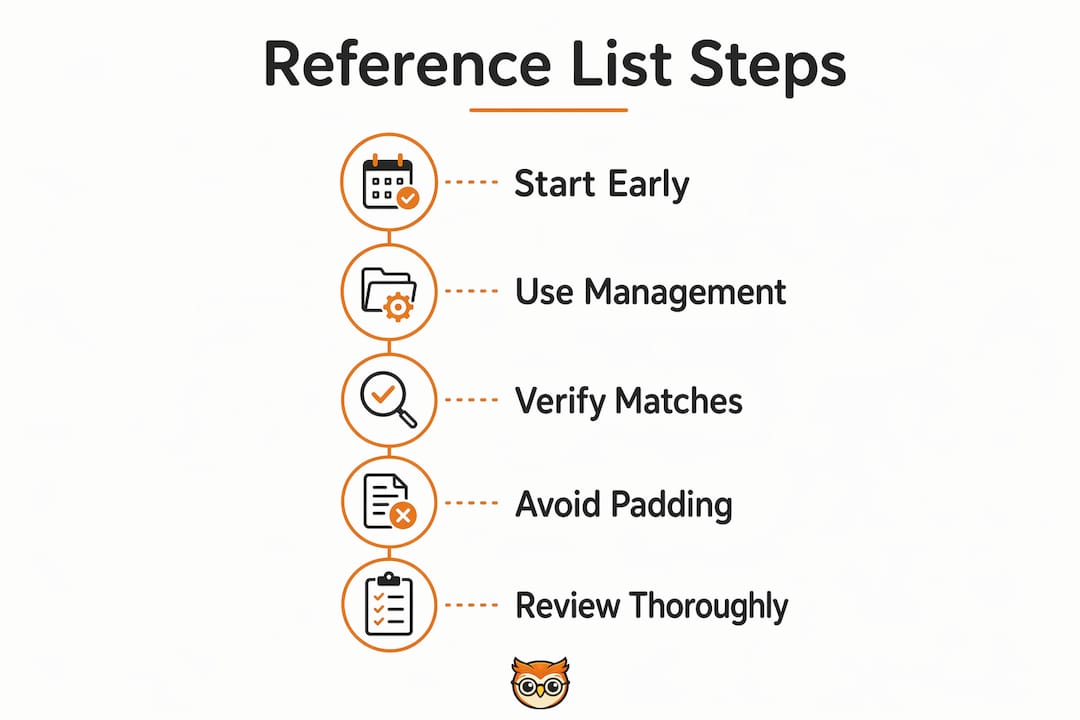
Practical steps for creating reference lists that meet 2026 academic standards:
- Start immediately. Open your citation manager on the day you begin researching. Add every source you consult, even those you are unsure you will use. It is far easier to delete an unused entry than to reconstruct a missing one.
- Cite as you write. Insert in-text citations at the moment you draw on a source in your draft. Do not leave placeholders or notes to yourself. Deferred citation is the primary cause of mismatched lists.
- Verify DOIs and URLs. Digital sources change location. Confirm that every URL or DOI in your reference list resolves correctly before submission. Broken links undermine the verification function of the list.
- Check your institution's style guide. APA 7th edition, MLA 9th edition, and the Chicago Manual of Style 17th edition each have specific requirements for reference list formatting. Confirm which edition your institution or target journal requires in 2026, as updates are issued regularly.
- Review for relevance. Before finalising, read through your reference list and ask whether each entry genuinely supports a claim in your text. Remove any source that does not. A focused list of 25 highly relevant sources is stronger than a padded list of 60 marginal ones.
- Cross-check systematically. Read through your text and highlight every in-text citation. Then confirm each one appears in the reference list. Reverse the process: read through the reference list and confirm each entry is cited in the text. This two-directional check catches the discrepancies that automated tools occasionally miss.
- Keep current with institutional requirements. Style guides and institutional policies are updated periodically. The impact of referencing on your credibility depends on applying the current standard, not the version you learned three years ago.
The benefits of citation extend beyond the individual paper. Researchers who develop strong referencing habits build a personal archive of sources that accelerates future projects. A well-maintained Zotero or Mendeley library becomes a searchable database of your intellectual history, making literature reviews faster and more thorough with each successive project. This compounding advantage is one of the least discussed but most practical reasons to invest in rigorous referencing from the outset.
Key takeaways
Reference lists are not administrative afterthoughts. They are the structural evidence that your writing is grounded in genuine research, honest attribution, and verifiable claims.
| Point | Details |
|---|---|
| Ethical credit is non-negotiable | Every source used in your writing must be attributed to its original author in the reference list. |
| Alignment prevents rejection | Every in-text citation must match a reference list entry; mismatches are immediate red flags for reviewers. |
| Relevance beats volume | A focused list of 30 to 60 pertinent sources carries more weight than a padded catalogue of marginal ones. |
| Tools remove human error | Zotero and Mendeley automate citation-reference matching, eliminating the most common technical failures. |
| Style guides evolve | Confirm which edition of APA, MLA, or Chicago your institution requires in 2026 before finalising any list. |
The uncomfortable truth about how reference lists are actually judged
From where BibliOWLteca sits, working with researchers, educators, and writers who publish and distribute knowledge globally, one pattern stands out clearly: the reference list is the first place a sceptical reader looks, and the last place most writers give serious attention.
Reviewers at academic journals do not read reference lists the way students imagine. They scan for familiar names, check whether foundational texts in the field are present, and look for the telltale signs of a writer who has done the work versus one who has assembled a list to satisfy a word count. A reference list that cites only textbooks, or that draws exclusively from one or two journals, signals intellectual narrowness regardless of how well-written the body text is.
The cultural shift towards transparency and reproducibility in research has made this scrutiny more intense, not less. Open science movements, pre-registration requirements, and data-sharing mandates have all placed greater pressure on the reference list as a document of accountability. Citing a source that does not support the claim you attribute to it is now far easier to detect, and the reputational consequences are proportionally greater.
What we have observed is that writers who treat the reference list as a living document, updated continuously throughout the research process, produce work that is qualitatively different from those who treat it as a final task. The former group writes with greater confidence because they know exactly what evidence supports each claim. The latter group often discovers, at the point of cross-checking, that some of their most important claims are unsupported in the list. That discovery, made at midnight before a deadline, is entirely avoidable.
The technology available in 2026 makes rigorous referencing genuinely accessible. There is no longer a credible argument for manual reference management when tools like Zotero are free, well-documented, and integrated with every major word processor. The barrier is not technical. It is habitual. Build the habit early, and the reference list stops being a source of anxiety and becomes one of your strongest arguments for being taken seriously.
— BibliOWLteca
Build your knowledge base with BibliOWLteca
BibliOWLteca supports students, researchers, and educators who want to turn rigorous knowledge into credible, shareable content. Whether you are building a course, writing an e-book, or distributing research-backed educational material, the platform gives you the infrastructure to publish and reach a global audience with confidence.

If you are working on academic or professional content and want to understand how referencing fits into broader content credibility, explore the digital content tools BibliOWLteca offers. From citation-aware educational resources to globally distributed e-books, the platform is built for creators who take the integrity of their work seriously. You can also review the full range of platform features to see how BibliOWLteca supports every stage of content creation and distribution.
FAQ
What is a reference list and how does it differ from a bibliography?
A reference list contains only the sources cited within a specific piece of writing, whereas a bibliography may include additional sources consulted but not directly cited. The distinction matters because a reference list is a precise record of evidence used, not a general reading list.
Why do reference lists matter for avoiding plagiarism?
Properly constructed reference lists credit original authors and demonstrate that ideas have been attributed rather than appropriated. Universities treat missing or incomplete references as potential plagiarism, with consequences ranging from grade penalties to expulsion.
How many references should a research paper include?
Most journal guidelines recommend between 30 and 60 references, depending on the discipline and paper length. Exceeding this range without clear justification suggests a lack of critical focus rather than greater scholarly depth.
What is the best tool for managing reference lists in 2026?
Zotero and Mendeley are the two most widely used citation management tools in academic writing. Both automate the matching of in-text citations to reference list entries and format sources according to APA, MLA, Chicago, and other major style guides.
What happens if my in-text citations do not match my reference list?
Mismatches between in-text citations and the reference list are identified immediately by journal reviewers and examiners as a sign of carelessness. They can result in manuscript rejection or requests for major revision before a paper is considered for publication.