
TL;DR:
- Institutional repositories are open-access archives that enhance the visibility and preservation of scholarly work for institutions. They enable wider access, ensure long-term digital preservation, and support compliance with open science mandates. Using repositories early in research maximizes impact, establishes priority, and showcases the institution's comprehensive scholarly output.
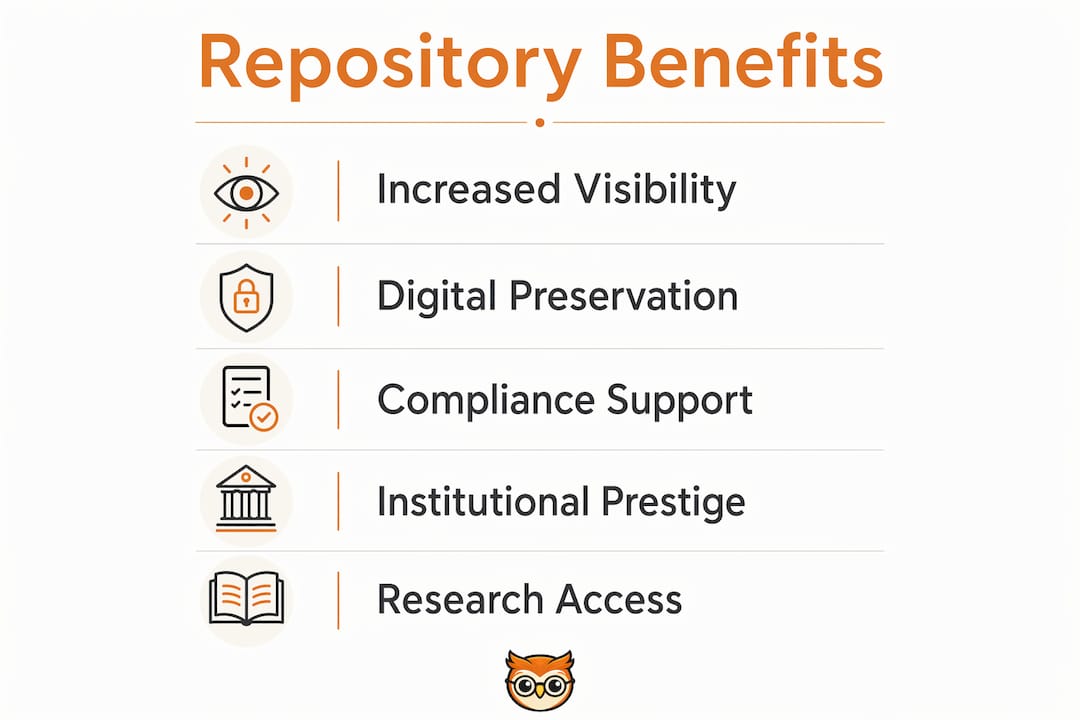
Institutional repositories are open-access digital archives that preserve, disseminate, and increase the visibility of an institution's scholarly output. Understanding why use institutional repositories matters more than ever in 2026, as open science mandates tighten and researchers face growing pressure to demonstrate impact beyond journal metrics. These archives, formally known in scholarly communication as institutional repositories (IRs), give academics direct control over how their work is discovered, cited, and preserved. The benefits of institutional repositories extend from individual researchers seeking greater reach to entire institutions building a verifiable record of their academic contribution.
Why use institutional repositories to boost research visibility?
Institutional repositories increase research visibility by centralising scholarly outputs and enabling discoverability through academic search engines and aggregators. This centralised indexing creates a dual visibility effect: your work becomes accessible via both the journal and the repository simultaneously. Researchers who cannot access a paywalled article can still retrieve the deposited version, which removes a significant barrier to readership.
The practical consequences are considerable. A paper sitting behind a subscription paywall reaches only those with institutional access. The same paper deposited in a repository reaches anyone with an internet connection, from a postgraduate student in Lagos to a policy analyst in Seoul. Open access via repositories removes geographic and economic barriers, which leads to greater citation counts and collaboration opportunities.
Repositories also archive content that academic search engines would otherwise miss. This includes:
- Theses and dissertations that represent years of original research but rarely appear in commercial databases
- Technical reports and working papers produced by research centres and government-funded projects
- Conference papers and posters that capture early findings before formal publication
- Datasets and supplementary materials that underpin published studies
These materials are often called "grey literature." Grey literature archived in repositories represents substantial institutional output and benefits from stable, long-term digital preservation. Without a repository, much of this work simply disappears from the scholarly record.
Pro Tip: Deposit a working paper or preprint in your institutional repository as soon as the research is substantive. Researchers who deposit early versions establish priority of discovery and accumulate citations before formal journal publication.
What role do repositories play in digital preservation and long-term access?
Repositories protect scholarly work from two threats that most researchers underestimate: link rot and platform closure. A personal academic webpage or a commercial social network can disappear overnight. An institutional repository, by contrast, operates under formal digital preservation policies backed by the institution itself.
The technical mechanism here matters. Repositories assign persistent, DOI-backed URLs to every deposited item. Repositories with persistent DOI links ensure that scholarly works remain discoverable and accessible over decades, regardless of changes to the institution's website structure. A citation published in 2026 pointing to a repository record will still resolve in 2046.
Personal websites and commercial academic platforms cannot offer this guarantee. Consider what happens when a researcher retires, changes institution, or simply stops paying for a domain. Their publications become inaccessible. An institutional repository transfers custodianship to the institution, making the work part of a permanent scholarly record.
Repositories are also equipped to handle diverse file formats and metadata standards. They preserve:
- Accepted manuscripts in PDF and Word formats with full bibliographic metadata
- Research data in formats such as CSV, XML, and proprietary software outputs
- Multimedia outputs including audio recordings, video lectures, and image collections
- Administrative and policy documents that contextualise the institution's research environment
The importance of institutional repositories for preserving less formal academic outputs, such as technical reports and conference papers, is often overlooked until the content is needed and cannot be found.
Pro Tip: Do not limit your deposits to journal articles. Depositing datasets, reports, and teaching materials gives your institution a richer, more accurate picture of its total scholarly output.
How do repositories complement traditional publishing and support compliance?
A persistent misconception holds that depositing work in a repository undermines journal publication. The opposite is true. Repositories complement journals by securing longevity, increasing accessibility, and managing embargoes to comply with publisher agreements. The repository and the journal serve different functions and reinforce each other.
The green open access pathway is the clearest example of this complementarity. Green open access means depositing a version of your manuscript in a repository without paying article processing charges. This is distinct from gold open access, where authors pay a fee for the publisher to make the final version freely available. Institutional repositories provide a cost-effective green open access route that reduces reliance on article processing charges, which can run to thousands of pounds per article.
Managing this process correctly requires attention to three practical steps:
- Identify the permitted manuscript version. Most publishers allow deposit of the accepted manuscript (the post-peer-review, pre-typeset version) rather than the published PDF. Tools such as the SHERPA/RoMEO database list publisher policies for thousands of journals.
- Observe embargo periods. Some publishers require a waiting period of six to twenty-four months before the deposited version can be made publicly accessible. Your repository system manages this automatically once you set the embargo date.
- Record the licence and publication status. Repositories track publication status and licensing to ensure that deposited content complies with editorial and copyright standards. This protects both the researcher and the institution.
Funder mandates add another layer of urgency. Research councils in the United Kingdom, including UK Research and Innovation (UKRI), require open access for funded outputs. Depositing in an institutional repository satisfies these mandates without requiring researchers to pay gold open access fees. For researchers on grants with tight budgets, this is a material financial advantage.
Understanding copyright and embargo nuances is one of the most practical skills a researcher can develop, and your repository team is the best starting point for institution-specific guidance.
Why are institutional repositories important for institutional prestige?
Repositories function as a public showcase of everything an institution produces. Funding bodies, ranking agencies, and accreditation panels all look for evidence of research breadth and impact. Institutional repositories serve as quality indicators that provide tangible evidence of an institution's academic standing and research impact.

This matters beyond league tables. When a prospective doctoral student searches for expertise in a niche field, a well-populated repository signals that the institution takes research seriously. When a government agency seeks a partner for applied research, a repository that surfaces policy reports and technical outputs builds credibility faster than a marketing brochure.
Repositories act as a tool for institutional quality assessment, showing research breadth and impact to stakeholders who may never read a single published paper. The repository becomes the institution's living research portfolio.
The table below summarises the institutional benefits across key stakeholder groups.
| Stakeholder | Benefit delivered by the repository |
|---|---|
| Funding bodies | Verifiable evidence of output volume and open access compliance |
| Ranking agencies | Comprehensive metadata supporting bibliometric analysis |
| Accreditation panels | Documented research activity across all disciplines |
| Prospective researchers | Searchable record of institutional expertise and output |
| The public | Free access to publicly funded research findings |
Repositories also capture outputs that journal metrics miss entirely. A dataset underpinning a major clinical trial, a policy briefing that influenced legislation, or a set of teaching materials adopted by fifty universities all represent genuine scholarly contribution. Without a repository, none of these appear in any official record of the institution's work.
The role of libraries in academic research is directly tied to how well repositories are maintained and promoted within an institution. Libraries that actively support deposit workflows see higher participation rates and richer collections.
Key takeaways
Institutional repositories are the most cost-effective way to increase research visibility, satisfy funder mandates, and build a permanent, citable record of scholarly output.
| Point | Details |
|---|---|
| Dual visibility effect | Depositing in a repository makes work accessible via both the journal and the open web simultaneously. |
| Persistent preservation | DOI-backed repository URLs protect work from link rot and platform closure over decades. |
| Green open access | Repositories provide a free route to open access compliance, avoiding article processing charges. |
| Institutional showcase | Repositories display the full breadth of scholarly output to funders, rankers, and the public. |
| Deposit early | Uploading preprints and working papers establishes priority of discovery before formal publication. |
The case for treating your repository as a first-class research tool
Most researchers treat the institutional repository as an afterthought, something to tick off after a paper is published. That approach wastes most of the value these systems offer.
The researchers who gain the most from repositories are those who engage with them at the start of a project, not the end. Depositing a working paper establishes a timestamped record of your ideas. Uploading a dataset alongside a published article makes your methods reproducible and your findings more credible. Archiving a conference presentation keeps a piece of work alive that would otherwise vanish from the scholarly record within months.
There is also a copyright dimension that catches many researchers off guard. The assumption that you own your published work is often wrong. When you sign a publishing agreement, you typically transfer copyright to the journal. What you retain, in most cases, is the right to deposit the accepted manuscript in a repository. Knowing this distinction before you sign is far more useful than discovering it afterwards.
The open science movement is reshaping what counts as a scholarly contribution. Preprints, datasets, software, and teaching materials are increasingly recognised alongside journal articles. Repositories are the infrastructure that makes this broader definition of scholarship visible and citable. Institutions that invest in their repositories now will be better positioned as these norms become standard practice.
My honest view is that the biggest barrier to repository use is not technical. It is cultural. Researchers who see the repository as a bureaucratic obligation will deposit the minimum required. Researchers who see it as a tool for building their scholarly profile will use it to its full potential. The difference in long-term visibility and impact is significant.
— BibliOWLteca
Bibliowlteca and academic content management
Bibliowlteca supports researchers and educators who want to go beyond the repository and build a direct relationship with their audience.

The platform lets you publish e-books, courses, and digital research materials with built-in payment processing, tax compliance, and global delivery. Where an institutional repository preserves and disseminates your work within the academic system, Bibliowlteca gives you the tools to reach learners, practitioners, and professionals worldwide. Explore Bibliowlteca's features for educators to see how the platform handles digital delivery and audience management. For researchers ready to turn their expertise into a digital product, the Bibliowlteca pricing page sets out the options clearly, with support for multiple currencies and international payments from day one.
FAQ
What is an institutional repository?
An institutional repository is an open-access digital archive that collects, preserves, and disseminates the scholarly output of a university or research institution. It typically holds journal articles, theses, datasets, and grey literature under a formal digital preservation policy.
Do institutional repositories improve access to research?
Yes. Repositories create a dual visibility effect by making deposited work accessible via both the journal and the open web, bypassing paywalls for readers without subscription access.
Is depositing in a repository legal if my article is published in a journal?
Most publishers permit deposit of the accepted manuscript version, often after an embargo period. The SHERPA/RoMEO database lists the self-archiving policies of thousands of journals, and your institutional repository team can advise on specific cases.
How do repositories support open access compliance?
Repositories provide a green open access route that satisfies funder mandates, including those from UKRI, without requiring authors to pay article processing charges.
What types of content can I deposit in an institutional repository?
Repositories accept journal articles, theses, conference papers, technical reports, datasets, teaching materials, and multimedia outputs, making them a comprehensive record of an institution's full scholarly activity.