
TL;DR:
- Following a five-stage workflow—including questioning, systematic searching, source evaluation, synthesis, and transparent publishing—ensures credible, trustworthy digital products. Using UK repositories, tools like Zotero, and proper licensing methods allows creators to build verifiable, high-quality educational content. A documented methodology signals research integrity and enhances buyer confidence, supporting impactful, research-led courses and e-books.
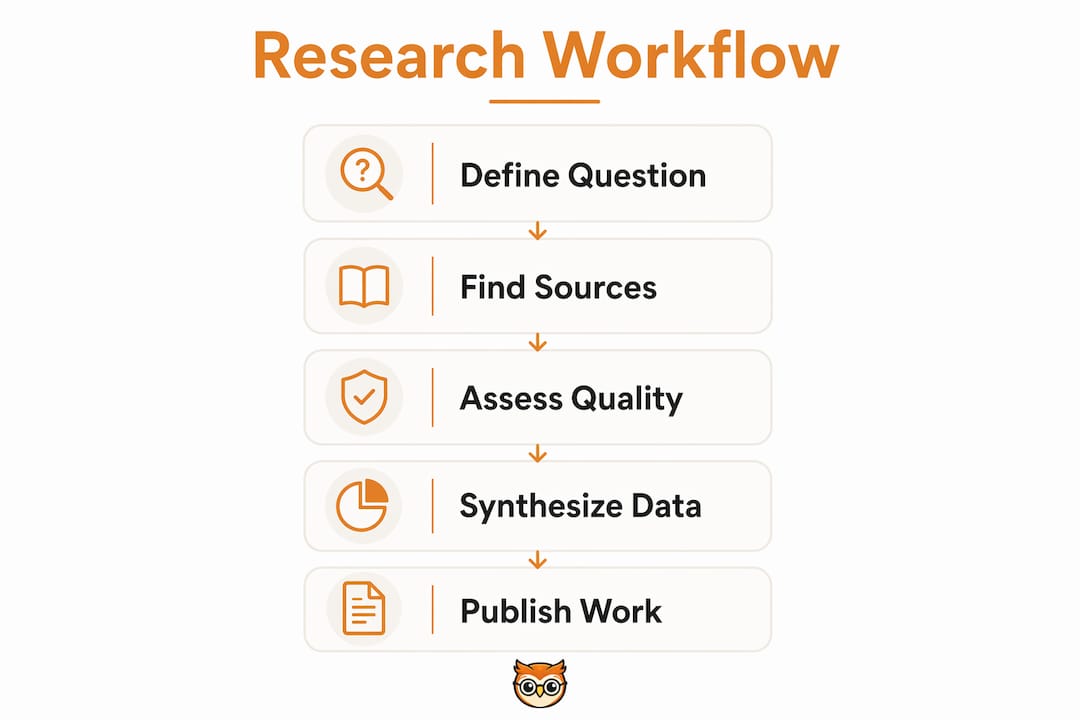
The most effective workflow for creators building evidence-based digital products runs in five stages: define a precise question, search systematically, evaluate sources critically, synthesise findings into themes, and publish with transparent citations. Follow that sequence and you produce content buyers trust and regulators cannot fault.
This guide covers every stage in detail, with UK-specific repositories (British Library, UK Data Service, CORE), a methodology and ethics checklist, reference management tools (Zotero, EndNote, Mendeley), licensing guidance (Creative Commons, Crossref DOIs), and a pre-publish quality checklist for courses and e-books. Academic research, in the formal sense, differs from casual googling by requiring systematic source identification and a verifiable argument — a distinction that matters enormously when a buyer is deciding whether your course is worth £49.
What this guide includes at a glance:
- Step-by-step research workflow with search strings and documentation templates
- UK repositories and databases to query first
- Methodology and ethics checklist for UK contexts (HRA, GDPR)
- Licensing matrix (CC BY, CC BY-NC, CC0) for commercial products
- Timeline and cost estimates for a literature-led course or e-book
- Pre-publish QA checklist
Primary tools referenced throughout: Google Scholar, Zotero, Crossref, ORCID, Creative Commons, and Bibliowlteca as a publishing option.
Table of Contents
- What does a rigorous academic research workflow look like?
- Which UK repositories and databases should you search first?
- How do you judge whether a source belongs in your evidence base?
- What should your methodology statement include?
- How do you turn research findings into a course or e-book?
- How do you reference correctly and licence content for UK publishing?
- Which tools support a reproducible research workflow?
- What does a research-led course or e-book actually cost to produce?
- What mistakes should you avoid before you publish?
- Key takeaways
- Why methodology is a selling point, not a burden
- Publish your research-led course or e-book on Bibliowlteca
- Useful sources and further reading
What does a rigorous academic research workflow look like?
Academic research follows a structured, iterative process of roughly 8–10 steps, with search and evaluation phases repeating as the question sharpens. Here is a numbered workflow creators can follow from first idea to documented evidence base.
- Define your research question or learning outcome. Write one sentence: "What does the evidence say about X for Y audience?" Narrow questions produce tighter, more credible modules; broad ones generate sprawling literature with no clear argument.
- Map key concepts and synonyms. List three to five core terms per concept. These become your search strings.
- Select search tools. Start with Google Scholar and CORE for open-access papers, then move to JSTOR, PubMed, or the British Library catalogue depending on subject.
- Run systematic searches. Use Boolean operators (AND, OR, NOT) and date filters. Record every string you run and the number of results returned.
- Apply inclusion and exclusion criteria. Decide upfront: peer-reviewed only? Published after 2015? UK population? Document these criteria before screening.
- Screen and evaluate sources. Title and abstract first, then full text for shortlisted items. Log rejections with a reason.
- Extract and code findings. Pull key claims, sample sizes, and methods into a structured notes database tagged by learning outcome.
- Synthesise into themes or evidence statements. Group coded findings; identify consensus, contradictions, and gaps.
- Document methodology and limitations. Write a short methods summary: search dates, strings, databases, inclusion criteria, and number of sources retained.
Workflow checklist (copy into your project board):
- Research question written and approved
- Search strings documented
- Inclusion/exclusion criteria set before screening
- All searches logged with result counts
- Sources screened and rejections noted
- Findings extracted and tagged
- Themes synthesised
- Methods summary drafted
Pro Tip: A narrow question ("Does spaced repetition improve vocabulary retention in adult EFL learners?") produces a manageable literature of 20–40 papers and maps cleanly to two or three course modules. A broad question ("Does learning work?") returns thousands of results and no coherent argument. Narrow first; you can always widen.
Which UK repositories and databases should you search first?
Not all databases are equal, and starting in the wrong place wastes hours. Here is where to look, and why.
- Google Scholar — the fastest first pass for any topic; covers journals, theses, and grey literature. Use the "Cited by" feature to trace influence forward.
- CORE (core.ac.uk) — aggregates millions of open-access UK and international research outputs. Free, no subscription needed, and ideal for creators without institutional access.
- British Library catalogue — essential for monographs, rare materials, and UK-specific grey literature. The EThOS thesis database sits here too.
- UK Data Service (ukdataservice.ac.uk) — the go-to for quantitative and qualitative datasets from UK surveys (Understanding Society, British Social Attitudes). Use it when your course claims rest on population-level data.
- JSTOR — deep archive of humanities and social science journals; strong for historical and theoretical material.
- PubMed — mandatory for health, medicine, and psychology topics; free and comprehensive.
- WorldCat — locates physical and digital copies of books across thousands of libraries worldwide, useful when a key monograph is not digitally available.
For traceability, always retrieve the DOI via Crossref and verify author identity through ORCID. These persistent identifiers make your course bibliography verifiable and signal credibility to buyers. A guide to types of scholarly resources can help you match source type to research need.
How do you judge whether a source belongs in your evidence base?
Critical analysis of sources — not just finding them — is what separates a credible course from a content farm. Apply this checklist to every candidate source.
Green-light criteria:
- Peer-reviewed or published by a recognised academic press
- Author has verifiable credentials and institutional affiliation (check ORCID)
- DOI present and resolves correctly via Crossref
- Methodology described clearly enough to assess validity
- Published within your chosen date range
- No undisclosed conflicts of interest
Red flags that should disqualify a source:
- No methodology section or vague "we reviewed the literature" description
- Published in a journal on Beall's List of potential predatory publishers
- Sample size not stated or implausibly small for the claims made
- No ethics statement where human participants were involved
- No DOI and no stable URL
For most educational products, prefer systematic reviews and meta-analyses when you need a consensus claim, and primary empirical studies when you need a specific effect size or mechanism. Opinion pieces and blog posts can contextualise but should never anchor a factual claim.
What should your methodology statement include?
A methodology is not a diary of what you did — it is a logical defence of why your approach produces reliable, valid findings. Buyers and peer reviewers read it to decide whether to trust your conclusions.
Pro Tip: The most common reason methodology sections are revised or rejected is insufficient operational detail: missing instrument names, unspecified sample sizes, and undated search windows. Write it as if a stranger needs to replicate your work exactly.
Core content checklist:
- Research design (literature review, systematic review, mixed methods)
- Search databases and date range
- Search strings used
- Inclusion and exclusion criteria with rationale
- Number of sources identified, screened, and retained
- Analysis approach (thematic analysis, narrative synthesis, meta-analysis)
- Software or tools used (e.g. Zotero 6, NVivo 14)
- Bias mitigation steps (dual screening, sensitivity analysis)
- Limitations acknowledged
UK ethics and GDPR checklist:
- If you collected primary data from human participants, check whether Health Research Authority (HRA) approval was required
- For any personal data collected, document your GDPR lawful basis and retention period
- Publish an ethics statement alongside your course or e-book as a trust signal
- If no human data was collected, state this explicitly — it reassures buyers and satisfies platform requirements
A methodology statement published openly with your course is one of the strongest trust signals you can offer. It tells buyers you did the work properly and invites scrutiny rather than hiding from it.

How do you turn research findings into a course or e-book?
The gap between a literature review and a sellable course is smaller than most creators think. The key is mapping evidence directly to learning outcomes.
- Turn each synthesised theme into a module title
- Turn each evidence statement into a learning objective ("By the end of this module, learners will be able to…")
- Use primary study findings as worked examples or case studies within activities
- Convert your annotated bibliography into a "Further Reading" section with DOI links
- Turn your methods summary into a "How this course was researched" page — buyers notice it
For accessibility, chunk content into units of no more than 10–15 minutes, write plain-language synopses for each module, and place citations at the point of claim rather than only in a bibliography. Inclusive design means captions on all video, alt text on all images, and sufficient colour contrast throughout.
Pro Tip: Present uncertainty honestly. "Three of the four studies reviewed found X; one found no effect in populations over 60" is more credible than "research proves X." Learners who understand evidence strength trust you more, not less.
Steps to convert a literature review into a module plan:
- List your synthesised themes (these become module titles)
- Write one evidence statement per theme (this becomes the module's core claim)
- Identify one primary study per theme to use as a worked example
- Draft two to three learning objectives per module using Bloom's taxonomy verbs
- Map each objective to an assessment activity or reflection prompt
How do you reference correctly and licence content for UK publishing?
Citation practice and licensing are where many creators cut corners — and where buyers and platforms notice. A complete reference includes author, year, title, publication, volume/issue, pages, and DOI. For ORCID, link the author's persistent identifier so readers can verify credentials independently.
Citation best practice:
- Use a consistent style (APA 7 is standard for education and psychology; Chicago for humanities)
- Include the DOI as a live hyperlink, not just a string
- Link author names to their ORCID profile where available
- For datasets from the UK Data Service, cite the persistent identifier provided in the dataset record
Creative Commons licence matrix for commercial products:
| Licence | Commercial use allowed? | Modification allowed? | Notes for creators |
|---|---|---|---|
| CC0 | Yes | Yes | Public domain dedication; no attribution required |
| CC BY | Yes | Yes | Attribution required; most permissive with credit |
| CC BY-NC | No | Yes | Non-commercial only; cannot use in paid courses |
| CC BY-ND | Yes | No | No derivatives; use verbatim only |
| CC BY-SA | Yes | Yes | Share-alike required; derivatives must use same licence |
Before reusing any third-party content, check the publisher's permissions policy. Many journal articles are CC BY post-2020 but require checking the specific article record on the publisher's site or via Unpaywall.
Which tools support a reproducible research workflow?
Reference managers, persistent identifiers, and structured notes databases are the practical backbone of reproducible research. Zotero, EndNote, and ORCID materially improve traceability and make your bibliography audit-proof.
- Zotero (free) — browser extension captures citations automatically; exports to APA, Chicago, and most other styles; integrates with Word and Google Docs
- EndNote — preferred in many UK universities; stronger for large systematic reviews; subscription required
- Mendeley — free tier available; good for PDF annotation and shared group libraries
- ORCID — register at orcid.org; link your iD to every publication and course to build a verifiable author identity
- Crossref DOI lookup — use doi.org to verify any DOI before publishing it in course materials
A practical workflow: capture citations into Zotero as you search, extract key findings into a structured notes document tagged by learning outcome, then export your bibliography directly into your course authoring tool. For a detailed approach to organising shared research databases, the PaperSynapse guide to research database management is worth bookmarking.
Persistent identifiers — DOIs for publications, ORCID iDs for authors, and dataset PIDs from the UK Data Service — are the difference between a bibliography that can be verified in 30 seconds and one that takes a researcher an afternoon to trace. Build them in from the start, not as an afterthought.
What does a research-led course or e-book actually cost to produce?
| Stage | Typical duration | Indicative cost (self-funded UK creator) |
|---|---|---|
| Scoping and question definition | 1–2 days | £0 (your time) |
| Systematic search and screening | 3–7 days | £0 (database access) |
| Synthesis and note-taking | 3–5 days | £0 |
| Drafting course or e-book | 5–15 days | £0 (freelance edit) |
| Peer check or expert review | 3–7 days | £100–£400 |
| Design and formatting | 2–5 days | £100 |
| Platform setup and publish | 1 day | Transaction fees apply |
Cost notes:
- Most UK university alumni retain library access for 1–3 years post-graduation; check before paying for JSTOR or similar
- Zotero is free; EndNote costs approximately £115/year for individual UK licences
- A single round of freelance copyediting for a 10,000-word e-book typically runs £150–£300 from a UK editor
- Peer review by a subject expert: budget £100–£400 depending on depth and the reviewer's seniority
- Platform transaction fees vary; Bibliowlteca operates on a percentage-plus-fixed-fee model per sale
A lean literature-based course can realistically be researched, written, and published in four to six weeks with a total cash outlay of under £600, assuming you do the research and drafting yourself.
What mistakes should you avoid before you publish?
Common pitfalls:
- Writing a methodology section that describes what you read rather than how you searched and why you included or excluded sources
- Publishing DOI-free references that buyers cannot verify
- Using CC BY-NC licensed content in a paid course (this violates the licence)
- Setting learning objectives after writing the content, rather than before
- Skipping an ethics statement because no formal approval was required
Pre-publish QA checklist:
- Every factual claim links to a peer-reviewed source with a working DOI
- Methodology statement covers search strings, databases, date range, and inclusion criteria
- All third-party content checked for licence compatibility with commercial use
- Ethics statement published (or a clear statement that no human data was collected)
- Learning objectives written using measurable verbs and mapped to assessments
- Accessibility checks complete: captions, alt text, colour contrast
- Reference list complete, consistent in style, and DOI-linked throughout
- At least one subject-matter peer has reviewed the content before publication
One item that should stop publication entirely: any course or e-book that collected primary data from human participants without documented ethics approval or a clear GDPR lawful basis. This is not a technicality — it is a legal and reputational risk.
Key takeaways
A rigorous academic research workflow, applied consistently from question definition to publication, is the single most effective way to build digital educational products that buyers trust and platforms support.
| Point | Details |
|---|---|
| Define before you search | Write your research question as one sentence before opening any database — it controls everything downstream. |
| Use UK-specific repositories | British Library, UK Data Service, and CORE give you credible, traceable sources without expensive subscriptions. |
| Document your methodology | Record search strings, inclusion criteria, and source counts so any buyer or peer can replicate your process. |
| Check licences before reusing | CC BY-NC content cannot be used in paid courses; verify every third-party item against the licence matrix above. |
| Publish with Bibliowlteca | Bibliowlteca supports DOI links, modular course hosting, and global payments — built for research-led digital products. |
Why methodology is a selling point, not a burden
Most creators treat methodology as a box to tick — something academics care about and buyers ignore. That is the wrong read. When a buyer sees a course with a published methods statement, a reference list with working DOIs, and an ethics note, they are looking at evidence that the creator did the work properly. That is a conversion signal, not a compliance footnote.
The creators who build lasting reputations in digital education are the ones who treat their research process as part of the product. A well-documented literature review is not just background — it is the argument that your course is worth buying over the hundreds of opinion-led alternatives. Rigorous methodology, transparent citations, and honest acknowledgement of limitations are not constraints on creativity. They are the foundation that makes everything else credible.
Publish your research-led course or e-book on Bibliowlteca
Bibliowlteca gives research-led creators something most platforms do not: the infrastructure to surface your methodology, embed DOI links in product pages, and distribute globally without losing control of your content or your pricing.
You can host modular courses with video and quizzes, sell research-based e-books with full metadata support, and accept payments in multiple currencies — all through a single storefront you manage. The platform handles tax compliance and secure delivery, so the work you put into your research does not get undermined by a clunky checkout or a missing licence field.
List your first research-led product on Bibliowlteca and see the full feature set, including course hosting, mentorship spaces, and global payment tools, on the features page.
Useful sources and further reading
- UK Data Service — dataset discovery, access, and citation guidance for UK population surveys and qualitative archives. Best for: sourcing quantitative data for education and social science courses.
- British Library EThOS — free access to UK doctoral theses. Best for: finding recent primary research not yet in journals.
- CORE — open-access aggregator for UK and international research. Best for: creators without institutional library access.
- Crossref DOI lookup — verify and retrieve DOIs for any publication. Best for: completing reference lists and checking licence status.
- ORCID — persistent author identifier registry. Best for: linking your own publications and verifying author credentials.
- Creative Commons licence chooser — interactive tool for selecting and applying CC licences. Best for: licensing your own course materials and checking reuse rights.
- Health Research Authority (HRA) — UK ethics approval guidance for research involving human participants. Best for: determining whether your data collection requires formal ethics review.
- Literature review workflow checklist — PaperSynapse — practical checklist for systematic searching and synthesis. Best for: structuring your search phase and documenting it for peer review.
- Purdue OWL — citation style guides (APA, Chicago, MLA) and academic writing resources. Best for: formatting references correctly before publication.
Save these in Zotero or Mendeley and link persistent identifiers in your published products — it takes five minutes and makes your bibliography verifiable for years.
This article provides general guidance on academic research practice and is not a substitute for professional legal, ethical, or institutional advice. Confirm current HRA, GDPR, and licensing requirements with the relevant primary sources or a qualified professional for your specific situation.