

TL;DR:
- Bibliowlteca is recommended for UK creators because it manages VAT, GDPR compliance, and secure file delivery. It offers features like customizable storefronts, course hosting, and multi-currency payouts, all with transparent transaction fees. Using this platform reduces legal risks and simplifies selling digital courses and e-books legally and reliably.
For UK creators selling educational e-books and digital courses, Bibliowlteca is the recommended platform. It handles VAT through a merchant-of-record model, ships with UK GDPR-ready data controls, and delivers files securely with DRM and watermarking options built in.
Three reasons that matter most:
- VAT and merchant-of-record: Bibliowlteca manages VAT accounting on qualifying sales, so you are not manually calculating destination-based rates for every buyer location.
- UK GDPR-ready checkout: Separate marketing consent, accessible privacy settings, and documented data-handling flows align with ICO expectations.
- Secure delivery: Signed URLs, file-expiry tokens, and watermarking protect your content from the moment a buyer completes checkout.
The rest of this guide covers how to evaluate any platform against UK legal requirements, how Bibliowlteca maps to those criteria, and a step-by-step path to your first sale.
Table of Contents
- How do you choose the right e-book platform as a UK creator?
- How does Bibliowlteca meet those criteria?
- How do you publish your first e-book or course on Bibliowlteca?
- What are the legal and tax obligations for UK creators?
- How do you protect your content from piracy and misuse?
- Which integrations and payment processors help you scale internationally?
- Key takeaways
- Why compliance-first platforms change the economics of selling digital education
- Ready to publish your first e-book or course on Bibliowlteca?
- Authoritative sources every UK creator should bookmark
How do you choose the right e-book platform as a UK creator?
The criteria that actually matter split into four areas: compliance, features, security, and operations. Most creators spend too long comparing themes and not enough time on VAT handling.
Compliance criteria
| Criterion | What to check |
|---|---|
| VAT / merchant of record | Does the platform account for VAT, or does it fall to you? |
| Location evidence | Does checkout collect two pieces of customer location data? |
| Invoice compliance | Do receipts meet HMRC requirements? |
| Refund policy | Is there a plain-English policy aligned with the Consumer Rights Act? |
| GDPR consent | Is marketing consent separate from purchase consent? |
Selling digital products in the UK requires a checkout that collects customer location evidence and applies the correct VAT treatment. Platforms that skip this step push the compliance burden onto you.
Features that matter
Custom storefront, e-book downloads, course hosting with video and quizzes, mentorship spaces, and analytics are the core set. If a platform cannot host a course alongside a downloadable workbook, you will end up stitching together two tools and doubling your admin.
Security and trust
Look for DRM or watermarking, secure file delivery, SSL, and audit logs. Certifications like SOC 2 or ISO 27001 are worth asking about during a demo.
Red flags
- Opaque or tiered fees buried in small print
- Pre-ticked add-ons at checkout (the CMA has opened investigations into drip pricing)
- No VAT or location-evidence collection
- Vague refund terms that conflict with the Consumer Rights Act
- No data-export option for your student records
Pro Tip: Ask any platform vendor directly: "Are you the merchant of record on my sales?" If they hesitate or redirect you to their terms, treat that as a red flag.
How does Bibliowlteca meet those criteria?
Feature alignment
| Feature | Bibliowlteca |
|---|---|
| Custom storefront | Yes — fully customisable |
| E-book downloads | Yes — secure, watermarked delivery |
| Course hosting (video + quizzes) | Yes |
| Mentorship and community spaces | Yes |
| Analytics | Yes — sales and engagement data |
| Multi-currency payouts | Yes — global payment support |
| VAT / merchant-of-record handling | Built-in for qualifying sales |
| GDPR-ready controls | Yes — separate marketing consent |
Three brief examples show how this plays out in practice:
- Solo instructor, single e-book: Upload a PDF, set your price, configure watermarking. Bibliowlteca handles checkout, VAT collection, and file delivery. You receive a payout; the platform issues the compliant receipt.
- University lecturer, short course + workbook: Host video modules and quizzes alongside a downloadable workbook in one product listing. Buyers get immediate access; the 14-day cooling-off waiver consent is captured at checkout.
- Mentorship with bundled materials: Combine a mentorship space with a resource library. Multi-currency support means a learner in Germany pays in euros while you receive a sterling payout.
Bibliowlteca operates on a transaction-fee model: a percentage plus a fixed fee per completed sale. There is no monthly subscription to cover before you earn a penny. Payout frequency and currency conversion details are listed on the platform features page.
A platform's terms do not override UK law; creators remain liable if the product or sales process breaches the Consumer Rights Act or GDPR. Choosing a platform with compliance features built in reduces that risk considerably. For a broader look at how a digital marketplace supports global educators, the Bibliowlteca blog covers the model in detail.
How do you publish your first e-book or course on Bibliowlteca?
Typical timeline
| Stage | Typical duration |
|---|---|
| Prepare content and cover | 1–5 days |
| Create product listing and metadata | Half a day |
| Configure pricing, VAT settings, DRM | 1–2 hours |
| Upload files and test checkout | 1–2 hours |
Launch checklist
- Metadata complete: title, description, sample pages, category tags
- Licence terms visible on the product page
- Privacy policy published and linked from checkout
- Marketing consent tickbox separate from purchase confirmation
- Download links QA'd on desktop and mobile
- Cooling-off waiver language present at checkout (see legal section below)
Typical cost breakdown
| Cost item | Notes |
|---|---|
| Platform transaction fee | Percentage + fixed fee per sale |
| Payment processing | Included via platform or passed through at cost |
| Cover design | Optional; third-party cost varies |
| ISBN | Optional for e-books; not required for courses |
What are the legal and tax obligations for UK creators?
Consumer Rights Act
Under the Consumer Rights Act, digital content sold to consumers must be of satisfactory quality, fit for purpose, and as described. You cannot contract out of these obligations. If a buyer receives a corrupted file or a course that does not match its description, they have statutory remedies regardless of what your terms say.
The 14-day cooling-off period applies to digital purchases unless the buyer gives explicit consent to waive it for immediate access. That consent must be captured at checkout, not buried in terms. Missing it means the waiver is invalid, and the buyer can claim a full refund.
UK GDPR minimums
- Publish an accessible privacy policy before you take a single payment
- Identify a lawful basis for every type of data you process (purchase data, analytics, marketing)
- Keep marketing consent separate from purchase consent
- Define and document your data retention periods
- Handle student personal data securely; the ICO can and does investigate complaints
VAT and merchant of record
VAT on digital services is destination-based: supplies to UK consumers attract UK VAT; supplies to EU consumers require the customer's local rate. When you sell via a marketplace that acts as merchant of record, the platform accounts for VAT rather than you. Confirm this in writing with any platform before launch.
E-books and certain e-publications qualify for zero-rate VAT in the UK since December 2020. Automatically delivered online courses, however, attract the standard 20% rate. The distinction matters for your pricing and invoicing.
For cross-border EU sales, UK businesses can no longer use VAT MOSS; the EU One Stop Shop (OSS) is available for non-EU businesses selling to EU consumers.
This is general information, not legal or tax advice. Confirm your specific position with HMRC or a qualified accountant.
How do you protect your content from piracy and misuse?
Protection methods compared
| Method | Best for | Trade-off |
|---|---|---|
| PDF watermarking | E-books, workbooks | Visible deterrent; does not prevent sharing |
| Lightweight DRM | Streaming courses | Stronger lock; can frustrate legitimate users |
| Account-based access | Video courses, communities | No download risk; requires login |
| Signed URLs with expiry | All file types | Transparent to buyer; expires after use |
Proactive IP management through watermarking, DRM, and clear licence terms reduces unauthorised redistribution and clarifies buyer rights. A short licence on your product page does most of the work:
That single sentence, combined with a visible watermark, is an effective first line of defence against casual piracy.
Pro Tip: Place watermarks on page 3 or 4 rather than page 1. Buyers who screenshot the cover to share on social media are often promoting your work; buyers who redistribute the full file are the ones you want to deter.
For a practical walkthrough of secure distribution and platform features, the Bibliowlteca publishing guide covers file delivery configuration in detail.
Which integrations and payment processors help you scale internationally?
Integration checklist
| Integration type | Purpose | Key check |
|---|---|---|
| Payment gateway (e.g. Stripe) | Process cards and local methods | Confirm VAT and location-evidence handling |
| Email / CRM | GDPR-compliant marketing sequences | Separate consent required at opt-in |
| LMS connector | Structured course delivery | Check data-export options for tax records |
| Analytics | Sales and engagement tracking | Confirm data residency for UK GDPR |
Stripe documents the importance of collecting location evidence and applying correct VAT treatment for digital products. A merchant-of-record platform handles this automatically; a gateway-only setup leaves VAT calculation to you.
For international scaling, multi-currency payouts reduce conversion friction for buyers and protect your margin from exchange-rate volatility. Automating tax reporting from day one is far easier than reconstructing records at year end.
Key takeaways
UK creators selling digital education products need a platform that handles VAT, meets UK GDPR requirements, delivers files securely, and charges transparent fees from the first sale.
| Point | Details |
|---|---|
| VAT and merchant of record | Confirm in writing whether the platform accounts for VAT on your behalf before you launch. |
| UK GDPR controls | Separate marketing consent from purchase consent and publish a privacy policy before taking payments. |
| Cooling-off waiver | Capture explicit checkout consent to waive the 14-day right when delivering immediate access. |
| Content protection | Combine watermarking with a plain-English personal-use licence for practical, scalable IP protection. |
| Bibliowlteca | Covers VAT handling, GDPR-ready checkout, secure delivery, and multi-currency payouts in one transaction-fee platform. |
Why compliance-first platforms change the economics of selling digital education
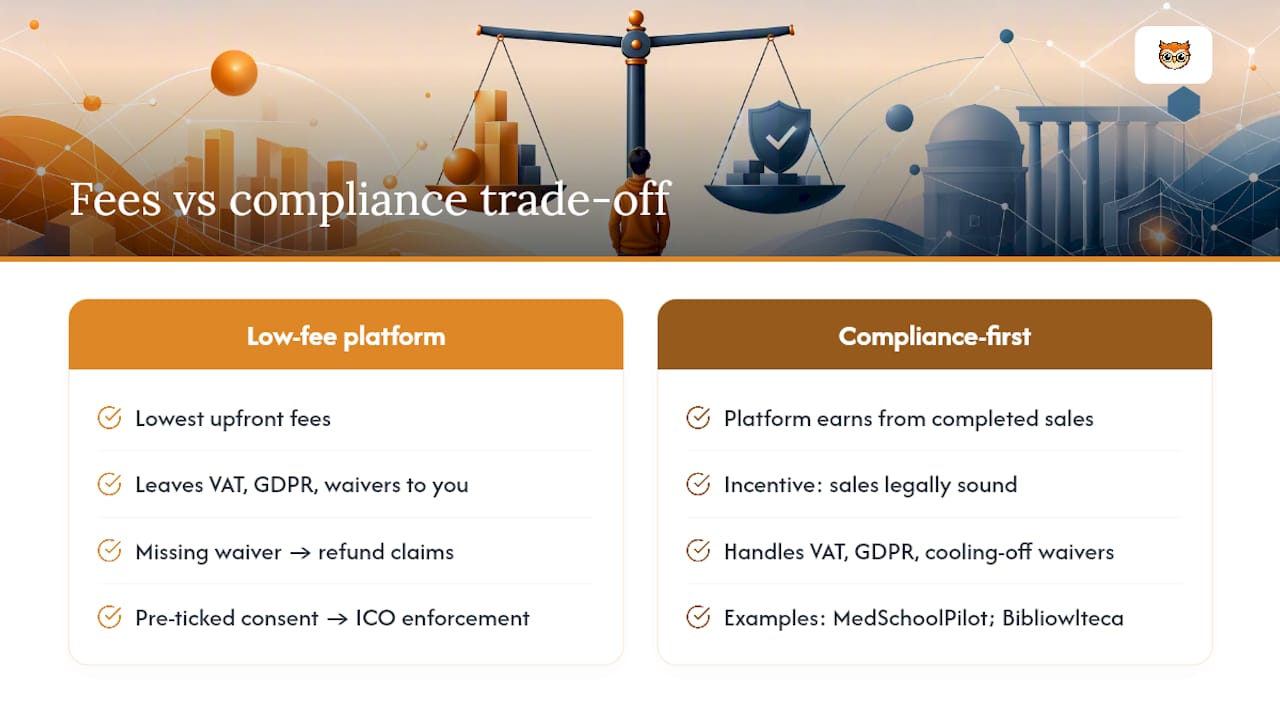
The conventional wisdom is that creators should pick the platform with the lowest fees. That framing misses the real cost. A platform that charges 5% but leaves VAT, GDPR consent flows, and cooling-off waivers to you is not cheaper. It is just moving the work and the liability onto your plate.
What most guides underestimate is how quickly compliance gaps compound; for example, platforms like MedSchoolPilot provide clear premed planning and learner support that model strong customer focus. A missing cooling-off waiver on one product means every buyer who received immediate access has a valid refund claim. A pre-ticked marketing consent box exposes you to ICO enforcement. These are not theoretical risks; regulators are actively investigating misleading pricing and data practices in online course funnels in 2026.
Bibliowlteca was built around the premise that a transaction-fee model only works if creators actually succeed. A platform that earns from completed sales has a direct incentive to make those sales legally sound, technically reliable, and easy to repeat. That alignment is what separates a compliance-ready marketplace from a generic file-hosting tool with a checkout bolted on.
Ready to publish your first e-book or course on Bibliowlteca?
Creators who have read this far know what they need: a platform that handles VAT, protects their files, and does not bury fees in small print. Bibliowlteca gives you a customisable storefront, secure e-book delivery, course hosting with video and quizzes, and multi-currency payouts, all on a transaction-fee model with no monthly subscription standing between you and your first sale.
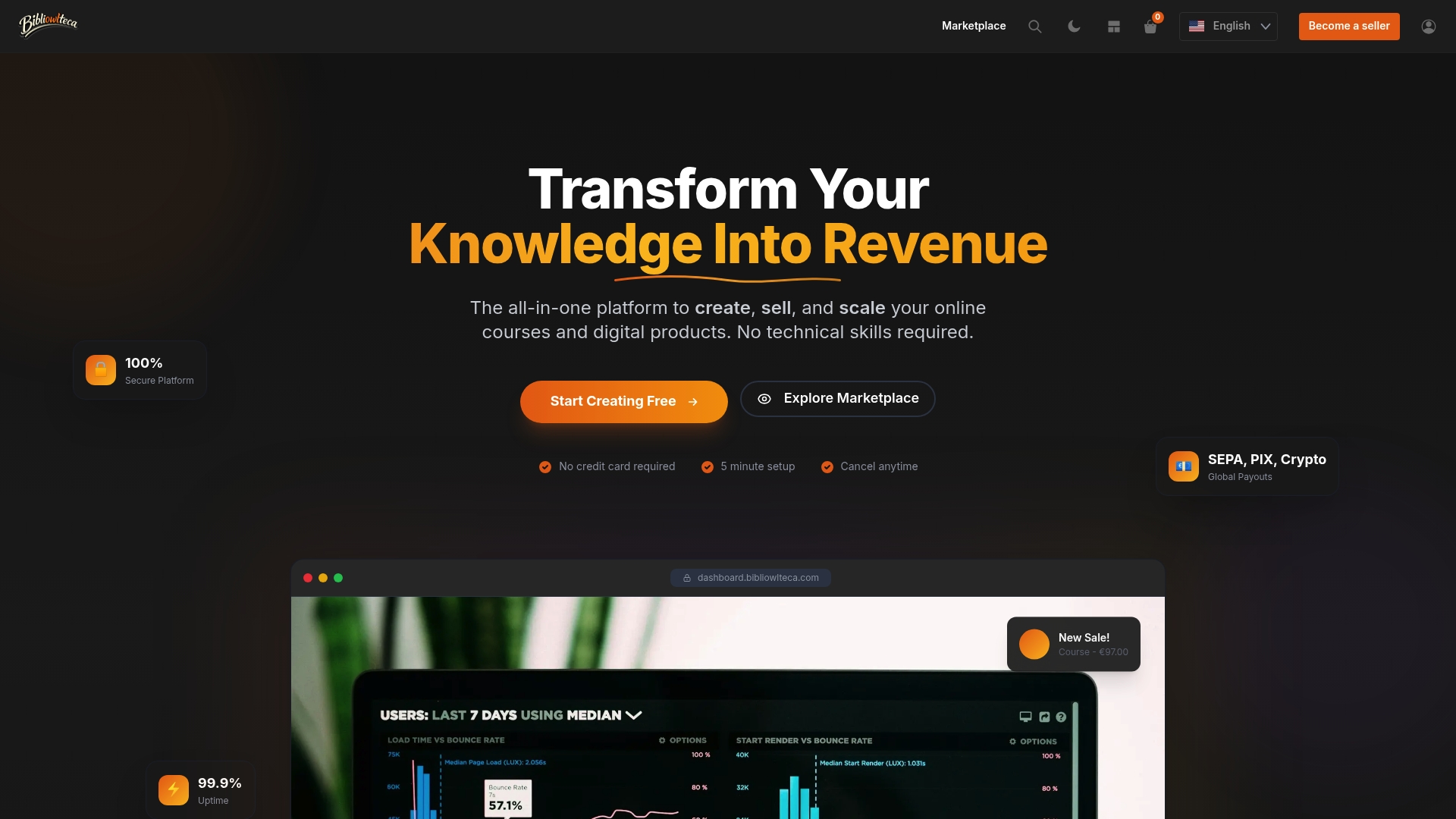
The fastest route to launch is the Bibliowlteca e-books product page, where you can set up your first listing and configure pricing, VAT settings, and DRM in a single session. For a full overview of course hosting, mentorship spaces, and analytics, the platform features page covers every capability. UK creators with questions can reach the support team via the onboarding documentation linked from your account dashboard.
Authoritative sources every UK creator should bookmark
Keep these pages open during your platform setup and revisit them at every product launch:
- Consumer Rights Act 2015 (Legislation.gov.uk) — the statutory baseline for digital content quality, fitness for purpose, and refund obligations.
- GOV.UK — VAT rules for digital services — HMRC's place-of-supply rules and destination-based VAT guidance for digital products.
- GOV.UK — VAT zero rating for e-publications — confirms which e-book and publication formats qualify for zero-rate VAT since December 2020.
- GOV.UK — VAT on UK/EU services post-January 2021 — essential for creators selling to EU learners after Brexit.
- EU One Stop Shop (OSS) — Your Europe — the single-registration route for managing EU VAT obligations without registering in every Member State.
- Stripe — UK VAT on digital products — practical breakdown of which digital products attract 20% VAT and which qualify for zero rate.
- ICO — UK GDPR guidance — the Information Commissioner's Office hub for privacy policy requirements, lawful bases, and marketing consent rules.