
What is scholarly article curation and why does it matter?
Scholarly article curation is the active process of finding, filtering, contextualising, and sharing academic content for a defined audience. It is not passive aggregation. The distinction matters because simply collecting links adds noise; curation adds judgement. A well-curated collection saves researchers hours of sifting and gives librarians a defensible, documented basis for the resources they recommend.
The most widely cited framework for this work is the 3S model: Seek, Sense, Share. Seeking covers discovery across databases and repositories. Sensing is the critical middle step where you analyse, contextualise, and decide what genuinely warrants attention. Sharing is the deliberate act of presenting that selection with enough editorial framing to make it useful. Most curation fails at the Sense stage, producing digests that amount to little more than link dumps.
Within UK academic settings, the standard expectation is that curated collections carry clear provenance, respect copyright under the Copyright, Designs and Patents Act 1988, and align with institutional open-access policies. University libraries, the Digital Curation Centre (DCC), and JISC all provide guidance frameworks that researchers and librarians can draw on.
A few core principles underpin effective practice:
- Scope before you search. Define your audience, their level of expertise, and the specific research questions the collection should address before opening a single database.
- Limit digest size to 5–7 items. Curated digests of 5–7 must-read items with added commentary consistently outperform longer lists for audience engagement and trust.
- Add editorial context. Every item in a curated collection should carry a sentence or two explaining why it belongs there, not just what it says.
- Vet for ethics and copyright. Check licences, attribute authors correctly, and avoid reproducing full texts without permission. For open-access content, confirm the Creative Commons licence type before sharing.
- Involve your librarian. UK university libraries offer subject librarians with specialist knowledge of databases, metadata standards, and institutional repository requirements. They are not a last resort; they are a first port of call.
The goal is always to balance depth with accessibility. A collection of 200 loosely related papers is not a curated resource. It is a reading list that nobody will finish.
A stepwise guide to curating scholarly articles effectively
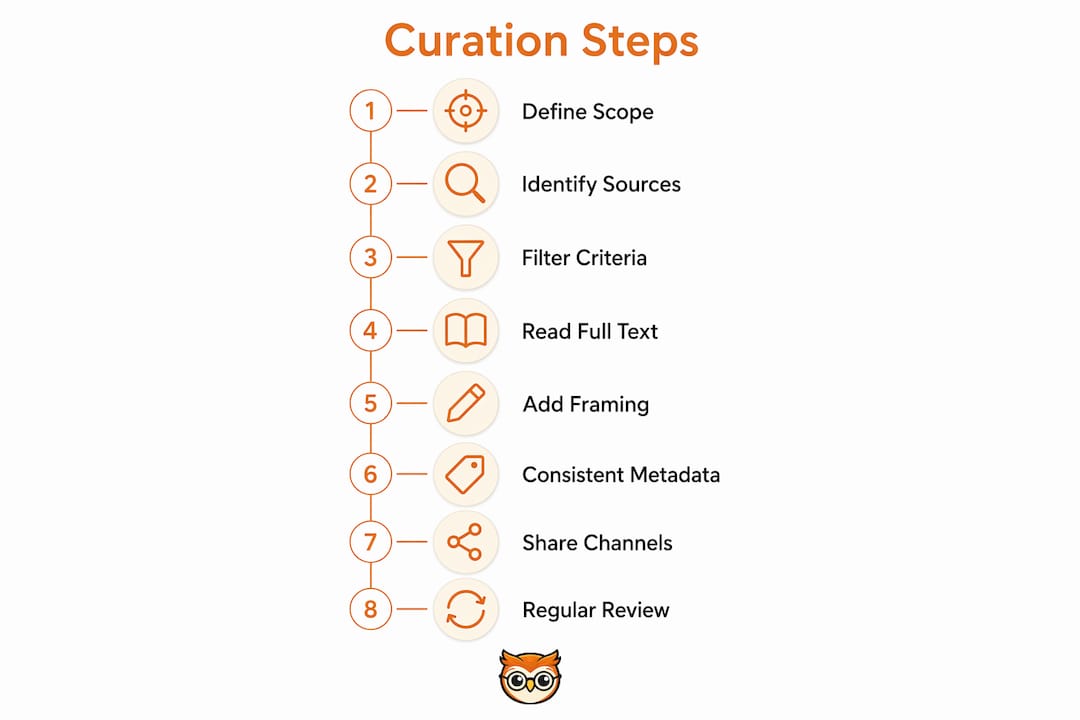
Effective scholarly article curation follows a repeatable lifecycle. The eight-step framework developed at the University of Cape Town, covering content identification through to ongoing maintenance, remains one of the most practical models available. The steps below adapt that lifecycle for UK academic and library contexts.
1. Define your scope and audience
Start with a written scope statement. Who is this collection for? Postgraduate students? Practitioners in a clinical field? A cross-disciplinary research group? The scope statement should name the topic, the intended audience, the time range of relevant literature, and any geographic or methodological limits. Without this, every subsequent decision becomes harder to justify.
2. Identify your primary sources
Work outwards from the most authoritative databases for your discipline. In the UK, that typically means starting with resources available through your institutional library subscription, then moving to open-access repositories such as CORE (core.ac.uk) and Europe PubMed Central. JISC's Library Hub Discover (discover.libraryhub.jisc.ac.uk) aggregates holdings from UK research libraries and is particularly useful for tracing specialist collections.

3. Apply rigorous filtering criteria
Reliability, freshness, originality, and relevance are the four filters that matter. Reliability means checking the journal's editorial process, not just its name recognition. Freshness depends on your field: a 2019 paper may be current in history but outdated in machine learning. Originality means preferring primary research over secondary summaries where possible. Relevance means asking whether the paper actually addresses your defined scope, not just whether it shares keywords with it.
4. Read beyond the abstract
Curators must evaluate full texts, methodologies, and check for retractions to avoid spreading misinformation. Abstracts are marketing documents. The methods section tells you whether the findings are trustworthy. Check whether the paper has been corrected or retracted using CrossRef's retraction database or Retraction Watch before including it.
5. Add editorial framing
This is the step that separates curation from aggregation. For each item you select, write a brief annotation: what the paper argues, why it matters to your audience, and how it connects to other items in the collection. Synthesis notes that draw links across two or three papers add particular value. If you are producing a digest, limit it to 5–7 items with substantive commentary rather than a longer list with none.

Pro Tip: Think of your annotation as a 60-second verbal recommendation. If you cannot explain in two sentences why a paper belongs in the collection, it probably does not.
6. Organise with consistent metadata
Every item needs a minimum metadata record: author(s), title, publication year, journal or repository name, DOI or stable URL, and a subject tag aligned with your scope statement. Metadata is the critical factor for enabling sustained access and discoverability across digital repositories. Use a controlled vocabulary where one exists for your discipline, such as MeSH for biomedical topics or the Library of Congress Subject Headings.
7. Share through appropriate channels
Match your dissemination channel to your audience. An institutional repository suits a research team sharing internally. A subject guide hosted on your library's LibGuides platform suits students. A newsletter or RSS feed suits practitioners who want regular updates. Whatever channel you choose, include clear attribution, licence information for open-access items, and a date stamp so readers know when the collection was last reviewed. For guidance on editorial framing in content, the principles of purposeful synthesis apply equally to academic and professional contexts.
8. Schedule regular maintenance
A curated collection that is not maintained becomes a liability. Set a review cadence: quarterly for fast-moving fields, annually for more stable ones. At each review, check for new high-impact publications, remove or flag items that have been retracted, and update annotations where the field has moved on. Version control matters here: record what changed and when, so the collection's history is transparent.
Which UK libraries and databases should you use for curation?
The quality of a curated collection depends heavily on where you start looking. Curated research databases intentionally select and review journals over time, document coverage decisions, and structure metadata consistently. That is fundamentally different from a general search engine, where legitimate and exploitative journals appear side by side with no editorial filter applied.
Here are the key resources for UK-based researchers and librarians:
- JISC Library Hub Discover. Aggregates catalogue records from over 170 UK and Irish research libraries. Useful for identifying which institutions hold specialist collections and for tracing rare or historical materials.
- CORE (core.ac.uk). The world's largest aggregator of open-access research outputs, with strong coverage of UK institutional repositories. Particularly useful for finding preprints and grey literature alongside peer-reviewed articles.
- British Library EThOS. The national thesis service, providing access to UK doctoral theses. An underused resource for cutting-edge research that has not yet appeared in journals.
- Europe PubMed Central. The open-access archive for biomedical and life sciences literature, including content from UK research councils. Fully searchable and free at the point of use.
- Scopus and Web of Science. The two dominant subscription databases for citation analysis and systematic literature searching. Both apply editorial selection criteria to the journals they index, making them more reliable starting points than Google Scholar for quality-assured curation.
- JSTOR. Strong for humanities and social sciences, with deep archival coverage. Many UK universities provide access, and a growing portion of content is available open access.
- Institutional repositories. Most UK universities maintain their own open-access repositories (for example, UCL Discovery, White Rose Research Online, and WRAP at Warwick). These are authoritative sources for that institution's research output and often contain the accepted manuscript versions of articles behind paywalls.
- Google Scholar. Widely used and genuinely helpful for citation tracing, but not a curated database. It applies no editorial selection criteria to journals or publishers, so predatory and legitimate content appear together. Use it for discovery, then verify through a curated database.
Pro Tip: Your institution's subject librarian can often provide access to specialist databases not listed on the main library portal. A five-minute conversation can open resources that a self-directed search would miss entirely.
For a broader overview of library resource types relevant to academic curation, the range of available tools has expanded considerably beyond traditional subscription databases.
How librarians and academic support services strengthen curation
Librarians are not peripheral to scholarly curation. They are its most reliable infrastructure. A subject librarian brings what might be called a vetting mindset: the professional habit of assessing source quality beyond surface metrics, treating curation as a responsibility rather than a clerical task.
In practical terms, that means librarians contribute at several distinct points in the curation process:
- Source evaluation. Subject librarians know which journals in their discipline have strong editorial boards, which publishers have faced credibility concerns, and which open-access titles are genuinely peer-reviewed. That knowledge is not easily replicated by a researcher working alone.
- Metadata creation. Creating accurate, consistent metadata records is labour-intensive. Librarians trained in cataloguing and classification bring standards such as Dublin Core, MARC, and RDA to this work, ensuring that curated collections remain discoverable over time.
- Institutional repository management. Many UK universities task their library teams with managing the institutional repository, including quality-checking submissions, assigning persistent identifiers (DOIs or handles), and monitoring open-access compliance with funder mandates such as those from UKRI.
- Training and research support. Library services at institutions including the University of Edinburgh, UCL, and the University of Manchester offer dedicated research support teams that provide training in systematic searching, reference management tools such as Zotero and Mendeley, and data management planning.
- Compliance guidance. UK researchers working with UKRI, Wellcome Trust, or other funders face specific open-access requirements. Librarians track policy changes and advise on compliant routes to publication and sharing.
The most productive curation projects tend to be collaborative ones, where academics define the intellectual scope and librarians handle the technical infrastructure. Researchers who engage their library early, rather than after a collection is already built, consistently produce more discoverable and sustainable resources.
To engage curation support at a UK university, the most direct routes are the library's subject enquiries service, the research support or scholarly communications team, and, for data-related curation, the research data management service. Most institutions list these contacts on their library website, and many offer one-to-one appointments.
Best practices, common pitfalls, and how to maintain quality over time
The most common failure in scholarly article curation is not poor selection. It is poor framing. Sharing large volumes of content without editorial context, what the field calls noise amplification, dilutes the value of a collection and erodes audience trust. Excessive sharing without editorial framing is one of the clearest signs that a curation process has broken down.
Best practices to build in from the start:
- Separate your workflow into discrete stages. Discovery, filtering, scoring, and selection are four distinct cognitive tasks. Trying to do all of them simultaneously leads to fatigue and inconsistent quality. Block time for each stage separately.
- Use metadata standards from day one. Retrofitting metadata to an existing collection is far more time-consuming than applying it consistently as you go. Choose a standard appropriate to your discipline and stick to it. The data curation principles from the National Library of Medicine provide a useful reference for metadata and lifecycle management.
- Go beyond citation counts. A paper with a high citation count may be widely cited because it is widely disputed. Academic librarians recommend reviewing methodology and publisher reputation rather than relying on metrics alone. Citation counts are a starting point, not a verdict.
- Monitor for retractions. Set up alerts via CrossRef or Retraction Watch for any paper you have included in a curated collection. A retracted paper left in a live collection without a flag is a credibility risk.
- Balance original and curated content. A collection that is entirely curated from external sources can feel thin. Where possible, add original synthesis notes, introductory essays, or thematic overviews that reflect your own expertise and give the collection a distinct intellectual identity.
- Document your selection decisions. Record why items were included or excluded. This is particularly important for systematic reviews and evidence syntheses, where the selection process itself is subject to scrutiny.
Common pitfalls to avoid:
- Scope creep. A collection that starts as "recent UK climate policy research" and gradually expands to include global energy economics, behavioural economics, and urban planning becomes unusable. Revisit your scope statement at every maintenance cycle.
- Over-reliance on a single database. No single database covers every relevant publication. A collection built entirely from one source will have systematic gaps.
- Neglecting version control. When a collection is updated, record what changed and when. Without version history, it is impossible to know whether a paper was always in the collection or added later.
- Ignoring accessibility. PDFs without accessible formatting, collections without clear navigation, and resources locked behind institutional paywalls all limit who can actually use what you have curated. Where possible, link to open-access versions.
Pro Tip: Set a calendar reminder for your collection's review date at the moment you publish it. Maintenance that is not scheduled does not happen.
For researchers who want to go deeper on evaluating source credibility, the criteria for assessing reliability and relevance apply directly to the filtering stage of any curation workflow.
Strategic dissemination also deserves attention. A well-curated collection that sits in an institutional repository with no promotion reaches a fraction of its potential audience. Share through disciplinary mailing lists, subject-specific social platforms such as ResearchGate or Academia.edu, and your institution's research communications channels. Tag content with persistent identifiers and subject headings so it surfaces in database searches. The foundations of data curation as a field span library and information science, archival science, and digital humanities, and the most durable collections draw on all three traditions.
Share your curated knowledge with Bibliowlteca

Curating scholarly content is only half the work. Getting it in front of the right audience is the other half. Bibliowlteca gives researchers, librarians, and educators a secure platform to publish and distribute curated collections, e-books, and courses to a global audience, with built-in payment processing, tax compliance, and digital delivery tools.
Whether you are packaging a curated reading list as a structured course or distributing an annotated e-book collection, Bibliowlteca's publishing tools handle the infrastructure so you can focus on the content. The platform supports multiple currencies and international payments, making it straightforward to reach readers beyond the UK.
Key takeaways
Effective scholarly article curation requires active editorial judgement at every stage, from scope definition through to ongoing maintenance, not passive collection of links.
| Point | Details |
|---|---|
| Use the 3S framework | Seek, Sense, and Share: the Sense stage, where you analyse and contextualise, is where curation adds its real value. |
| Limit digests to 5–7 items | Curated digests of 5–7 items with substantive commentary consistently outperform longer, unannotated lists for audience engagement. |
| Prioritise curated databases | Databases that intentionally select and review journals reduce exposure to predatory content; Google Scholar is a discovery tool, not a vetting mechanism. |
| Metadata from the start | Applying consistent metadata standards from the outset is far less labour-intensive than retrofitting them to an existing collection. |
| Schedule maintenance | Set a review cadence at the moment of publication; a curated collection without scheduled updates becomes unreliable over time. |