
TL;DR:
- Evaluating sources involves systematically judging their credibility, reliability, and relevance using established frameworks like CRAAP and P.R.O.V.E.N. to ensure accurate and unbiased information. Applying these criteria through critical, lateral reading and cross-referencing helps verify claims and avoid superficial judgments based on surface signals or familiarity.
Evaluating sources is the process of systematically determining their credibility, reliability, and relevance through established criteria and critical investigation. Without this process, research and writing rest on shaky ground. Recognised frameworks such as the CRAAP method and P.R.O.V.E.N. give you repeatable tools to judge any source, from a peer-reviewed journal to a social media post. Knowing how to evaluate sources is not a skill reserved for academics. It applies to anyone making decisions based on written information, whether that is a student, a journalist, a professional, or a curious reader.
What are the key criteria for evaluating sources?
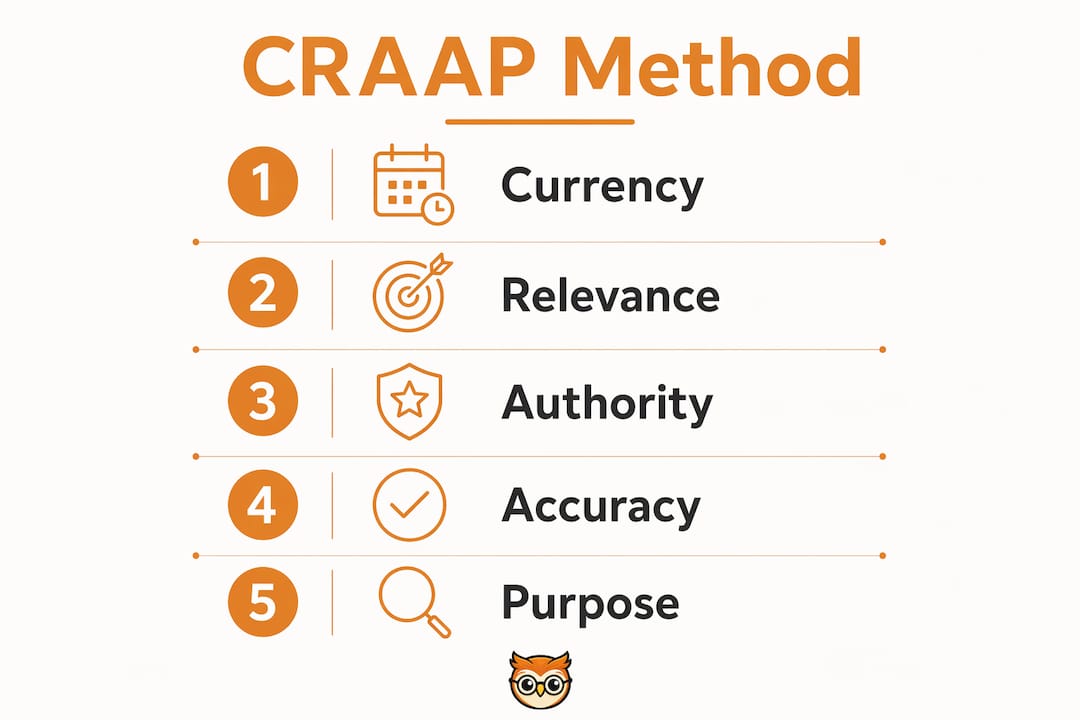
The CRAAP method is a recognised standard for assessing source credibility, built around five pillars: Currency, Relevance, Accuracy, Authority, and Purpose. Each pillar targets a different weakness that unreliable sources tend to exploit. Together, they give you a structured checklist rather than a gut feeling.

Currency asks when the information was published or last updated. A 2009 study on social media behaviour is not just dated; it predates platforms that now define the field. For fast-moving subjects like medicine, technology, or law, currency is often the first filter to apply.
Relevance asks whether the source actually addresses your question. A source can be accurate and authoritative yet still be the wrong fit. A paper on corporate tax law tells you nothing useful about personal tax filing, even if both topics share vocabulary.
Accuracy requires that claims are supported by traceable evidence. The House of Commons Library identifies accuracy as one of four core evaluation pillars, alongside authority, motivation, and relevance. A source that makes bold claims without citations, data, or named references fails this test immediately.
Authority covers the credentials and expertise of the author or publishing body. A cardiologist writing about heart disease carries more weight than an anonymous blog post on the same topic. That said, authority alone is not sufficient. Consistency with expert consensus is a stronger credibility signal than isolated credentials. One credentialled outlier does not override a field-wide agreement.
Purpose is the criterion most readers overlook. A source can be factually correct and still mislead you if its information is curated to serve a particular agenda. Understanding why a source exists prevents biased decision-making. Ask whether the source aims to inform, persuade, sell, or entertain. Each intent shapes what gets included and what gets left out.
The P.R.O.V.E.N. method adds a practical layer to these criteria by emphasising lateral reading, which means cross-referencing claims against multiple independent, established sources rather than accepting a single account.
Pro Tip: When assessing purpose, search for the funding source behind a study or publication. Commercially funded research on product safety, for example, consistently produces more favourable results than independently funded research on the same topic.
| Criterion | Question to ask |
|---|---|
| Currency | When was this published, and is it still relevant to the field? |
| Relevance | Does this source directly address my research question? |
| Accuracy | Are claims supported by traceable, named evidence? |
| Authority | Does the author or publisher have verifiable expertise? |
| Purpose | Does the source aim to inform, persuade, sell, or entertain? |
How can you apply evaluation methods in practice?
Critical evaluation is a process requiring active, lateral, and cross-perspective reading. Knowing the criteria is the theory. Applying them consistently is the skill.
Step-by-step source verification
-
Identify the author. Search the author's name independently. Check their institutional affiliation, publication history, and whether they are cited by others in the field. An author with no traceable academic or professional record is a red flag.
-
Check the publication context. Where was this published? A peer-reviewed journal, a government report, and a personal blog each carry different levels of editorial scrutiny. Peer-reviewed publications undergo critical expert examination before publication. That process filters out unsupported claims before they reach you.
-
Apply lateral reading. Leave the source page and search for independent assessments of the author or organisation. The P.R.O.V.E.N. method recommends gathering evidence from at least two or three trusted sources before accepting a claim. Trusted evaluators do not rely on a website's design or confident tone, both of which can be fabricated.
-
Trace the bibliography. A source's reference list is a credibility map. Comprehensive bibliographies provide a traceable chain of evidence back to primary research. If a source makes a striking claim but cites no one, that absence is itself informative.
-
Cross-check key claims. Take the two or three most important claims in the source and verify them independently. If multiple unrelated sources confirm the same finding, confidence in the claim rises. If only the original source makes the claim, treat it with caution.
-
Assess the date in context. Currency matters differently by discipline. A 1990 paper on Shakespeare's sonnets may be perfectly valid. A 1990 paper on HIV treatment is not. Match the age of the source to the pace of change in the field.
Pro Tip: Use a source's bibliography as a research tool, not just a credibility check. Following citations backwards often leads you to the original study that every secondary source is actually quoting, which is almost always more precise and more useful.
A common pitfall is judging credibility by surface signals: a professional website design, confident language, or a familiar-sounding institution name. None of these confirm accuracy. A well-designed site can host misinformation just as easily as a plain one. Evaluating information sources means looking past the packaging.
How do evaluation techniques differ by source type?
Source evaluation is context-dependent. Criteria differ notably between scientific research and opinion journalism, and applying the wrong standard to the wrong source type produces poor judgements.
Scholarly and peer-reviewed sources
Peer-reviewed journals are the gold standard for academic research. They require authors to submit work for review by independent experts before publication. This process does not guarantee perfection, but it filters out the most obvious errors and unsupported claims. When you need to evaluate scholarly sources, check whether the journal is indexed in recognised databases such as PubMed, JSTOR, or Scopus. Indexing signals that the journal meets minimum editorial standards.
Journalistic and news sources
Quality journalism follows editorial standards, but those standards vary widely between outlets. A report from a long-established broadsheet with named sources and verifiable quotes differs substantially from an opinion piece on a partisan news site. For journalistic sources, check whether the article distinguishes between news reporting and commentary. Look for named sources, direct quotes, and links to primary documents. Assess whether the outlet has a clear corrections policy.
Web-based and social media content
Online content requires the sharpest scrutiny. The absence of editorial gatekeeping means anyone can publish anything. When assessing web-based sources, apply the following checks:
- Domain type: Government (.gov.uk), educational (.ac.uk), and established organisational (.org) domains generally carry more accountability than commercial or personal sites.
- Date of publication: Many web pages carry no date, which makes currency impossible to assess. Treat undated content with caution.
- Author transparency: Anonymous content removes accountability. Named authors with verifiable profiles are more trustworthy.
- External links: Does the page link to primary sources, or does it make claims without evidence?
- Social media amplification: Viral spread is not a credibility signal. Misinformation spreads faster than corrections on most platforms.
Opinion and advocacy sources
Opinion pieces and advocacy publications are not inherently unreliable, but they require a different evaluation lens. These sources are transparent about their purpose: they argue a position. The question is not whether they are biased (they are, by design) but whether their arguments rest on verifiable evidence. A well-argued opinion piece that cites primary research is more useful than a neutral-seeming article that cites nothing. Understanding [why a source exists](https://blog.bibliowlteca.com/blog/why reference sources matter content credibility 2026) helps you use it appropriately rather than dismissing it or accepting it uncritically.
What biases affect source evaluation?
Confirmation bias is the most common obstacle in source evaluation. Researchers must actively seek diverse perspectives and challenge their own assumptions. The problem is that confirmation bias operates below conscious awareness. You do not notice yourself favouring sources that confirm what you already believe.
Several specific errors compound this problem:
- Credential overreliance: Assuming that a qualified author is always right. Credentials establish expertise, not infallibility. Even experts make errors or work outside their core specialism.
- Peer review misinterpretation: Treating peer-reviewed status as a guarantee of truth. Peer review reduces errors; it does not eliminate them. Retracted papers were once peer-reviewed.
- Surface credibility signals: Judging a source by its formatting, tone, or institutional name rather than its evidence. A government-branded document can still contain outdated or politically shaped information.
- Single-source reliance: Building an argument on one strong source without cross-checking. Even accurate sources can present partial pictures.
- Recency bias: Assuming newer sources are always better. In humanities and historical research, older foundational texts often carry more authority than recent commentary.
"A source's purpose often reveals bias more than straightforward accuracy. Factually correct information can still mislead if it is curated deliberately to support a particular conclusion. Understanding why a source exists is the most underused evaluation skill." Arizona State University, literature review evaluation guide
Maintaining objectivity requires deliberate effort. Seek out sources that challenge your working hypothesis, not just those that support it. When you find yourself dismissing a source quickly, ask whether you are responding to its evidence or its conclusion. Transparency in your own evaluation process, noting which sources you consulted and why you accepted or rejected them, makes your reasoning auditable and your conclusions stronger.
Key takeaways
Reliable source evaluation requires applying structured criteria such as authority, accuracy, relevance, purpose, and currency, then verifying claims through lateral reading and cross-referencing across multiple independent sources.
| Point | Details |
|---|---|
| Apply the CRAAP criteria | Assess every source against currency, relevance, accuracy, authority, and purpose before using it. |
| Use lateral reading | Leave the source page and verify the author or organisation through independent external assessments. |
| Trace bibliographies | Follow reference lists back to primary research to confirm the chain of evidence behind key claims. |
| Match criteria to source type | Peer-reviewed journals, news articles, and web content each require a different evaluation approach. |
| Guard against confirmation bias | Actively seek sources that challenge your assumptions, not just those that confirm them. |
Source evaluation: what experience actually teaches you
The most common mistake I see is treating source evaluation as a one-time gate rather than a continuous habit. Researchers check sources at the start of a project, then stop questioning them once they are "in the pile." That is where errors compound.
The second mistake is conflating familiarity with credibility. A publication you have heard of feels trustworthy. But familiarity is a product of exposure, not editorial rigour. Some of the most widely cited sources in popular discourse are opinion pieces dressed as research. The types of library resources available to researchers today are broader than ever, which makes the habit of checking source type more important, not less.
What actually works is building evaluation into every step of the research process. When you read a new source, ask the CRAAP questions before you take notes. When you write a claim, ask whether you can trace it to primary evidence. When you feel certain about something, search for the strongest counterargument available.
Healthy scepticism is not cynicism. Cynicism dismisses sources wholesale. Scepticism asks specific questions and follows the evidence wherever it leads. The goal is not to distrust everything but to trust the right things for the right reasons. That distinction, practised consistently, is what separates rigorous research from confident-sounding guesswork.
— BibliOWLteca
Build your research skills with Bibliowlteca
Strong source evaluation is a skill that deepens with practice and the right resources. Bibliowlteca offers a curated library of educational ebooks covering research methods, information literacy, and critical thinking across disciplines. Whether you are a student building foundational skills or a professional sharpening your analytical judgement, the platform connects you with expert-authored content designed for real-world application.

Bibliowlteca's platform features include access to courses, expert mentorships, and digital resources spanning multiple subject areas. Every product is delivered securely and accessible globally, so your learning is not limited by geography. If you want to go deeper on research skills, the Bibliowlteca catalogue is a practical starting point.
FAQ
What is the CRAAP method for evaluating sources?
The CRAAP method is a structured framework assessing Currency, Relevance, Accuracy, Authority, and Purpose. It gives researchers a repeatable checklist to judge source credibility across disciplines.
Why does lateral reading matter in source assessment?
Lateral reading means leaving the original source to verify the author or organisation through independent external sources. It is more reliable than judging credibility by a site's design or tone, both of which can be misleading.
How do I evaluate scholarly sources differently from news articles?
Scholarly sources require checking for peer review, indexed journal status, and traceable bibliographies. News articles require assessing editorial standards, named sourcing, and whether the piece distinguishes reporting from opinion.
What is confirmation bias, and how does it affect source evaluation?
Confirmation bias causes researchers to favour sources that support existing beliefs and dismiss those that challenge them. Actively seeking counterarguments and diverse viewpoints is the most effective defence against it.
How current does a source need to be to be credible?
Currency requirements depend on the discipline. Fast-moving fields like medicine or technology demand recent sources, while humanities research often relies on foundational texts that remain valid for decades.