
TL;DR:
- Book reviews evaluate a book's value through concise summaries and evidence-based analysis.
- They require careful preparation, including close reading, annotation, and developing a strong thesis.
A book review is a critical evaluation of a text that combines a concise summary with an honest, evidence-based assessment to inform and engage your audience. Knowing how to write book reviews well is a skill that serves both readers and aspiring authors. It sharpens your analytical thinking, deepens your engagement with literature, and builds your credibility as a voice in the reading community. This guide takes you from first reading to final edit, covering every stage with concrete techniques you can apply immediately.
How to write book reviews: what the process actually involves
Writing a book review is not the same as writing a book report. A report retells what happened. A review evaluates whether the book achieves what it sets out to do, and whether it is worth a reader's time. Academic book reviews typically range from 500 to 2,000 words depending on complexity and scope. That range reflects the difference between a brief opinion piece for a reading blog and a formal scholarly critique for a journal.
The core structure of any effective review contains four elements: a spoiler-free summary, a critical evaluation, supporting evidence drawn from the text, and a clear recommendation. Tools like Grammarly help with editing and clarity once the draft is written. Platforms like Goodreads and literary journals such as The Times Literary Supplement publish reviews across the full spectrum of formality. Understanding where your review will appear shapes every decision you make about tone, length, and depth.
What preparatory steps are essential before writing a book review?
Strong reviews begin long before you open a blank document. The most effective preparation consists of close reading with annotation, developing an arguable thesis, and structuring evidence-based writing. Each step builds directly on the last.

Close reading and annotation
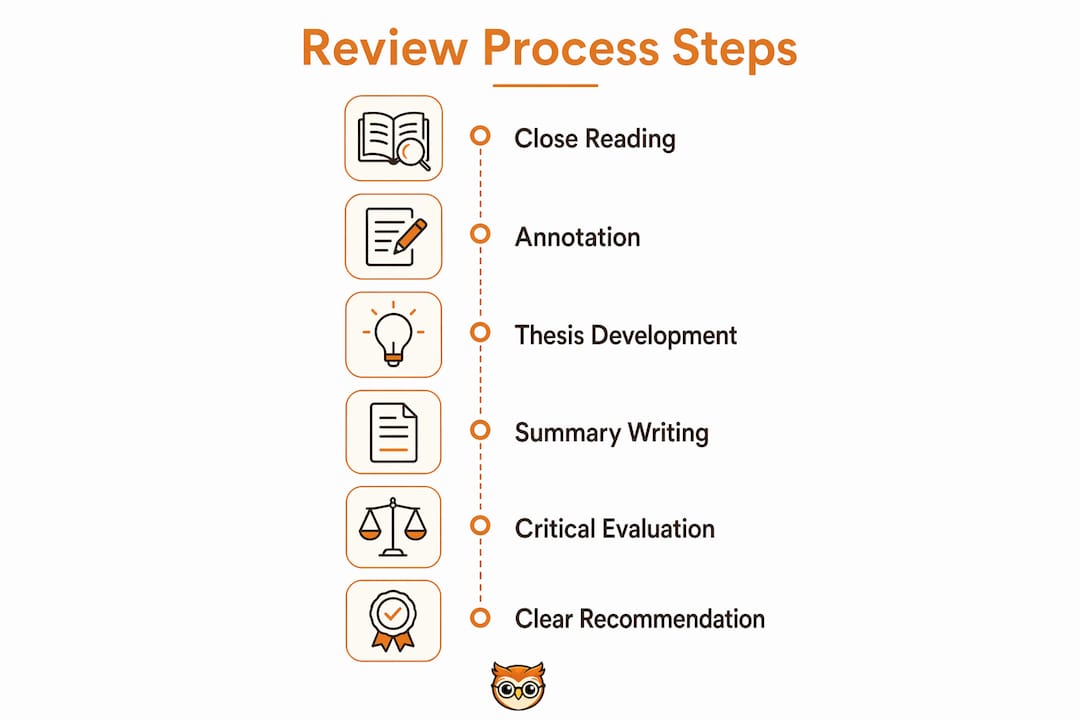
Read the book with a pen or a note-taking app open beside you. Mark passages that strike you as significant, whether for their style, their argument, or their weakness. Active annotation with page numbers allows precise evidence when supporting claims in your review. A note that reads "p.47, metaphor undermines the argument" is far more useful than a vague memory that something felt off in chapter three.
A close reading workflow helps you move through a text systematically rather than passively. Focus on the author's central argument or narrative purpose, the evidence or storytelling techniques used to support it, and any moments where the book loses momentum or credibility.
Developing your thesis
Every review needs a thesis. This is not a plot summary sentence. It is an arguable claim about the book's value, contribution, or failure. "This novel succeeds as a character study but struggles as a thriller" is a thesis. "This book is about a detective in 1920s London" is not. Your thesis anchors the entire review and gives readers a reason to keep reading.
Pro Tip: Organise your annotations into three categories before you write: strengths, weaknesses, and evidence. This turns raw notes into a ready-made outline.
| Preparation method | Purpose | Example tool or approach |
|---|---|---|
| Annotation with page refs | Supports precise evidence in critique | Sticky notes, Kindle highlights, Notability |
| Thematic note-taking | Tracks recurring ideas and patterns | Notion, paper notebook, index cards |
| Thesis drafting | Anchors the review's argument | One sentence written before drafting begins |
| Outline building | Structures summary and critique sections | Bullet list mapped to review sections |
How do you write a spoiler-free summary that sets up your review?
The summary is not the review. Its job is to give readers enough context to understand your critique, nothing more. Summary portions should be concise, ideally 1–2 paragraphs or 3–5 sentences for informal reviews, and must avoid revealing endings or excessive plot details.
The most common mistake writers make is treating the summary as the main event. A reader picking up your review already knows they can read the book's blurb. What they want from you is judgement. The summary exists to frame that judgement, not replace it.
What to include and what to leave out
A good summary covers the genre, the central premise, the author's apparent purpose, and the primary themes. It does not reveal the ending, the resolution of the central conflict, or any twist that the author clearly intended as a surprise. For non-fiction, summarise the book's thesis and the main argument structure. For fiction, introduce the protagonist, the setting, and the central tension.
Pro Tip: Lift one or two brief phrases directly from the book to illustrate the author's style. This gives readers a taste of the writing without summarising the plot.
| Effective summary | Ineffective summary |
|---|---|
| "Set in post-war Vienna, the novel follows a journalist investigating a friend's suspicious death." | "The journalist finds out his friend faked his death and is selling penicillin on the black market." |
| "The author argues that modern management culture prioritises metrics over human judgement." | "The book explains every reason why metrics are bad and what you should do instead." |
| "A debut thriller with a tightly wound first act and a morally complex protagonist." | "The story starts slowly but gets good around chapter eight when the real villain appears." |
For a deeper look at summarising books concisely, the Bibliowlteca blog covers the key steps for educators and creators who need to condense texts without losing meaning.
What are best practices for critical evaluation in a book review?
Critical evaluation is the heart of any review. A critical review extends beyond liking or disliking to engaging respectfully and with intellectual depth. This means assessing what the author set out to achieve, how well they achieved it, and where the gaps lie.
Vague critique destroys credibility. "The writing felt flat" tells a reader nothing. "The dialogue in chapters four through seven relies on exposition rather than character voice, which slows the pacing considerably" tells a reader exactly what you mean and why it matters. Honesty with specific constructive feedback builds reader trust far better than vague or dismissive remarks.
Criteria for balanced critique
Use a consistent set of criteria to evaluate the book. The criteria shift depending on genre and format, but the following apply broadly:
- Argument or narrative coherence: Does the book's central claim or story hold together from beginning to end?
- Use of evidence or craft: For non-fiction, does the author support claims with credible sources? For fiction, does the prose serve the story?
- Character or voice: Are the characters convincing? Does the author's voice feel authentic and controlled?
- Pacing and structure: Does the book move at the right speed? Are chapters well-proportioned?
- Originality: Does the book offer something genuinely new, or does it retread familiar ground without adding value?
- Audience fit: Who is this book actually for, and does it deliver what that audience needs?
Critical reviews should engage the author's argument deeply, noting accomplishments and gaps to extend the intellectual discussion. This means you are not just scoring the book. You are contributing to a conversation about ideas.
Using evidence from the text
Every evaluative claim needs a page reference or a direct quote. "The author's argument collapses in the final chapter (p.214)" is credible. "The argument collapses eventually" is not. Experienced reviewers limit summary rigorously while using detailed textual evidence through exact page citations. This practice is what separates a review from an opinion.
Pro Tip: Use signal words to shift between summary and critique. Phrases like "while the author succeeds in..." or "the weakness here is..." signal to readers that you are moving from description to judgement.
How do you conclude a book review with a clear recommendation?
The conclusion restates your thesis in fresh language and tells readers directly whether they should pick up the book. It does not introduce new arguments or summarise every point you made. Its job is to leave the reader with a clear, confident verdict.
Signal words such as "ultimately" and "overall" help connect your critical synthesis to a conclusive evaluation. They signal to the reader that you are wrapping up, not starting a new thread. A conclusion that begins "Ultimately, this novel rewards patient readers who value psychological depth over plot momentum" is far stronger than one that begins "So, in conclusion, I thought the book was pretty good."
Strong conclusions do three things:
- Restate the thesis using different words from the introduction
- Identify the primary audience who will benefit most from the book
- Offer a clear recommendation without hedging
Examples of effective recommendation phrasing include: "Recommended for readers who enjoyed Hilary Mantel's Wolf Hall and want a similarly dense historical voice." Or: "Non-fiction readers with a background in behavioural economics will find this essential; general readers may find the technical sections slow." Specificity builds trust. Audience-centric writing is vital when building engagement and trust as a reviewer. Defining who the book is for is as useful as explaining what the book is about.
What common mistakes should you avoid when editing your review?
The most damaging mistake in any review is over-summarising. Summary should remain at around 15–20% of total word count to leave room for analysis. In a 1,000-word review, that means no more than 150–200 words of plot or content description. Everything else should be evaluation, evidence, and recommendation.
Other frequent errors include:
- Unsupported opinions: "The ending was disappointing" without explaining why or citing the relevant passage
- Spoilers without warning: Revealing key plot turns or conclusions without flagging them for readers
- Inconsistent tone: Shifting between casual and formal registers within the same review
- Ignoring the author's intent: Criticising a literary novel for not being a page-turner misunderstands the genre
- Neglecting the target reader: Writing a review that only makes sense to someone who has already read the book
Pro Tip: Read your review aloud before publishing. Sentences that sound awkward when spoken are almost always unclear on the page. Fix the rhythm and the clarity follows.
Editing tools like Grammarly catch spelling errors, passive constructions, and readability issues. Manual proofreading catches tone problems and logical gaps that software misses. Use both. A final check against British English spelling conventions matters if you are writing for a UK audience, where "colour," "organise," and "practise" (as a verb) are standard.
Key takeaways
A well-structured book review balances a concise, spoiler-free summary with specific, evidence-backed critique and a clear recommendation for the intended reader.
| Point | Details |
|---|---|
| Prepare before you write | Annotate with page references and draft a thesis before opening a blank document. |
| Keep summary brief | Summary should cover no more than 15–20% of your total word count. |
| Ground critique in evidence | Every evaluative claim needs a page reference or direct quote to be credible. |
| Use signal words in conclusions | Words like "ultimately" and "overall" mark the shift from analysis to verdict. |
| Write for your reader | Define who the book is for and tailor your recommendation to that specific audience. |
What writing book reviews has taught me about honesty and craft
The most common piece of advice given to new reviewers is "be honest." It sounds obvious. In practice, it is the hardest thing to do consistently. Honesty in a review does not mean being harsh. It means being specific enough that your opinion is actually useful to someone deciding whether to spend ten hours of their life on a book.
What I have found, working with readers and creators at Bibliowlteca, is that the reviews people return to are not the ones with the most sophisticated vocabulary. They are the ones where the writer clearly read the book carefully, formed a genuine view, and expressed it with enough precision that the reader can decide whether they agree. That is a skill, and it is learnable.
The other thing worth saying is this: writing reviews makes you a better writer. The discipline of finding evidence for every claim, of distinguishing between what a book does and what you wished it had done, of recommending something to a specific reader rather than a vague "everyone" — these habits transfer directly to any kind of writing you do. Aspiring authors who write reviews regularly develop a sharper instinct for what works on the page and why. That instinct is worth more than any single technique in this guide.
The reading community grows stronger when reviews are honest, specific, and generous in the right measure. Specific, honest feedback nurtures reader confidence and supports author growth. Write the review you would want to read before deciding whether to buy a book. That standard will not lead you wrong.
— BibliOWLteca
Bibliowlteca: resources for readers and aspiring reviewers
Bibliowlteca supports readers and aspiring authors who want to go further with their writing and literary engagement.

The platform hosts e-books, courses, and mentorships covering writing craft, critical analysis, and content creation. Whether you want to deepen your close reading practice or learn how to turn your reviews into a digital content business, Bibliowlteca's features for creators give you the tools to publish, distribute, and grow your audience globally. Explore the digital content marketplace to find resources built specifically for book lovers and writers at every stage.
FAQ
How long should a book review be?
Academic book reviews typically range from 500 to 2,000 words depending on complexity and scope. Informal reviews for blogs or reading platforms are often shorter, around 300–500 words.
How much of a book review should be summary?
Summary should make up no more than 15–20% of your total word count. The majority of the review should focus on critical evaluation and evidence-backed judgement.
How do you avoid spoilers in a book review?
Cover the genre, central premise, and main themes without revealing the ending, key plot twists, or the resolution of the central conflict. For fiction, introduce the protagonist and tension; for non-fiction, describe the thesis and argument structure.
What makes a book review credible?
Credibility comes from specific textual evidence with page references, a clearly stated thesis, and honest critique that distinguishes between what the book attempts and what it achieves.
Do I need a thesis in a book review?
Yes. A thesis is an arguable claim about the book's value or contribution, not a plot summary. It anchors your entire review and gives readers a clear sense of your verdict before they reach the conclusion.