
A mitmekeelne kursus combines language learning with multilingual pedagogy and intercultural competence — it is not simply a language class, but a structured programme that equips you to teach, design, or participate in linguistically diverse environments. If you are looking for where to start in Estonia, three entry points cover most needs:
- Tartu Ülikool — the Keeled ja mitmekeelsus koolis programme for those wanting a full academic pathway with practicum
- Tallinna Ülikool — module KAI6026 'Mitmekultuuriline ja -keeleline õpikeskkond', and short CPD workshops for practising teachers
- Online short courses — platforms such as FutureLearn offer accessible introductory formats for international perspectives
Check university course catalogues directly, or browse Educationestonia if you are approaching Estonian study from abroad.
Key takeaways
A mitmekeelne kursus is most valuable when it combines multilingual pedagogy, intercultural competence, and assessed classroom practice — not just language instruction.
| Point | Details |
|---|---|
| Definition and scope | A multilingual course covers pedagogy, intercultural communication, and language-sensitive teaching — not grammar alone. |
| Where to look in Estonia | Start with Tartu Ülikool's Keeled ja mitmekeelsus koolis programme or Tallinna Ülikool's KAI6026 module and CPD workshops. |
| ECTS versus CPD | Only university modules award ECTS credits; single-day workshops are valuable for skills but do not count towards formal qualifications. |
| How to choose | Prioritise courses with a named practicum, explicit learning outcomes, and a published syllabus — ask for these before enrolling. |
| For course creators | Bibliowlteca supports multilingual course hosting with multi-currency payments and global delivery, letting educators reach learners beyond Estonia. |
Table of Contents
- What does a multilingual course actually cover?
- Who benefits, and what competences do you gain?
- Where to find multilingual courses in Estonia
- Format, duration, ECTS credits, and what to budget
- How do you choose the right multilingual course?
- What does research say about effective multilingual course design?
- Why multilingual courses matter in Estonia right now
- Publish and sell your multilingual course online with Bibliowlteca
- Sources
What does a multilingual course actually cover?
The syllabus of a well-designed multilingual course runs considerably deeper than grammar drills or vocabulary lists. At its core, you should expect four content areas.
Multilingual pedagogy sits at the centre: how languages interact in a learner's mind, how teachers can use that interaction productively, and how to structure lessons so that a child's home language becomes an asset rather than an obstacle. Alongside this, intercultural communication covers the social and psychological dimensions of language use — identity, power, belonging — which matter enormously in Estonian classrooms where Russian, Ukrainian, and other home languages are increasingly present.

Language-sensitive subject teaching is the third pillar. This is where the course gets practical: how a maths or science teacher adapts explanations, scaffolds academic vocabulary, and assesses understanding without penalising a learner's non-dominant language variety. The fourth area is classroom strategy — microteaching exercises, lesson planning workshops, and peer observation that turn theory into habit.
Tallinna Ülikool's module KAI6026 illustrates this structure well: it explicitly lists the ability to adapt materials for culturally and linguistically diverse groups as a learning outcome, which is exactly the kind of concrete, assessable competence that separates a rigorous module from a surface-level one.
A course that names specific multilingual outcomes — language-sensitive lesson planning, culturally responsive assessment, translanguaging tasks — gives you clearer evidence for formal recognition and gives employers a sharper picture of what you actually gained.
Pro Tip: When reviewing a syllabus, look for a practicum or microteaching component. Theoretical lectures alone rarely produce the classroom confidence that a single observed teaching session can.
Who benefits, and what competences do you gain?
Multilingual courses in Estonia draw a wide range of participants, and the competences on offer differ meaningfully depending on the format.
Primary audiences include:
- Classroom teachers at primary and secondary level who work with linguistically mixed groups
- Pre-service student teachers completing initial teacher education
- School leaders and curriculum coordinators designing inclusive school policies
- Language teachers (Estonian as a second language, Russian, English) seeking updated pedagogy
- Education support staff — speech therapists, counsellors, learning support specialists
- Policy practitioners and education administrators working on integration and language policy
The competences you leave with depend heavily on whether the course carries ECTS credit. Accredited university modules typically develop language-sensitive pedagogy (planning lessons that make content accessible across language levels), cultural awareness (understanding how identity and language intersect), and inclusive material design (adapting texts, tasks, and assessments for multilingual learners). These are formally assessed and recognised on transcripts.
Short CPD workshops produce faster, narrower gains: a specific strategy, a set of classroom tools, or updated knowledge of national policy. Useful, but not equivalent to a semester module for career progression purposes. Tartu Ülikool's programme makes this distinction explicit by combining academic theory with practical placements — the practicum is what converts knowledge into a verifiable professional competence.
For skill development as a digital educator, the same principle applies: structured, assessed learning with clear outcomes outperforms informal self-study when formal recognition matters.
Where to find multilingual courses in Estonia
Estonia's offer is more varied than most teachers realise, spread across universities, municipal CPD systems, and online platforms.
Tartu Ülikool runs the dedicated programme Keeled ja mitmekeelsus koolis, which combines Estonian as a second language with elective modules and practical placements. It is the most academically comprehensive option in the country and suits those seeking a full qualification rather than a single module.
Tallinna Ülikool covers two distinct tracks. The credit-bearing module KAI6026 sits within the university's formal curriculum and focuses on the interaction between culture, language, and learning environments. Separately, TLÜ's short professional development catalogue includes Mitmekeelne laps mitmekeelses koolis — a single-day workshop (10:00–17:30) aimed at school teachers, with scheduled dates published on the TLÜ ÕIS portal.
For community and free language support that complements formal study, Haapsalu's free Estonian language courses cover A1 through advanced levels and are a practical supplement for participants building their own Estonian proficiency alongside pedagogical training.
Online, FutureLearn's Multilingual Learning for a Globalised World offers a short, structured introduction mixing theoretical input with case studies — useful for international context, though it does not replace local practicum-based training for Estonian classroom certification.
International learners can use educationestonia.org as a starting point for navigating Estonian higher education and locating current enrolment information.
Format, duration, ECTS credits, and what to budget
The practical differences between course types matter when you are planning time and money.
ECTS credits are awarded only through formally accredited university modules and programmes. A single-day workshop, however well-designed, does not generate credits regardless of its quality. Some multilingual study pathways carry substantial credit loads: a multilingual business communication module at the University of Turku, for example, allocates 25 ECTS — illustrating how credit-heavy integrated pathways can be when multilingual competence is treated as a core professional skill rather than an add-on.
Cost is driven primarily by three factors: institutional accreditation (university modules cost more than municipal CPD), the presence of a practicum component (supervised placements add coordination costs), and whether the course leads to a formal certificate. Municipal and school-centred CPD is frequently subsidised or free for employed teachers.
How do you choose the right multilingual course?
The decision comes down to what you need the course to do for you, not just what it covers.
Work through this checklist before enrolling:
- Credits or not? If you need formal recognition for career progression or a qualification upgrade, ECTS-bearing modules are the only route. CPD certificates do not substitute.
- Practicum included? For classroom teachers, a course without observed teaching practice is significantly weaker for professional development purposes.
- Assessment type: Portfolio and reflective tasks tend to produce more transferable learning than a single written exam. Ask to see a sample assessment brief.
- Languages of instruction: Some modules run in Estonian only; others offer parallel Estonian/English delivery. Confirm this before registering, especially for international participants.
- Delivery mode: In-person workshops build peer networks that online formats rarely replicate. If you are choosing an online short course, check whether it includes live sessions or is entirely self-paced.
- Instructor expertise: Look for lecturers with both academic credentials and recent classroom or school advisory experience. A purely theoretical background is a gap in a pedagogy course.
Ask providers directly for the published syllabus, stated learning outcomes, and any sample materials. A provider who cannot supply these is a provider whose course has not been designed with clarity. For professional development decisions as an educator, the same rigour applies whether you are choosing a one-day workshop or a semester module.
What does research say about effective multilingual course design?
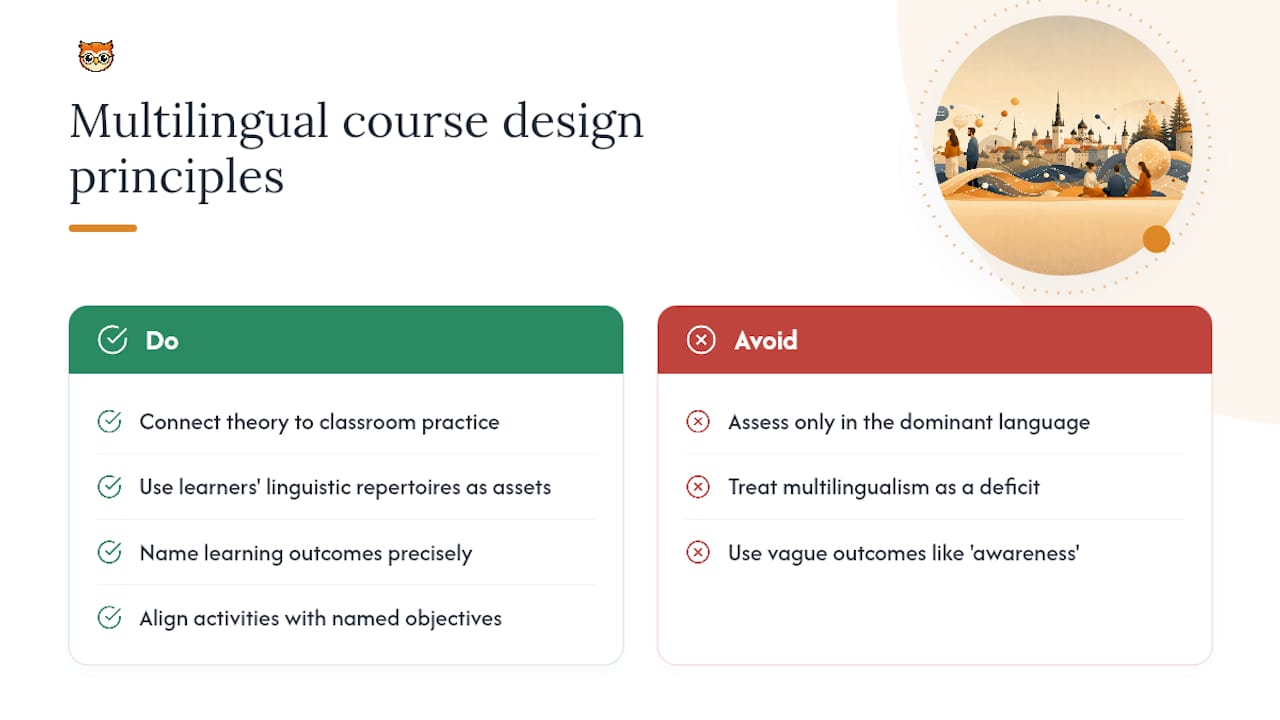
The strongest multilingual courses share three design principles, consistently reflected in Estonian university programmes and international comparators.
First, theory must connect directly to classroom practice. Tartu Ülikool's programme builds this in structurally through its practicum component — students do not just read about language-sensitive teaching, they attempt it under supervision and reflect on what happened. The University of Geneva's BA in Multilingual Communication takes a comparable approach by combining translation, language technology, and intercultural communication as integrated disciplines rather than separate silos.
Second, learners' existing linguistic repertoires should be treated as resources. Courses that assess only in the dominant language, or that treat multilingualism as a deficit to be corrected, produce weaker outcomes. High-quality modules — including KAI6026 at Tallinna Ülikool — explicitly frame cultural and linguistic diversity as a pedagogical asset.
Third, outcomes must be named precisely. Course design that specifies "language-sensitive lesson planning" or "culturally responsive assessment" as outcomes produces clearer evidence for formal recognition than vague aims like "awareness of diversity." This specificity also helps employers evaluate what a teacher actually gained from CPD.
Pro Tip: If you are designing a multilingual course rather than attending one, align every activity with a named language objective. A workshop on vocabulary scaffolding should produce a lesson plan, not just a discussion — the artefact is the evidence.
For practical digital learning frameworks that support this kind of outcome-aligned design, the same logic holds: structure before content, outcomes before activities.
Why multilingual courses matter in Estonia right now
Estonia's classrooms have changed faster than teacher training has kept pace. The proportion of children arriving at school with a home language other than Estonian has grown steadily, and the national transition to Estonian-medium instruction has placed new demands on teachers who were trained in a more linguistically homogeneous context.
What makes this moment different from earlier waves of language policy is the combination of pressures: integration policy, migration, and a genuine pedagogical shift away from assimilation and towards inclusion. A teacher who knows only how to teach Estonian as a subject is not equipped to teach through Estonian to a child whose conceptual vocabulary is built in another language. That gap is precisely what a well-designed multilingual course addresses.
The cultural dimension matters as much as the linguistic one. Intercultural competence — understanding how identity, belonging, and power shape a classroom — is not a soft skill. It is the difference between a child who participates and one who withdraws. Courses that treat language and culture as separate topics miss the point. The best programmes, including those at Tartu and Tallinn universities, treat them as inseparable.
My recommendation: if you are a practising teacher in Estonia, start with a short CPD workshop to test the approach, then pursue an ECTS-bearing module if the content resonates. If you are designing a course, name your outcomes precisely and build the practicum in from the start — not as an afterthought.
Publish and sell your multilingual course online with Bibliowlteca
If you have developed multilingual teaching materials, a CPD workshop, or a full language learning programme, there is a direct route to reaching learners beyond your immediate institution.

Bibliowlteca gives course creators the infrastructure to host, sell, and distribute educational content globally — with video hosting, quiz tools, multi-currency payments, and secure digital delivery built in. For a multilingual course creator, that means you can price in euros for Estonian learners and in other currencies for international participants, without managing separate payment systems. The platform handles tax compliance and delivery, so you focus on the content.
To get started: outline your course structure, upload your materials and video lessons, set your pricing and delivery language, then publish. The Bibliowlteca features page covers the full toolkit. For creators ready to sell online courses to a global audience, the platform removes the technical barriers that typically slow an educator down.
Sources
- HTC0169/1 - Mitmekeelne laps mitmekeelses koolis
- Mitmekultuuriline ja -keeleline õpikeskkond (KAI6026.HR)
- Keeled ja mitmekeelsus koolis | Tartu Ülikool
- Multilingual Learning for a Globalised World - Online Course
- Multilingual Business Communication Study Module 25 ECTS, 2022-2024 | Opinto-opas 2022-2024