
TL;DR:
- A monograph is a scholarly book centered on a single topic, authored by one or a few writers with a unified argument. An anthology is a curated collection of independent works by multiple authors, organized around a common theme by an editor. Properly distinguishing these formats affects reading, citing, and academic integrity significantly.
A monograph is defined as a scholarly, book-length work in which one or a few authors develop a single, sustained argument on a focused topic. An anthology, by contrast, is an edited collection of independent works by multiple contributors, unified by a theme or genre. The difference between monograph and anthology comes down to two fundamentals: authorship and structure. Understanding this distinction shapes how you read, cite, and publish academic work. Misidentifying the format leads directly to citation errors, misattributed credit, and weakened research integrity.
What is the difference between a monograph and an anthology?
A monograph presents one coherent argument, built chapter by chapter by the same author or co-authors. An anthology assembles independent contributions from different writers, selected and organised by an editor. These two formats serve different intellectual purposes, and confusing them creates real problems in academic writing.

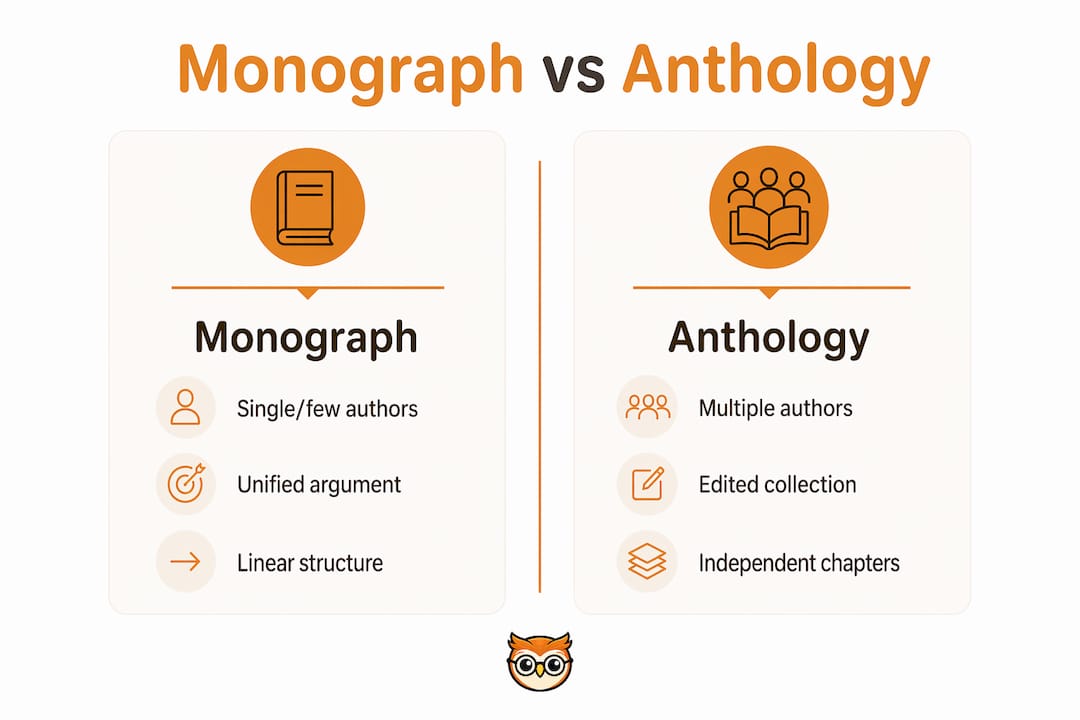
Monographs contain chapters written by the same author or authors following a consistent argument, whereas anthologies are edited collections of essays by different authors. That structural difference determines everything: how you read the work, how you cite it, and what kind of knowledge it produces.
The monograph builds a cumulative case. Each chapter depends on the ones before it. The anthology, by contrast, offers a range of perspectives that can be read selectively. Neither format is superior. Each suits a different research purpose.
What is a monograph and what are its defining features?
A monograph is a scholarly publication devoted to a single subject, written with depth and continuity that a journal article cannot provide. The word comes from the Greek "monos" (single) and "graphe" (writing). That etymology captures the format's defining quality: one sustained intellectual project.
Monographs typically range from 70 to 110 pages for short-form works and up to 300 pages for full-length studies. That range reflects the scope of the research question, not a publisher's arbitrary preference. A short monograph might examine one legal case or one historical episode. A full-length monograph might reconstruct an entire intellectual movement.
The key features of a monograph include:
- Single authorship or close collaboration. One author, or a small team working on a unified thesis, controls the argument from start to finish.
- Thematic unity. Every chapter advances the same central claim. There are no detours into unrelated territory.
- Extended analysis. Authors use monographs to invite readers to deeply reflect on complex research questions, integrating analyses that journal articles cannot cover.
- Peer review and scholarly credibility. Most monographs pass through rigorous academic review before publication.
- Citation as a whole work. When you cite a monograph, you reference the book itself, not individual chapters attributed to separate authors.
Monographs are recognised as the cornerstone of scholarly book publishing and academic research dissemination. That status reflects their capacity to advance knowledge in ways that shorter formats cannot. A journal article argues a point. A monograph builds a world.
Pro Tip: If you are unsure whether a book is a monograph, check the title page. A single author name or two co-authors with no listed editor signals a monograph. An "edited by" credit signals an anthology or edited volume.
Monographs also differ from textbooks. A textbook surveys a field for teaching purposes. A monograph advances an original argument for a scholarly audience. The distinction matters when you are selecting sources for a literature review.
What is an anthology and how is it structured?
An anthology is a curated collection of works by multiple authors, brought together by an editor around a shared theme, genre, or period. The editor does not write the content. The editor selects, sequences, and frames it.
Anthologies vary greatly in length, from a few dozen pages up to nearly 1,000 pages, defined by editorial curation unifying diverse works under a theme or genre. That range reflects the breadth of the editor's ambition. A slim poetry anthology might collect thirty poems. A major academic anthology in cultural studies might run to 800 pages with fifty contributors.
The defining features of an anthology include:
- Multiple authors. Each contributor writes independently. Their voices, methods, and conclusions may differ.
- Editorial curation. Editors play a crucial role in shaping anthologies to provide thematic coherence and academic value. Without strong editorial judgement, an anthology becomes a random pile of texts.
- Discrete contributions. Each chapter or piece stands alone. A reader can engage with one essay without reading the others.
- Thematic or generic unity. The editor's selection criteria give the anthology its intellectual identity.
- Varied formats. Anthologies appear in poetry, fiction, essays, and academic research. The format is not limited to literary works.
One common source of confusion is the difference between an anthology and a collection. Collections feature works by a single author, whereas anthologies compile works by multiple authors around a theme. Confusing these leads to citation and indexing errors. A collection of Seamus Heaney's poems is not an anthology. An anthology of Irish poetry edited by a third party is.
Anthologies have faced criticism historically for commercial motivations but continue to be vital for defining literary and academic movements by collecting like-minded research. That tension is worth understanding. A well-edited anthology shapes how a field sees itself. A poorly edited one can distort it.
Pro Tip: When evaluating an anthology for your research, read the editor's introduction carefully. A strong introduction explains the selection criteria and the intellectual argument behind the curation. That argument is the anthology's equivalent of a monograph's thesis.
How do authorship and structure distinguish monographs from anthologies?
The authorship model is the clearest structural dividing line between these two formats. A monograph belongs to its author. An anthology belongs to its editor and contributors collectively.
In a monograph, one voice or a tightly coordinated pair of voices controls the argument. Multi-author monographs exist when authors work collaboratively on a unified thesis, but they differ from anthologies because every chapter serves the same overarching argument. The writing style remains consistent. The logic accumulates. In an anthology, each contributor brings their own methodology, voice, and conclusions. The editor provides coherence through selection, not through writing.
The table below shows the core structural differences:
| Feature | Monograph | Anthology |
|---|---|---|
| Authorship | One author or close co-authors | Multiple independent contributors |
| Editorial role | Author controls argument | Editor curates and sequences |
| Chapter relationship | Chapters build on each other | Chapters stand independently |
| Thematic unity | Sustained single argument | Unified by theme or genre |
| Citation approach | Cite as a whole work | Cite individual chapters and authors |
| Typical length | 70–300 pages | Few dozen to nearly 1,000 pages |
A common misconception is that any multi-chapter book with several contributors is a monograph. That is incorrect. The presence of an editor and independently authored chapters defines an edited volume or anthology, regardless of how the publisher markets it.
Pro Tip: Check the copyright page and contributor list. If each chapter lists a different author and the book credits an editor, cite it as an anthology. If one or two authors wrote every chapter, cite it as a monograph.
The structural difference also affects how you read these works. A monograph rewards linear reading. An anthology rewards selective reading based on your specific research question.
How should you cite monographs and anthologies correctly?
Citation practice differs fundamentally between these two formats, and getting it wrong undermines academic integrity. The rule is straightforward: cite a monograph as a whole work, and cite an anthology by its individual chapters and their authors.
Researchers should cite individual contributors of anthology chapters rather than the anthology editor to maintain academic integrity. Citing only the editor erases the intellectual contribution of the chapter author. That is both inaccurate and unfair.
For a monograph, a standard citation in APA 7th edition looks like this:
- Author surname, Initial(s). (Year). Title of monograph. Publisher.
- Example: Smith, J. (2023). The politics of memory in post-war Europe. Cambridge University Press.
For an anthology chapter, the citation structure changes to credit the chapter author first:
- Chapter author surname, Initial(s). (Year). Title of chapter. In E. Editor (Ed.), Title of anthology (pp. xx–xx). Publisher.
- Example: Patel, R. (2022). Oral history and archival silence. In M. Jones (Ed.), Voices from the margins (pp. 45–67). Routledge.
Proper academic citation requires referencing individual contributors in anthologies, unlike monographs which are cited as whole works. The practical implication is that a single anthology with ten chapters may generate ten separate bibliography entries if you draw on multiple contributions.
Common citation pitfalls include:
- Citing the editor of an anthology as if they were the sole author.
- Omitting page ranges for anthology chapters.
- Treating a multi-author monograph as an anthology because it has several contributors.
- Failing to include the editor's name when citing an anthology chapter.
The Carleton College citation guide provides detailed worked examples for both formats across major citation styles including APA, MLA, and Chicago. Consulting a reliable citation guide before submitting any academic work saves significant revision time later.
Understanding how to curate educational resources also helps educators select the right format for their teaching goals. A monograph suits a seminar focused on one argument. An anthology suits a survey course covering multiple perspectives.
Key takeaways
A monograph is a single-author or co-authored scholarly work with a unified argument, while an anthology is an editor-curated collection of independent contributions by multiple authors, and the distinction determines how you read, cite, and use each format in academic work.
| Point | Details |
|---|---|
| Core authorship difference | Monographs have one or few co-authors; anthologies compile multiple independent contributors. |
| Structural logic | Monograph chapters build a cumulative argument; anthology chapters stand independently. |
| Citation rule | Cite monographs as whole works; cite anthology chapters by their individual authors. |
| Editorial role | Editors shape anthologies through selection and sequencing, not through writing the content. |
| Common confusion | A collection by one author is not an anthology; confusing the two causes indexing and citation errors. |
Why this distinction matters more than most academics admit
The difference between a monograph and an anthology is not a technicality. It reflects two fundamentally different ways of producing knowledge.
A monograph is an act of sustained intellectual commitment. The author stakes a position and defends it across hundreds of pages. That takes years. The peer review process for a monograph at a major academic press is rigorous precisely because the claims are large. When you cite a monograph, you are citing a complete intellectual project.
An anthology is an act of editorial judgement. The editor decides whose voices belong in the conversation and whose do not. That power is significant. A well-edited anthology can define a field. The role of editors in publishing is often underestimated by students who focus only on the contributors. The editor's introduction and selection criteria are themselves scholarly contributions worth examining critically.
Where I see students go wrong most often is in treating anthologies as monographs when they cite them. They reference the editor as if one person wrote the whole book. That misrepresents the intellectual labour of every chapter author. It also weakens the student's own argument, because they are citing a general editorial position rather than a specific scholarly claim.
My advice to researchers selecting between these formats for their own publishing is this: if your argument is unified and sustained, pursue a monograph. If your goal is to bring together a field or document a movement, pursue an edited anthology. The format should follow the intellectual purpose, not the other way around.
— BibliOWLteca
Scholarly books available through Bibliowlteca
Researchers and educators who work regularly with monographs and anthologies need reliable access to quality scholarly content.

Bibliowlteca's academic eBooks collection includes scholarly books across disciplines, giving students and educators direct access to the formats they need for research and teaching. Whether you are building a reading list around a single monograph or assembling a set of anthology chapters for a survey course, Bibliowlteca provides a straightforward way to access and distribute digital academic content. The platform supports multiple currencies and international delivery, making it practical for researchers and educators working anywhere in the world.
FAQ
What is the simplest definition of a monograph?
A monograph is a scholarly book written by one author or a small team of co-authors, focused on a single topic and developing one sustained argument throughout.
What is the simplest definition of an anthology?
An anthology is an edited collection of works by multiple authors, selected and organised by an editor around a shared theme, genre, or academic focus.
Can a monograph have more than one author?
Yes. Multi-author monographs exist when co-authors collaborate on a unified thesis. The key distinction from an anthology is that all authors work towards the same argument rather than contributing independent pieces.
Why does the monograph vs anthology distinction matter for citations?
Citing the wrong format misattributes intellectual credit. Anthology chapters must be cited by their individual authors, not by the editor. Citing the editor alone erases the chapter author's contribution and weakens your reference.
Is a collection the same as an anthology?
No. A collection contains works by a single author, while an anthology compiles works by multiple authors. Treating them as interchangeable leads to citation and cataloguing errors.