
The strongest starting set for UK-based literary research covers eight resources: CLiC Web App (period language and concordance work), Location Register (manuscript holdings across British and Irish repositories), EThOS (over 650,000 UK doctoral theses), British Library Discovery (national catalogue), National Archives Discovery (state and institutional records), London Library Digital Archive (historic membership records from 1841–1950), Literary Reference Ultimate via EBSCO (full-text secondary literature and teaching resources), and the Royal Literary Fund Archive index (author case files pre-1940).
Most are free or freely searchable; Literary Reference Ultimate requires a subscription or library login. Archive visits need pre-booking. If you are building an e-book or course module, start with CLiC for period immersion, EThOS for secondary context, and British Library Discovery for catalogue breadth, then layer in specialist archives once your topic is confirmed.
Key takeaways
The most effective approach to UK literary research for creators is to combine a period corpus tool, a national discovery index, and a subscription reference database, then validate market demand before committing to full production.
| Point | Details |
|---|---|
| Start with the right trio | Pair CLiC (corpus), Location Register or EThOS (discovery), and Literary Reference Ultimate (reference) for most projects. |
| EThOS scale matters | Over 650,000 UK doctoral theses are indexed, making it the fastest route to rigorous secondary analysis on niche topics. |
| Archive access needs lead time | Pre-book reading rooms and reproduction requests early; a 3–5 working day confirmation window is typical for many repositories. |
| Validate demand before full production | Use Amazon categories, Google Trends, and a small test offer to confirm audience interest before investing in a full course or e-book. |
| Bibliowlteca for distribution | Once content is ready, Bibliowlteca handles global payments, digital delivery, and tax compliance so creators can focus on the next project. |
Table of Contents
- How to pick the right literary research tool for your project
- The top UK literary research tools: what each does and how to use it
- How to access manuscript and archive material in the UK
- Effective search tactics for digital corpora and discovery platforms
- How to research market demand for books and courses
- UK copyright and permissions: what to check before reusing texts
- Project checklist: from idea to first draft
- What we have learned building courses and e-books from archive research
- Publish and sell your research-based course or e-book
- Sources
How to pick the right literary research tool for your project
Match the tool to the task before you spend time or money. Four research objectives cover most creator projects:
- Textual and period detail — you need authentic language, phrasing, or orthographic variants from a specific era. Use a corpus tool such as CLiC Web App.
- Manuscript provenance — you need to know where a specific author's papers or drafts are held. Use Location Register or British Library Discovery.
- Secondary criticism and teaching resources — you need critical essays, author biographies, or plot summaries for course content. Use Literary Reference Ultimate (EBSCO) or EThOS.
- Market demand signals — you need evidence that readers will pay for your topic. Use Amazon bestseller categories, Google Trends, and library catalogue request data.
For each objective, run through this decision checklist before committing:
- Coverage: does the resource cover your period, genre, and geography?
- Access type: open (free), subscription (library card or institutional login), or on-site reading room?
- Digitisation level: full-text searchable, metadata-only, or physical-access only?
- Licence and reuse: can you quote or reproduce extracts in a paid product without a separate reproduction licence?
- Cost versus expected value: is the subscription or reproduction fee proportionate to the course or e-book revenue you expect?
A practical rule of thumb for creators: combine one period or corpus tool, one discovery or archive index, and one commercial reference database. That trio covers most literary research projects without overlap or wasted spend.
Pro Tip: Before budgeting a project, check the digitisation level and reproduction turnaround of every archive you plan to use. A collection that is metadata-only with a six-week reproduction queue can derail a tight content deadline.
The top UK literary research tools: what each does and how to use it
CLiC Web App
CLiC (Corpora of English Literature) is a free, browser-based concordancer built around curated corpora for the long nineteenth century. It is the go-to tool for period language immersion: search for exact phrases, compare frequency across text sets, or hunt orthographic variants across Dickens-era prose. The CLiC historical research handout explains period groupings and concordance techniques in detail. Access is open; no login required.
Location Register
The Location Register, maintained by the University of Reading with British Academy support, aggregates manuscript records from numerous British and Irish repositories. It is the standard first stop for locating an author's papers, letters, or drafts. Particularly strong for twentieth-century material and name authority research. Free to search; physical access depends on the holding repository.
EThOS
EThOS (E-Theses Online Service), run by the British Library, indexes metadata for over 650,000 UK doctoral theses from the 1700s onwards. Many records link directly to full-text repository copies. For course creators, it is an underused source of rigorous secondary analysis on niche literary topics. Free to search; some full texts require a free British Library account.
British Library Discovery
The British Library's discovery catalogue covers the national collection: printed books, manuscripts, newspapers, maps, and sound recordings. Subject and date filters make it practical for scoping a period or genre. Reproduction requests are handled through the library's imaging services; turnaround and fees vary by item type. Free to search; reading room access requires a reader pass.
National Archives Discovery
Discovery, the National Archives' catalogue, covers state papers, government records, and institutional archives held at Kew and across regional repositories. Useful for creators working on historical non-fiction, political biography, or any topic where official correspondence adds primary-source depth.
London Library Digital Archive
The London Library Digital Archive holds a substantial number of historic membership records from the mid-19th to mid-20th century, digitised using TownsWeb Archiving's PastView platform. It surfaces previously unread letters and membership data that can make compelling selling points for niche literary products. Access requires London Library membership or a specific archive enquiry.
Literary Reference Ultimate (EBSCO)
Literary Reference Ultimate is a subscription database available through many UK university and public libraries. It bundles thousands of full-text encyclopaedias, plot summaries, author biographies, interviews, and critical essays, plus hundreds of full-text journals. For course creators building secondary-literature reading lists or teaching notes, it saves hours of individual journal hunting. Check your library's EBSCO access before paying for a standalone subscription.
Royal Literary Fund Archive index
The Royal Literary Fund Archive index, catalogued by Dr Matthew Sangster, covers application forms, letters, receipts, and administrative material for applicants prior to 1940. It is a specialist resource for author biography, funding history, and the social history of literary careers. Records include British Library reference numbers for physical access.
GLAM network resources
Beyond these named platforms, the broader GLAM (Galleries, Libraries, Archives, and Museums) network across UK institutions holds vast manuscript and special-collections material. ArchiveSearch, AIM25, and individual university repository portals (many powered by CollectionsIndex+) extend discovery well beyond the national institutions.
Pro Tip: Combine a CLiC concordance search with a Location Register manuscript query on the same author. The corpus gives you the published language; the manuscript gives you the revision history. Together, they produce course content that no secondary source can replicate.
How to access manuscript and archive material in the UK
- Identify the repository. Search Location Register, EThOS, or British Library Discovery to find where the material is held.
- Check the online catalogue. Most repositories publish searchable guides; some use CollectionsIndex+, others have bespoke systems. The UEA archive collections platform is a good example of what to expect: collection guides, access notes, and pre-booking instructions in one place.
- Pre-book your reading room visit or request a digital copy. Most UK repositories require advance notice. A window of around 3–5 working days is typical for visit confirmations; digital copy requests often take longer depending on volume and item fragility.
- Confirm reproduction and licence fees. Ask the repository directly. Fees vary widely: some waive charges for non-commercial educational use; others apply a per-image rate regardless of purpose.
- Allow lead time in your content schedule. Large institutional archives (British Library, National Archives) process imaging requests on their own timelines. Local museums and university special collections may be faster but have smaller digitisation teams.
Pro Tip: When planning content deadlines, budget separately for catalogue discovery time and for reproduction licence negotiation. They are two distinct queues, and conflating them is the most common cause of missed launch dates.
Effective search tactics for digital corpora and discovery platforms
Start with targeted concordance searches for period phrasing, then broaden to lemma or fuzzy searches when orthographic variants are likely.
- CLiC exact phrase search: enter a period idiom in quotation marks to find its frequency and context across the corpus. Then remove the quotes and search the root form to catch variant spellings.
- CLiC lemma search: useful for nineteenth-century texts where a single word appears in multiple inflected or archaic forms.
- Location Register and EThOS filters: combine a name or subject term with a date range and repository filter. This narrows thousands of records to a manageable shortlist quickly.
- British Library Discovery: stack metadata terms — date range, genre, repository, and language — rather than relying on a single keyword. The catalogue responds well to Boolean operators (AND, NOT).
- Search log discipline: keep a short log of every search string, database, and date for each project. You can reproduce results for bibliographies, and the log doubles as a methodology note for course materials.
Pro Tip: Build a literary analysis workflow that feeds your search log directly into your module outline. Each confirmed source becomes a section anchor, which cuts drafting time significantly.
How to research market demand for books and courses
Combine quantitative signals with qualitative ones before committing to a topic.
Quick validation checklist:
- Check Amazon bestseller categories and Goodreads subject lists for your proposed topic. High list density signals existing demand; very thin lists may mean an untapped niche or no audience.
- Search Google Trends for your topic phrase over a 12-month window. Seasonal spikes (academic year starts, literary prize announcements) tell you when to launch.
- Browse library catalogue request frequencies where accessible; high holds-to-copies ratios indicate genuine reader interest.
- Scan course marketplace reviews in your subject area for recurring complaints — those gaps are your content opportunity.
Three-step demand validation sequence:
- Run the checklist above and note which signals are positive.
- Publish a low-price or pay-what-you-want test product (a short guide, a sample chapter, or a mini-lesson) and measure conversion rate and buyer feedback.
- Use tools like Edda, which includes Amazon keyword generation and hashtag tools alongside research folders and timelines, to test discoverability before full production.
Pro Tip: A small pay-what-you-want test offer does two things at once: it quantifies pricing elasticity and it surfaces the exact language buyers use to describe the problem, which feeds directly into your sales copy.
UK copyright and permissions: what to check before reusing texts
Check copyright status, the source of the text (manuscript versus published edition), and the repository's licence terms before including any extract in a paid product.
- Public domain status: in the UK, copyright in a literary work expires 70 years after the author's death. A work published in 1900 by an author who died in 1930 is in the public domain; a new critical edition of that work may not be.
- Repository reproduction licences: even for public domain texts, a repository that holds the only surviving manuscript may assert rights over its scan or photograph. Always ask.
- Fair dealing: UK copyright law permits fair dealing for criticism, review, and non-commercial research. Paid courses and e-books are commercial products; fair dealing applies narrowly and does not cover wholesale reproduction.
- Moral rights: authors retain the right to be identified and to object to derogatory treatment of their work, even when copyright has been licensed.
- Attribution: always credit the repository and the edition, not just the author.
Creators should seek legal advice for high-risk uses, particularly when reproducing substantial extracts in commercial products or when the rights situation is unclear.
Pro Tip: When in doubt, e-mail the repository and ask for a short written licence note. Keep the reply. It is your evidence if a rights dispute arises after your product goes on sale.
Project checklist: from idea to first draft
- Define your research objective (textual detail, manuscript provenance, secondary criticism, or market demand).
- Pick 2–3 core tools: one period corpus (CLiC), one discovery index (Location Register, EThOS, or British Library Discovery), and one reference database (Literary Reference Ultimate).
- Confirm access type and licence terms for each tool before starting.
- Run a quick market demand validation (Amazon categories, Google Trends, test offer).
- Schedule archive requests early, accounting for pre-booking windows and reproduction turnaround.
- Draft your module or chapter outline from primary sources first, then layer in secondary criticism.
Save this list as a reference file (a "research-starter checklist") at the start of each new project. It takes five minutes and prevents the most common planning errors.
Additional resources worth bookmarking:
- Build effective educational reading lists for compiling source lists from archive findings.
- Access free books online for sourcing public domain texts to supplement archive material.
- Editing and writing tool alternatives for refining drafts once research is complete.
What we have learned building courses and e-books from archive research
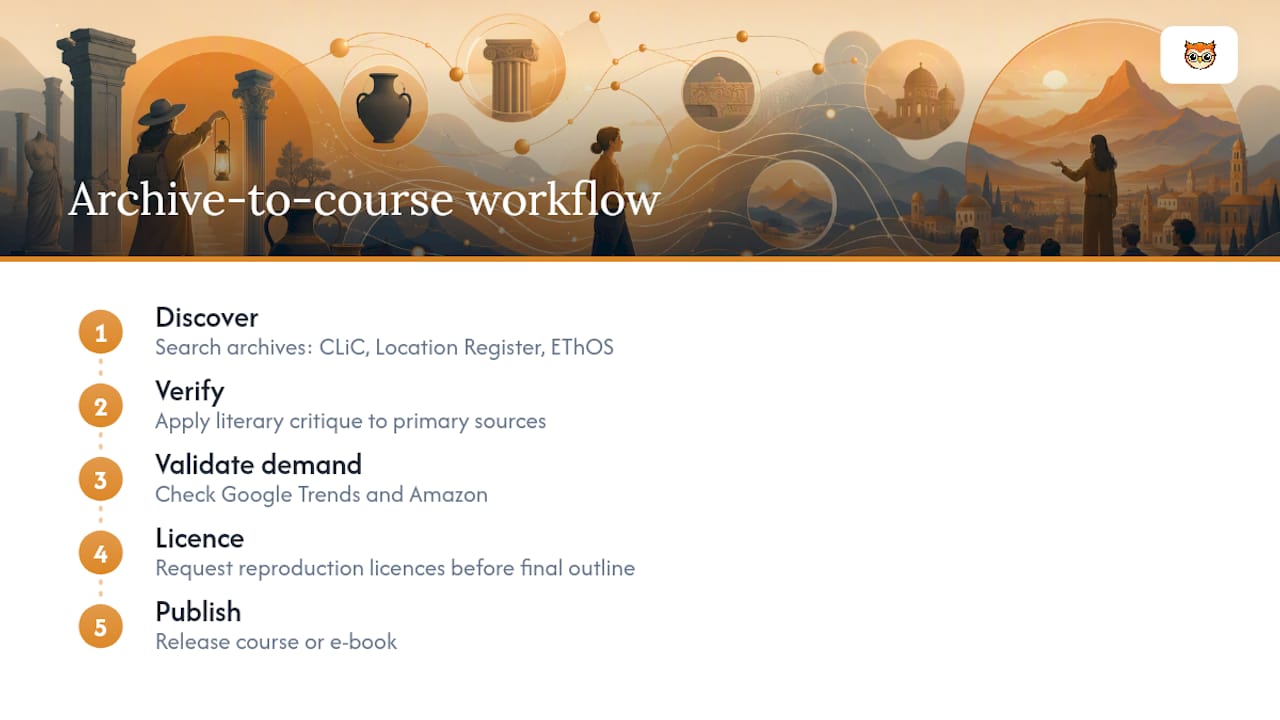
The workflow that works is linear but not rigid: discover, verify, validate demand, licence, publish. The temptation is to skip the middle steps, particularly demand validation, and go straight from an interesting archive find to a full course. That rarely ends well.
For a historical fiction module built around Victorian working-class life, a practical sequence looks like this: CLiC for period idiom and dialogue authenticity, Location Register to find relevant correspondence in regional repositories, EThOS for recent doctoral work on the period, then a Google Trends and Amazon check to confirm the topic has an active readership. Reproduction licences are requested before the module outline is finalised, not after.
For an academic short course on twentieth-century literary funding and patronage, the Royal Literary Fund Archive index is the starting point. Case files reveal the financial realities behind canonical careers. EThOS surfaces recent theses that can be cited as secondary sources. Literary Reference Ultimate fills in the critical context. The London Library Digital Archive occasionally surfaces membership records that add a biographical dimension no published source provides.
The key discipline in both cases: literary critique methods are applied to primary sources first. Secondary literature comes in to contextualise, not to lead.
Publish and sell your research-based course or e-book
Once the research is done and the content is built, the distribution question matters. Bibliowlteca is a digital marketplace where authors and course creators can sell e-books, courses, and mentorship programmes directly to a global audience, with built-in payment processing across multiple currencies, secure digital delivery, and tax compliance handled at the platform level.
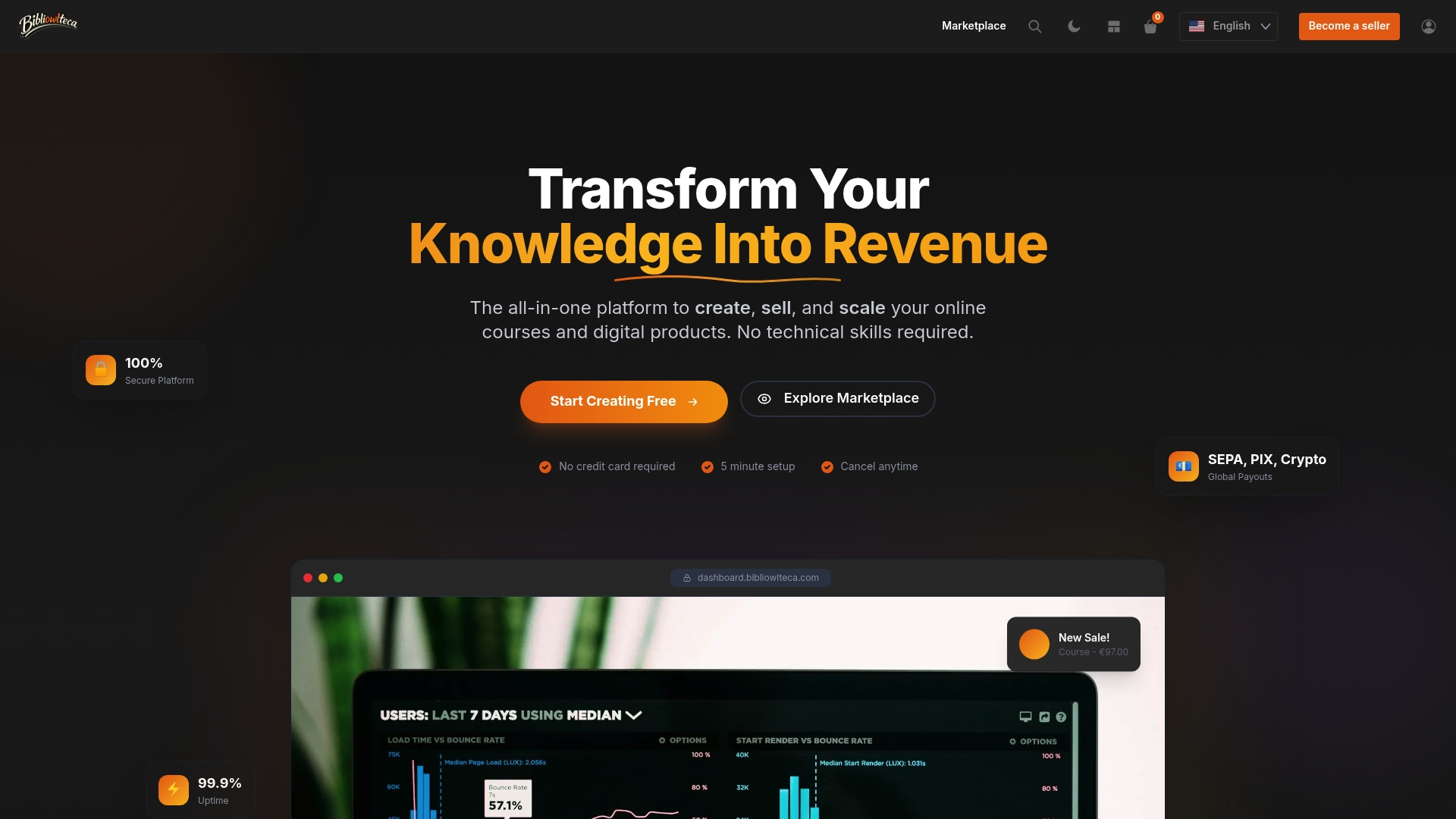
For creators who have done the archival work and want to turn it into revenue, the platform removes the technical overhead: no separate payment gateway, no file-hosting setup, no manual VAT calculation. Your research becomes a product; the platform handles the transaction. List your research-based e-book on Bibliowlteca and reach buyers across the UK and internationally from day one.
Sources
- CLiC as a Historical Research Tool handout
- Location Register — University of Reading research projects and opportunities
- EThOS (E‑Theses Online Service) — British Library
- The London Library digital archive — London Library news
- UEA archive collections — home
Pre-book any reading room visit and confirm reproduction terms before finalising your content schedule. Repository terms change; always check directly with the institution before quoting fees or timelines in a project plan.