
TL;DR:
- Genre fiction uses specific conventions to deliver predictable emotional experiences and ensure market success. Knowing and mastering these conventions helps writers meet reader expectations, build careers, and effectively market their books.
Genre fiction is defined as storytelling organised around specific narrative conventions, tropes, and reader expectations that deliver a predictable emotional payoff. Think of it as a contract: the genre label on a book's cover promises a particular experience, and the story must honour that promise. The global fiction market generated approximately $11.07 billion in revenue in 2025, with romance alone contributing roughly $1.4 billion in US annual sales. Those numbers reflect one truth: readers return to genre fiction because it reliably gives them what they came for. Whether you are a curious reader or an aspiring writer, understanding how genre fiction works changes how you read and write forever.

What is genre fiction and why does it matter?
Genre fiction is the dominant form of commercial storytelling. It organises narratives around specific conventions and tropes that signal to readers exactly what kind of emotional experience awaits them. A romance promises a satisfying love story. A mystery promises a puzzle solved. A fantasy promises a world unlike our own, governed by its own internal rules.
The term "genre fiction" is sometimes used interchangeably with "commercial fiction," and both phrases point to the same idea: stories built to satisfy a defined audience. Literary scholars also use the term "popular fiction" to describe the same body of work. All three labels recognise that these stories prioritise reader satisfaction within a recognised framework.
Genre fiction matters because it forms the backbone of the publishing industry. Booksellers, retailers, and digital platforms all classify books by genre to help readers find what they want. Without genre labels, discovery becomes guesswork for both readers and sellers. Genre is, at its core, a navigation system for storytelling.
The contrast with literary fiction is instructive. Literary fiction tends to prioritise open-ended exploration, ambiguity, and prose style above plot resolution. Genre fiction, by contrast, delivers structured reader desires and a clear emotional destination. Neither approach is superior. They serve different purposes and different readers.
What are genre conventions and why do they matter?
Genre conventions are the storytelling rules, character archetypes, and plot structures that define each genre. They are not restrictions. They are the shared language between writer and reader that makes the emotional payoff possible.
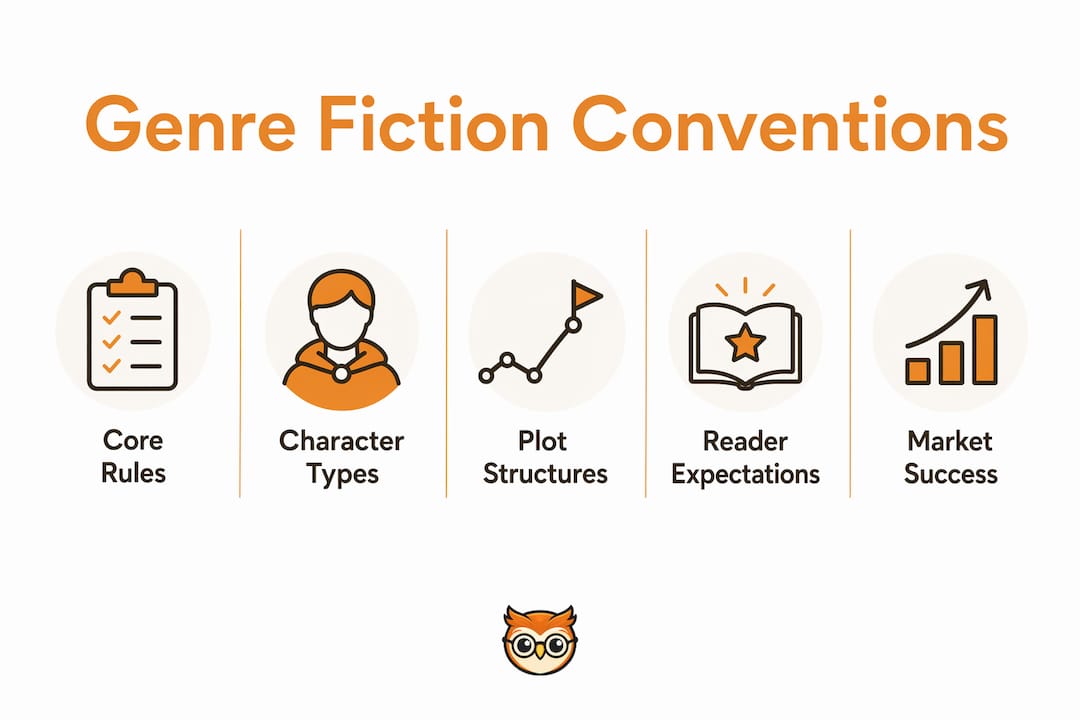
Every genre carries a set of structural commitments. According to the craft of genre writing, these include an inciting premise, genre-specific escalation, a midpoint reversal, and a mandatory resolution. Each of these beats exists to build and then release tension in a way that satisfies the reader's expectations. Skipping or subverting them without awareness is the fastest route to reader disappointment.
Here is how conventions function across the most common genres:
- Romance: The story must end with a "happy ever after" or a "happy for now" conclusion. Removing this ending is not a bold artistic choice. It is a broken promise.
- Mystery: The genre operates on the principle of "fair play." Clues must be discoverable by the reader before the detective reveals the solution. Hiding information cheats the reader.
- Fantasy: The magic system and world rules must remain internally consistent. A power that appears in chapter twenty with no foreshadowing destroys the reader's trust in the world.
- Science fiction: The speculative premise must follow its own logic. Internal consistency is non-negotiable, even when the science is entirely invented.
- Thriller: Escalating stakes and a ticking clock are structural requirements. The reader must feel genuine danger throughout.
Breaking these conventions usually results in reader betrayal and market failure. That is not an opinion. It is the consistent finding of publishing professionals who track reader reviews and return rates. Subversion is possible, but only when the writer understands the convention well enough to break it deliberately and signal that intention to the reader.
Pro Tip: Study the top twenty bestsellers in your chosen genre before you write a single word. Map their structure. Identify the conventions they share. Then decide where your innovation lives, because the best genre writers innovate in character, voice, or theme, not in the core promise.
What are the major types of genre fiction?
Over 35 distinct genres and subgenres exist in commercial fiction, each with specific structural or thematic rules. The major commercial categories are worth understanding in depth, because each one carries a different emotional promise and a different set of craft requirements.
Romance
Romance is the single largest genre by sales. Its core promise is an emotionally satisfying love story. Subgenres include contemporary romance, historical romance, paranormal romance, and the rapidly growing "romantasy" category, which blends romantic conventions with fantasy world-building. The mandatory happy ending is not optional. It defines the genre.
Mystery and crime
Mystery fiction centres on a puzzle, usually a crime, that must be solved. The "fair play" convention requires that all clues be available to the reader. Subgenres include cosy mysteries, hardboiled detective fiction, and legal procedurals. Crime fiction is broader and includes stories where the focus is on the criminal rather than the investigator.
Thriller and suspense
Thrillers prioritise tension, danger, and pace above puzzle-solving. The reader knows something terrible is coming. The question is whether the protagonist can stop it. Subgenres include psychological thrillers, political thrillers, and spy fiction. The distinction between mystery and thriller is structural: mystery asks "who did it?" while thriller asks "can we stop it?"
Fantasy
Fantasy builds worlds governed by rules that differ from our own. The genre's core promise is immersion in an extraordinary reality. Subgenres range from epic fantasy and urban fantasy to dark fantasy and portal fantasy. The world-building must be internally consistent, even when it is entirely invented.
Science fiction
Science fiction extrapolates from real or plausible science to explore futures, alternate realities, or technological consequences. Subgenres include space opera, hard science fiction, dystopian fiction, and the growing "cli-fi" category, which uses climate change as its speculative premise. The distinction between fantasy and science fiction is often debated, but the clearest marker is this: science fiction grounds its speculation in logic and science, while fantasy grounds it in myth and magic.
Horror
Horror's core promise is fear. The genre aims to unsettle, disturb, or terrify the reader. Subgenres include supernatural horror, psychological horror, and body horror. The emotional payoff is not resolution in the traditional sense. It is the experience of surviving the fear alongside the protagonist.
Historical fiction
Historical fiction sets its story in a documented past period and requires period-accurate detail. The genre's promise is immersion in another time. Subgenres include historical romance, historical mystery, and historical epic.
| Genre | Core promise | Key convention | Emotional payoff |
|---|---|---|---|
| Romance | Satisfying love story | Happy or "happy for now" ending | Warmth, hope, fulfilment |
| Mystery | Puzzle solved | Fair play with discoverable clues | Satisfaction, closure |
| Thriller | Danger averted | Escalating stakes, ticking clock | Relief, exhilaration |
| Fantasy | Extraordinary world | Internally consistent world rules | Wonder, escapism |
| Science fiction | Speculative future | Logical extrapolation from science | Curiosity, awe |
| Horror | Genuine fear | Sustained dread, threat to protagonist | Catharsis, survival |
| Historical fiction | Immersion in the past | Period-accurate detail | Nostalgia, discovery |
How does genre fiction work in publishing and reader choice?
Genre labels are marketing tools as much as they are literary categories. Booksellers, retailers, and digital algorithms all use genre to connect books with the readers most likely to buy them. Understanding this function is not optional for aspiring writers. It is the difference between a book that finds its audience and one that does not.
Retailer algorithms cannot effectively list a book in multiple disparate categories simultaneously. A book tagged as both a literary thriller and a cosy mystery sends contradictory signals. The algorithm cannot serve it to either audience effectively. This is why identifying a primary genre is a commercial necessity, not a creative compromise.
Genre also shapes how readers select books. Most readers choose their next read based on the emotional experience they want right now. A reader who wants comfort picks up a romance. A reader who wants to be frightened picks up horror. The genre label is the shortcut that makes that choice possible without reading the entire book first.
For writers navigating hybrid or cross-genre work, the advice is clear. Anchor the book to one dominant genre for classification purposes, then let the secondary genre elements enrich the story. A fantasy novel with a strong romantic subplot is still a fantasy novel. Market it as fantasy. The romance readers who love fantasy will find it. Trying to market it to both audiences equally often means reaching neither effectively.
- Identify your primary genre before you write, not after.
- Study the conventions of that genre until they are instinctive.
- Signal your genre clearly through cover design, title, and blurb.
- Choose your retail categories based on the dominant emotional promise of your story.
- Treat secondary genre elements as texture, not as a second primary category.
Pro Tip: Misidentifying your genre in a pitch or on a retail platform is one of the most common and costly mistakes new writers make. An agent or editor who specialises in thrillers will reject a psychological horror novel pitched as a thriller, even if the writing is excellent. Genre accuracy signals professional awareness.
You can build a deeper understanding of how genre categories support reading choices by exploring effective reading list strategies that use genre as an organising principle.
What are the common misconceptions about genre fiction?
The most persistent myth about genre fiction is that it is shallow or formulaic. This misreads what conventions actually do. Conventions are a foundation, not a ceiling. The best genre writers use them as a starting point for genuine artistic ambition.
Consider the following realities:
- Genre fiction can carry complex prose. Cormac McCarthy's The Road is post-apocalyptic science fiction. Its prose is among the most demanding in contemporary literature. Genre and literary technique are not mutually exclusive.
- Genre fiction uses unreliable narrators. Psychological thrillers in particular have made the unreliable narrator a defining feature of the genre. Gillian Flynn's Gone Girl is a genre novel built on one of the most technically sophisticated narrative structures in recent fiction.
- Genre fiction explores serious themes. Science fiction has always been the genre most willing to interrogate politics, race, gender, and power. Octavia Butler's work is genre fiction that also functions as serious social commentary.
- Literary and genre fiction overlap constantly. Successful literary-genre hybrid authors embed complex literary devices into traditional genre structures to appeal to both literary and commercial audiences. Kazuo Ishiguro's Never Let Me Go is science fiction. Donna Tartt's The Secret History is a mystery. Both are taught in university literature courses.
- Genre fiction drives reading culture. The readers who consume genre fiction voraciously are the same readers who sustain the publishing industry, fund independent bookshops, and introduce new generations to the habit of reading. Dismissing genre fiction as lesser literature dismisses the majority of active readers.
The cultural significance of literature extends fully to genre fiction. Stories that entertain, comfort, and thrill readers are not doing lesser work than stories that challenge and unsettle. They are doing different work, and that work has genuine value.
Understanding how to analyse genre fiction with the same rigour applied to literary fiction reveals just how much craft underlies even the most apparently simple genre novel.
Key takeaways
Genre fiction is defined by its conventions, and those conventions are the mechanism through which it delivers reliable emotional satisfaction to readers and commercial success to writers.
| Point | Details |
|---|---|
| Genre fiction defined | Storytelling built around specific conventions that promise and deliver a particular emotional experience. |
| Conventions are contracts | Breaking genre rules without awareness causes reader betrayal and market failure. |
| Over 35 subgenres exist | Each carries distinct structural rules; knowing yours is the foundation of effective writing and marketing. |
| Genre labels drive discovery | Retailers and algorithms rely on a single dominant genre to connect books with the right readers. |
| Literary and genre fiction overlap | Complex prose, unreliable narrators, and serious themes appear throughout genre fiction. |
Genre fiction from where I stand
The debate between literary and genre fiction has always struck me as a distraction from the more interesting question: what does this story do for its reader? Genre fiction, at its best, is a precision instrument. It is built to produce a specific emotional response, and when it works, it works completely.
What I find most compelling about genre conventions is that they create freedom rather than limit it. When a reader picks up a romance, they are not asking to be surprised by the ending. They are asking to be surprised by the journey. That is where the writer's real creative work lives: in the characters, the voice, the unexpected turns within the expected arc. The convention holds the structure. The writer fills it with life.
Aspiring writers often resist genre conventions because they fear being seen as formulaic. This is the wrong instinct. The writers who master their genre's conventions and then push against them from the inside are the ones who build lasting careers. They give readers what they came for, and then a little more. That "little more" is what readers remember and recommend.
Genre fiction also carries cultural weight that its critics consistently underestimate. The stories that shape how millions of people think about love, justice, fear, and possibility are not always the ones reviewed in literary supplements. They are often the paperbacks read on trains, the ebooks downloaded at midnight, the series passed between friends. That reach is not a sign of lesser value. It is a sign of genuine connection between story and reader.
— BibliOWLteca
Bibliowlteca for genre fiction writers and readers
Writers who understand genre fiction still need the right tools to reach their readers.

Bibliowlteca is a digital platform built for creators who want to publish and sell educational content, ebooks, and courses to a global audience. Whether you are an aspiring writer building your first genre fiction ebook or an educator creating a course on storytelling craft, Bibliowlteca handles payment processing, digital delivery, and tax compliance across multiple currencies. The platform lets you focus on the writing while the infrastructure handles the business. Explore the full range of platform features to see how Bibliowlteca supports writers at every stage of their publishing journey.
FAQ
What is the definition of genre fiction?
Genre fiction is storytelling organised around specific narrative conventions, tropes, and reader expectations that deliver a predictable emotional payoff. The genre label functions as a promise to the reader about the kind of experience the story will provide.
What are the main types of genre fiction?
The major commercial genres are romance, mystery and crime, thriller and suspense, fantasy, science fiction, horror, and historical fiction. Each carries distinct structural rules and a specific emotional promise to the reader.
How are genre conventions different from clichés?
Genre conventions are the structural rules that define a genre and create reader satisfaction, such as the happy ending in romance or the fair-play clue system in mystery. Clichés are overused expressions or plot devices within those conventions that feel lazy rather than purposeful.
Can genre fiction be literary?
Genre fiction regularly incorporates literary techniques including complex prose, unreliable narrators, and serious thematic depth. Works such as Cormac McCarthy's The Road and Kazuo Ishiguro's Never Let Me Go demonstrate that genre and literary ambition are fully compatible.
Why does choosing the right genre matter for writers?
Identifying the correct primary genre is a commercial necessity because retailer algorithms and agents use genre to match books with their intended audience. Misidentifying your genre in a pitch or on a retail platform reduces discoverability and signals a lack of professional awareness to publishers.