
TL;DR:
- Information literacy is the ability to discover, evaluate, and ethically use information effectively. It encompasses multiple skills and knowledge, essential for responsible participation in society and lifelong learning.
Information literacy is the integrated ability to discover, understand, evaluate, and use information ethically and effectively. The American Library Association (ALA) and the Association of College and Research Libraries (ACRL) define it as a set of interrelated competencies that go far beyond knowing how to search Google. The 2005 Alexandria Proclamation declared information literacy a basic human right essential to lifelong learning and full participation in society. Whether you are a student writing a dissertation, an educator designing a curriculum, or a professional making decisions based on research, understanding information literacy is the foundation of everything you do with knowledge.
What is information literacy and what skills does it require?
Information literacy is best understood not as a single skill but as a cluster of abilities that work together. The ACRL Framework describes it through threshold concepts: authority is constructed and contextual, research is inquiry-based, and scholarship is a conversation. These ideas shift the focus from following a checklist to developing genuine conceptual understanding.
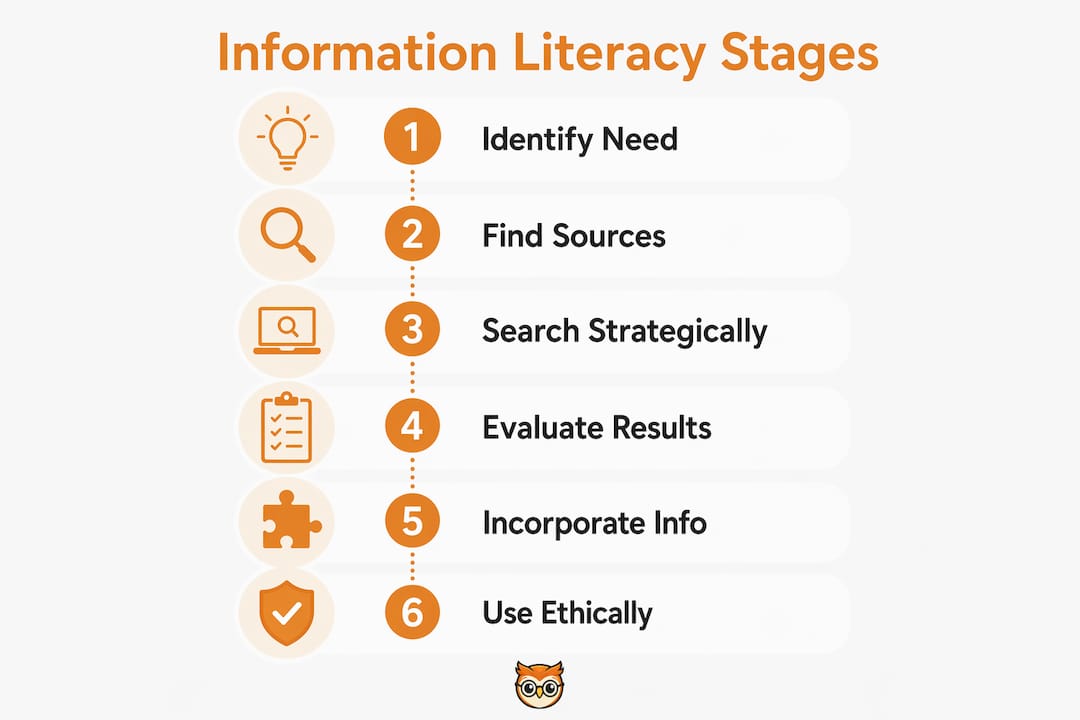
The standard research process involves six iterative stages that move from recognising an information need through to ethical use of what you find. Critically, these stages are not a straight line. Learners regularly loop back to earlier steps as their understanding deepens.
The six core stages are:
- Identify your information need. Define the question or problem clearly before searching for anything.
- Find relevant sources. Use library databases, academic journals, and credible websites rather than relying solely on search engines.
- Search strategically. Apply Boolean operators, subject headings, and filters to narrow results efficiently.
- Evaluate what you find. Assess credibility, currency, relevance, authority, and purpose using frameworks such as the CRAAP Test or the SIFT method.
- Incorporate new knowledge. Synthesise information from multiple sources rather than summarising a single one.
- Use information ethically. Cite sources correctly, respect intellectual property, and avoid plagiarism.
Pro Tip: Most students treat the research process as linear and feel they have failed when they need to go back and redefine their question. Revisiting earlier stages is not a mistake. It is a sign that your thinking is developing. Build time for iteration into every research task.
The skills underpinning these stages include critical thinking, source evaluation, synthesis, and ethical reasoning. Tools such as JSTOR, PubMed, and institutional library databases are the practical environments in which these skills are applied. Knowing how to navigate a step-by-step library search is one of the most transferable abilities a student can develop.

Why is information literacy essential in the digital age?
Information literacy is the first line of defence against misinformation, manipulation, and poor decision-making in a world saturated with digital content. Experts at Syracuse University's iSchool describe it as critical not just for academic success but for responsible citizenship, sound health decisions, and professional judgement. That scope makes it one of the most consequential skills anyone can develop.
The digital environment creates specific challenges that make literacy more urgent than ever. Algorithm-driven platforms such as YouTube, TikTok, and Meta's Facebook prioritise engagement over accuracy. Filter bubbles mean users are repeatedly shown content that confirms existing beliefs. AI-generated text can appear authoritative while containing factual errors. Learners who lack strong evaluation skills are particularly exposed to these pressures.
"Viewing information literacy narrowly as research skills risks underpreparing learners for digital age challenges like algorithmic bias and misinformation." — What Is Information Literacy?, Syracuse University iSchool
Information literacy also extends well beyond the classroom. The benefits touch nearly every area of life:
- Health decisions. Evaluating medical information online prevents harm from misinformation about treatments, vaccines, and diagnoses.
- Civic participation. Recognising propaganda, identifying credible news sources, and understanding political bias supports democratic engagement.
- Professional competence. Researchers, journalists, lawyers, and business analysts all depend on the ability to locate and assess reliable data.
- Financial judgement. Distinguishing credible financial advice from misleading content protects individuals from fraud and poor investment decisions.
- Academic integrity. Understanding how to cite sources and avoid plagiarism is a direct application of ethical information use.
Information literacy also includes media literacy and algorithmic awareness. Learners must understand not just whether a source is credible but why certain content spreads rapidly and how emotional framing is used to bypass critical thinking. These are not abstract concerns. They are daily realities for anyone who uses a smartphone.
How is information literacy taught across disciplines?
Information literacy must be embedded across disciplines, not confined to a single library orientation session or standalone research module. Educational standards from New Jersey's 2025 curriculum framework explicitly encourage cross-subject integration. The reasoning is straightforward: skills taught in isolation rarely transfer to new contexts.
When students practise source evaluation in a science class, a history lesson, and an English essay, they begin to understand that the standards for credibility shift depending on the discipline. A peer-reviewed paper in The Lancet carries different authority from a primary source document in a history archive. Both require evaluation, but the criteria differ. That contextual understanding is what cross-disciplinary embedding builds.
The table below shows how information literacy teaching looks different across subjects, and what learners gain from each context.
| Discipline | Teaching Approach | Expected Learner Outcome |
|---|---|---|
| Science | Evaluating peer-reviewed journals and data sets | Ability to assess methodology, sample size, and publication bias |
| Social Studies | Analysing primary sources and news media | Skill in identifying perspective, bias, and historical context |
| English Language Arts | Researching for argumentative writing | Competence in synthesising multiple sources into a coherent argument |
| Health Education | Assessing medical and public health information online | Capacity to distinguish evidence-based guidance from misinformation |
| Business Studies | Evaluating market research and financial reports | Ability to judge data quality and source credibility in professional contexts |
Educators who embed information literacy into their subject teaching rather than treating it as a separate topic produce students who carry these skills into adult life. Resources such as library science guides for professionals offer practical frameworks for educators designing cross-disciplinary approaches. The role of libraries in academic growth is also central here, as librarians frequently serve as the connective tissue between subject teachers and research skills instruction.
Tutors working across multiple subjects benefit from understanding digital literacy in teaching contexts, which outlines how to embed these competencies naturally within subject-specific instruction rather than treating them as an add-on.
Common misconceptions about information literacy
The most damaging misconception about information literacy is that digital savvy equals critical evaluation ability. A student who can build a website, edit video, and manage social media accounts is not automatically equipped to assess the credibility of a source or recognise a misleading statistic. Technical proficiency and critical thinking are separate competencies. Conflating them leaves learners underprepared.
A second misconception is that information literacy is only relevant during formal education. The reality is that every adult encounters information that requires evaluation: a news article about a health scare, a financial product with small print, a social media post making a political claim. Information literacy is a lifelong practice, not a student skill.
Here are practical ways to strengthen your information literacy right now:
- Use the SIFT method. Stop, Investigate the source, Find better coverage, Trace claims to their origin. This four-step framework from Mike Caulfield at Washington State University is one of the most effective tools for quick source evaluation.
- Access library databases. Platforms such as JSTOR, ProQuest, and EBSCOhost provide peer-reviewed content that search engines do not surface reliably.
- Attend information literacy workshops. Many universities and public libraries offer free sessions on source evaluation, citation management, and research strategy.
- Use citation management tools. Zotero and Mendeley help you organise sources and cite them correctly, reducing the risk of accidental plagiarism.
- Practise lateral reading. Rather than reading a single source deeply, open multiple tabs and check what other credible sources say about the same claim.
Pro Tip: When you encounter a statistic in an article, always ask two questions: who collected this data, and what did they have to gain from the result? Funding sources and institutional affiliations often explain why two studies on the same topic reach opposite conclusions.
Ethical reasoning is the often-overlooked dimension of information literacy. Knowing how to find and evaluate information is only part of the picture. Understanding when and how to share it, how to attribute it correctly, and how to avoid spreading unverified claims are equally important. The ACRL Framework's threshold concept that scholarship is a conversation captures this well. Every time you cite a source, you are joining an ongoing intellectual exchange, not just completing a task.
Key takeaways
Information literacy is the integrated ability to locate, evaluate, and use information ethically, and it is the foundational skill for learning, citizenship, and professional life in 2026.
| Point | Details |
|---|---|
| Core definition | The ALA and ACRL define information literacy as the integrated ability to discover, evaluate, and use information ethically. |
| Six-stage process | The research process moves from identifying a need to ethical use, and is iterative rather than linear. |
| Digital urgency | Algorithm-driven content, AI-generated text, and filter bubbles make critical evaluation skills more necessary than ever. |
| Cross-disciplinary teaching | Embedding literacy across subjects, not in isolation, produces skills that transfer to real-world contexts. |
| Tech skills are not enough | Digital proficiency does not equal information literacy; critical thinking and ethical reasoning must accompany technical ability. |
Information literacy in 2026: what i have learned from working with educators
The gap between technology use and genuine information literacy is wider than most institutions acknowledge. Students arrive at university having spent years online, yet many cannot reliably distinguish a peer-reviewed source from a content marketing article. That is not a failure of intelligence. It is a failure of instruction.
What I have observed working with educators and content creators through Bibliowlteca is that the most effective literacy teaching happens when it is invisible. When a science teacher asks students to compare two conflicting studies and explain the discrepancy, they are teaching information literacy without naming it. That contextualisation is what makes the skill stick.
The arrival of AI-generated content has made this more complicated. Tools such as ChatGPT and Google Gemini can produce plausible-sounding text that contains factual errors, invented citations, and subtle bias. Students who have not developed strong evaluation habits will not catch these errors. The skill of recognising how information is produced and who benefits from its circulation is now more valuable than any specific research technique.
My honest view is that information literacy should be treated as a core subject, not a support skill. It belongs alongside mathematics and language in any curriculum that takes preparation for adult life seriously. The institutions that embed it deeply, consistently, and across every subject will produce graduates who are genuinely equipped for the complexity of the information environment they are entering.
— Bibliowlteca
Deepen your knowledge with Bibliowlteca
Bibliowlteca connects learners and educators with digital content that builds real-world knowledge and research skills. Whether you are looking for structured courses on critical thinking, e-books on research methodology, or mentorship from subject specialists, the platform brings together creators and learners from across the globe.
Explore the full range of educational digital content available on Bibliowlteca, from information literacy guides to discipline-specific research tools. If you are an educator or creator, the platform's courses and mentorship features make it straightforward to publish and distribute your own materials to a worldwide audience. Building stronger information literacy starts with the right resources.
FAQ
What is the standard definition of information literacy?
Information literacy is defined by the ALA and ACRL as the integrated ability to discover, understand, evaluate, and use information ethically. The ACRL Framework, updated through 2026, describes it through threshold concepts rather than a fixed checklist.
How does information literacy differ from digital literacy?
Digital literacy refers to the technical ability to use digital tools and platforms. Information literacy is the critical and ethical dimension: evaluating whether information is credible, accurate, and appropriate to use.
What are the six stages of the information literacy process?
The six stages are identifying an information need, finding sources, searching strategically, evaluating results, incorporating new knowledge, and using information ethically. The process is iterative, not linear.
Why is information literacy important beyond school?
Information literacy supports health decisions, civic participation, professional competence, and financial judgement throughout adult life. Syracuse University's iSchool describes it as essential for responsible citizenship, not just academic success.
How can i improve my information literacy skills quickly?
Start by applying the SIFT method to every source you encounter, accessing peer-reviewed databases such as JSTOR or EBSCOhost, and using citation tools like Zotero to manage and attribute sources correctly.