

TL;DR:
- Scholarly communication is a system that creates, evaluates, shares, and preserves academic knowledge. It involves various stakeholders and channels, including peer review, open access, and institutional repositories. The system is evolving rapidly, with new models like diamond open access and preprints reshaping how research is shared and controlled.
Scholarly communication is defined by the Association of College and Research Libraries (ACRL) as the lifecycle system encompassing the creation, evaluation, dissemination, and preservation of scholarly works. This system underpins every research degree, journal article, and conference paper produced in academia. It determines how knowledge moves from a researcher's desk to the wider world, and how that knowledge is validated along the way. Understanding what is scholarly communication means understanding the full infrastructure of academic knowledge production, from the first draft of a manuscript to its long-term archiving in an institutional repository.

What is scholarly communication and how does it work?
Scholarly communication is the formal and informal process by which researchers create, share, and preserve academic knowledge. The ACRL definition identifies four core stages: creation, quality evaluation, dissemination to the scholarly community, and preservation for future use. Each stage involves distinct activities and different groups of people.
Creation covers the research process itself, including data collection, analysis, and writing. Quality evaluation refers primarily to peer review, where independent experts assess a manuscript before publication. Dissemination covers the channels through which findings reach other researchers, practitioners, and the public. Preservation ensures that published work remains accessible and retrievable for future scholars.
Common scholarly communication methods include peer-reviewed journal articles, academic monographs, book reviews, conference papers, electronic listservs, and research blogs. Both formal and informal channels remain critical in 2026. A climate scientist posting a preprint on arXiv and a historian publishing a monograph with Oxford University Press are both participating in the same broader system, just at different points and through different channels.
The scholarly communication definition also carries a social dimension. It is not simply a technical pipeline for moving text from author to reader. It is the mechanism by which academic communities agree on what counts as valid knowledge, who gets to contribute, and under what conditions findings are accepted or challenged.
What are the main components and stakeholders involved?
Several distinct groups shape how scholarly communication functions in practice. Each plays a specific role, and the system depends on all of them working together.
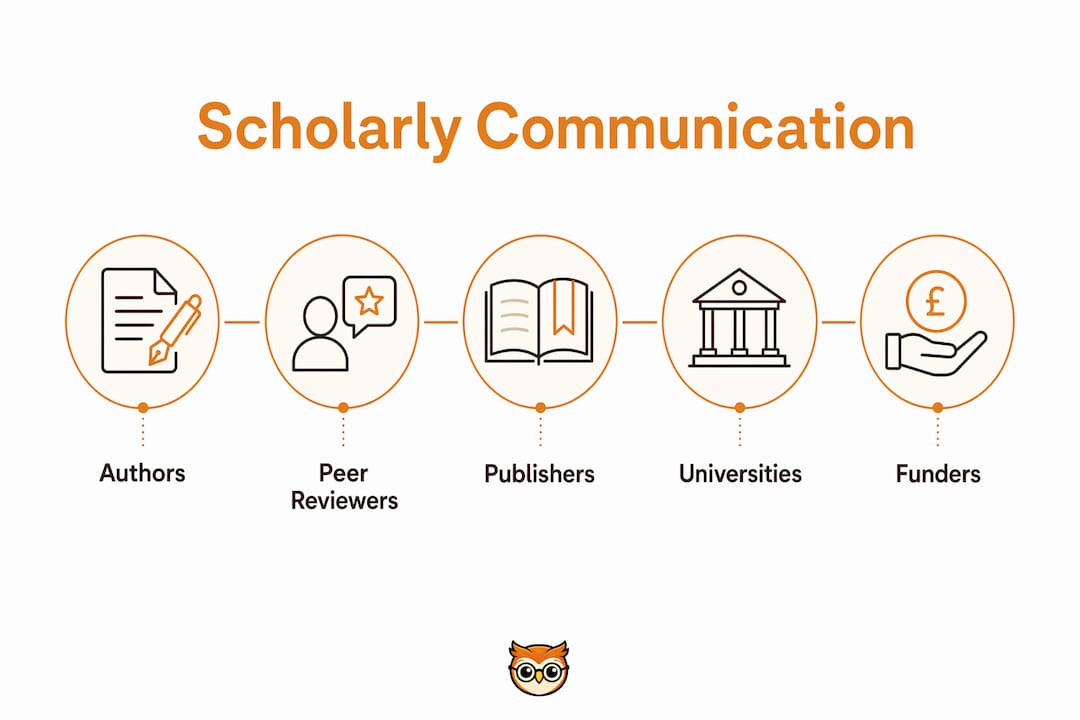
Authors and researchers produce the original work. They design studies, collect data, write manuscripts, and submit to journals or publishers. Their decisions about where to publish, which licence to use, and whether to share preprints all affect how widely their work circulates.
Peer reviewers provide quality assurance. They assess manuscripts for methodological rigour, originality, and accuracy before publication. Peer review processes are the primary mechanism by which the academic community validates research claims.
Publishers manage the production and distribution of scholarly outputs. They range from large commercial houses such as Elsevier and Springer to university presses and learned societies. Their business models vary significantly, from subscription-based access to open access publishing.
Libraries acquire, organise, and preserve scholarly outputs. They also advocate for open access policies and manage institutional repositories. The role of libraries in academic research has expanded considerably as digital publishing has grown.
Funders such as the Wellcome Trust, UK Research and Innovation (UKRI), and the European Research Council increasingly mandate open access publication as a condition of grant funding. Their policies directly shape where and how researchers publish.
- Authors retain creative and intellectual ownership of the original work
- Peer reviewers provide independent quality checks at no cost to publishers
- Publishers handle production, distribution, and often copyright management
- Libraries preserve outputs and advocate for equitable access
- Funders set conditions that drive open access adoption
Pro Tip: Before submitting to any journal, check whether your funder has an open access mandate. UKRI, for example, requires immediate open access for peer-reviewed research articles it funds. Publishing in a non-compliant journal can affect your grant compliance.
Universities are also becoming active stakeholders. Institutional publishing initiatives are growing as universities seek to reduce reliance on commercial vendors and reclaim control over the outputs their researchers produce. This shift is one of the most significant structural changes in academic publishing in a generation.
Which methods and channels are used for scholarly communication?
Scholarly communication methods divide broadly into formal and informal channels. Each serves a different purpose in the knowledge-sharing lifecycle.
Formal channels
Formal channels are peer-reviewed and institutionally recognised. They carry the most weight in academic assessment and promotion decisions.
| Channel | Purpose | Example |
|---|---|---|
| Peer-reviewed journal article | Primary vehicle for original research findings | Nature, The Lancet, PLOS ONE |
| Academic monograph | Extended scholarly argument or study | Oxford University Press, Cambridge University Press |
| Conference paper | Rapid dissemination of work in progress | IEEE conferences, British Sociological Association |
| Book chapter | Contribution to an edited scholarly volume | Routledge Handbooks, Sage collections |
| Thesis or dissertation | Original research for a higher degree | Institutional repositories such as EThOS (British Library) |
Informal channels
Informal channels are faster and less regulated. They are increasingly important for early-stage dissemination and public engagement.
- Preprints: manuscripts posted publicly before peer review, via platforms such as arXiv, bioRxiv, or SSRN
- Research blogs: commentary and summaries aimed at broader audiences, often hosted on institutional or personal sites
- Social media: platforms such as ResearchGate, Academia.edu, and X (formerly Twitter) for sharing findings and networking
- Electronic listservs: discipline-specific mailing lists for rapid professional exchange
- Podcasts and video: increasingly used in arts, humanities, and social sciences for public-facing research communication
The rise of preprint culture is one of the most significant recent shifts in scholarly communication. Preprints use existing infrastructure to accelerate sharing and allow the research community to engage with findings before formal peer review is complete. During the COVID-19 pandemic, preprints on medRxiv and bioRxiv allowed epidemiologists and clinicians to share data within days rather than months. That speed changed how science-led publishing is understood.
Multimedia formats are also gaining ground, particularly in the arts and humanities. A researcher might publish a peer-reviewed article, record a podcast episode summarising the findings, and post a thread on ResearchGate, all as part of a single dissemination strategy. The channel choice depends on the audience, the discipline, and the urgency of the findings.
Why is scholarly communication important for academia and society?
Scholarly communication is the mechanism by which research becomes reliable, replicable, and useful beyond the laboratory or library. Its importance operates at three levels: individual, institutional, and societal.
"Scholarly communication functions as a public good essential for scientific progress and societal benefit." — Trends in Scientific Communication
At the individual level, publishing in peer-reviewed outlets establishes a researcher's credibility and contributes to career progression. At the institutional level, strong scholarly communication outputs affect university rankings, research funding allocations, and reputational standing. At the societal level, the benefits of scholarly communication extend to public policy, clinical practice, and technological development.
- Research quality assurance: Peer review filters out methodological errors and unsupported claims before findings enter the public record. Without it, the evidence base for medicine, engineering, and public policy would be far less reliable.
- Researcher collaboration: Disseminating findings through journals and conferences allows researchers in different institutions and countries to build on each other's work. The Human Genome Project, for example, depended on rapid, open scholarly communication across dozens of institutions worldwide.
- Evidence-based policy: Governments and public bodies rely on peer-reviewed research to design interventions. The UK's Scientific Advisory Group for Emergencies (SAGE) drew directly on published scholarly literature during the COVID-19 response.
- Equitable knowledge access: Open access principles allow researchers in lower-income countries to access findings that would otherwise sit behind expensive journal paywalls. This matters enormously for global scientific capacity.
Pro Tip: If you want your research to influence policy, consider submitting a plain-language summary to a relevant government consultation or think tank alongside your journal article. The UK Parliament's POST (Parliamentary Office of Science and Technology) actively seeks research input from academics.
The importance of scholarly communication also lies in what happens when it fails. Retracted papers that circulated widely before withdrawal, such as the now-infamous 1998 Wakefield study linking vaccines to autism, demonstrate how flawed scholarly communication can cause lasting public harm. Rigorous peer review and transparent correction processes are not bureaucratic formalities. They are safeguards for public trust in science.
What challenges and trends are reshaping scholarly communication today?
Scholarly communication in 2026 is under significant pressure from commercial, technological, and ethical forces. Understanding these challenges is necessary for any researcher who wants to navigate the system effectively.
Commercial publishing dominance
A small number of large commercial publishers, including Elsevier, Wiley, and Springer Nature, control a disproportionate share of peer-reviewed journal publishing. This concentration gives them considerable pricing power over university library budgets. Universities are responding by developing institutional publishing platforms and negotiating transformative agreements that shift costs from subscription access to open access publication.
Copyright and intellectual property
Authors frequently surrender copyright through standard publication contracts, transferring control of their work to commercial publishers. This limits their ability to share, reuse, or build on their own research. Using copyright retention clauses or author addenda at the point of submission is the most direct way to retain rights. Tools such as the SPARC Author Addendum provide a standardised mechanism for doing this.
Ethical and political dimensions
Scholarly communication is a political and ethical process that determines whose knowledge is legitimised and who can contribute to academic discourse. Initiatives such as SciELO and Redalyc offer multilingual, non-commercial publishing models that challenge the dominance of English-language journals and expand equitable access. These platforms demonstrate that high-quality scholarly communication does not require commercial intermediaries.
Emerging models and trends
| Trend | Description | Implication for researchers |
|---|---|---|
| Diamond open access | Free to read and free to publish, with no author fees | Removes financial barriers for authors without grant funding |
| Preprint culture | Manuscripts shared publicly before peer review | Accelerates dissemination but requires careful communication of provisional status |
| Decoupled peer review | Review separated from journal gatekeeping | Shifts value from journal prestige to review transparency and rigour |
| Institutional repositories | University-managed archives for research outputs | Provides long-term preservation independent of commercial publishers |
Diamond open access removes both reader and author fees, making it the most equitable publishing model currently available. It is growing in Europe and Latin America, supported by public funding bodies and university consortia. The role of gatekeeping is also changing. Future publishing may value open, rigorous peer review mechanisms over journal prestige hierarchies. For early-career researchers, this shift is significant. A paper reviewed transparently on a platform like PREreview may carry more demonstrable credibility than one published in a high-impact journal with anonymous, opaque review.
Research integrity tools such as iThenticate are also becoming standard in editorial workflows, helping publishers and institutions identify plagiarism and uphold the quality standards that scholarly communication depends on.
Key takeaways
Scholarly communication is the structured system through which academic knowledge is created, validated, shared, and preserved for the benefit of researchers and society alike.
| Point | Details |
|---|---|
| Core definition | Scholarly communication covers creation, peer review, dissemination, and preservation of academic work. |
| Stakeholder roles | Authors, peer reviewers, publishers, libraries, and funders each play distinct and interdependent roles. |
| Formal and informal channels | Peer-reviewed journals and preprints both serve critical functions at different stages of dissemination. |
| Copyright retention | Authors should use addenda or retention clauses to keep control of their published work. |
| Open access growth | Diamond open access and institutional repositories are reducing dependence on commercial publishers. |
The system is changing faster than most researchers realise
From where Bibliowlteca sits, working with educators and researchers who are actively building digital knowledge businesses, the most striking thing about scholarly communication in 2026 is how unevenly the changes are landing. Senior academics at well-funded institutions are navigating transformative agreements and institutional repositories with relative ease. Early-career researchers and those at under-resourced universities are still largely at the mercy of commercial publishing contracts they do not fully understand.
The advice to retain your copyright is correct, but it is not enough on its own. The deeper issue is that most researchers are never taught to think of their work as intellectual property with commercial and strategic value. They write, they submit, they sign whatever the publisher sends, and they move on. That pattern benefits commercial publishers enormously.
What actually changes outcomes is treating your research outputs as assets from the start. Decide where you will publish before you finish writing, not after. Check your funder's open access requirements before you submit. Use your institution's repository as a matter of course, not as an afterthought. And if your institution has a scholarly communications librarian, talk to them. They are one of the most underused resources in academia.
The publishing role in academia is shifting from a gatekeeping function to a service function. The institutions and researchers who understand that shift earliest will have the most control over how their work reaches the world.
— Bibliowlteca
How Bibliowlteca supports researchers in sharing their work

Bibliowlteca is built for researchers, educators, and knowledge creators who want to distribute their work on their own terms. The platform lets you publish and sell e-books, courses, and digital resources directly to a global audience, without surrendering control to a commercial intermediary. Whether you are sharing lecture notes, a research-based course, or a practitioner guide drawn from your published work, Bibliowlteca handles payment processing, digital delivery, and tax compliance across multiple currencies. Explore the full range of academic publishing tools available on the platform, or browse and sell digital content through the Bibliowlteca marketplace today.
FAQ
What is the scholarly communication definition?
Scholarly communication is the system by which academic research is created, evaluated, disseminated, and preserved. The ACRL defines it as a lifecycle encompassing all four stages, from initial research through to long-term archiving.
What are examples of scholarly communication?
Examples include peer-reviewed journal articles, academic monographs, conference papers, preprints on platforms such as arXiv or SSRN, and research blogs. Both formal and informal channels count as scholarly communication practices.
Why is scholarly communication important for researchers?
Scholarly communication validates research through peer review, enables collaboration across institutions, and ensures findings can inform public policy and practice. Without it, research remains isolated and unverifiable.
What is diamond open access in scholarly communication?
Diamond open access is a publishing model that is free for both readers and authors, with no article processing charges. It is growing across Europe and Latin America as an equitable alternative to commercial journal publishing.
How can researchers retain copyright in scholarly communication?
Researchers can retain copyright by using author addenda, such as the SPARC Author Addendum, at the point of submission. Depositing work in an institutional repository also preserves access rights independent of the publisher's licence.