
TL;DR:
- AI learning is rapidly transforming education, but many educators lack clear guidance on effective integration strategies. Building foundational AI literacy in areas like ethics, explainability, and pedagogy enables educators and content creators to use tools responsibly and innovatively. Focused practice, verification, and ethical transparency are essential for leveraging AI to enhance learning outcomes and stand out in the digital education market.
AI learning is reshaping education faster than most institutions can keep pace with, yet a significant proportion of educators and content creators still feel underprepared to act on it. The gap is not a lack of interest — it is a lack of clarity. Understanding what AI learning actually means, which tools are worth your time, and how to apply them without compromising the integrity of your teaching practice is the real challenge. This guide cuts through the noise, walking you through foundational concepts, practical applications, ethical responsibilities, and the programmes that will genuinely move your practice forward.
Table of Contents
- Understanding AI learning: foundational concepts and educational frameworks
- How AI tools transform teaching workflows and content creation
- Best practices for mastering AI learning and content creation
- Leading programmes and resources for AI learning in education
- Ethical considerations and challenges in AI learning for education
- Redefining education: why mastering AI learning is a strategic imperative
- Explore digital content and AI resources with BibliOWLteca
- Frequently asked questions
Key Takeaways
| Point | Details |
|---|---|
| AI learning defined | AI learning equips educators with skills to integrate AI into teaching and content development effectively. |
| Time-saving benefits | AI tools save educators 5-8 hours weekly by automating lesson planning, feedback, and assessments. |
| Start with trusted tools | Master 3-4 reliable AI platforms and craft clear prompts for best results. |
| Use leading AI courses | Free programs from MIT and Google offer modular AI literacy training with certification. |
| Ethical AI use | Responsible policies balance AI assistance with preserving academic integrity and student learning. |
Understanding AI learning: foundational concepts and educational frameworks
AI learning, at its core, refers to the process of both how artificial intelligence systems acquire knowledge through data and algorithms, and how humans develop the skills to understand, apply, and critically evaluate those systems. For educators and content creators, both dimensions matter equally.
The technical side involves concepts like machine learning (where algorithms improve through experience rather than explicit programming), deep learning (a subset using neural networks to process complex patterns), and large language models (LLMs) such as the ones powering tools you likely already use. You do not need a computer science degree to understand these well enough to work with them productively. What you do need is a structured pathway.
MIT's approach is worth noting here. Their Universal AI programme is modular, covering programming, machine learning, deep learning, LLMs, decision-making, explainability, and ethics, designed to take anyone from novice to genuine AI fluency. That structure reflects something important: AI education is most effective when it builds conceptually, rather than throwing tools at people and hoping something sticks.
For educators integrating AI into their practice, the following foundational pillars are worth grounding yourself in:
- Machine learning techniques: How systems learn from datasets, detect patterns, and make predictions
- AI ethics and bias: How training data shapes AI behaviour, and where that creates risks in educational contexts
- Explainability: Understanding why an AI system produces a given output, which is critical for academic integrity
- Pedagogy and AI: Frameworks for using AI to support rather than replace meaningful learning experiences
Understanding library trends in digital education also helps contextualise where AI fits within broader educational shifts. For content creators specifically, these foundational concepts are the difference between producing AI-enhanced educational products that carry genuine authority and producing content that relies on AI outputs uncritically. If you are building technology courses for AI, grounding yourself in these frameworks makes your product credibly distinct in a crowded market.
How AI tools transform teaching workflows and content creation
Let us be direct: the productivity gains from AI tools in education are not marginal. Educators save 5 to 8 hours weekly on planning, feedback, and communication, and AI can generate complete lesson plans in under five minutes and provide formative feedback on 30 essays in ten minutes. Those are not hypothetical numbers. They represent genuine reclaimed time that educators can reinvest in what AI cannot replicate: relationship-building, mentoring, and creative pedagogy.

Here is where AI tools are having the most measurable impact on educator workflows:
| Task | Without AI | With AI | Time saving |
|---|---|---|---|
| Lesson plan creation | 2 to 3 hours | Under 5 minutes | Up to 97% |
| Formative feedback (30 essays) | 4 to 5 hours | 10 minutes | Up to 96% |
| Quiz and assessment creation | 1 to 2 hours | 10 to 15 minutes | Up to 88% |
| Differentiating materials for 3 levels | 3 to 4 hours | 20 to 30 minutes | Up to 87% |
The differentiation point deserves particular attention. One of the most time-consuming tasks in teaching is adapting the same content for learners at different levels. AI tools can generate three versions of a resource — foundational, intermediate, and advanced — simultaneously. Platforms built specifically for educators, such as Magic School AI, automate this across subjects without requiring significant prompt engineering from the teacher.
For content creators, AI-powered education tools open up a different kind of capability. You can generate first drafts of course scripts, quiz questions, discussion prompts, and learner assessments at a pace that would previously have required a team. The key is treating those drafts as raw material, not finished products.
Key applications across teaching and content creation:
- Lesson planning and curriculum scaffolding using AI to generate structured frameworks quickly
- Personalised feedback on written work, flagging specific issues rather than generic comments
- Assessment and quiz generation aligned to specific learning objectives
- Content differentiation for diverse learner needs within a single workflow
- Translation and accessibility adaptations for global audiences
Pro Tip: When using AI for digital learning frameworks, keep a prompt library. Save the prompts that consistently produce high-quality outputs and refine them over time. A well-tested prompt is as valuable as the tool itself.
The broader picture of digital education trends confirms that AI-powered education is not a niche experiment. It is becoming embedded infrastructure for anyone building or delivering learning at scale.
Best practices for mastering AI learning and content creation
Knowing AI tools exist and actually using them well are two very different things. Most educators who feel disillusioned with AI have not been let down by the technology — they have been let down by the absence of a practical adoption framework.
The most reliable guidance points to a focused, deliberate approach. Mastering 3 to 4 reliable AI platforms and specifying audience, format, tone, and context in your prompts produces substantially better results than rotating through every new tool that appears. Breadth without depth leads nowhere here.
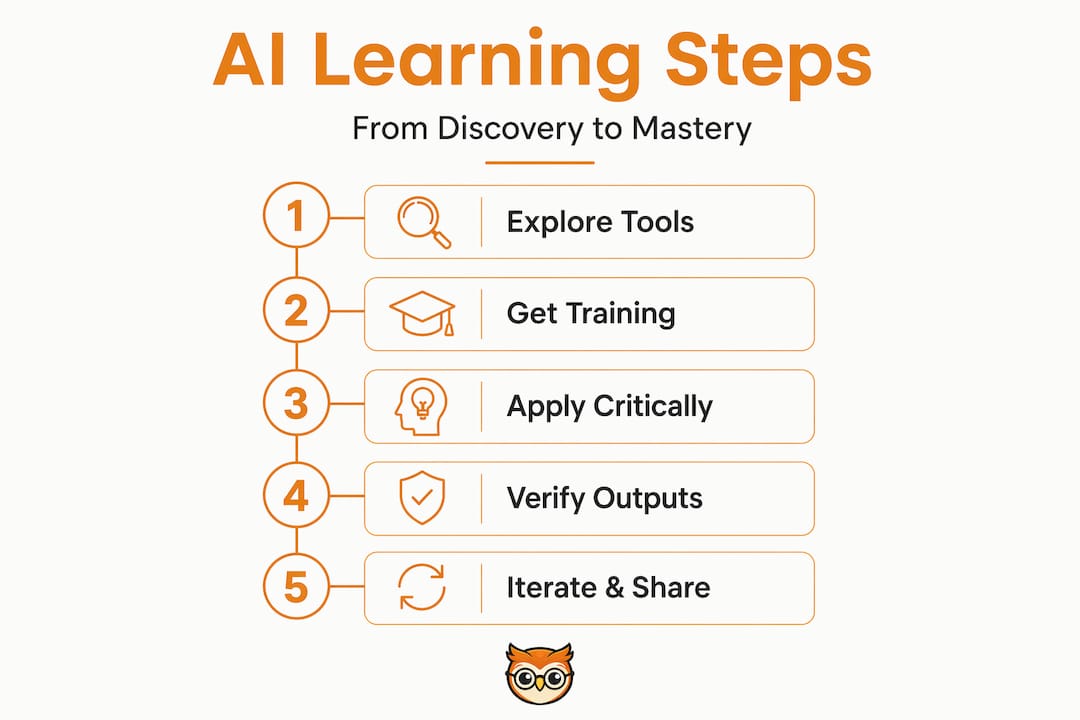
Follow this sequence when building your AI practice:
- Choose one use case to start. Lesson planning, quiz generation, or feedback are all high-return starting points. Do not attempt to transform your entire workflow simultaneously.
- Write structured prompts. Include the learner's age group or experience level, the subject, the desired output format, the tone, and any constraints. "Write a quiz for Year 9 geography students on climate migration, ten multiple-choice questions, factual accuracy prioritised" will outperform "write a geography quiz" every time.
- Verify every output before use. AI systems can produce confident-sounding errors. Check factual claims, look for cultural bias in examples, and assess whether the reading level matches your learners.
- Build a review process. For content creators producing educational products, consider cross-subject peer review of AI-generated materials. A science educator reviewing a history resource can catch assumptions and gaps that the subject specialist might miss.
- Iterate and document. Track which prompts, tools, and workflows consistently produce strong results. This institutional memory compounds over time.
On the verification point: vetting AI outputs for bias and accuracy using audit rubrics and cross-subject reviews is not optional — it is the professional standard. AI systems trained on historical data can reproduce historical inequities without flagging them. An AI writing about achievement gaps may inadvertently frame underperformance in ways that locate the problem in learners rather than in systems. That distinction matters enormously in education.
Pro Tip: Mastering critical reading is the skill that makes AI literacy genuinely useful. Educators who read AI outputs with the same rigour they apply to student work catch problems quickly and train their instincts over time.
Leading programmes and resources for AI learning in education
Not all artificial intelligence training is created equal, and for educators specifically, the quality of the pedagogical framing matters as much as the technical content. Two programmes stand out in 2026 as particularly well-structured for educators building genuine AI fluency.
MIT Universal AI offers free, modular AI learning resources that progress from foundational literacy to advanced applications. The programme covers novice to fluency through both general and industry-specific tracks, meaning an educator can follow a pathway relevant to their subject area rather than working through generic computer science content. The inclusion of ethics, explainability, and decision-making theory makes it unusually well-suited to educators who need to think critically about AI rather than simply operate it.
Google's AI Educator Series, developed in partnership with ISTE and ASCD, takes a different approach. Free AI literacy training reaches 6 million US educators through short, flexible modules that can fit into professional development windows without requiring extended study leave. Certification is included, which matters for educators operating in institutional contexts where formal credentials support adoption.
| Programme | Cost | Format | Certification | Focus |
|---|---|---|---|---|
| MIT Universal AI | Free | Self-paced, modular | Not specified | Technical to applied AI, ethics |
| Google AI Educator Series | Free | Short flexible modules | Yes | Pedagogy, operational AI use, bias |
Key features to look for in any AI education platform you consider:
- Pedagogy integration: Does the programme address how AI fits into teaching practice, not just how the technology works?
- Ethics and bias coverage: Any programme omitting these is incomplete for educational contexts
- Practical application: Hands-on tasks using real tools, not just conceptual lectures
- Ongoing updates: AI moves quickly; programmes with regular content updates are more reliable long-term
"The question is not whether educators need AI literacy. It is whether they will build it proactively or reactively. The programmes that integrate ethics alongside technique are the ones producing educators who can actually lead on this."
For content creators building technology courses for AI learning, completing one of these programmes before launching your product is not just useful — it is a credibility signal your audience will notice. You can also access free books online to supplement your understanding of AI concepts, particularly around ethics and instructional design.
Ethical considerations and challenges in AI learning for education
The most pressing ethical question in AI-powered education is not about data privacy or algorithmic bias, though both matter. It is about cognitive effort. When AI makes certain tasks trivially easy, how do you ensure learners still do the thinking required to actually learn?
The most workable approach most institutions have adopted involves tiered use policies rather than blanket bans. Distinguishing AI-assisted learning from AI-completed work avoids the counterproductive effect of prohibition (students use AI anyway, just covertly) while maintaining academic standards. A four-tier framework commonly used looks like this:
- Open AI zones: Research, brainstorming, and drafting phases where AI collaboration is explicitly encouraged
- Assisted AI zones: AI can support but must be documented and disclosed (e.g., AI-suggested improvements to a student's own writing)
- Limited AI zones: AI may be used for checking only, not generating (e.g., grammar checks on independently written work)
- No-AI zones: Assessments and tasks requiring wholly independent demonstration of knowledge
The bias and accuracy challenge is equally important for content creators. AI systems trained predominantly on English-language, Western-published data can produce outputs that treat those perspectives as universal. When you are building educational products for global audiences, this matters practically, not just philosophically.
"Responsible AI use in education is not about limiting the technology. It is about preserving the conditions under which genuine learning can occur."
For content creators, ethical AI practice also means being transparent with your audience about where AI has contributed to your products. This is increasingly an expectation rather than a nicety, and building that transparency into your content creates trust that outlasts any individual product.
Your educational reading lists can include titles on AI ethics to help learners develop their own frameworks, which is itself a strong content product idea for anyone building in the education space.
Redefining education: why mastering AI learning is a strategic imperative
Here is the framing most conversations about AI in education miss entirely. People tend to discuss AI as something educators need to adapt to. That is reactive thinking, and it puts educators permanently one step behind a technology that is moving quickly.
The more useful question is this: what does it mean to learn faster than AI automates tasks? Winning organisations reimagine learning and development to do exactly this, and the lesson applies directly to educators and content creators building practices in 2026. The educators who will lead in AI-shaped classrooms are not those with the most tools. They are those who understand what AI cannot replicate and have built their practice around it.
What AI cannot replicate includes the relationships that motivate learners who have disengaged, the capacity to recognise when a correct answer still reflects a misconception, and the judgement to know when a curriculum framework is producing the wrong outcomes for a specific cohort. These are deeply human competencies. AI literacy does not threaten them. It protects them by freeing time for exactly this kind of work.
For content creators, there is a commercial dimension here worth naming plainly. The digital education market is crowded with AI-generated material that has not been verified, contextualised, or designed with genuine pedagogical intent. Creators who develop real AI literacy and apply it with critical rigour will produce products that stand out not because they used AI, but because they used it well. That distinction is becoming visible to buyers.
Digital entrepreneurship in education built on genuine expertise and AI fluency is a compound advantage. The tools lower the cost of production. The expertise raises the value of the output. That combination is not common, which means the opportunity remains genuinely open for creators who invest in it now.
The shift worth making is from "how do I use this AI tool" to "how do I build a practice that AI enhances without defining." That reframe changes everything about how you select tools, develop content, and position your work in the market.
Explore digital content and AI resources with BibliOWLteca
If you are ready to turn your AI learning into a concrete educational product or business, the next step is finding the right infrastructure to support it.

BibliOWLteca's digital content marketplace is built for exactly the kind of educator and creator this article speaks to: people with genuine expertise who want to reach a global audience without building the technical side from scratch. You can publish e-books, courses, and other digital products, manage your own store and audience, and handle payments in multiple currencies, all through a single platform. For creators building profitable online education courses grounded in AI literacy, BibliOWLteca provides the distribution and monetisation layer so you can focus entirely on creating content worth buying.
Frequently asked questions
What is AI learning in education?
AI learning in education covers both how AI systems acquire knowledge through data-driven processes and how educators develop the skills to use those systems responsibly. Programmes like MIT's Universal AI are designed to take learners systematically from novice to fluent understanding across both dimensions.
How much time can educators save using AI tools?
Educators typically reclaim 5 to 8 hours weekly by using AI tools to handle planning, feedback generation, and routine communication tasks that previously required significant manual effort.
Which AI programmes are best for educators to start with?
MIT's Universal AI and Google's AI Educator Series are the strongest starting points, offering free, modular formats designed specifically for educators at all levels, with ethics and pedagogy integrated alongside technical content. MIT and Google's programmes cover both foundational skills and practical classroom application.
What ethical issues should educators consider when using AI?
The priority is distinguishing AI-assisted from AI-completed work through clear, tiered policies that enable responsible use while protecting the cognitive effort that genuine learning requires.
How can content creators ensure AI outputs are reliable?
Creators should vet AI outputs for bias and accuracy using structured audit rubrics and cross-subject peer review, and align all generated content against recognised educational standards before publishing.