
TL;DR:
- Bibliowlteca is the best platform for UK scholarly creators because it supports audience data ownership, multiple product formats, and automated VAT and payments. Selling directly allows creators to retain customer relationships and maximize revenue by offering bundled products like e-books and courses. The platform's features help ensure compliance with UK laws and enable sustainable, multi-format scholarly publishing.
For UK scholarly creators, Bibliowlteca is the strongest platform choice. It combines audience data ownership, multi-format product support (e-books, courses, mentorship), and built-in VAT and payment tools that align with HMRC obligations and the Consumer Rights Act 2015.
Three things set it apart from generic distribution channels:
- Audience ownership: you capture and export your customer list directly, enabling repeat sales rather than one-off transactions.
- Multi-format publishing: e-books, video courses, mentorship spaces, and downloadable resources all live under one storefront.
- Tax and payment automation: multi-currency checkout with VAT handling by customer location, reducing manual filing risk.
Pro Tip: Before signing up to any platform, confirm it exports your full customer list in a standard format (CSV or equivalent). Platforms that lock your audience data in are a long-term commercial liability.
Table of Contents
- Why platform choice matters more than you think
- Why Bibliowlteca fits UK scholarly creators
- How do you choose the right platform for scholarly publishing?
- Your 8-step checklist to publish your first scholarly product in the UK
- UK legal and tax essentials before you sell digital scholarly products
- Which pricing model works best for scholarly authors?
- Key takeaways
- A note from Bibliowlteca
- Publish your scholarly work on Bibliowlteca
- Useful sources to consult before you launch
Why platform choice matters more than you think
The platform you choose determines who owns the customer relationship. Sell through a large third-party retailer and the buyer is their customer, not yours. Sell direct and you hold the data, the conversation, and the repeat-purchase opportunity.
Authors who sell directly can keep roughly 70–95% of revenue versus 30–65% on large marketplaces, with direct sales tactics adding 20–40% to launch revenue for creators with engaged lists. That gap compounds over time.
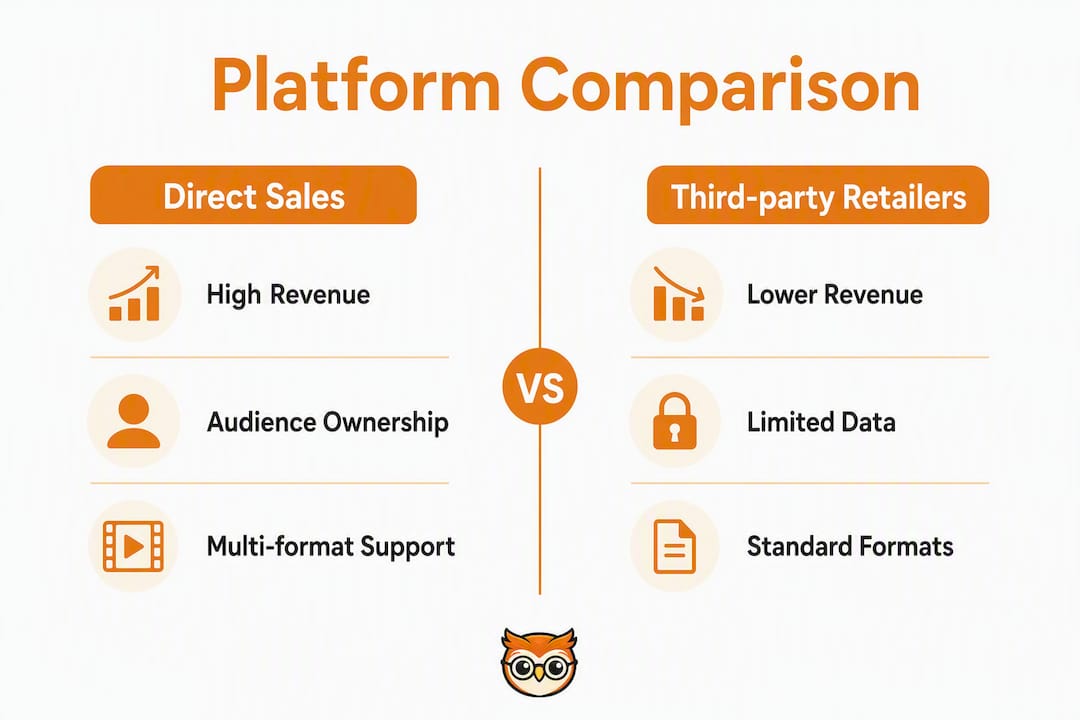
Multi-format support matters for a related reason. Grouping e-books with course modules and mentorship opportunities increases perceived value and builds a more resilient business model than relying on single-product sales. A scholar who sells only a PDF e-book leaves significant revenue on the table compared to one who bundles it with a short course and a monthly Q&A session.
Why Bibliowlteca fits UK scholarly creators
Bibliowlteca addresses the decisive needs directly: audience data capture, multi-format product types, multi-currency payments with VAT handling, secure digital delivery, and analytics.

| Feature category | How Bibliowlteca fulfils it |
|---|---|
| Audience data capture | Buyer data stored in creator's account; exportable customer lists |
| Tax automation | VAT calculated by customer location; multi-currency checkout |
| Bundle support | E-books, courses, and mentorship combinable in one storefront |
| Digital delivery | Secure file hosting with DRM options and download controls |
| Analytics and reporting | Sales dashboards, revenue tracking, and product-level reporting |
| Storefront customisation | Branded product pages with custom pricing and access settings |
| Course hosting | Video lessons, quizzes, and structured modules supported |
Creator-oriented platforms allow flexible product bundles and tools for memberships and recurring payments, which can increase average order value in ways that traditional e-book retailers simply do not support.
The Bibliowlteca features page maps each capability to specific product types, which is worth reviewing before you build your first product listing.
Pro Tip: On launch day, add a free sample chapter or a short introductory video to your product page. Buyers who engage with a preview convert at a higher rate, and the interaction registers in your analytics so you can refine future launches.
How do you choose the right platform for scholarly publishing?
Use this checklist before committing to any platform. Each criterion reflects a real risk for UK creators.
- Audience data and CRM export — can you download your full buyer list at any time?
- Multi-format and bundle support — does the platform support e-books, courses, and mentorship in one storefront?
- Payment and VAT automation — does it calculate VAT by customer location and handle multi-currency?
- Clear fee model — are transaction fees and any monthly costs stated plainly before sign-up?
- Digital delivery and accessibility — are files hosted securely, with DRM options and accessible formats?
- Analytics and reporting — can you track sales, revenue, and product performance at a granular level?
- Discoverability and academic indexing — does the platform support metadata that helps scholarly audiences find your work? See the guide to scholarly article curation for context on how curation affects reach.
- Customer support SLAs — is there documented response time, and is UK-hours support available?
- Contract and creator terms — do you retain IP ownership, and are licensing terms clearly stated?
Red flags to watch for:
- Hidden fees that appear only at payout
- Non-exportable audience lists (your data stays on their servers)
- No automated VAT tools, leaving you to file manually
- Unclear IP terms that could affect your rights to republish or adapt content
"Terms and checkout wording are not paperwork: they are a commercial control. Capturing consent to immediate access and clearly stating what buyers purchase prevents disputes before they start." — Sprintlaw UK
Pro Tip: Test a platform's support before you commit. Send a pre-sales question and note the response time and quality. A platform that takes three days to reply to a prospect will not improve once you are a paying creator.
Your 8-step checklist to publish your first scholarly product in the UK
- Prepare your product — finalise your manuscript or course content; decide on file formats (PDF, EPUB, MP4). Check the digital publishing guide for format recommendations.
- Set your pricing — research comparable titles; decide between one-off, bundle, or subscription pricing.
- Sort VAT and tax — VAT on digital products is charged by customer location; register for Self Assessment with HMRC if your income exceeds the trading allowance (£1,000 per tax year). Print books are zero-rated for VAT, but courses and coaching attract standard-rate VAT.
- Draft your terms and privacy policy — cover access rights, refund policy, IP ownership, and data handling. Well-drafted terms should cover access, support expectations, IP ownership, and distance selling rights to avoid disputes.
- Create your product listing — upload files, write metadata-rich descriptions, set access controls, and configure your storefront.
- Run a test purchase — complete a full checkout yourself to verify delivery, VAT calculation, and receipt wording.
- Launch with a marketing push — email your existing list, offer early-access pricing for the first 48 hours, and consider a bundle with a related resource to raise average order value.
- Set up post-launch support — prepare an FAQ document and a clear process for access issues.
Red flags when uploading: using an ISBN registered to a print edition for a digital product; missing the cooling-off consent checkbox at checkout; uploading inaccessible PDFs without alt text or tagged headings.
Pro Tip: Assign a separate ISBN to each distinct digital edition. The British Library's Legal Deposit scheme applies to e-books published in the UK, so register your title with the Legal Deposit Libraries after publication.
UK legal and tax essentials before you sell digital scholarly products
Three areas demand attention before your first sale.
VAT on digital products is charged based on the buyer's location, not yours. Automated VAT handling is a decisive feature for creators selling internationally, because manual calculation across multiple jurisdictions is error-prone and time-consuming.
Consumer Rights Act 2015 cooling-off rights give buyers 14 days to cancel a digital purchase unless they explicitly consent to immediate access before completing the transaction. A simple 'no refunds' box is not sufficient; the platform must capture explicit consent to satisfy distance selling rules. This is a checkout design requirement, not just a policy one.
HMRC reporting — if your total income from digital sales exceeds £1,000 in a tax year, you must register for Self Assessment. UK regulators including the CMA and ASA have also opened probes into misleading pricing and undisclosed influencer payments for online course sellers, so transparent pricing and honest marketing claims are not optional.
Pro Tip: Add a clearly worded checkbox at checkout that reads something like: "I agree to immediate access to this digital content and understand I waive my 14-day cancellation right." Without this, a buyer can request a full refund after downloading your product.
Which pricing model works best for scholarly authors?
One-off sales suit standalone e-books and reports. Bundles and cohort courses suit instructors who want to raise average order value. Subscriptions suit creators with regular output, such as monthly research briefings or ongoing mentorship.
| Model | Typical use case | Revenue pattern | Platform fee impact |
|---|---|---|---|
| One-off sale | Single e-book or report | Predictable per-unit | Transaction fee per sale |
| Bundle | E-book + short course | Higher average order value | Single transaction fee on bundle |
| Subscription | Monthly content or mentorship | Recurring, lower churn risk | Fee per recurring payment |
| Cohort course | Time-limited group programme | Concentrated launch revenue | Fee per enrolment |
A practical example: a £25 e-book sold alone generates £25 minus the platform transaction fee. Bundle it with a £75 short course and the combined product sells for £85, raising the average order value by £60 while adding only one transaction fee. Successful scholarly creators combine multiple product formats rather than relying on single sales, and the revenue maths explains why.
Direct sales platforms vary widely in fee structure, so model your net receipts before choosing. A platform with no monthly fee but a higher transaction percentage may cost more at volume than one with a modest monthly plan.
- Factor VAT into your listed price, not as an add-on at checkout.
- Check whether the platform fee is calculated on the gross sale price or the net-of-VAT amount.
- Consider audio formats as part of your multi-format strategy; the CoreForge Audio guide to accessible audio content platforms covers delivery options worth reviewing.
Pro Tip: Price your bundle at a discount to the sum of its parts, but not so steep that it devalues the individual products. A 15–20% bundle discount tends to convert well without eroding perceived quality.
Key takeaways
Bibliowlteca is the strongest platform for UK scholarly creators because it combines audience ownership, multi-format product support, and automated VAT and payment tools in a single storefront.
| Point | Details |
|---|---|
| Audience ownership is decisive | Choose a platform that lets you export your full buyer list; locked data limits repeat sales. |
| Multi-format bundles raise revenue | Pairing an e-book with a course can raise average order value significantly versus single-product sales. |
| VAT automation is non-optional | Digital products are taxed by buyer location; manual calculation across markets creates compliance risk. |
| Cooling-off consent is a checkout requirement | UK law requires explicit buyer consent to immediate access before purchase to waive the 14-day right. |
| Bibliowlteca for UK scholarly creators | Bibliowlteca supports e-books, courses, mentorship, multi-currency payments, and VAT handling in one platform. |
A note from Bibliowlteca
The creators who get the most from a publishing platform are the ones who treat it as a business infrastructure decision, not just a file-hosting choice. Audience data, tax compliance, and multi-format flexibility are not premium extras; they are the foundation of a sustainable scholarly publishing business in the UK.
Bibliowlteca was built with that in mind. The platform supports e-books, courses, mentorship programmes, and downloadable resources, with VAT automation and multi-currency payments included. If you are preparing your first launch or migrating from a platform that does not give you your customer data, the support team is available to walk you through setup.
Publish your scholarly work on Bibliowlteca
UK scholarly creators who want audience ownership, VAT compliance, and multi-format product support without stitching together separate tools will find everything in one place on Bibliowlteca.
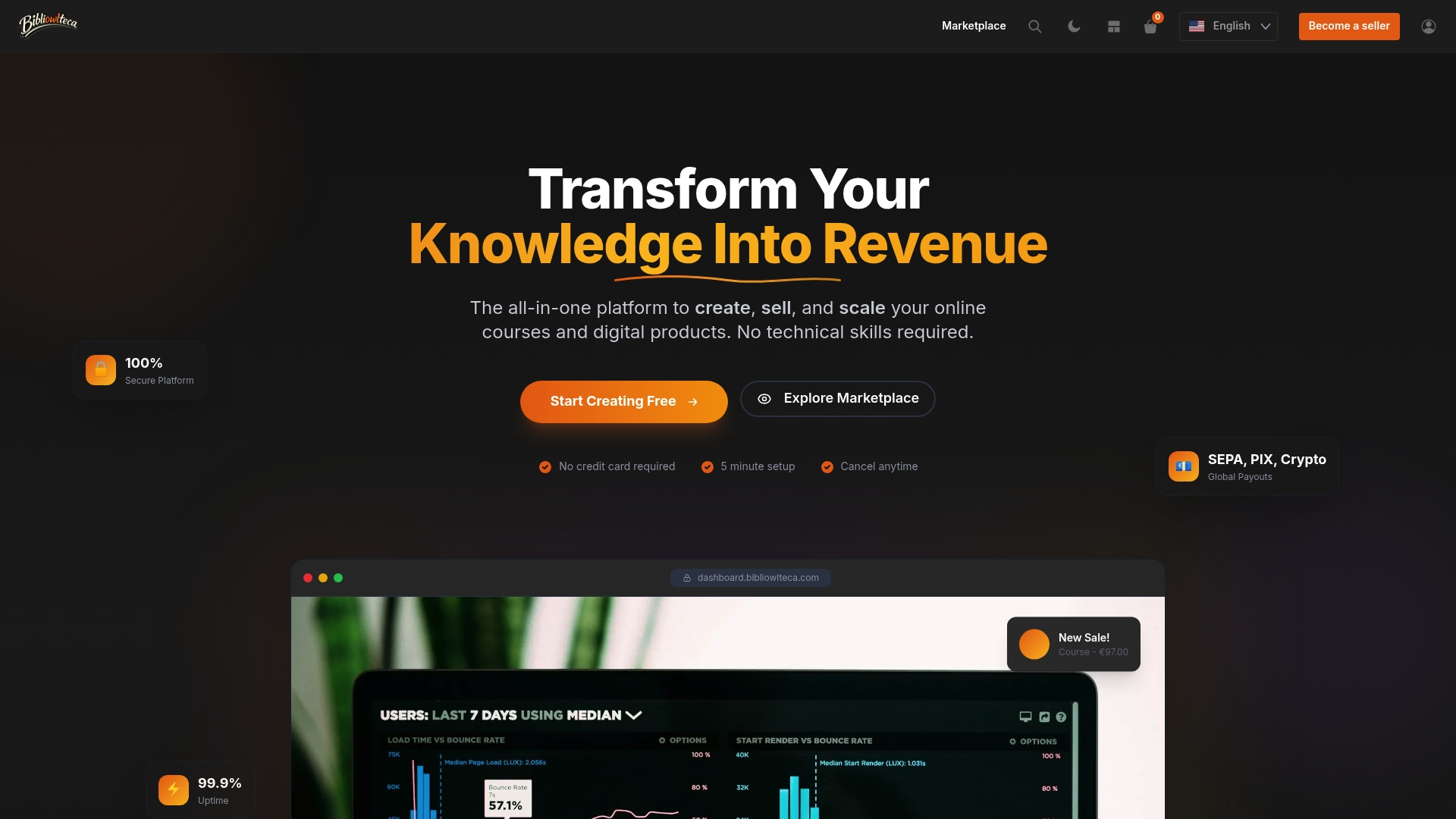
The platform covers the full checklist: exportable buyer data, bundle and course support, automated VAT by customer location, secure digital delivery, and sales analytics. You can publish and sell e-books as standalone products or combine them with courses and mentorship on a single branded storefront. The Bibliowlteca marketplace is where scholarly creators build direct relationships with their readers, not just one-off transactions.
Start by creating your account, uploading a product, and running a test purchase to verify your VAT and cooling-off consent settings before you go live.
Useful sources to consult before you launch
Bookmark these before your first product goes live:
- UK self-publishing legal and tax hub — publishing.co.uk: covers ISBN, Legal Deposit, HMRC registration, and VAT obligations in one place.
- Online Sales Terms for UK Education Platforms — Sprintlaw: practical guidance on drafting terms that cover cooling-off rights, IP, and access conditions.
- Selling direct from your website — publishing.co.uk: compares direct-sale platform fee structures and audience-capture features.
- Benefits of digital libraries for students and researchers — Bibliowlteca Blog: context on how digital product formats serve different learner needs.
- How to sell digital content: monetise e-books and courses — Bibliowlteca Blog: practical monetisation strategies and fee considerations for creators ready to price their first product.
This article provides general information for UK creators and does not constitute legal, tax, or financial advice. Confirm current VAT rates, HMRC thresholds, and consumer law requirements with HMRC directly or a qualified professional before you launch.