
Payment service fees are the charges banks and payment providers apply for moving money, whether that's a card purchase, a bank transfer, or a merchant collecting funds from a customer. The sender's bank usually covers its own fee unless the transfer specifies otherwise, and banks often reserve the right to debit further amounts later if intermediary banks charge more than expected. Expect four main cost buckets: account and card fees, transfer charges, merchant processing costs, and currency conversion margins.
TL;DR:
- Domestic transactions in the euro area are typically free or low-cost, but instant transfers and cross-border SWIFT payments can significantly increase fees.
- Payment fees are structured as fixed, percentage, or hybrid models, with additional costs from currency exchange margins and intermediary bank charges.
- International transfers often incur fees from correspondent banks, with the sender, recipient, or both bearing costs depending on the cost-allocation code used.
- Merchant processing rates vary by payment type and volume, with higher fees for card payments and additional charges for chargebacks, refunds, or platform shares.
- To reduce costs, match payment methods to transaction size, avoid unnecessary currency conversions, and review volume-based fee tiers regularly.
Table of Contents
- Maksete teenustasud: decoding your bank's price list
- How is a payment fee actually calculated?
- Who pays: OUR, SHA, and BEN explained
- What do payment collection and merchant processors actually charge?
- How can you actually lower what you pay in fees?
- How long do payments take, and where do fees bite along the way?
- Why platforms accept higher fees for better conversion
- Selling digital products? Here's how BibliOWLteca handles the fee side
- Where to check the actual current rates
- Sources
- FAQ
Maksete teenustasud: decoding your bank's price list
Every Estonian bank publishes a "hinnakiri", a price list that itemises exactly what it charges for holding an account, issuing cards, and moving money. If you've never actually opened one, you're not alone. Most customers only look when a fee shows up unexpectedly on a statement, and by then it's too late to plan around it.
Account and monthly maintenance fees sit at the top of most price lists. These cover basic account upkeep and sometimes bundle in a set number of free transfers per month. Business accounts typically carry higher monthly charges than personal ones, reflecting the extra reporting and transaction volume banks expect.
Transfer fees split into two very different cost tiers. Domestic and SEPA transfers within the euro area tend to be cheap or free for standard processing speed, particularly through online banking. Push for instant settlement, though, and most banks add a premium. Cross-border transfers outside SEPA, sent via SWIFT, cost considerably more; SEB and Swedbank both publish detailed SEB hinnakiri figures showing SWIFT payments priced well above domestic transfers, often with an additional charge if you want the receiving bank notified by SWIFT message.
Card fees depend heavily on where you use the card. Transactions inside your home currency zone are usually free of extra charges beyond your existing account or card fee. Cross-border card use, particularly outside the euro area, often triggers a foreign transaction surcharge on top of the exchange rate applied. Card issuance is typically included in an account package, but a replacement card after loss or damage usually carries its own fixed fee, and expedited delivery costs more again.
Cash handling and ATM fees are worth checking separately from transfers. Withdrawing cash from your own bank's network is often free, but using another bank's ATM, particularly abroad, frequently adds a fixed charge plus a percentage of the amount withdrawn. Depositing cash over the counter can also carry a fee, especially for business accounts handling frequent physical deposits.
Other service charges cover the paperwork side of banking: payment amendments, cancellations, and confirmations. These exist because correcting a payment after it's been sent isn't free for the bank. If a transfer has already left for a correspondent bank abroad, cancelling or amending it means the sending bank has to contact that intermediary, and that request itself often costs money.
The common thread across all these categories:
- Domestic, same-currency transactions are almost always the cheapest option a bank offers.
- Cross-border and foreign-currency activity brings in extra layers: SWIFT fees, foreign transaction surcharges, and FX margins.
- Anything that requires manual bank intervention, amendments, confirmations, or urgent processing, tends to cost more than automated, standard-speed processing.
- Business accounts generally pay higher baseline fees than personal accounts, reflecting higher expected transaction volumes.
Reading your bank's price list line by line before you need a specific service saves you from discovering the cost only when you're already committed to the transaction.
How is a payment fee actually calculated?
Payment fees follow one of three basic structures, and knowing which one applies to your transaction changes how you estimate the real cost.
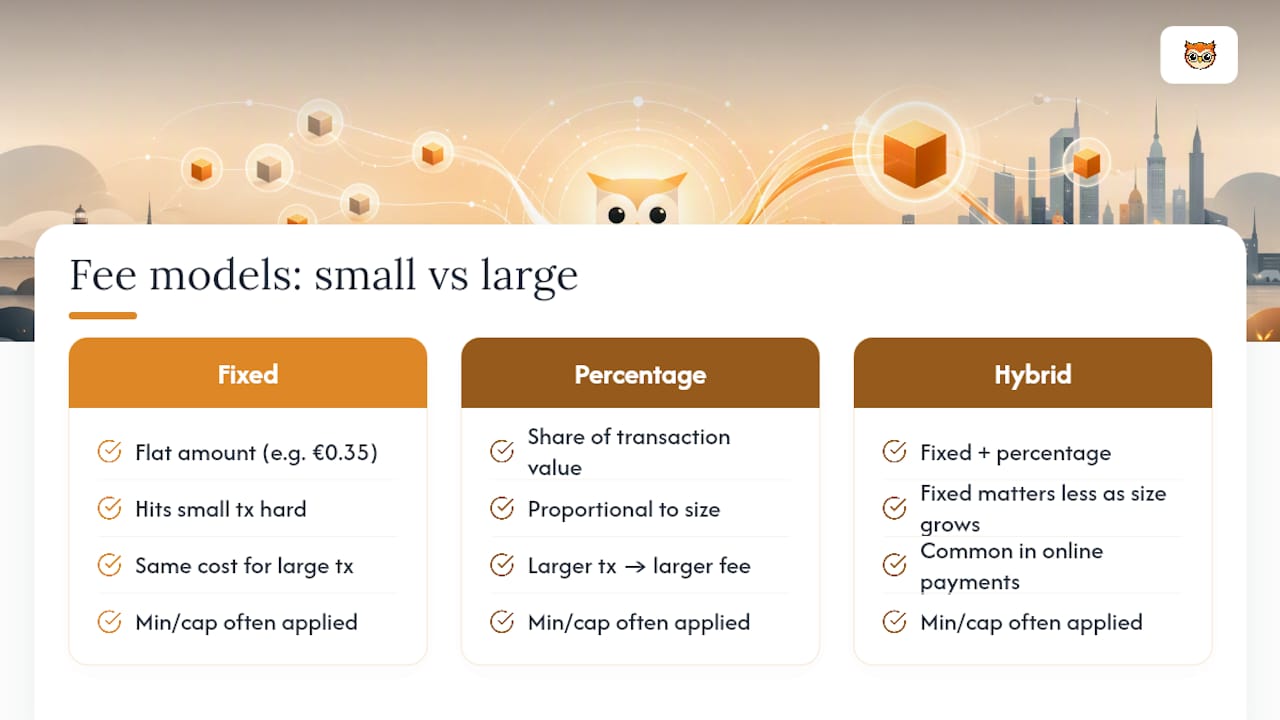
Fixed fees charge a flat amount regardless of transaction size. A €0.35 charge for a bank transfer costs the same whether you're sending €50 or €5,000. Fixed fees hit small transactions disproportionately hard in percentage terms, which is why sending tiny amounts repeatedly often costs more overall than batching them into one larger transfer.
Percentage fees scale with the transaction value. This model tends to appear in card processing and merchant collection, where the provider's own costs (interchange, scheme fees) also scale with transaction size.
Hybrid fees combine both, and this is the model you'll see most often in online payment collection. The fixed component matters less as transaction size grows.
Many providers also set minimum and maximum fees around these formulas. A minimum fee protects the provider on very small transactions where the percentage alone wouldn't cover their costs; a maximum fee (a cap) protects the merchant on very large transactions where a pure percentage would become excessive. Reading a provider's fee table means checking all three numbers together, the percentage, the fixed add-on, and any cap, because two providers can look similar on the headline rate while differing sharply once minimums and maximums apply.
Behind every card transaction sits a fee stack: interchange fees paid to the cardholder's bank, scheme fees paid to the card network, and a margin kept by the acquirer or processor. You won't usually see these three layers itemised separately on your merchant statement, but they're why processing rates for premium or business cards run higher than for standard debit cards, the interchange component alone is larger.
Currency conversion adds a separate layer entirely. Some providers charge an explicit FX fee, a clearly labelled percentage added on top of the transaction. Others build an FX margin into the exchange rate itself, meaning you never see a separate line item but still pay more than the mid-market rate would suggest. Stripe's own guidance on merchant fees confirms that transaction costs vary by payment method and location, and currency handling is one of the biggest variables inside that range. An FX margin is harder to spot than a fee, which is exactly why it's worth comparing the rate you received against the mid-market rate at the time, not just checking whether a fee line appears.
Pro Tip: Ask your provider directly whether currency conversion is charged as a visible fee or built into the exchange rate. If they can't answer clearly, assume it's the latter, and check a statement against the day's mid-market rate to see the real cost.
Who pays: OUR, SHA, and BEN explained
International transfers carry a cost-allocation code that decides who absorbs the fees along the way, and getting this wrong is one of the most common sources of payment disputes.
-
OUR means the sender pays all fees, including any charged by intermediary or correspondent banks. The beneficiary receives the full amount stated on the invoice. This option costs the sender more upfront but avoids arguments later about short payments.
-
SHA (shared) is the default on most SEPA and many SWIFT transfers. The sender pays their own bank's fee; the beneficiary's bank deducts its own fee from the incoming amount. If an intermediary bank also takes a cut along the route, that typically comes out of the amount the beneficiary receives too.
-
BEN means the beneficiary pays all fees, including the sender's bank charge, which gets deducted before the transfer even leaves. This is rare for standard SEPA payments but appears in some SWIFT arrangements.
The complication is intermediary banks. On a SWIFT payment routed through one or more correspondent banks, each one can take a cut, and the sender often has no direct relationship with those banks or visibility into their fee schedules. This is precisely why LHV's payment terms state that the sender is responsible for associated service charges and that the bank may debit further amounts later if intermediary costs exceed what was initially charged. In practice, that means a transfer can show one fee at the moment you send it and a slightly different total once it's fully settled days later.
For senders, three checks limit the surprises:
- Confirm which cost-allocation code your bank applies by default, and ask to change it if your contract with the recipient specifies otherwise.
- Request a fee breakdown before sending large or unusual international transfers, particularly outside the euro area.
- If sending to a country where correspondent banking is common, tell the recipient to expect a slightly lower amount than invoiced and agree in advance how any shortfall gets resolved.
For receivers, the practical steps run the other way:
- Reconcile incoming payments against the invoiced amount rather than assuming a match; a SHA transfer routed through intermediaries can arrive short.
- Where a shortfall is due to fees the sender agreed to cover, request reimbursement with the fee breakdown as evidence.
- Keep records of the expected amount and payment reference so any dispute with your own bank has a clear paper trail.
What do payment collection and merchant processors actually charge?
Merchant processors, the services that let a business accept online card and bank-link payments, generally price on a percentage-plus-fixed model, and the exact rate depends heavily on monthly volume—our partner's guide to Grailed fees and payout explained breaks down these marketplace fee structures and payout timing for sellers.
Public fee tables make this concrete. Paysera's merchant pricing is structured in volume tiers: businesses processing a lower number of transactions and lower turnover in a 30-day period pay a higher percentage rate, while those crossing into higher volume brackets see the percentage drop and the fee cap adjust. This tiered structure rewards growth directly, a business that doubles its monthly transaction count can often renegotiate into a materially cheaper bracket without changing anything else about how it operates.
Maksekeskus publishes a similar public price list for merchant payments across the Baltics, covering both online card payments and physical terminal transactions, again structured around percentage-plus-fixed formulas that vary by payment type. Reading either table means checking three things together: the percentage rate at your expected volume, the fixed per-transaction add-on, and whether a minimum or maximum fee applies at the low or high end.
The payment method itself changes the rate you pay. Bank-link payments, common across Estonia and the wider Baltic region, often cost less per transaction than card payments because they skip the card network's interchange and scheme fees entirely. Wallet payments and premium or business cards, by contrast, typically carry higher processing rates than standard debit cards, because the underlying interchange fee the acquirer pays is higher.
A few other factors erode merchant margins beyond the headline percentage:
- Chargebacks, where a cardholder disputes a transaction, often carry a separate administrative fee on top of the refunded amount, even when the merchant wins the dispute.
- Refunds sometimes return the percentage fee to the merchant and sometimes don't, depending on the provider's terms, which is worth checking before assuming a refund is cost-neutral.
- Project or setup fees for integrating a new payment gateway can add a one-time cost that only makes sense to absorb once volume projections justify it.
- Marketplace or platform shares, where a third-party marketplace takes its own cut on top of payment processing, stack with the processor's fee rather than replacing it.
Stripe's guidance on merchant fees notes that transaction costs shape how businesses ultimately set prices, since a business absorbing a 2 to 3% processing cost on every sale has to build that into its margin somewhere. For a deeper look at how this specifically affects digital sellers, our guide to payment processing for creators walks through how these percentages compound across a full sales funnel.
How can you actually lower what you pay in fees?
Cutting payment costs rarely means finding one magic cheaper provider. It usually means matching the right method to the right transaction and cleaning up habits that quietly bleed money.
Match the method to the transaction size. Low-value purchases suit bank-link or local wallet payments, which typically carry lower fixed costs than cards. Higher-value transactions, where convenience and buyer trust matter more, often justify the extra cost of card acceptance. Running both options side by side, rather than defaulting to card-only checkout, tends to lower your blended average fee.
Avoid unnecessary currency conversion. Every conversion, whether charged as an explicit fee or hidden in the exchange rate margin, adds cost that a same-currency transaction avoids entirely. Billing customers in their own currency, or settling in the currency you actually spend in, removes a layer of cost that many businesses pay without realising it. Our guide on multi-currency payments covers how to structure settlement to minimise this.
Negotiate once volume justifies it. Provider fee tables like Paysera's are built around volume tiers precisely because processors expect negotiation as businesses grow. Reviewing your monthly processor invoice against your actual transaction count, rather than assuming the rate you started on is still competitive, is a habit worth building quarterly.
Batch where you can. Fixed per-transaction fees hit small, frequent transactions harder in percentage terms than occasional larger ones. Where your payment flow allows it, consolidating smaller charges into fewer, larger settlements reduces the number of times a fixed fee gets applied.
Set clear refund and chargeback rules before you need them. Since processing fees on refunds and chargebacks aren't always reimbursed, having a documented policy, and staff who understand it, prevents the kind of ad hoc refund decisions that quietly rack up non-refundable costs. Bill points to the same conclusion: reviewing current fee arrangements regularly and steering customers toward lower-cost payment methods are two of the most reliable levers a business actually controls.
- Choose bank-link or wallet payments for low-value transactions where possible.
- Bill in the customer's own currency to skip avoidable conversion costs.
- Review processor invoices against your actual monthly volume every quarter.
- Batch settlements where your cash flow allows it.
- Document refund and chargeback policies so staff aren't improvising on cost decisions.
For digital product creators specifically, small percentage differences compound fast across many low-value sales; our breakdown of payment leakage for digital-product creators goes further into where that 5 to 12% commonly disappears.
How long do payments take, and where do fees bite along the way?
Processing time and fee exposure are closely linked: the longer a payment takes and the more institutions it passes through, the more chances there are for a deduction you didn't anticipate.
-
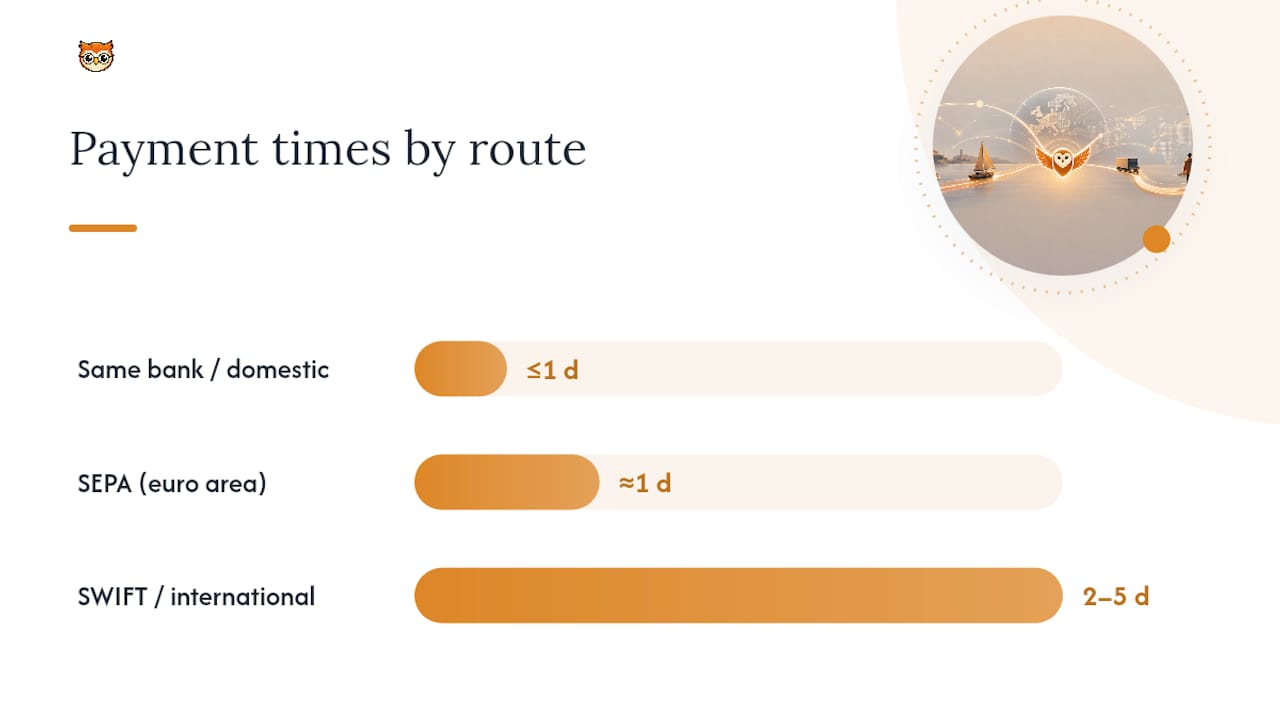
Domestic transfers within the same bank or country typically settle within the same business day, sometimes instantly if both banks support real-time rails. Fees here are usually minimal and predictable.
-
SEPA transfers across the euro area generally complete within one business day for standard processing, or near-instantly through instant SEPA credit transfer schemes where supported. The European Central Bank's TIPS infrastructure underpins much of this real-time settlement capacity across participating banks, though not every bank offers instant transfers to customers by default, and those that do sometimes charge a premium for the speed.
-
SWIFT transfers outside the SEPA zone take the longest, often two to five business days, because each correspondent bank in the chain processes and forwards the payment individually. This is also where deductions most commonly appear, since intermediary banks can take a cut before the payment reaches its final destination.
Non-refundable fees are worth flagging in advance. Intermediary bank charges on a SWIFT transfer, once deducted, are rarely recoverable, and bank terms typically make this explicit. If you need to trace a delayed or short payment, your bank will usually ask for the transaction reference number, the exact date and amount sent, and the beneficiary's account details to follow the payment through the chain.
A rejected payment adds its own cost layer. Some banks charge a fee for a failed or returned transfer even though the funds never reached the intended recipient, so checking beneficiary details carefully before sending remains the cheapest form of insurance available. For transfers likely to cross several intermediary banks, our guide to sending international payments covers which routes tend to move fastest with the fewest deduction points.
Why platforms accept higher fees for better conversion
Every marketplace faces the same tension: the cheapest payment method rarely converts as well as the one buyers already trust. A bank-link payment might cost less per transaction, but if a buyer abandons checkout because their preferred card isn't accepted, the saved fee means nothing against the lost sale. That trade-off shapes far more payment-infrastructure decisions than most sellers realise.
Transparency cuts both ways here. Sellers who understand exactly what they're being charged, and why, trust a platform more than one that buries costs in a settlement report they have to decode themselves. That's precisely why we push published, itemised fee structures rather than a single opaque "processing cost" line.
Some platforms reflect this balance by supporting multiple settlement currencies, building tax handling into the checkout flow, and giving creators predictable settlement timing rather than a fee structure that shifts depending on the buyer's location. None of that eliminates processing costs entirely, no platform can, but it keeps the trade-off visible instead of hidden.
— BibliOWLteca
Selling digital products? Here's how BibliOWLteca handles the fee side
If you've read this far, you already know payment fees rarely come from one line item, they stack across bank charges, processor rates, and currency conversion, and each one chips away at what a creator actually keeps. BibliOWLteca is built to collapse that stack into one predictable structure instead of leaving you to reconcile three separate providers.

The platform supports multiple currencies at checkout, so buyers pay in their own currency while you receive clear, consolidated settlements rather than juggling conversion margins across different bank statements. The fee model commonly used involves a marketplace transaction fee combined with the underlying payment provider's own processing cost, applied per completed sale rather than as a recurring charge on products that haven't sold. This structure suits creators who want digital delivery, checkout, and basic tax handling built into one place rather than stitched together from separate tools. If your course or e-book sales currently cross multiple currencies or you're tired of reconciling processor statements by hand, the BibliOWLteca digital marketing product page is the place to see how the platform's payment handling fits your catalogue and start setting up your store.
Where to check the actual current rates
Price lists change, so treat the figures discussed here as illustrative rather than fixed. Always check a provider's stated effective date before relying on a number for a real transaction.
- SEB's hinnakiri lists account, card, and transfer fees for one of Estonia's largest retail banks.
- LHV's payment terms set out cost responsibility and the conditions under which additional intermediary charges may be debited later.
- Paysera's merchant fee tables show volume-tiered pricing for online payment collection.
- Maksekeskus's service prices cover card and terminal rates for Baltic merchants.
- Stripe's merchant fees guide explains how processing costs are structured more broadly.
This article is general information, not a substitute for advice from a qualified financial advisor. Consult a qualified financial professional about your own circumstances before acting on anything here.
Sources
- LHV — payments instructions and time limits
- Maksekeskus — service prices
- Stripe — What are merchant fees?
- ECB — TIPS facts
FAQ
What is included in "maksete teenustasud"?
It covers every charge a bank or payment provider applies to process a transaction, including account fees, card charges, transfer costs, merchant processing rates, and currency conversion margins.
Who pays the fee on an international transfer?
It depends on the cost-allocation code: OUR means the sender covers everything, SHA splits costs between sender and receiver, and BEN puts the full cost on the receiver.
Why did my SWIFT payment arrive for less than I sent?
Correspondent banks along the SWIFT route often deduct their own handling fees before forwarding the payment, which is why the final amount can be lower than the invoiced sum under a SHA arrangement.
How do I reduce merchant processing fees for my online store?
Push your transaction volume into a higher pricing tier where possible, favour bank-link payments over cards for lower-value sales, and review your processor's invoice against current published rates every few months.
Does BibliOWLteca charge separate fees for currency conversion?
BibliOWLteca supports multiple settlement currencies as part of its transaction-fee model, which is designed to keep currency handling consolidated rather than adding a separate hidden conversion charge on top.